Gecko Out Level 783 Solution Walkthrough | Gecko Out 783 Answer
How to solve Gecko Out level 783? Get step by step solution & cheat for Gecko Out level 783. Solve Gecko Out 783 easily with the answers & video walkthrough.


Gecko Out Level 783: Board Layout, Rules, and Win Condition
Starting Board and Key Obstacles
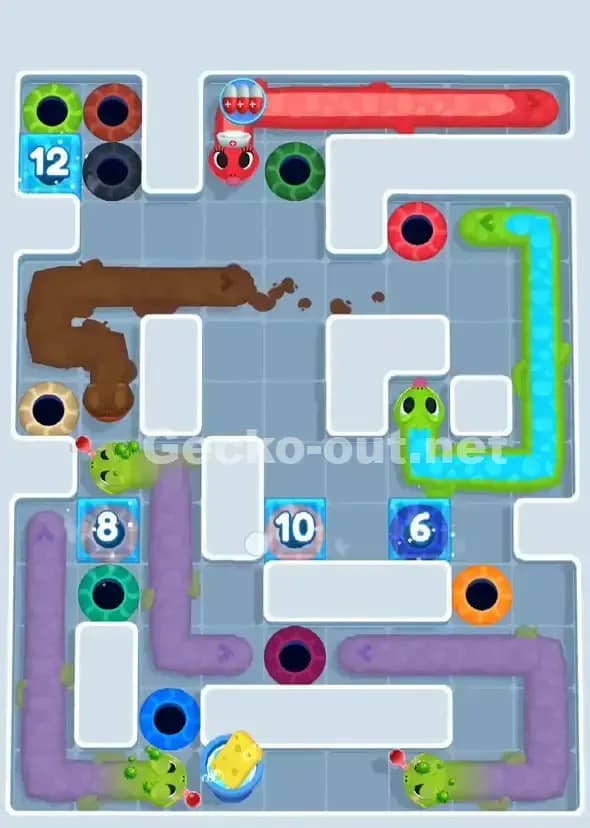
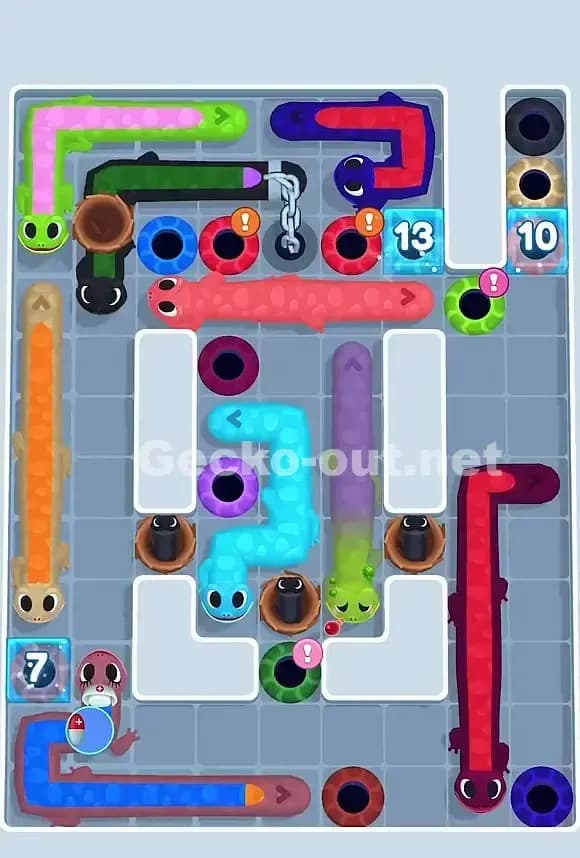
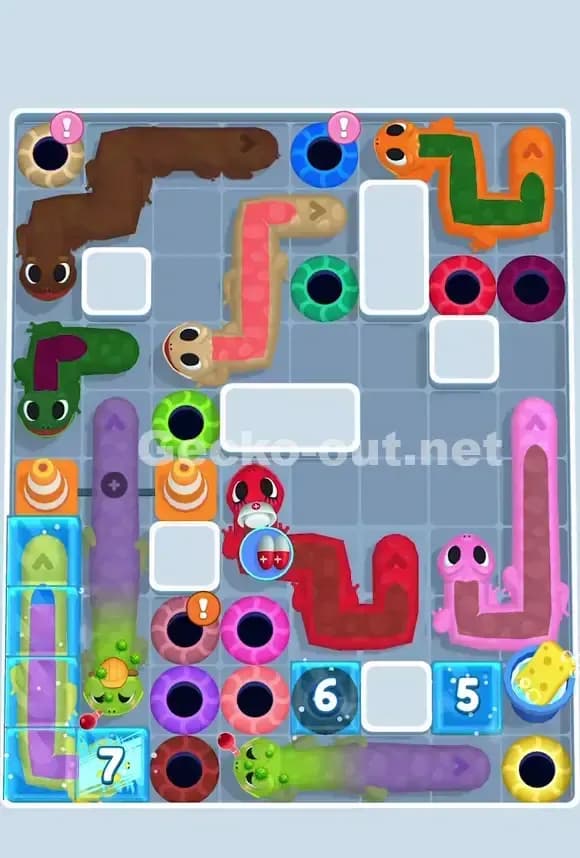
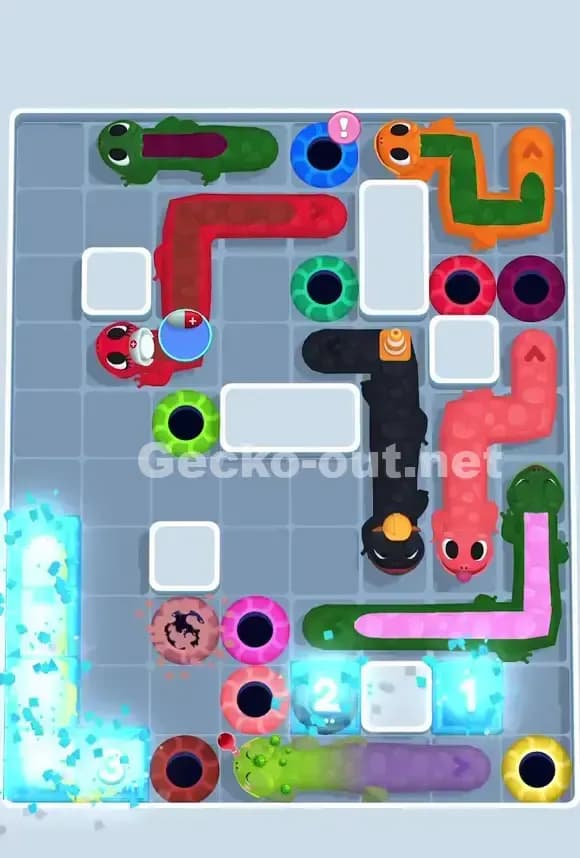
Gecko Out Level 783 is a crowded, colorful puzzle that'll test your spatial reasoning hard. You're working with seven individual geckos spread across the board, each one a different color: brown, blue, green, red, pink, purple, and yellow. The board itself is dense—white empty squares are your dragging space, but they're scattered throughout, and the real estate is tight. What makes Gecko Out 783 particularly nasty is that you've got multiple gang geckos (linked pairs) tucked into corners and edges, plus a couple of frozen or icy exit holes that can't be forced. The brown gecko starts in the upper left, the blue one sits near the top center, and the green gecko occupies the upper right—all three are battling for access to a narrow vertical corridor. Meanwhile, red, pink, and purple geckos are clustered in the middle and lower sections, and they're all jostling for the same escape routes. The timer sits at a generous 180 seconds, but don't let that fool you—moving seven geckos through this knot requires precision, not speed.
Win Condition and Time Pressure
To win Gecko Out Level 783, every single gecko must reach its matching-colored hole before the timer hits zero. Each gecko's body follows the exact path you drag its head through, which means your route planning can't be sloppy—one wrong turn locks up the entire puzzle. The timer is your silent enemy here; it's not so tight that you'll panic, but it's tight enough that meandering costs you. You need to get all seven geckos out in roughly 3 minutes, which breaks down to about 25–30 seconds per gecko if you're efficient. That sounds doable until you realize that repositioning a long gecko body to clear a lane for another gecko can eat up 15 seconds alone.
Pathing Bottlenecks and Logical Traps in Gecko Out Level 783
The Central Corridor Choke Point
The single biggest bottleneck in Gecko Out Level 783 is the central vertical corridor running down the middle of the board. Three geckos need to pass through or near this space to reach their exits, but the corridor is only wide enough for one body at a time. If you send the brown gecko down first without planning the blue gecko's route carefully, you'll trap blue behind brown's body, and then pink gets locked out entirely. This is the knot that everyone struggles with. The trick is recognizing that you don't have to send geckos straight down—you can route them around the sides, using the perimeter spaces to avoid the crush. But that requires seeing the board in layers, not just looking at the obvious path straight ahead.
The Lower-Left Gang Gecko Trap
Below the main corridor, you've got a gang gecko (two linked bodies) hugging the left edge. These paired geckos move as one unit, which sounds simple until you realize they occupy twice as much space as a solo gecko. When you drag the head of a gang gecko, both bodies follow that exact path simultaneously. This creates a hidden trap: if you're not careful about which gang gecko you move first, you'll create a tangled mess where one body blocks the other's exit route. The gang geckos can't overlap themselves, so if you drag them carelessly through a tight corner, they'll jam up and refuse to move—game over.
The Frozen Exit Zone Mystery
In the lower-right area, there's a purple exit hole that looks like it might be icy or locked. It's not completely blocked, but it's not a standard exit either. The puzzle design here is tricky because players often assume all holes are equally accessible, but Gecko Out Level 783 throws in this subtle wrinkle: some exits have a slightly delayed activation or require you to approach from a specific direction. I remember spending about thirty seconds trying to ram the purple gecko into that hole from the wrong angle before I realized I needed to approach from above, not from the side.
Personal Moment of Clarity
Honestly, the first time I attempted Gecko Out Level 783, I felt that creeping frustration where everything looked possible but every move seemed to tighten the knot instead of loosen it. I was moving geckos in random order, and by the halfway mark, I had three geckos out and four still tangled, with only 45 seconds left. That's when I paused, took a breath, and sketched out the board mentally. I realized I'd been treating the puzzle like a race when it's actually a geometry problem—you have to think backward from the exits, not forward from the starting positions. Once I identified which gecko absolutely had to go first to free up space for everyone else, the whole thing unraveled beautifully.
Turn-by-Turn Path Strategy to Beat Gecko Out Level 783
Opening: The Purple Gecko Sacrifice
Start Gecko Out Level 783 by moving the purple gecko out first. I know that sounds counterintuitive because purple isn't in the most obvious starting position, but hear me out: purple is a gang gecko on the left side, and getting it out of the way immediately frees up the entire left corridor. Drag purple's head down and around the bottom-left exit hole, making sure its body doesn't clip any walls on the way. Once purple is out, you've opened up a critical lane that will become your "parking lot" for other geckos. Don't move any gecko into that space just yet—leave it empty as a buffer zone. This decision buys you flexibility for the middle-game shuffle.
Mid-Game: The Sequential Release
Once purple is gone, move the yellow gecko next. Yellow is tucked in the bottom-right area, and it's got a fairly direct path to its exit if you route it carefully along the right edge. As you drag yellow's head, keep it hugging the outer wall to avoid crossing through the central corridor—you want that space clear for the bigger, longer geckos. Yellow should be out within 40 seconds of starting, leaving you about 2 minutes for five more geckos.
Now tackle the red and pink geckos, which are gang geckos in the middle-lower region. These two are where your patience pays off. Move red's head first, routing it through the now-open left lane (the one purple just vacated) and down to its matching exit. Red's body will snake behind it, but because you've kept the left corridor clear, it won't jam. Once red is out, pink has a straight shot downward through the same lane. Do not move pink before red—if you do, red gets trapped behind pink's body.
End-Game: The Upper Cluster Escape
You're now at about the 100-second mark with three geckos still on the board: brown, blue, and green—all jammed in the upper section. This is where most players panic because the space looks impossibly crowded. The key is to move them in strict order: green first, then blue, then brown last.
Move green's head to the right, routing it around the right-side perimeter and down to its green exit hole in the upper-right area. Green doesn't need to cross the central corridor at all—it's got its own path around the edge. Once green is out, blue has breathing room at the top. Blue's path is longer; it has to snake down the central corridor, but with green gone, there's no body blocking its way. Drag blue's head down carefully, watching for any obstacles mid-corridor, and route it to its matching exit.
Finally, move brown. Brown is the longest gecko on the board, and its body will fill whatever path you give it. The good news is that with green and blue already gone, the entire board is open. Drag brown's head in whatever direction reaches its exit fastest—usually straight down through the now-clear central corridor. Brown should exit cleanly in the last 20–30 seconds, giving you a comfortable buffer before the timer expires.
Why This Path Order Works in Gecko Out Level 783
Head-Drag Logic and Body Untangling
Gecko Out Level 783 is solved by understanding that you're not just moving geckos—you're choreographing their bodies out of the way. When you drag a head, the body follows the exact path you drew, so the trick is to draw paths that don't create new blockages. By moving purple and yellow first (the geckos farthest from the central corridor), you open up escape lanes. Then you move the gang geckos in the correct sequence, ensuring that each one's body exits completely before the next one tries to use the same lane. Finally, you tackle the upper cluster, which can only be solved once the lanes below are clear. This sequence is a domino effect—each gecko's exit unlocks the next gecko's path.
The Pause-and-Commit Decision Point
You've got 180 seconds to solve Gecko Out Level 783, which sounds like plenty until you realize that hesitation kills you. My advice: spend the first 15–20 seconds pausing and mentally tracing the path for purple and yellow. Once you're confident, move quickly and commit to the drag. Don't second-guess mid-drag; if your path is wrong, you'll reset anyway. When you hit the mid-game section (around the 60-second mark), pause again and double-check the order for red and pink. A five-second pause here prevents a 30-second redo loop later. The end-game (last 80 seconds) should feel automatic—you're just executing the upper-cluster exit in order.
Booster Strategy: When (and When Not) to Use Them
Gecko Out Level 783 does not require boosters if you follow the correct path order. However, if you mess up the purple-to-yellow transition and find yourself with geckos overlapping around the 90-second mark, an extra-time booster is a valid safety net—it gives you another 30 seconds to untangle. A hint booster is less useful here because the puzzle's difficulty isn't about figuring out what to do; it's about execution. If you're genuinely stuck after two attempts, the hint system will just confirm the path order I've already described. Save your boosters for levels where the board state is truly ambiguous, not for a level like Gecko Out 783 where the solution is deterministic once you know the order.
Mistakes, Fixes, and Logic You Can Reuse in Other Gecko Out Levels
Common Mistake #1: Moving Gang Geckos First
Players often assume that gang geckos are obstacles to clear first because they're visually bulky. In Gecko Out Level 783, this is backwards. Moving a gang gecko before you've cleared escape lanes means its body will spiral into dead ends, and you'll waste 20 seconds rerouting it. Fix: always move solo geckos first to open lanes, then move gang geckos into the now-clear corridors.
Common Mistake #2: Ignoring the Central Corridor as a Shared Resource
New players treat the central corridor like a highway where multiple geckos can use it—they don't. Once one gecko's body occupies a square, no other gecko can pass through it. In Gecko Out Level 783, the corridor is the most valuable real estate on the board, and you must sequence geckos so that only one body transits it at a time. Fix: mentally "rent out" the corridor to one gecko at a time, and make sure previous geckos have exited before the next one enters.
Common Mistake #3: Dragging Paths That Cross Exit Holes Prematurely
Geckos exit when their head reaches a matching-colored hole. Some players drag a gecko's path straight through multiple holes, hoping to catch the right one—but the gecko exits at the first matching hole it touches. This can leave the body still on the board, blocking other geckos. In Gecko Out Level 783, make sure your drag path does not cross any hole until you're absolutely ready for that gecko to exit. Fix: always approach exit holes head-first and directly, not tangentially.
Common Mistake #4: Forgetting That Frozen Exits Require Specific Approach Angles
That purple exit zone I mentioned earlier? Players try to approach it from three different directions before realizing it has a preferred angle. Gecko Out Level 783 occasionally includes exits that don't activate unless you approach from a certain direction (usually from above). Fix: if a gecko reaches what should be its exit hole and doesn't exit, don't panic—just reset and try a different approach angle. On Gecko Out 783, the purple exit works best when approached from directly above.
Common Mistake #5: Running Out of Time During the Upper-Cluster Exit
Because the upper cluster (brown, blue, green) is so visually chaotic, players spend too long deliberating about the order. By the time they commit, they've burned 100+ seconds for just three geckos. Fix: solve the order intellectually before you start moving. Know that it's green → blue → brown, and execute that sequence without second-guessing.
Reusing This Logic on Similar Levels
Gecko Out Level 783 is a template for any multi-gecko level with a shared central corridor and gang geckos. If you encounter a level where you see gang geckos, a tight bottleneck, and geckos clustered in corners, apply this framework: (1) identify which gecko blocks the most lanes, (2) move that gecko first, (3) use the freed lane to route subsequent geckos, (4) sequence shared corridors carefully. This approach scales to puzzles with 5 geckos, 10 geckos, or even 15 geckos—the principle remains: open lanes first, then execute in order.
Final Encouragement
Gecko Out Level 783 is undeniably tricky, but it's not unfair. The frustration you feel at first is actually you learning the puzzle's geometry. Once you've solved it once, you'll see how elegant the solution is—there's a correct order, and everything else is noise. You've absolutely got the skill to beat this level; you just needed the right mental model. Now go drag those gecko heads and get them out of there!