Gecko Out Level 686 Solution Walkthrough | Gecko Out 686 Answer
How to solve Gecko Out level 686? Get step by step solution & cheat for Gecko Out level 686. Solve Gecko Out 686 easily with the answers & video walkthrough.
Gecko Out Level 686: Board Layout, Rules, and Win Condition
The Starting Board: A Colorful Tangle of Eight Geckos
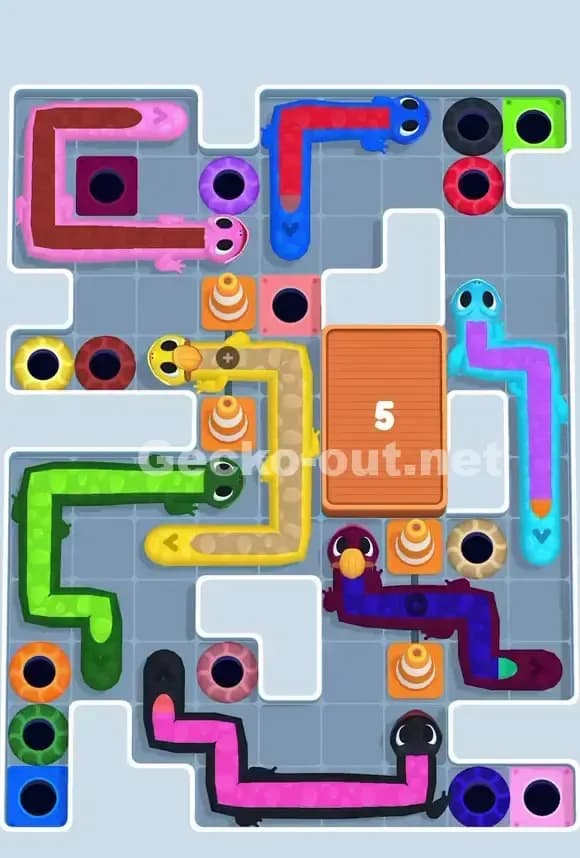
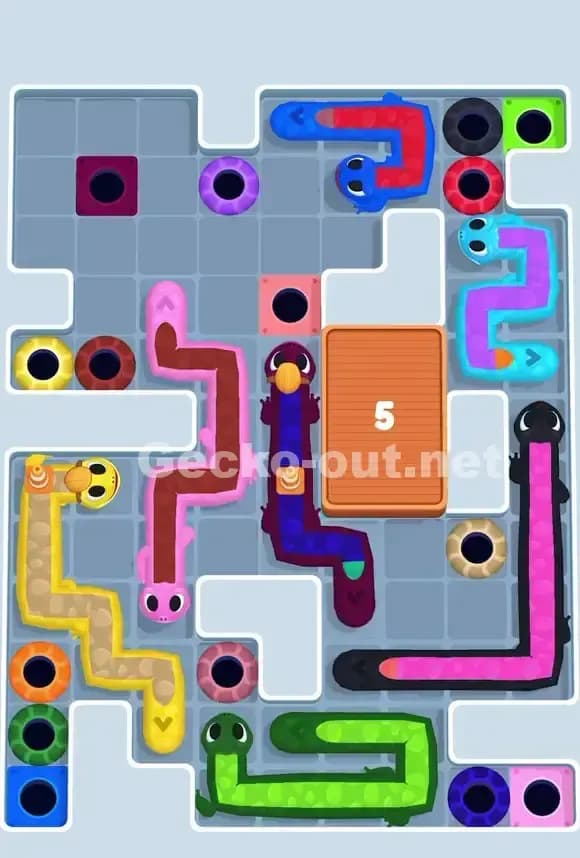
Gecko Out Level 686 throws you straight into chaos. You're looking at eight geckos spread across the board in six different colors: magenta (two geckos), blue, red, yellow, green, cyan, and dark purple. Each one is coiled up in a different corner or corridor, and they're all fighting for space to reach their matching-colored holes. The magenta geckos are the real standout—there are two of them, and they're positioned on opposite sides of the board, which immediately tells you they'll need careful sequencing to avoid jamming each other. The board itself is packed with white blockers (impassable walls) that create tight corridors and force every gecko to take very specific paths. You've also got several orange warning-style holes scattered around—these aren't exits, so accidentally dragging a gecko into one wastes time and momentum.
The timer is unforgiving, as always in Gecko Out Level 686. You need to extract all eight geckos before the clock runs out, and with this many overlapping pathways and twisted body lengths, even a single wrong drag can cost you precious seconds or, worse, trap you completely.
The Win Condition and How Movement Rules Create the Puzzle
To beat Gecko Out Level 686, every gecko must reach its matching-colored hole and exit. The core mechanic—dragging the gecko's head while the body follows that exact path—is both your tool and your trap. Unlike simpler levels, in Gecko Out Level 686 your drag paths don't just disappear; they determine whether future geckos can even move. If you drag the yellow gecko across a central corridor, you've just blocked access for any gecko that needs to use that same space later. This turns the level into a three-dimensional puzzle: you're not just thinking about where each gecko needs to go, you're thinking about the order in which they leave and how each departure opens or closes lanes for the rest. Miss the right sequence, and you'll hit the timer with two or three geckos still stranded, unable to reach their holes.
Pathing Bottlenecks and Logical Traps in Gecko Out Level 686
The Central Corridor: Your Biggest Choke Point
The absolute bottleneck in Gecko Out Level 686 is the center of the board. Multiple geckos—particularly the blue, red, and yellow ones—must funnel through a relatively narrow vertical and horizontal corridor system to access their holes on the right and bottom-right regions. This isn't a single tile; it's a small network, but it's the only realistic path for three geckos, and if you get the order wrong, you'll have long bodies stacked on top of each other with no room to maneuver. The blue gecko at the top, the red gecko in the mid-upper area, and the yellow gecko in the middle all want to use overlapping pathways. If you send the blue gecko through before repositioning the yellow one, the yellow's exit route gets cut off, and you're stuck. This is where Gecko Out Level 686 stops being a casual puzzle and becomes genuinely demanding.
The Magenta Puzzle: Two Geckos, One Color
Here's where things get sneaky in Gecko Out Level 686. You have two magenta geckos, one on the left side and one on the bottom area. Both need to reach magenta holes, but there's only one magenta hole on the left (inside a nested L-shaped corridor) and one on the right side. The twist? The left magenta gecko's path to its hole winds directly through some of the tight corridors that the right magenta gecko also needs to traverse, depending on which hole you assign to which gecko. You could send the left magenta straight to the left hole, which seems obvious—but that doesn't account for whether the right magenta has a clear path afterward. This kind of spatial reasoning is what separates a failed attempt from a clean solve in Gecko Out Level 686.
The Green Gecko's Long Body
The green gecko at the bottom-left is deceptively long. When you drag it, it will snake through its corridor and into the exit area, but if you're not careful about timing, its body will occupy space that the dark purple or cyan geckos might need. On Gecko Out Level 686, the green gecko should ideally be one of the first or last to leave, not somewhere in the chaotic middle where its length becomes a roadblock.
The Personal "Aha" Moment
I'll be honest: Gecko Out Level 686 frustrated me at first. I kept assuming I'd just drag each gecko in color order or by position, and every attempt failed around five geckos in when I'd realize I'd accidentally trapped someone. The breakthrough came when I stopped thinking about individual geckos and started thinking about the board as a flow system. Once I mapped out which gecko's exit opens which corridor for the next gecko, the whole puzzle clicked. Gecko Out Level 686 went from "how is this possible?" to "of course—this is the only way."
Turn-by-Turn Path Strategy to Beat Gecko Out Level 686
Opening: Start With the Perimeter Geckos
Your first move on Gecko Out Level 686 should be to extract the geckos that occupy the edges and won't block anyone else. I recommend starting with the green gecko on the bottom-left. It's isolated enough that you can drag it straight through its L-shaped corridor to the green hole without worrying about interference. This clears a significant chunk of the left side and gives you breathing room. Next, move to the yellow gecko in the center-left area—but don't drag it all the way out yet. Instead, move it just far enough to occupy a safer position where it won't jam the central corridor. The key insight for Gecko Out Level 686 at this stage is to avoid filling the center of the board; keep geckos near the edges until you're ready for the final push.
After those two, handle the cyan gecko on the right side. It has a relatively straightforward path downward and to the right, and clearing it opens up vertical space for others.
Mid-Game: Managing the Central Corridor and Long Bodies
This is where Gecko Out Level 686 demands precision. Now that you've cleared the perimeter, you need to tackle the central tangle: the blue, red, and magenta geckos. The safest sequence is to move the blue gecko from the top-right inward and downward toward its hole. Blue should go before red because the blue's path is more straightforward, and once it's out, the red gecko has a cleaner line to its own exit.
Next comes red. The red gecko sits in a tricky position but has a clear path downward and left if blue is already out of the way. On Gecko Out Level 686, timing red's exit right here is critical because red's body length means it occupies a lot of space as it moves.
Once blue and red are gone, the magenta geckos have much more room to breathe. Send the left magenta into the left magenta hole first. Its body follows an L-shaped path that's relatively contained, and removing it clears the left side entirely for the remaining geckos.
End-Game: The Final Three and the Time Crunch
You're in the home stretch of Gecko Out Level 686, and typically you have the right magenta, dark purple, and yellow remaining. By now, the board is much less crowded, so execution becomes easier—but time pressure is real. Right magenta should go next; with so much space available, you can drag it cleanly to its exit on the right side.
The dark purple gecko is next. Its path winds around the bottom-right area, and with most of the board clear, there's no risk of collision. Finally, send in the yellow gecko. Yellow's exit is one of the last ones, and by this point, it has a completely open runway.
If you're running low on time as you approach the final gecko, don't panic—just make sure each drag is deliberate and direct. Gecko Out Level 686 doesn't reward panic moves, but it absolutely rewards a calm, confident final sequence.
Why This Path Order Works in Gecko Out Level 686
Head Drag, Body Follow: The Untangling Logic
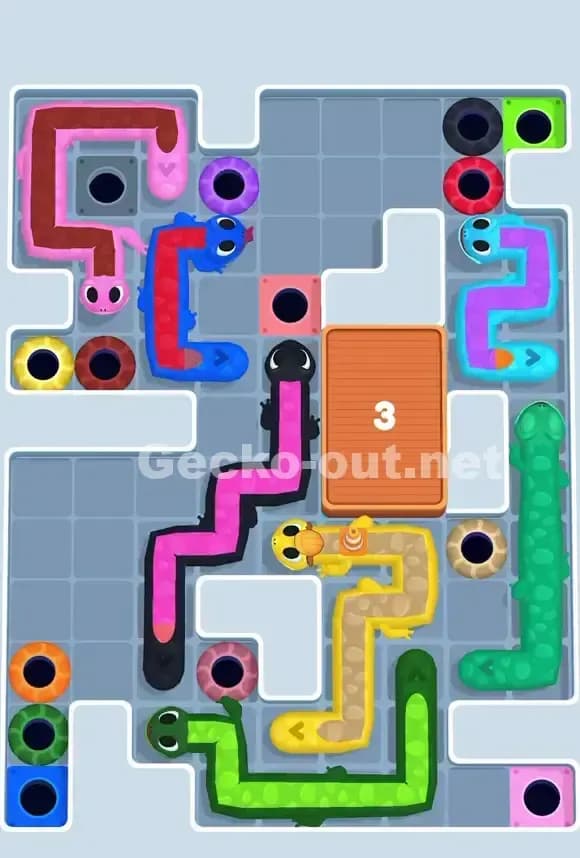
The reason this sequence works for Gecko Out Level 686 is rooted in the core mechanic. When you drag a gecko's head, its body traces your exact path. By removing geckos from the perimeter first (green, yellow, cyan), you're essentially creating lanes rather than removing obstacles. Each gecko that leaves doesn't just disappear; it unblocks a corridor for the next lizard. The central geckos (blue, red, magenta) go second because by that point, they have clear pathways. You're not fighting through a tangled knot; you're methodically unwinding it, one gecko at a time. Gecko Out Level 686's difficulty comes from geckos that are physically tangled together, but the solution is to extract them in an order that respects the board's geometry, not to pull them out randomly and hope.
Pause, Read, Commit
Here's my honest advice for Gecko Out Level 686: use your timer wisely. Don't be afraid to pause for 5–10 seconds after every 2–3 geckos to visually scan the remaining board and mentally trace the next gecko's path. This isn't wasted time; it's prevention. A 10-second pause now avoids a 30-second redo later. On Gecko Out Level 686, committing to a bad drag is the quickest way to failure. Once you've mentally confirmed the path is clear, move fast and decisively. The timer respects players who plan ahead.
Boosters: Use Time Wisely, Not as a Crutch
Gecko Out Level 686 is solvable without boosters if you follow this strategy. However, if you do find yourself running low on time with 2–3 geckos left, an extra-time booster is fair game. Don't use it preemptively; wait until you genuinely need it. A hammer-style tool isn't necessary here since there are no frozen exits or locked tiles blocking your path. The challenge is pure spatial reasoning, not destructible obstacles.
Mistakes, Fixes, and Logic You Can Reuse in Other Gecko Out Levels
Common Mistakes on Gecko Out Level 686
Mistake 1: Sending the magenta geckos too early. Many players try to clear color pairs immediately, but on Gecko Out Level 686, both magenta geckos occupy critical central space. Sending them early jams the board. Fix: Treat magenta as a mid-to-late stage extraction, not an opening move.
Mistake 2: Dragging yellow across the center corridor before blue and red are out. Yellow is long and tempting to move, but it's actually one of the last geckos you should extract. Fix: Recognize that yellow, while positioned centrally, is better served as a final-stage gecko.
Mistake 3: Not accounting for the cyan gecko's body length. The cyan gecko looks compact, but its body occupies more space than its head suggests. Moving it too late clogs the right side. Fix: Extract cyan relatively early, in the opening phase, to keep the right corridor open.
Mistake 4: Trying to loop geckos around white blockers instead of taking the intended path. Gecko Out Level 686's white walls are deliberate; they define the only viable routes. Trying to "optimize" by going around them wastes time and often creates collisions. Fix: Trust the board design and follow the corridors as given.
Mistake 5: Rushing the final gecko because you're low on time. Even with just one gecko left, a sloppy drag can send it into a warning hole or into the path of another gecko's body. Fix: Finish strong. The last gecko deserves the same care as the first.
Reusing This Logic on Similar Levels
The strategy from Gecko Out Level 686 applies directly to any level with multiple same-colored geckos, tight central corridors, or long body-length challenges. On levels where two geckos share a color, always ask: "Can both of them reach their respective holes, or do they compete for a single exit?" This is the magenta question, and it's the most important spatial reasoning in the Gecko Out series. Additionally, whenever you see a central bottleneck (a corridor that multiple geckos must traverse), start by identifying the geckos that don't need to use it. Extract those first. This principle transforms chaotic-looking boards into manageable sequences. Finally, on levels with long geckos like the green one in Gecko Out Level 686, always consider body length as a spatial cost, not just the head position. A gecko doesn't occupy a tile; it occupies an entire path.
The Encouraging Conclusion
Gecko Out Level 686 is genuinely one of the trickier puzzles in the series, but it's absolutely not impossible. It just demands that you think spatially and sequentially rather than reactively. Every player who's struggled with Gecko Out Level 686 and then solved it reports the same thing: once the right order clicks, the level feels elegant and almost inevitable. You've got this. Take a breath, map the board, and execute the plan. Gecko Out Level 686 is waiting for you to outsmart it.