Gecko Out Level 731 Solution Walkthrough | Gecko Out 731 Answer
How to solve Gecko Out level 731? Get step by step solution & cheat for Gecko Out level 731. Solve Gecko Out 731 easily with the answers & video walkthrough.
Gecko Out Level 731: Board Layout, Rules, and Win Condition
Understanding the Starting Board
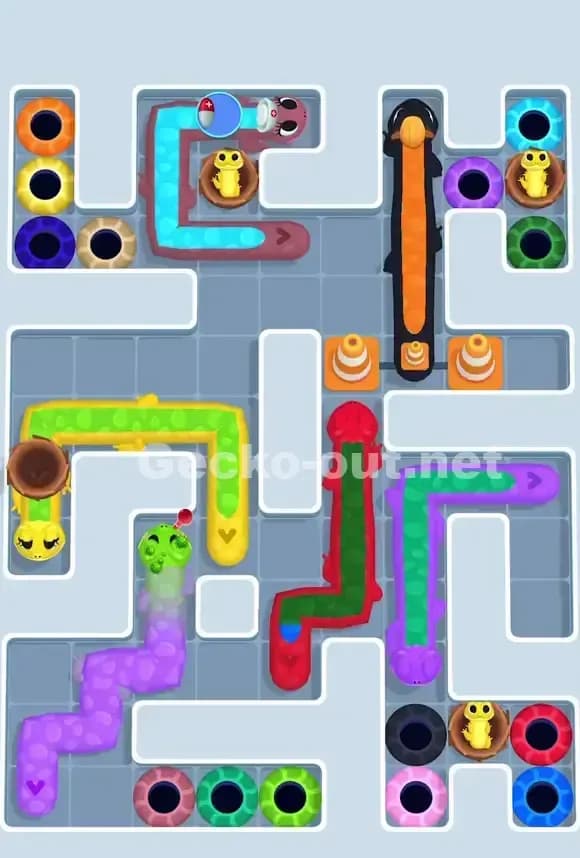
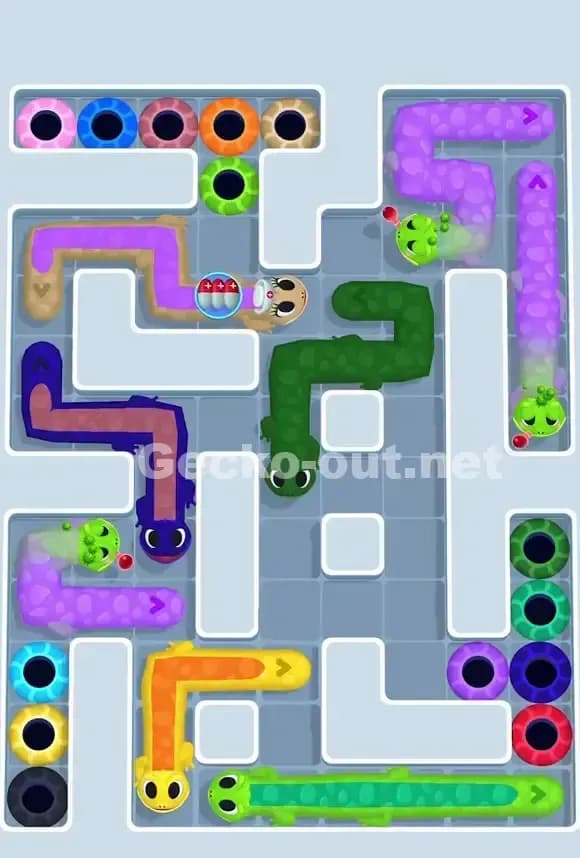
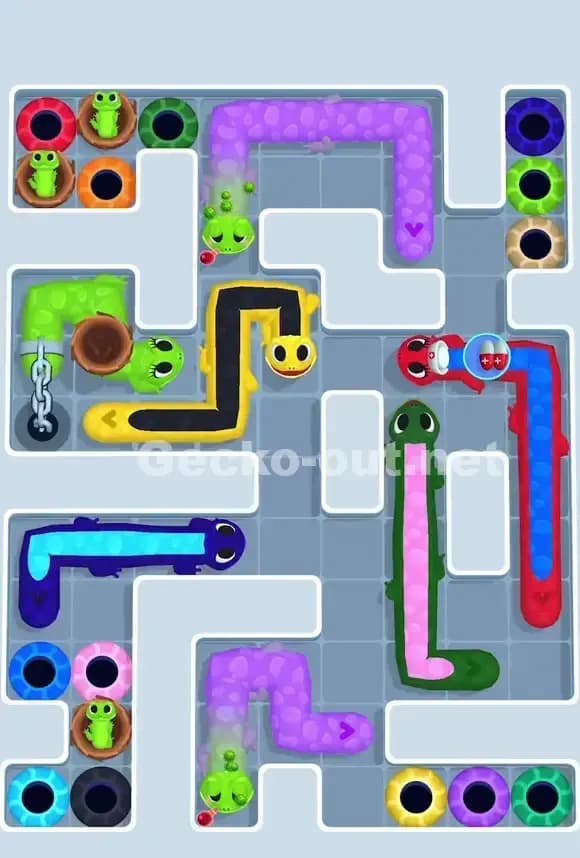
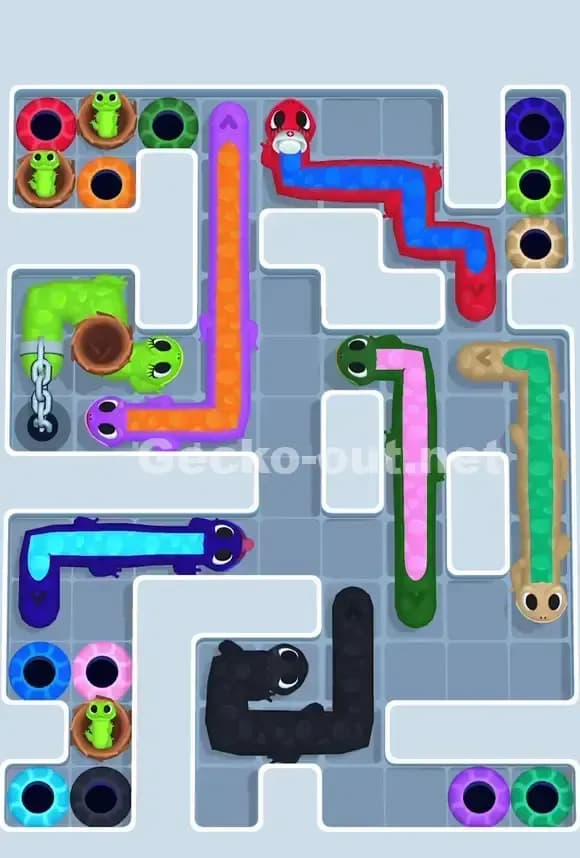
Gecko Out Level 731 is a deceptively crowded puzzle with six individual geckos and two gang-linked gecko pairs, scattered across a complex, winding grid. You're looking at a total of ten gecko heads that all need to escape—no small feat. The colors are split into red, yellow, green, blue, and purple, with each gecko needing to reach its matching-colored hole. What makes Gecko Out 731 particularly punishing is that the board layout forces you through tight corridors and shared pathways. There's a chained gecko on the left side (locked to a heavy weight), two linked gang geckos on the right in red and blue, and a frozen blue gecko pathway that blocks crucial routing. Walls form an intricate maze of white barriers, and you've got purple-tinted "warning" zones scattered throughout the middle section.
The Win Condition and Timer Pressure
To win Gecko Out Level 731, every single gecko—all ten heads—must reach their matching-colored exit hole before the timer expires. There's no partial credit here. The timer is relatively generous but not forgiving, which means you can't afford long hesitations or messy repathing. The drag-based movement system means every pixel of the path you draw becomes the gecko's exact route, and the body follows faithfully behind. If you draw a path that accidentally traps another gecko's exit route, you've just made Gecko Out 731 much harder, or even unsolvable. This is why planning the order matters so much.
Pathing Bottlenecks and Logical Traps in Gecko Out Level 731
The Critical Bottleneck: The Center Corridor
The absolute make-or-break bottleneck in Gecko Out Level 731 is the vertical corridor running through the middle of the board. This narrow passage is where the yellow smiley gecko, the purple geckos, and several others all need to pass through to reach their exits. If you route any gecko carelessly through this space, you'll block the others and create an unsolvable knot. The yellow gecko in the center is particularly tricky because its exit is on the right side, which means its path must traverse almost the entire width of the board—and that path will physically block other geckos if you're not careful. This is the single biggest chokepoint in Gecko Out Level 731.
Subtle Trap #1: The Chained Gecko's Heavy Anchor
The chained gecko on the left (brown hole) is linked to a heavy weight, which means its movement is constrained. You can't move it freely; you can only drag it as far as the chain allows. Many players instinctively try to route this gecko early, but doing so actually wastes precious time and space on the board. The smarter play is to leave it for later, after you've cleared other geckos and given the chain more "room" to extend into the now-empty areas.
Subtle Trap #2: The Gang Geckos on the Right
The two linked red and blue geckos on the right side move as a unit—when you drag one, the other follows in a fixed formation. This means you can't route them independently, and their combined body length is substantial. If you drag the red gecko toward its exit first without considering where the blue gecko's body will end up, you'll accidentally block the blue gecko's exit route. Gecko Out Level 731 punishes this kind of sequential thinking.
Subtle Trap #3: The Frozen Blue Pathway
There's a frozen (icy) blue zone in the upper-middle area that blocks direct passage. Geckos can't cross frozen exits, so any gecko routing through that area must navigate around it. This forces longer, more winding paths, which consumes board space and makes timing tighter.
My First Attempt: Frustration, Then Clarity
I'll be honest—my first run at Gecko Out Level 731 was a mess. I dragged the yellow gecko straight through the center corridor without thinking, then realized I'd locked out three other geckos from their exits. The second attempt, I got too cautious and spent 30 seconds just staring at the board. But on the third try, something clicked: I realized that the solution wasn't about speed or luck, but about working backward from the exits. Once I mapped out which gecko absolutely had to go first versus which ones could wait, the whole puzzle made sense. The bottleneck didn't disappear, but suddenly I knew exactly how to thread the needle.
Turn-by-Turn Path Strategy to Beat Gecko Out Level 731
The Opening: Clear the Constraints First
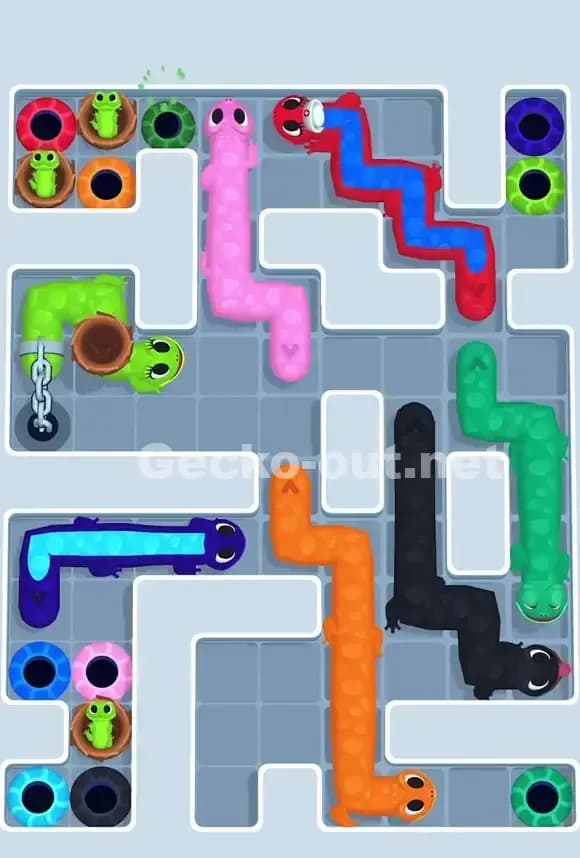
Start with the chained brown gecko on the left. Yes, it's constrained by the anchor, but that's actually perfect for your opening move. Dragging it to its brown hole is a straightforward path with minimal risk of blocking others. This immediately frees up that anchor space and removes one gecko from the "crowded left side" of the board. Next, tackle the blue gecko on the bottom left (the one without a chain). Route it through the lower-left corridor toward its blue exit on the bottom-right. This path is mostly isolated and won't interfere with the central chaos. Finally, move the pink gecko at the bottom toward its hole. These three moves take maybe 20 seconds total and clear out the lower portion of Gecko Out Level 731, giving you breathing room.
Mid-Game: Untangle the Center Without Creating New Knots
Once the bottom is clear, you've got room to maneuver the big players. Now address the yellow gecko in the center. This is the moment of truth for Gecko Out Level 731. Drag its head carefully along the right side of the board, avoiding the frozen blue zone, and route it all the way to the yellow exit on the bottom-right. It's a long path, but now that the board is less crowded, the route is clear. Immediately after, move one of the purple geckos (the ones in the purple zone above the center). Route it downward and around, through the now-vacant center corridor, toward its purple exit on the bottom. The key is to drag it in a way that doesn't block the remaining gecko's paths. Park the second purple gecko temporarily by moving it only partway toward its goal—you'll finish it later once other geckos are gone.
End-Game: Exit Order and the Final Push
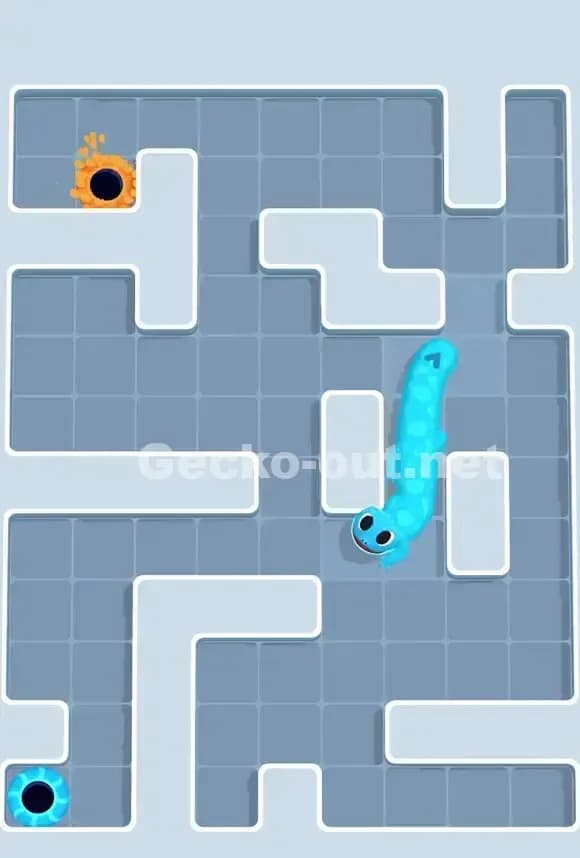
With the center corridor largely empty, finish the green gecko next. This one has a straightforward path up and to the right toward the green exit. Then tackle the two linked gang geckos (red and blue) as a unit. Drag them carefully toward their respective exits on the right side, moving them together. Because they're linked, you only drag once, and both move. Finally, finish the remaining purple gecko and any stragglers. At this point, the board is nearly empty, so even if you're running low on time, the paths are unobstructed and you can execute the final exits quickly. If you're in a time crunch, you can hold the gang geckos or a straggler gecko for the very end and just commit to fast, accurate dragging.
Why This Path Order Works in Gecko Out Level 731
How Head-Dragging and Body-Following Untangle the Knot
The genius of this strategy for Gecko Out Level 731 is that you're using removal as your main tool, not rerouting. Each gecko you successfully exit physically disappears from the board, which opens up space for the remaining geckos. By starting with the most-constrained geckos (the chained one, the isolated bottom ones), you remove obstacles rather than trying to route around them. The body-follow mechanic means every path you draw becomes permanent until that gecko exits, so the order determines whether paths stay "open" or become "walls." By clearing the edges first and leaving the center corridor for the big, complex geckos, you ensure that when those geckos do move, there's maximum space for their long bodies to extend.
Timing Your Pauses and Commits
Don't feel bad about pausing to think during Gecko Out Level 731. I recommend taking 5–10 seconds after each gecko exits to visually scan the remaining board and identify your next target. That brief moment of clarity prevents panic-dragging, which is how most players fail. However, once you've committed to a gecko's drag, commit fully—hesitation mid-drag can result in accidental wall collisions. The timer is generous enough that thoughtful play beats rushed play on Gecko Out Level 731.
Booster Strategy: Optional but Useful
You don't need boosters to beat Gecko Out Level 731, but they're not forbidden either. If you mess up a path and create a deadlock, an Undo booster (if available) lets you rewind one move without penalty. More practically, an Extra Time booster can be clutched into the end-game if you're at, say, 3 seconds remaining with one gecko left to exit. I'd recommend trying Gecko Out Level 731 without boosters first—if you nail the path order, you'll beat it with 10+ seconds to spare, which proves you've solved it properly.
Mistakes, Fixes, and Logic You Can Reuse in Other Gecko Out Levels
Five Common Mistakes on Gecko Out Level 731 and Their Fixes
-
Mistake: Routing the yellow gecko through the center first. This blocks everyone else. Fix: Leave yellow for mid-game, after you've cleared the edges.
-
Mistake: Separating the linked gang geckos by trying to drag one individually. They won't separate. Fix: Always treat them as a single unit and plan a path that satisfies both their exits simultaneously.
-
Mistake: Parking geckos in the center corridor "temporarily." There's no such thing—a parked gecko blocks traffic. Fix: Either route a gecko all the way to its exit or leave it completely untouched. No half-measures.
-
Mistake: Dragging the chained gecko early and expecting full mobility. The chain limits its range. Fix: Use the chain's constraint to your advantage by exiting it quickly and freeing up that space.
-
Mistake: Ignoring the frozen zones and accidentally routing a gecko into them. Frozen exits block passage. Fix: Map out frozen zones before you start dragging, and always route around them.
Transferable Logic for Similar Puzzles
The strategy you've learned on Gecko Out Level 731 applies to any level with tight corridors, linked geckos, or heavy bottlenecks. The key principle is clear the edges, preserve the center, and exit in order of constraint. On gang-gecko levels, always treat linked pairs as single units and plan exits that don't conflict. On frozen-exit levels, pre-identify the zones and build routes that bypass them. On chained-gecko levels, use their limited range as an advantage—they're easier to route because they can't go far, so get them out of the way first. This logic is reusable across difficulty tiers.
Final Encouragement
Gecko Out Level 731 is legitimately tough, but it's not impossible. It rewards patient planning and logical thinking. You're going to get it wrong a few times—that's completely normal. But once you see the pattern, once you understand that removal beats rerouting, you'll clear it cleanly. The satisfaction of threading all ten gecko heads through that intricate maze and watching them all exit before the timer hits zero? That's the whole reason these puzzles exist. You've got this.