Gecko Out Level 726 Solution Walkthrough | Gecko Out 726 Answer
How to solve Gecko Out level 726? Get step by step solution & cheat for Gecko Out level 726. Solve Gecko Out 726 easily with the answers & video walkthrough.
Gecko Out Level 726: Board Layout, Rules, and Win Condition
Understanding the Starting Position
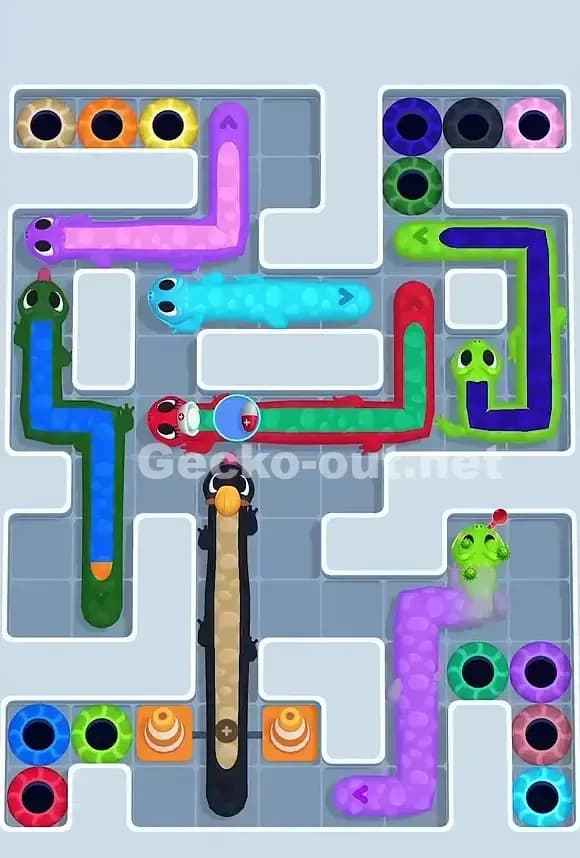
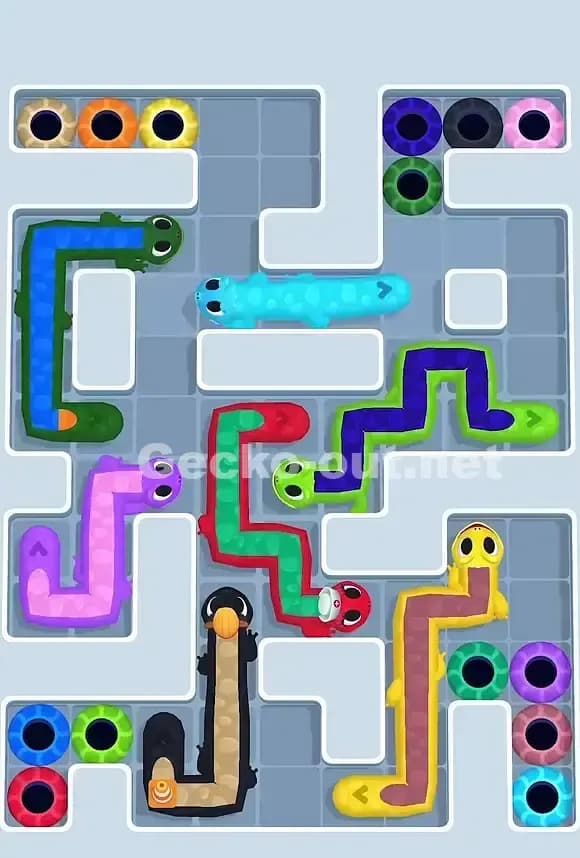
Gecko Out Level 726 is a dense, multi-gecko puzzle that demands careful spatial planning and sequencing. You're working with six distinct geckos: a purple one wrapping the upper-left corridor, a cyan gecko occupying the center-left area, a long green gecko snaking down the left side, a red gang gecko (paired with blue) in the middle zone, a lime-green gecko on the right edge, and a tan-and-black gecko anchoring the center-bottom. Each gecko needs to reach its matching colored hole—and there's a strict timer that won't wait for hesitation. The board is a labyrinth of tight corridors with minimal wiggle room, white obstacle zones blocking direct paths, and several color-matched exit holes scattered across the grid. The real kicker? Two of these geckos are gang-linked (the red and blue pair in the middle), meaning they move as a unit and must both exit safely to count as solved.
The Win Condition and Timer Pressure
Your job is simple in theory: drag each gecko's head along a valid path so its body follows, and deposit it into its matching hole before the clock runs out. However, Gecko Out Level 726 doesn't give you much breathing room. Once you commit to a path, the gecko's body locks into that exact route—you can't nudge it mid-move or reroute on the fly. If any gecko (including the gang pair) is still on the board when the timer hits zero, the entire level fails and you restart. This timer-plus-drag-pathing combo means you need a bulletproof plan before you start moving heads around, because backtracking or correcting mistakes will eat precious seconds.
Pathing Bottlenecks and Logical Traps in Gecko Out Level 726
The Central Corridor Choke Point
The single biggest bottleneck in Gecko Out Level 726 is the middle horizontal lane where the red-blue gang gecko is currently wedged. This corridor is the only viable exit route for multiple geckos, and if you move the gang pair carelessly, their long bodies will block everyone else's escape path. The gang gecko in particular is a gang-linked unit—meaning the red and blue heads move together—so it takes up even more real estate than a single gecko would. You absolutely must clear this pair out early and route them directly to their holes (which sit on the right side of the board), or you'll find yourself with two or three geckos stuck behind an immovable wall of red and blue body segments.
The Left-Side Green Gecko Entanglement
The green gecko running down the left edge is a second critical chokepoint. It's a long, winding gecko that currently occupies the bottom-left quadrant and blocks access to the orange holes at the base of the board. If you don't plan its exit path carefully, you'll lock out the blue and red geckos at the bottom from reaching their holes. The trap here is tempting to move it last because it seems "out of the way"—but actually, you need to route it out relatively early so other geckos can use the left corridor. The moment I realized I had to treat the green gecko as a priority exit, not a cleanup task, the puzzle suddenly felt manageable.
The Cyan Gecko's Awkward Center Position
The cyan gecko sits roughly in the middle of the board, and its exit hole is somewhere on the right edge. The problem? There's no direct corridor from its current position to its destination without crossing multiple other gecko paths. This gecko will force you to think two or three moves ahead: if you move cyan first, does it block the red-blue gang? If you move the gang first, can cyan still find a clear lane? I found myself staring at this gecko for longer than I'd like to admit before I realized the solution involved timing cyan's exit after certain other geckos had already escaped, freeing up the middle lanes.
Turn-by-Turn Path Strategy to Beat Gecko Out Level 726
Opening: Neutralize the Gang Gecko and Clear the Center
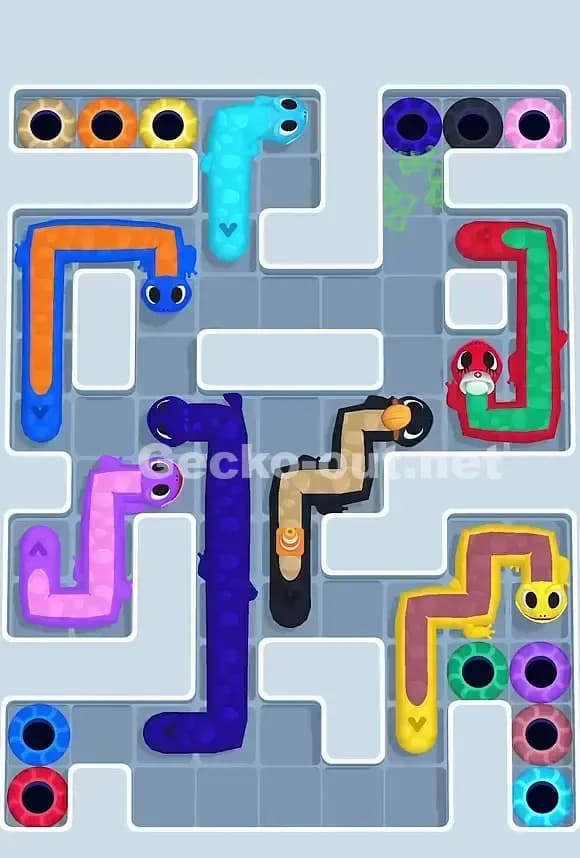
Start by dragging the red-blue gang gecko's head toward the right side of the board where their exit holes sit. Because this is a gang unit, you need to be extra deliberate: trace a path that hugs the right-side corridor and avoids colliding with the lime-green gecko also on that flank. The gang gecko's body is long, so this move will take several seconds, but it's critical because once they're out, the entire center lane opens up for everyone else. Immediately after, move the cyan gecko toward its matching hole on the right. By clearing these two from the center, you've freed up the main thoroughfare and reduced the overall board congestion significantly. This opening sequence might feel slow, but it's the highest-leverage move you can make early on.
Mid-Game: Sequence the Outer Geckos and Protect the Lanes
Once the center is clear, tackle the green gecko on the left. Drag its head downward and around toward the orange hole at the bottom-left corner. This gecko is long and serpentine, so watch its tail carefully to ensure no other gecko's path will get blocked. While the green gecko is exiting, you've got a brief window to move the purple gecko from the upper-left. Its exit hole should be in the upper region, so drag its head upward and trace a path that skirts the top edge without colliding with the cyan gecko's body (if it's still in the process of exiting). The lime-green gecko on the right is next: route it along the right corridor toward its green hole, staying above or below the gang gecko's exited body to avoid overlap. At this point, you should have four geckos either already out or in motion, and the board should look significantly less crowded.
End-Game: The Tan-and-Black Gecko and Final Cleanup
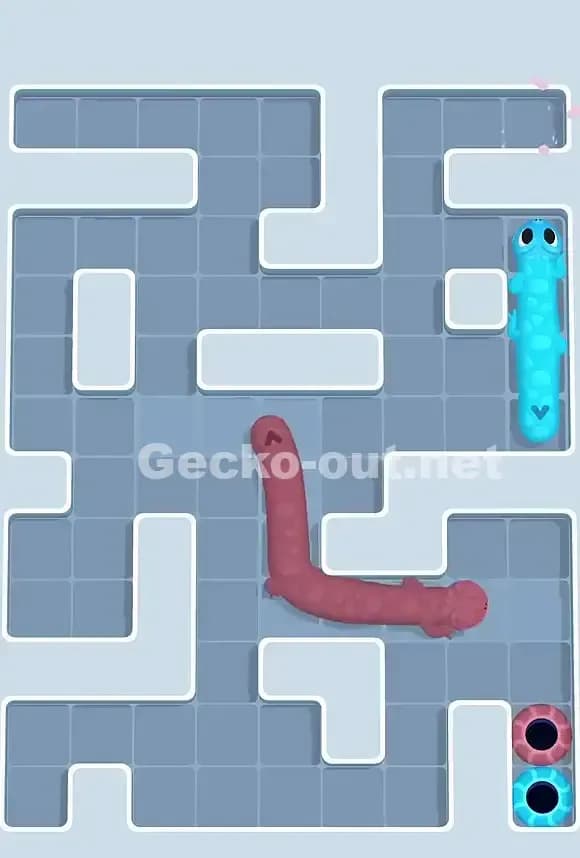
The tan-and-black gecko at the bottom-center is your final puzzle piece. By now, most of the board should be clear, so you have more routing flexibility. Drag its head toward the tan and orange holes near the bottom-right and bottom-left. The trick is choosing which exit to use—generally, go for whichever hole has the clearest path given the remaining geckos still on the board. Once this gecko is en route, immediately move any stragglers (like the purple gecko if it's still pending) to their holes. If you're running low on time, don't panic: glance at the timer, count how many geckos are still out, and commit to the fastest remaining paths even if they're not perfectly clean. A slightly suboptimal exit that lands you inside the time limit beats a perfect path that times out.
Why This Path Order Works in Gecko Out Level 726
Untangling the Knot, Not Tightening It
The key insight for Gecko Out Level 726 is that you're not moving geckos in a arbitrary order; you're systematically removing the ones that block the most other routes. By starting with the gang gecko and cyan (the center occupants), you immediately reduce the number of potential collisions for every other gecko. Then you work outward—clearing the left side, then the right side—so that each subsequent move has more free space to work with. The body-follow rule (your gecko's body traces the exact path your head took) means that a poorly planned early move can create an impassable wall for later geckos. By choosing an order that maximizes board space, you're working with the body-follow mechanic rather than against it.
Pacing and Pausing for Clarity
Gecko Out Level 726 gives you enough time to solve it if you're efficient, but not so much time that you can afford to be careless. I recommend pausing briefly after moving each gecko to visually verify that its body didn't clip any walls or other geckos and that your remaining geckos still have clear lanes to their holes. Then commit fully—drag the next gecko's head confidently and don't second-guess mid-move. The pause-and-commit rhythm keeps you from making rushed mistakes while still maintaining momentum against the timer.
Boosters: Optional Lifelines, Not Required Solutions
For Gecko Out Level 726, boosters like extra time or a hint tool are nice to have but not necessary if you follow this plan. That said, if you find yourself with only 10–15 seconds left and two geckos still pending, using an extra-time booster is a reasonable insurance policy. Don't use a booster early on though—they're most valuable as a safety net for the final stretch, when you've already solved most of the puzzle and just need a few more seconds to cross the finish line.
Mistakes, Fixes, and Logic You Can Reuse in Other Gecko Out Levels
Common Mistakes and Corrections
Mistake #1: Moving the long green gecko too early. This blocks the left corridor for other geckos trying to reach holes on the left side. Fix: Treat the green gecko as a mid-game priority, not a first move, so you can route around it if needed.
Mistake #2: Forgetting the gang gecko moves as a unit. Players often drag the red head one way without accounting for the blue body, causing an unintended collision. Fix: Always trace the gang gecko's full path mentally before dragging—visualize both the red and blue segments moving together along that route.
Mistake #3: Exiting the cyan gecko too late. It's easy to overlook the cyan gecko in the clutter and focus on more obvious geckos. But cyan's central position means it blocks a lot of traffic if left unchecked. Fix: Explicitly list all geckos and assign each a rough exit order before you start dragging.
Mistake #4: Using boosters impulsively. Players panic when the timer dips below 30 seconds and burn a booster early, then run out again later. Fix: Commit to solving the puzzle clean first, and only activate a booster if you're genuinely stuck with fewer than 10 seconds and unexited geckos.
Mistake #5: Dragging a head without confirming the hole is accessible. You drag a gecko toward its hole, only to discover the path is blocked by another gecko's body. Fix: Before each drag, trace the route visually and confirm that the exit hole is actually reachable given the current board state.
Reusing This Logic on Similar Levels
Gecko Out Level 726's strategy—identify the central bottleneck, clear it first, then work outward—applies to any level with gang geckos, long serpentine geckos, or tight corridors. Whenever you see a level with a central choke point or a gang unit, ask yourself: "Which gecko, if removed, opens up the most lanes for others?" That's your first move. Also, pay special attention to color-specific exit holes; if two geckos need the same color hole on opposite sides of the board, plan their routes so they don't collide mid-transit. Gecko Out Level 726 teaches you to think in layers: first untangle the knot, then direct traffic, then finalize exits.
Final Encouragement
Gecko Out Level 726 is undeniably tough—it's got a gang gecko, a maze of corridors, a timer, and multiple long geckos competing for space. But it's absolutely beatable with a clear head and a methodical approach. Once you execute the opening sequence (gang gecko and cyan out, center cleared), the puzzle starts to feel solvable rather than overwhelming. Trust the plan, move deliberately, and you'll have all six geckos safely out before the timer reaches zero. You've got this.