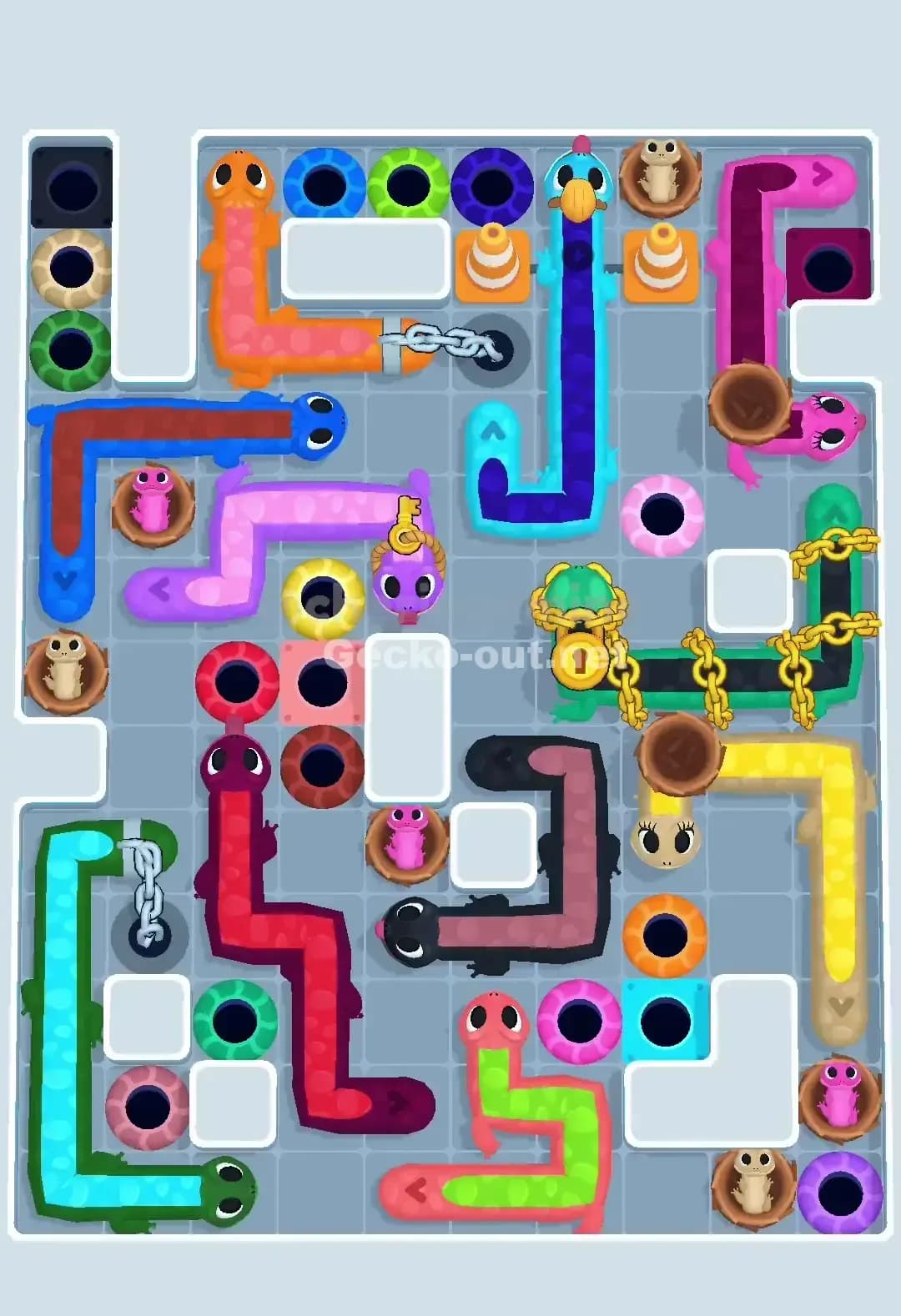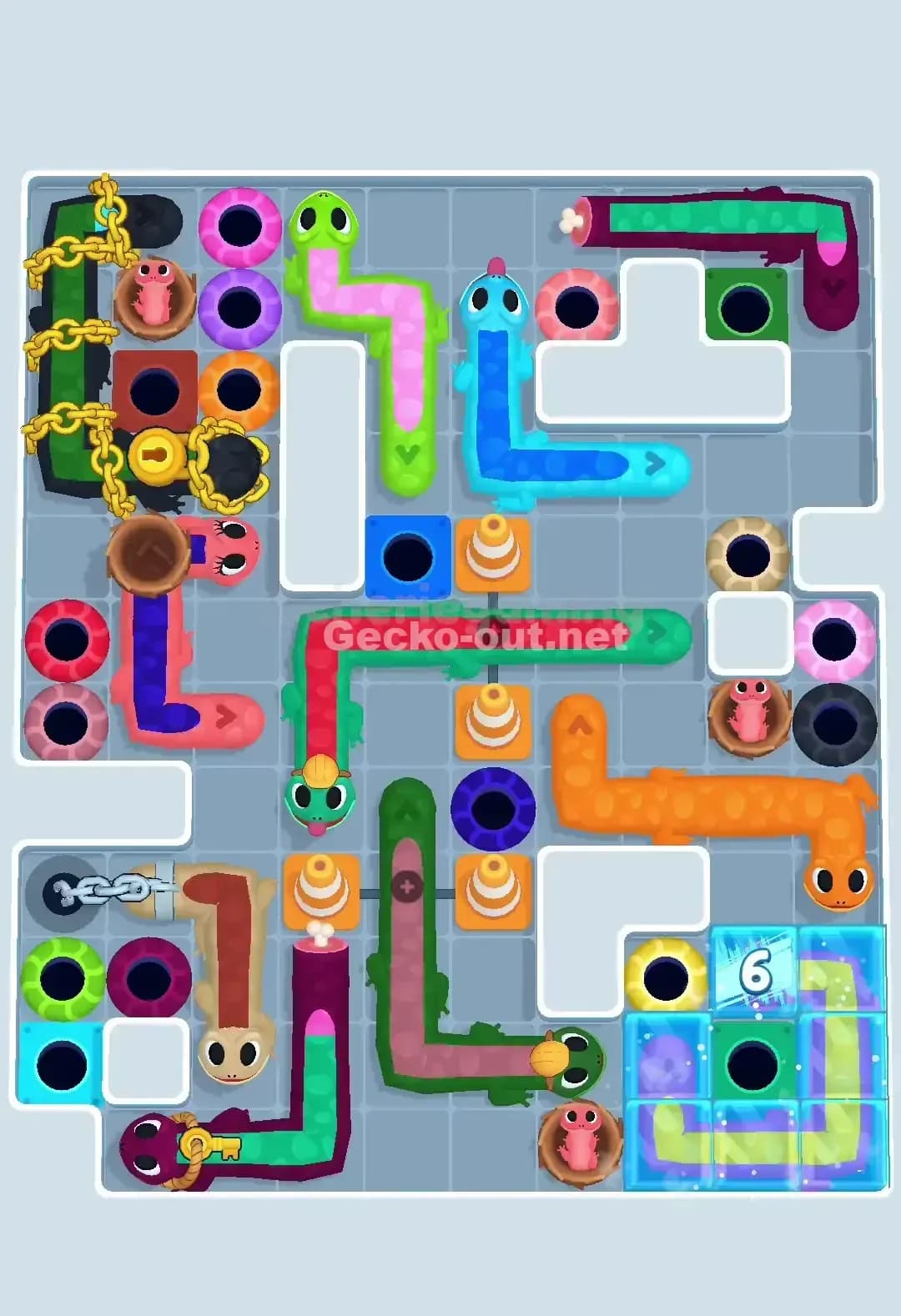
Gecko Out Level 676 Solution Walkthrough | Gecko Out 676 Answer
How to solve Gecko Out level 676? Get step by step solution & cheat for Gecko Out level 676. Solve Gecko Out 676 easily with the answers & video walkthrough.
Gecko Out Level 676: Board Layout, Rules, and Win Condition
Starting Board and Key Obstacles
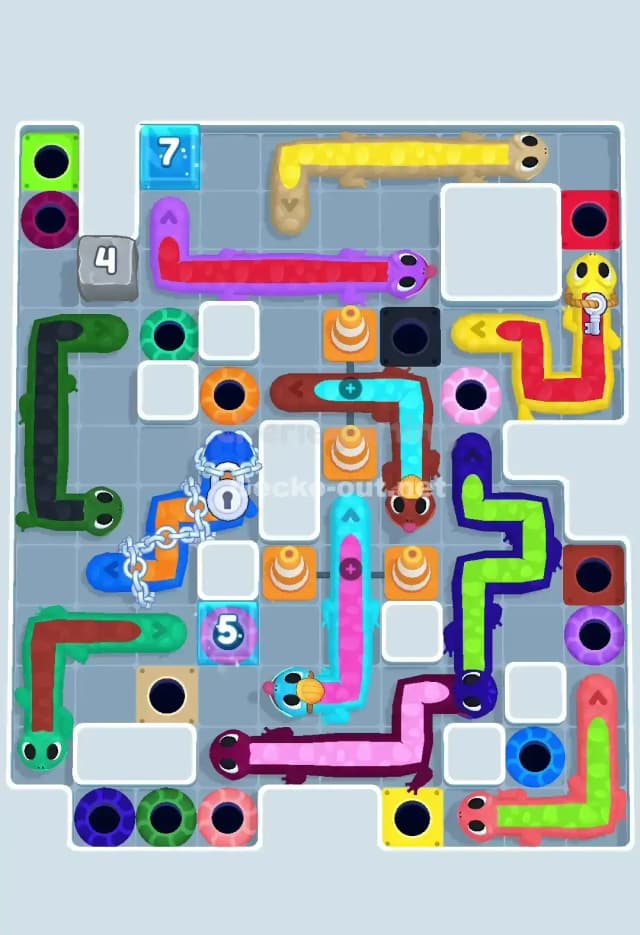
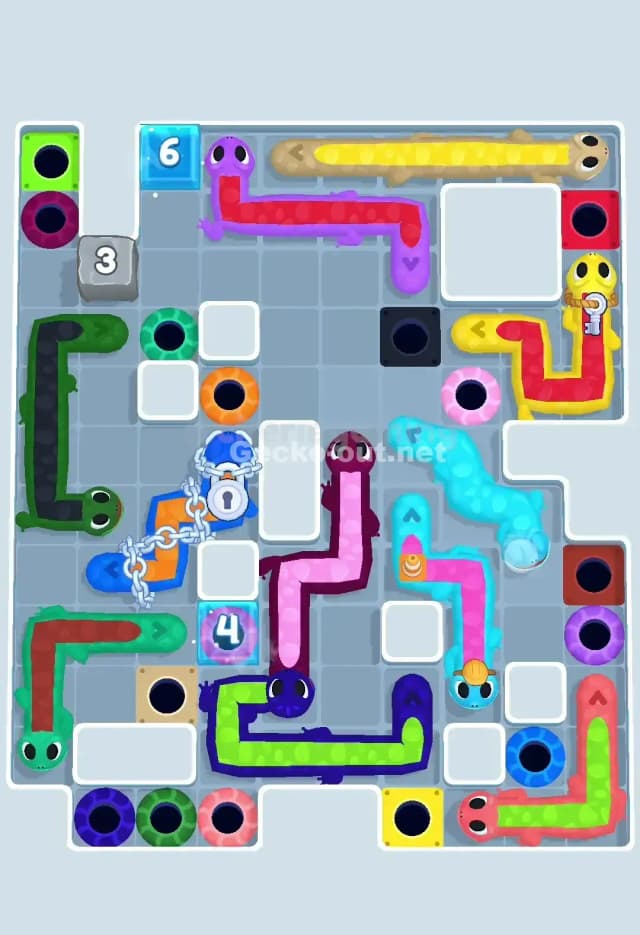
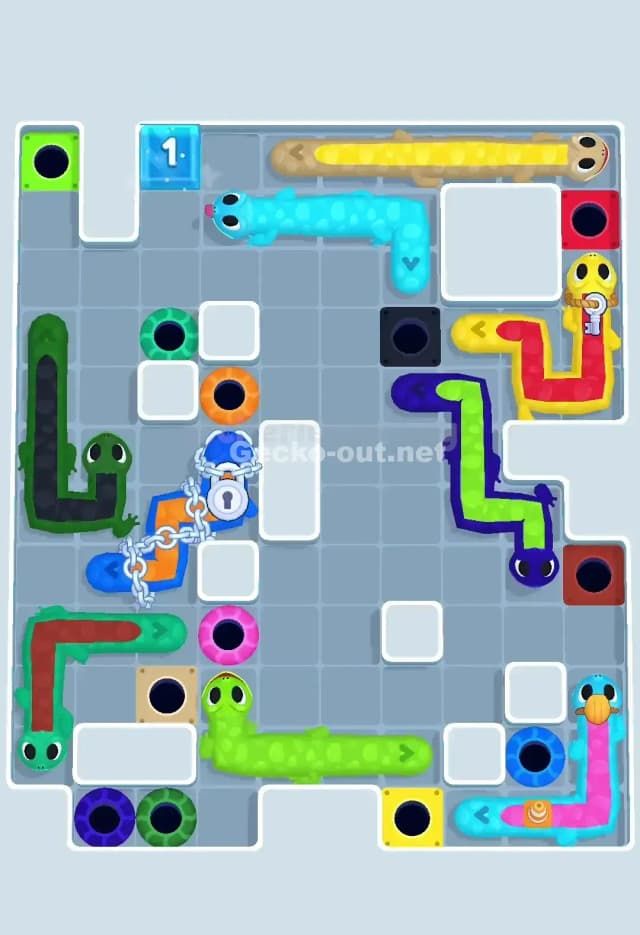
Gecko Out Level 676 is a densely packed puzzle that'll test your patience and planning skills. You're looking at approximately 15 geckos scattered across the board in six different colors: green, purple, pink, orange, cyan, yellow, red, and blue. The real challenge? They're all twisted together like a bowl of spaghetti, with multiple gang-linked geckos (connected by chains or direct body contact), frozen or locked exits, tall warning holes scattered throughout the middle of the board, and some seriously tight choke points that act as natural bottlenecks. The left side features a complex L-shaped green gecko with locked segments, while the right side has a dense cluster of colored geckos competing for limited exit space. There's also a time limit displayed as "7" at the top left—you've only got seven seconds to complete Gecko Out Level 676, which is incredibly tight.
Win Condition and Timer Pressure
Your goal is straightforward: drag each gecko's head along a valid path to its matching-colored hole. Every gecko's body follows the exact route you draw, which means you can't overlap walls, other geckos, or blocked exits. The moment you nail the path, that gecko slides out and vanishes from the board. However, Gecko Out Level 676 won't give you much breathing room—the seven-second timer is your real enemy. If even one gecko is still on the board when the timer hits zero, you lose the entire level. This forces you to plan multiple geckos simultaneously in your head before you even touch the first one. You can't afford trial-and-error; you need a strategy from the moment you see the board.
Pathing Bottlenecks and Logical Traps in Gecko Out Level 676
The Central Bottleneck Problem
The biggest single choke point in Gecko Out Level 676 is the middle corridor running vertically down the center of the board. Multiple geckos need to funnel through this narrow space to reach their exits, and if you move the wrong gecko first, you'll create a body-block that locks everyone else in place. The orange geckos and the cyan gecko are the worst offenders—their long bodies can easily stretch across the entire corridor and jam up the left-side green gecko and the right-side purple gecko simultaneously. This is why turn order matters more than you'd think; one wrong first move, and you've already lost the level.
Subtle Problem Spots Worth Noting
The locked chain-gang blue gecko on the left side is deceptively tricky because it doesn't move as a single unit—it's bound to another piece, which means dragging its head alone won't free it completely. You'll need to understand exactly which direction to pull it so the chain doesn't wrap around walls and create a jam. The second trap is the gang of warning holes in the middle-right quadrant; they look empty, but they're designed to trick you into routing a gecko's body straight through them, which wastes precious movement space and leaves less room for other geckos to pass nearby. Third, the upper-right yellow gecko is visually isolated, but its actual exit hole is on the far right edge—the path is much longer than it appears at first glance, and it'll occupy critical real estate if you're not careful about when you move it.
Moment of Frustration and Clarity
Honestly, when I first loaded Gecko Out Level 676, I wanted to scream. Seven seconds felt insulting—I couldn't even drag three geckos at that speed, let alone fifteen. But then it clicked: I wasn't supposed to move fifteen geckos in seven seconds. I was supposed to identify which geckos could move first without blocking others, drag them out in a lightning-fast sequence, and trust that the remaining geckos would have clear paths. The moment I stopped thinking "do this for each gecko" and started thinking "what's the order that prevents blocking," the puzzle went from impossible to challenging-but-fair.
Turn-by-Turn Path Strategy to Beat Gecko Out Level 676
Opening: Clear the Exits First
Start by identifying which gecko has the clearest, shortest path to its exit—that's usually your first move in Gecko Out Level 676. In this case, it's the green gecko on the left side. Don't overthink it; drag its head straight down and out through its matching exit hole at the bottom-left corner. This removes a large, body-heavy gecko from the board immediately and opens up the left corridor for other geckos to pass through. Your second move should target one of the corner geckos (blue or pink) that's already isolated near an exit; these give you "free" removals that reduce board congestion. As you clear these opener geckos, you're not just removing bodies—you're opening sightlines so you can see which geckos are now in the critical path and which can wait.
Mid-Game: Managing the Corridor and Avoiding New Jams
Once you've cleared two or three geckos, take a hard look at the central corridor. The orange gecko in the middle-left area is likely your next target for Gecko Out Level 676, because its long body is sprawling across valuable real estate. Drag it upward and route it around the upper exits—don't try to force it through the center, or it'll block the cyan gecko and the red gecko behind it. Immediately after, move the cyan gecko; its path should curve around the now-empty space left by the orange gecko. The key to mid-game success is this: every gecko you remove should make the next gecko's path simpler, not harder. If you're drawing a path and thinking "this feels tight," you've probably already made a mistake earlier. Pause, undo if the game allows it, and reconsider your previous move's exit point. Also, be mindful of gang-linked geckos—if two geckos are chained together, you can't move one without anticipating how the other will swing into the newly empty space.
End-Game: Last Geckos and Clock Management
By the time you're down to the final four or five geckos in Gecko Out Level 676, the timer is usually screaming at you with maybe one or two seconds left. This is where panic kills runs. The remaining geckos are typically clustered on one side of the board, and their exits are nearby—you're in the home stretch. Prioritize the geckos with the longest bodies first, because even a short path with a long gecko takes more time to drag than a short gecko with a short path. The purple gecko on the right and the yellow gecko at the top-right should be among your last moves; their paths are relatively clear by this point, and you can drag them quickly. If you're genuinely down to one or two seconds and one gecko remains, don't panic-drag—commit to a clean, deliberate path and trust that it'll work. Rushed drags often miss the exact exit hole.
Why This Path Order Works in Gecko Out Level 676
Body-Follow Physics and Untangling Logic
The reason this order works for Gecko Out Level 676 is grounded in how body-follow pathfinding operates. When you drag a gecko's head, every segment of its body traces the exact route you drew, which means longer geckos are more disruptive when they're on the board. By removing the longest geckos first, you're physically reducing the amount of "occupied space" on the grid, which means the remaining shorter geckos have clearer sightlines and fewer obstacles to navigate around. It's like untangling a knot from the outside in—you pull out the longest string first, and suddenly all the smaller strings fall free. The order also leverages the board's natural exit clustering; geckos that share exit zones should be moved in sequence (one pulls out, the next pulls out), rather than splitting them up and creating zigzag paths.
Pause and Commit: Timing Your Decisions
A common misconception is that Gecko Out Level 676 requires lightning reflexes. It doesn't—it requires sharp observation. Spend the first 1–2 seconds studying the board, identifying your first three moves, and visualizing their paths. Then execute. Don't drag randomly and hope for the best; you'll waste precious milliseconds on failed routes. Once you've locked in your mental plan, move deliberately and confidently. Each drag should take about half a second; if you're hesitating mid-drag, you've lost the race. The timer's tightness is actually a feature, not a bug—it forces you to eliminate weak decision-making and commit to a single clear strategy.
Booster Usage: When to Deploy Extras
For Gecko Out Level 676, I recommend treating boosters as optional rather than essential. If you have an extra-time booster, save it as a last resort; use it only if you're one gecko away from victory and the timer's about to expire. A hint booster is actually more useful here, because it can show you the optimal move order for the first three geckos, which often cascades into clarity for the rest of the level. However, if you're patient and methodical, you shouldn't need either. The puzzle is genuinely solvable with just clear planning and steady execution.
Mistakes, Fixes, and Logic You Can Reuse in Other Gecko Out Levels
Five Common Mistakes on Gecko Out Level 676 and How to Fix Them
Mistake 1: Moving the center corridor geckos first because they're eye-catching. Fix: Ignore the visual "weight" of a gecko and focus instead on which geckos have independent paths—these should move first. Mistake 2: Trying to route long geckos through the center instead of around the edges. Fix: Always trace the perimeter first; it's usually longer but keeps you out of other geckos' way. Mistake 3: Assuming every gecko has only one valid path to its exit. Fix: Test a few variations mentally before committing; sometimes a detour saves time overall. Mistake 4: Moving isolated geckos last because they "seem safe." Fix: Move them early to clear sightlines for the clustered geckos that really need space. Mistake 5: Pausing to think mid-drag, which wastes precious time. Fix: Commit fully before you touch the gecko; hesitation is your real enemy in Gecko Out Level 676.
Reusing This Strategy on Similar Levels
The logic behind Gecko Out Level 676 applies directly to any knot-heavy puzzle with multiple gang-geckos or frozen exits. Whenever you face a level with a tight timer and dense clustering, remember the "untangle from the outside in" philosophy: remove the longest, most disruptive geckos first, prioritize geckos with independent paths, and use each removal to open sightlines for subsequent moves. If a level has frozen exits, treat those geckos as immobile obstacles rather than future solutions, and route other geckos around them. Gang-gecko levels reward you for understanding the chain mechanics; moving one gang member often pivots the entire chain into a new configuration, so visualize the chain's swing radius before you drag.
Final Encouragement
Gecko Out Level 676 is tough, undeniably. Seven seconds is a tight constraint, the board is crowded, and the visual noise can feel overwhelming. But it's absolutely beatable with a clear plan and steady execution. The moment you stop trying to improvise and start planning your first three moves before you move anything, the level shifts from "impossible" to "challenging but fair." You've got this—take a breath, study the board for two seconds, and then move like you know exactly what you're doing. Because by the time you've planned it out, you will.