Gecko Out Level 646 Solution Walkthrough | Gecko Out 646 Answer
How to solve Gecko Out level 646? Get step by step solution & cheat for Gecko Out level 646. Solve Gecko Out 646 easily with the answers & video walkthrough.
Gecko Out Level 646: Board Layout, Rules, and Win Condition
Understanding the Starting Configuration
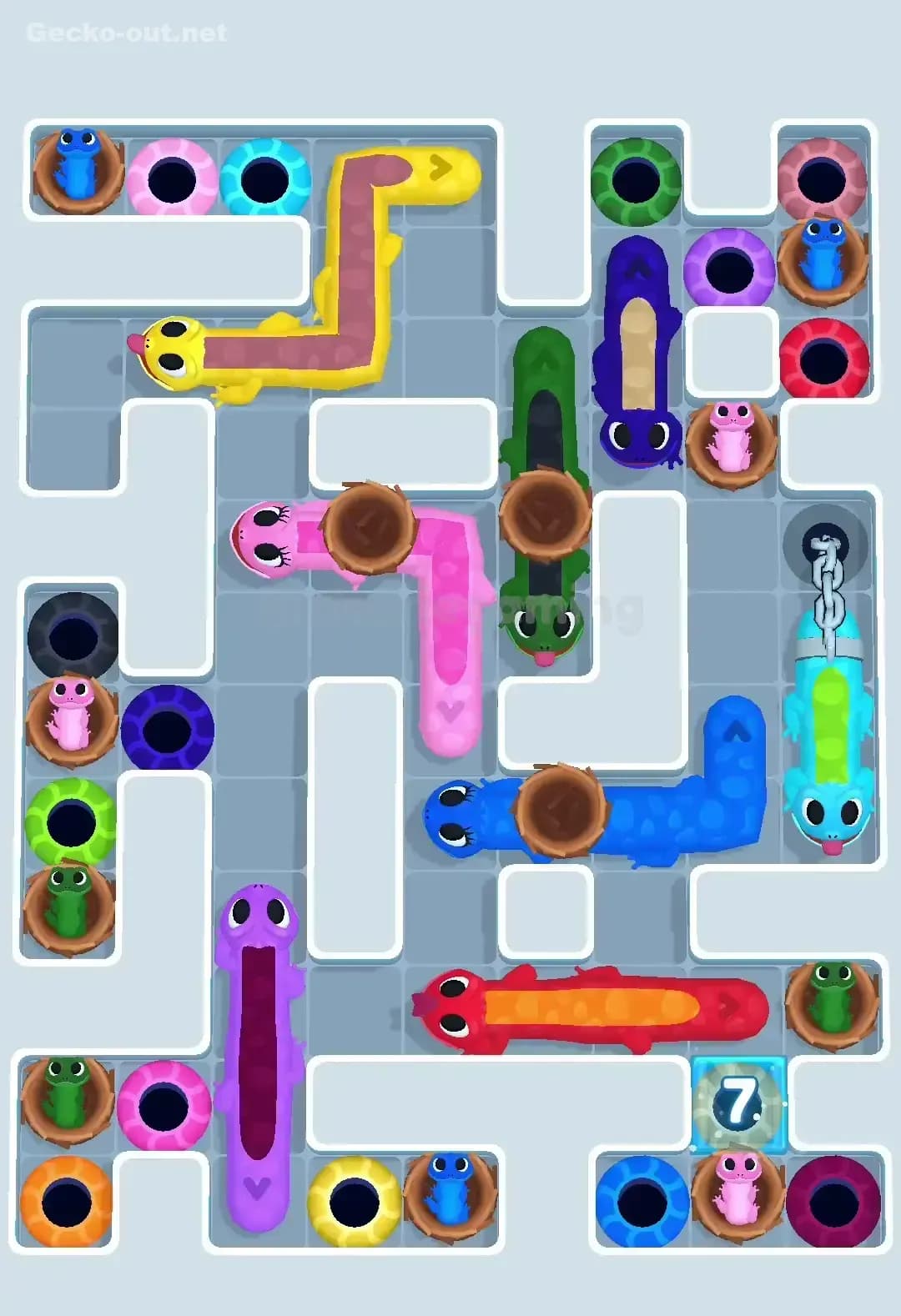
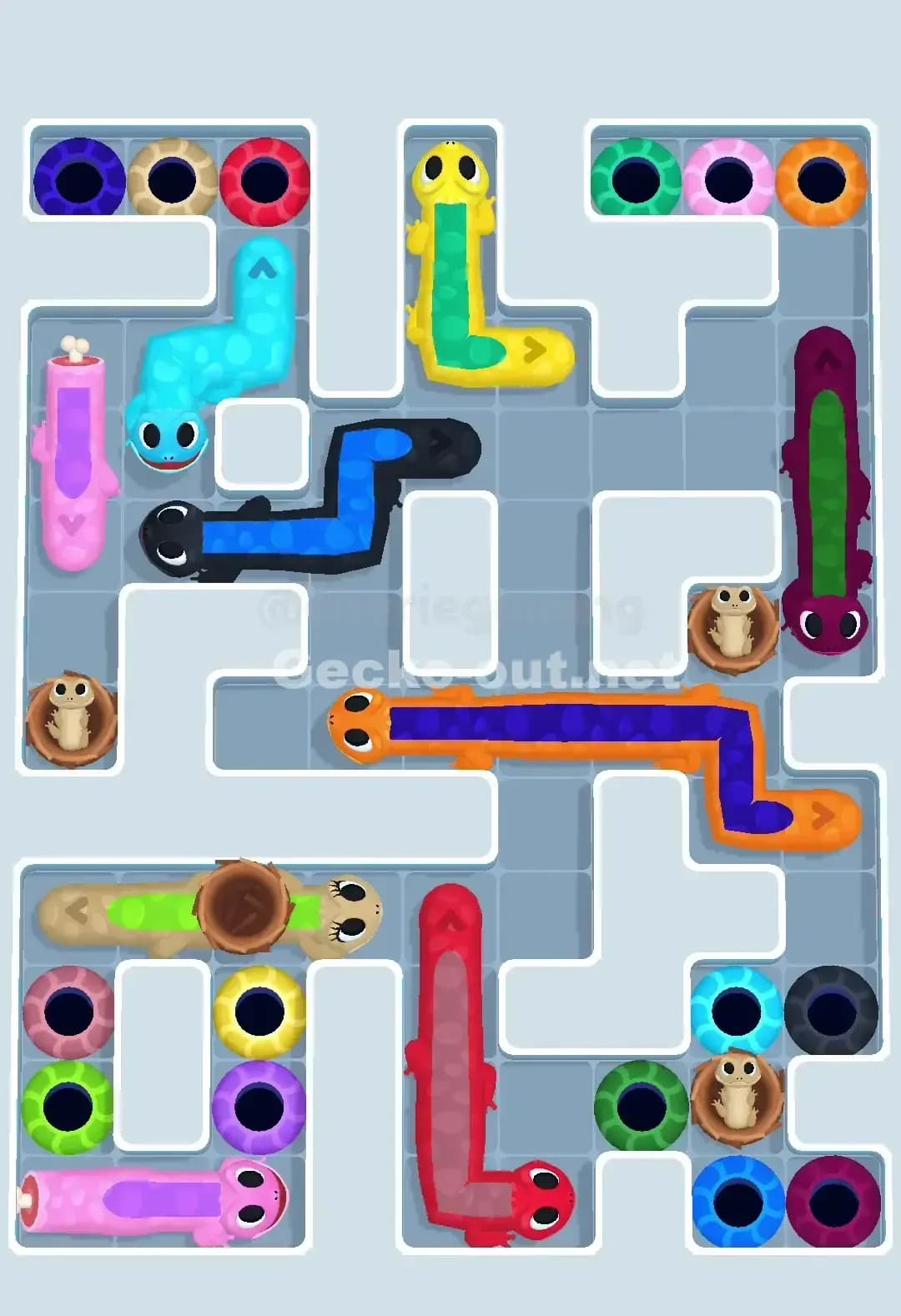
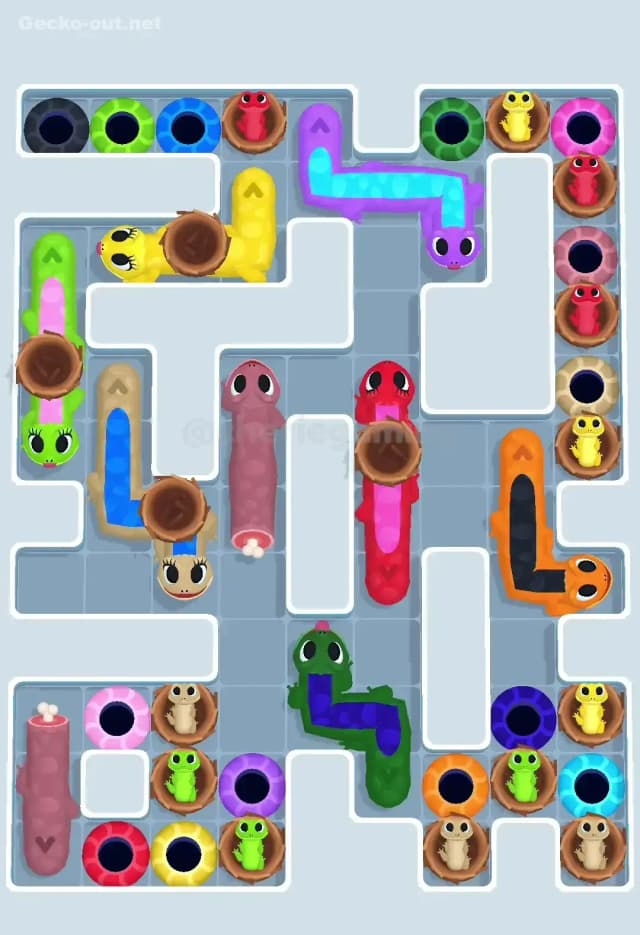
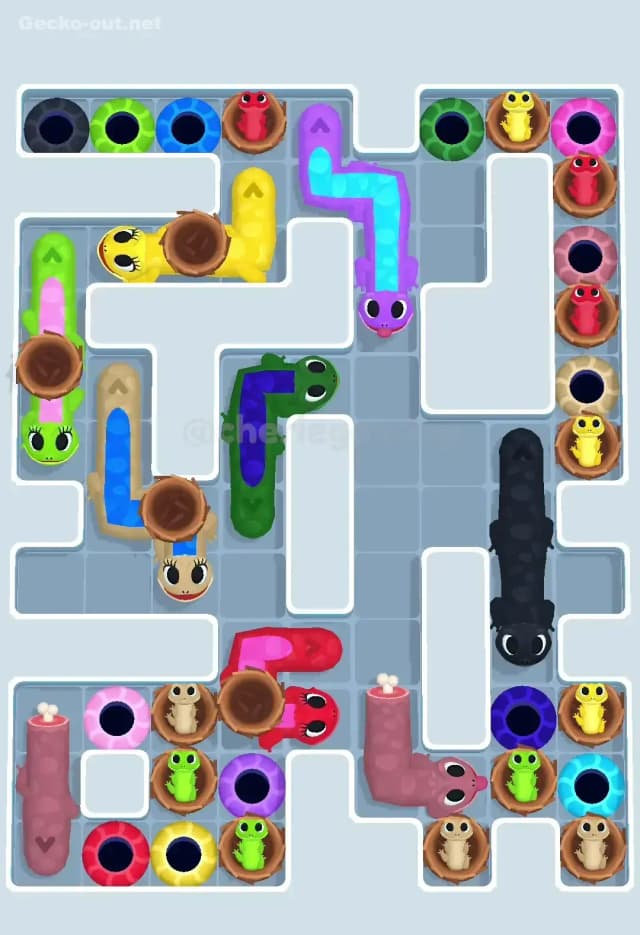
Gecko Out Level 646 presents one of the game's most intricate knot puzzles to date. You're working with a densely packed grid featuring eight geckos spread across the board in various colors: green, yellow, red, purple, orange, blue, pink, and tan. The initial setup shows these geckos already intertwined in several problem areas, with their bodies creating natural barriers that block multiple exit paths simultaneously. The brown circular holes scattered around the perimeter represent your target exits—each gecko needs to reach its matching color hole to complete Gecko Out Level 646.
What makes this configuration particularly challenging is the presence of several long-bodied geckos whose current positions create unavoidable choke points. The yellow gecko on the left side and the purple snake-like gecko in the upper-middle section immediately stand out as potential blockers. Meanwhile, shorter geckos are tucked into corners and edges, meaning you can't simply clear them first and work inward. The white wall sections create fixed corridors that force specific pathing choices, and there's very little "breathing room" on this board.
Win Condition and Movement Mechanics
To beat Gecko Out Level 646, you must guide every single gecko to its color-matched exit hole before the timer expires. The timer is unforgiving here—you'll have roughly 60-90 seconds depending on difficulty settings, which sounds generous until you realize how many repositioning moves are required. The core mechanic remains drag-based: you touch a gecko's head and draw a path across empty grid squares. The gecko's body follows that exact route, segment by segment, meaning every turn and loop you create becomes permanent until you move that gecko again.
This body-follow rule is what transforms Gecko Out Level 646 from a simple matching puzzle into a genuine spatial logic challenge. If you drag a gecko's head through a corridor without thinking about where its tail will end up, you can accidentally block an exit or trap another gecko entirely. The timer adds pressure, but rushing leads to sloppy paths that create new tangles. Success requires visualizing the full path—head to tail—before committing to any move.
Pathing Bottlenecks and Logical Traps in Gecko Out Level 646
The Primary Bottleneck: Center-Board Congestion
The single biggest obstacle in Gecko Out Level 646 is the traffic jam forming in the center and upper-middle sections. The purple gecko currently snakes through a critical intersection that at least three other geckos need to cross to reach their exits. If you try to clear the top-row geckos first without repositioning purple, you'll create an impossible knot where bodies overlap and no one can move. Similarly, the yellow gecko on the left occupies a vertical corridor that serves as the only clean path for the green gecko below it.
This bottleneck isn't immediately obvious because the geckos aren't technically overlapping yet—they're just positioned in ways that will cause overlaps the moment you start moving them. The pink gecko in the lower-left corner needs to travel upward, but both the green and yellow geckos are currently blocking its route. It's a three-way dependency that requires solving in reverse order of how the board appears.
Subtle Problem Spots That Sabotage Late-Game Moves
Beyond the central congestion, Gecko Out Level 646 hides several smaller traps. The red gecko in the middle-right area has a relatively short path to its exit, which tempts you to clear it early. However, moving red too soon blocks the escape route for the orange gecko at the bottom-right, whose exit is tucked behind a wall section. You need orange to move first, which means red has to wait or take a temporary detour.
Another deceptive spot involves the tan and green geckos at the bottom. Their holes are close together, but their starting positions mean their bodies will cross paths if you take the "obvious" direct routes. One of them needs to loop around the long way, adding precious seconds to your timer. The upper-right section also presents a false opening—there's space that looks like a safe staging area, but it's actually part of the required exit path for the blue gecko.
The Frustration Factor and the Breakthrough Moment
I'll be honest: Gecko Out Level 646 had me stuck for a solid twenty minutes on my first attempt. Every solution I tried ended with two or three geckos hopelessly tangled in the lower-left quadrant, their bodies forming an impossible braid. The breakthrough came when I stopped trying to clear geckos in color order or by proximity to exits. Instead, I started identifying which gecko was the "keystone"—the one whose removal would unlock multiple other moves. In this case, that's the yellow gecko. Once you get yellow safely out of the way (not necessarily into its hole immediately), suddenly the left side of the board opens up and you can choreograph a smooth sequence for green, pink, and the others.
Turn-by-Turn Path Strategy to Beat Gecko Out Level 646
Opening Moves: Establishing Control of the Left Corridor
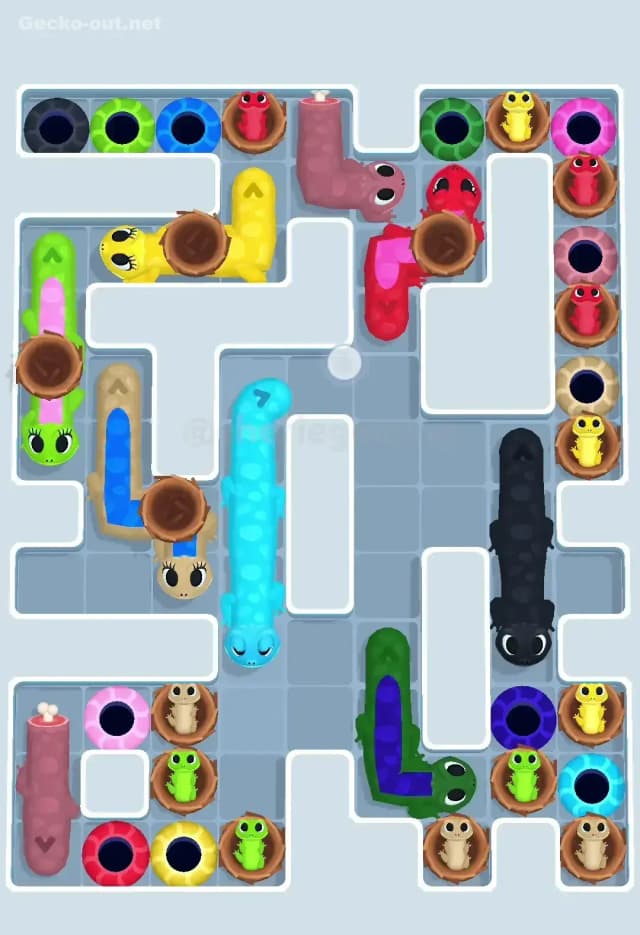
Start Gecko Out Level 646 by addressing the left side bottleneck immediately. Your first move should focus on the yellow gecko: drag its head downward and then curve it toward the bottom-left area, creating a temporary holding position that clears the vertical corridor. Don't send yellow to its exit yet—you're just parking it out of the way. This single move is critical because it frees up the green gecko below, which can now travel upward without interference.
Next, guide the green gecko in the lower-left section. Draw a path that takes it up through the now-empty corridor, loops it around the top-left section, and delivers it to its green exit hole near the top of the board. With green cleared, you've removed one body from the equation and opened more space. Now bring the pink gecko out from the lower-left corner—it has a relatively direct path upward and rightward to its pink exit in the middle-left area. These three moves establish board control and prevent the left side from becoming a permanent traffic jam.
Mid-Game: Managing the Central Tangle and Creating Exit Lanes
With the left quadrant under control, Gecko Out Level 646 shifts to the central and right-side geckos. The purple gecko in the upper-middle needs to move next. Draw a path that guides purple's head toward the right side of the board, carefully threading through the available corridors without crossing over any remaining geckos. Purple's body is long, so visualize the full sweep before committing—you want it to snake along the top edge and then drop down toward its purple exit on the right.
The orange gecko at the bottom-right should be your next priority. This one requires precision because its exit is partially blocked by wall segments. Drag orange's head upward first, creating an L-shape or gentle curve that positions its body along the right edge. Once orange is either in its hole or staged safely nearby, you can finally move the red gecko. Red has been waiting patiently in the middle-right area; now it has a clear shot to its red exit without blocking anyone else's path.
End-Game: Final Exits and Timer Management
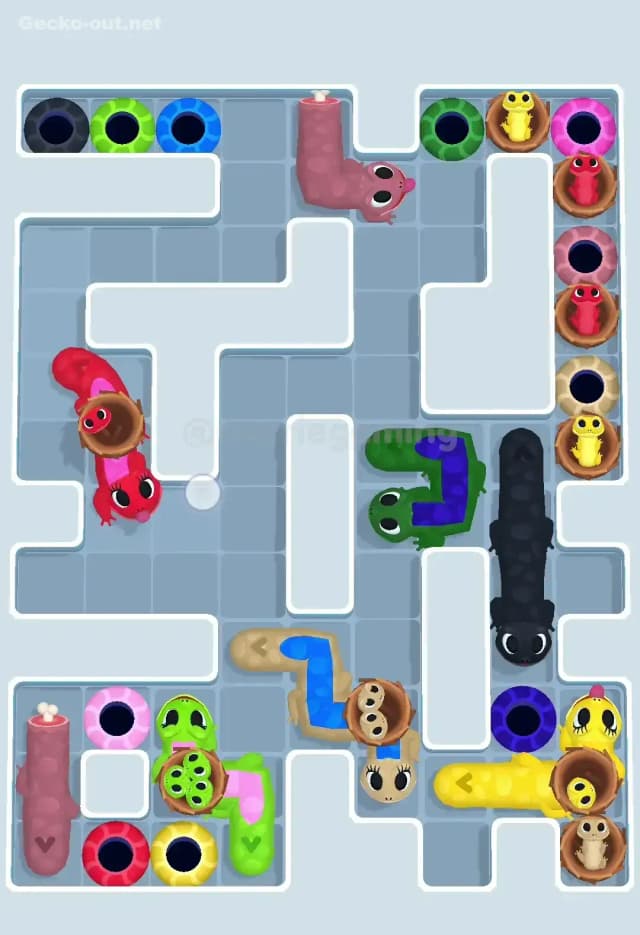
By this point in Gecko Out Level 646, you should have four or five geckos successfully exited, with three or four remaining. The yellow gecko (which you parked earlier) can now complete its journey to the yellow exit—there's plenty of open space for a clean path. The blue gecko, tan gecko, and any others left should have straightforward routes now that the major bottlenecks are cleared. Focus on the closest exits first to save time, but verify that each path doesn't accidentally cut off the final gecko's escape route.
If your timer is running low (under 15 seconds), resist the urge to panic-drag. One careful, correct path is better than three rushed ones that create new overlaps. Watch the body segments as they follow the head—if you see a tail curling into a space you need, pause and adjust the path. Gecko Out Level 646 gives you just enough time to execute this plan cleanly, but there's no room for backtracking or undoing multiple mistakes.
Why This Path Order Works in Gecko Out Level 646
Leveraging Body-Follow Mechanics to Untangle the Knot
The strategy outlined above succeeds because it respects the fundamental rule of Gecko Out: the body follows the head's exact path. Many players approach Gecko Out Level 646 by trying to move geckos "out of the way" without considering where their tails will land. This creates secondary tangles that are often worse than the original problem. By deliberately parking the yellow gecko in a specific temporary position, you're using its body as a controlled element rather than letting it become a random obstacle.
Similarly, clearing the green and pink geckos early isn't just about reducing the total number of geckos on the board—it's about removing long bodies from high-traffic corridors. Every gecko you successfully exit means fewer body segments occupying critical squares. The sequence matters because Gecko Out Level 646 has multiple dependency chains: gecko A blocks gecko B, which blocks gecko C. Solving out of order breaks these chains in the wrong direction, multiplying your problems.
Timer Management: When to Think and When to Commit
Gecko Out Level 646 demands a balanced approach to the timer. You need to spend the first 10-15 seconds reading the board and identifying the keystone gecko (yellow, in this case). Don't touch anything during this planning phase—just visually trace potential paths and look for conflicts. Once you've committed to a sequence, execute the first three or four moves relatively quickly. These are your foundation moves, and they're low-risk because you've already planned them.
The mid-game is where you slow down slightly. As you guide purple and orange, take an extra second to ensure their body paths are clean. A single misplaced segment here will cost you 20+ seconds of undoing and rerouting. The end-game accelerates again—by the time you're down to the final two or three geckos, the board is mostly clear and you can move swiftly. If you follow this rhythm, Gecko Out Level 646's timer becomes a manageable constraint rather than a panic-inducing countdown.
Booster Usage: Optional but Helpful for New Players
Technically, you can beat Gecko Out Level 646 without boosters if you execute the path sequence correctly. However, if you're struggling with the timer, consider using the "+30 seconds" booster at the start of the level. This gives you breathing room to plan and execute without the mid-game panic that leads to mistakes. Alternatively, the "hint" booster can highlight the correct first move (usually the yellow gecko repositioning), which is valuable if you're stuck on which gecko is the keystone.
Avoid using the "shuffle" or "undo" boosters unless absolutely necessary—they're better saved for higher levels where boards have additional mechanics like frozen exits or gang geckos. Gecko Out Level 646 is a pure pathing puzzle, so the solution is consistent and learnable. Once you've internalized the yellow-green-pink opening sequence, you can replicate it reliably without booster support.
Mistakes, Fixes, and Logic You Can Reuse in Other Gecko Out Levels
Common Errors That Block Your Progress
The most frequent mistake on Gecko Out Level 646 is moving the red gecko too early. It looks like an easy clear because the path seems short, but doing so blocks the orange gecko's only viable exit route. If you've already moved red and realized your error, drag it completely off to the side (even into a weird position) to reopen the corridor, clear orange, then bring red back for a second attempt. It wastes time but prevents a full board reset.
Another classic error is dragging the green gecko directly toward its exit via the shortest path, which causes its body to curl through the space needed by pink. The fix: always route green along the outer edge first, then curve it inward toward the exit. This uses more grid squares but keeps critical corridors open. Similarly, players often forget that purple's body is long and try to move its head in a straight line—this creates a diagonal body segment that bisects the board. Always give purple a curved, sweeping path that follows the board's natural corridors.
A third mistake involves the yellow gecko's parking position. If you move yellow downward but don't curve it enough to the left, its tail blocks the bottom-left corridor where pink needs to travel. The correct parking spot is the very corner of the lower-left quadrant, with yellow's body forming an L-shape that maximizes open space.
Applying This Strategy to Similar Levels
The keystone-identification method used in Gecko Out Level 646 is applicable to dozens of other high-difficulty levels. Whenever you encounter a dense knot, spend 10 seconds identifying which gecko's removal creates the most new options. This is usually (but not always) the longest gecko positioned in a central corridor. Levels in the 600s and 700s frequently use this design pattern, so mastering it here pays dividends later.
The "parking" technique—moving a gecko to a temporary safe position instead of immediately exiting it—is also reusable. Any level with tight corridors and multiple long-bodied geckos will benefit from this approach. You're essentially creating a movable staging area, which is far more flexible than trying to exit geckos in their current positions.
Finally, the timer management rhythm (plan, execute foundation, slow mid-game, fast end-game) works universally. Gecko Out's timer is designed to be tight but fair—you have exactly enough time if you avoid backtracking. Internalizing this rhythm reduces the anxiety that causes rushed mistakes.
Final Thoughts on Gecko Out Level 646
Gecko Out Level 646 sits firmly in the "difficult but fair" category. It doesn't rely on hidden mechanics or luck—every failure is a pathing logic error that you can diagnose and fix. The level tests your ability to visualize body-follow movement, identify bottleneck geckos, and execute a sequence under time pressure. It's genuinely challenging, and you shouldn't feel bad if it takes multiple attempts. Once the yellow-as-keystone insight clicks, though, the level becomes almost mechanical. You'll find yourself breezing through it on future replays, wondering why it ever felt so hard. Stick with the turn-by-turn strategy above, watch those tail segments, and Gecko Out Level 646 will absolutely fall. You've got this.