Gecko Out Level 1075 Solution Walkthrough | Gecko Out 1075 Answer
How to solve Gecko Out level 1075? Get step by step solution & cheat for Gecko Out level 1075. Solve Gecko Out 1075 easily with the answers & video walkthrough.


Gecko Out Level 1075: Board Layout, Rules, and Win Condition
Understanding the Starting Board in Gecko Out Level 1075
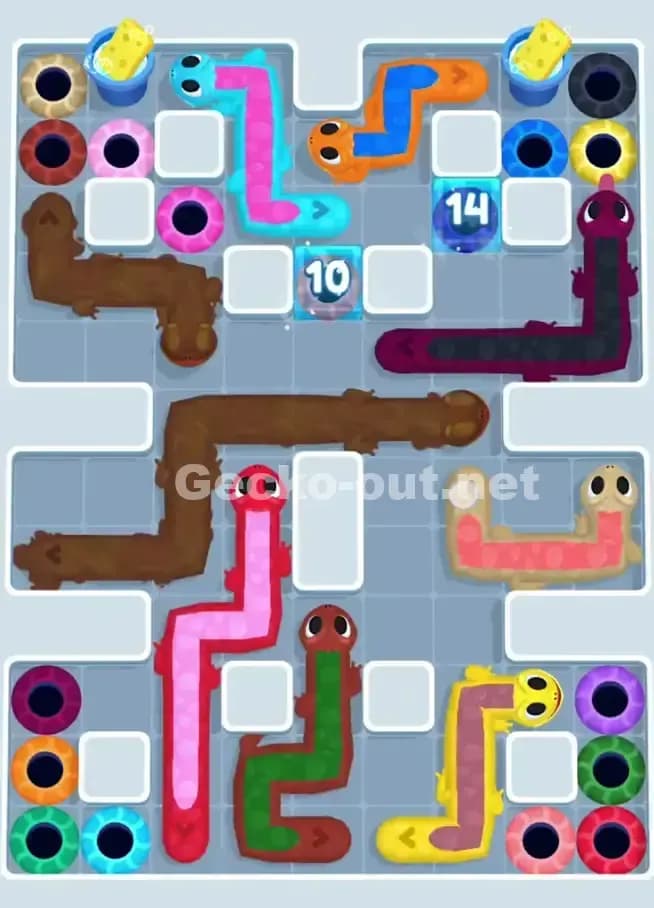
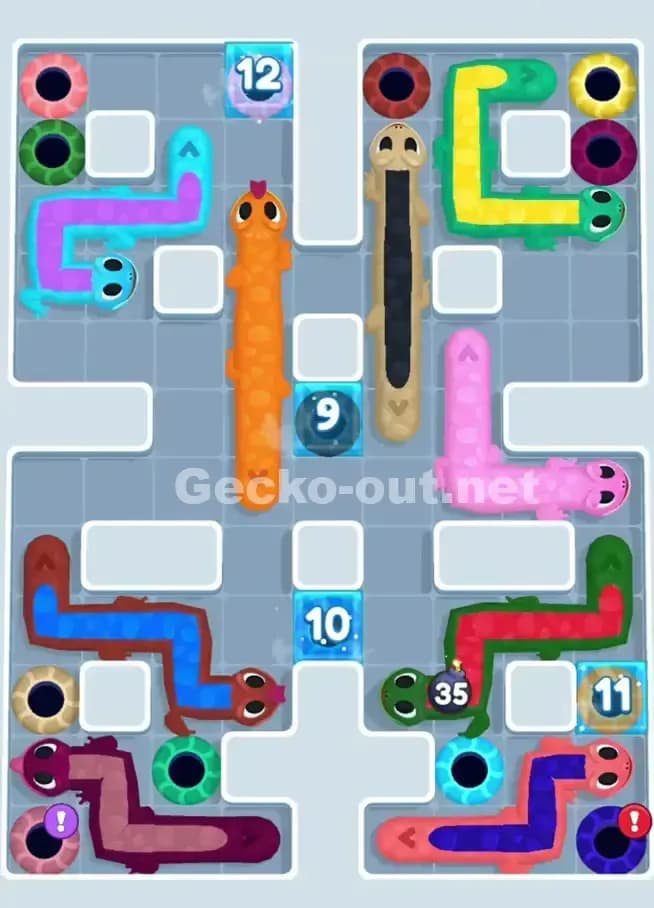
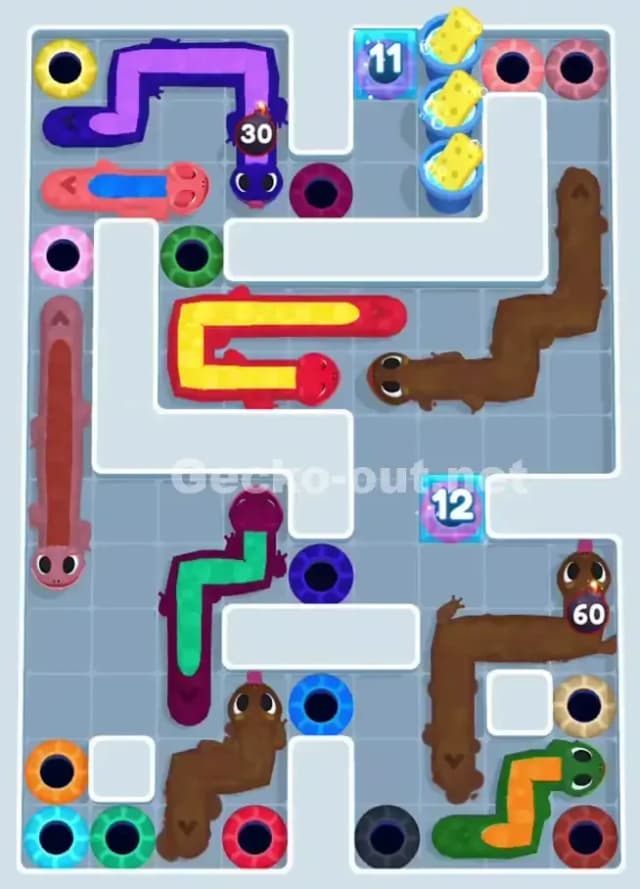
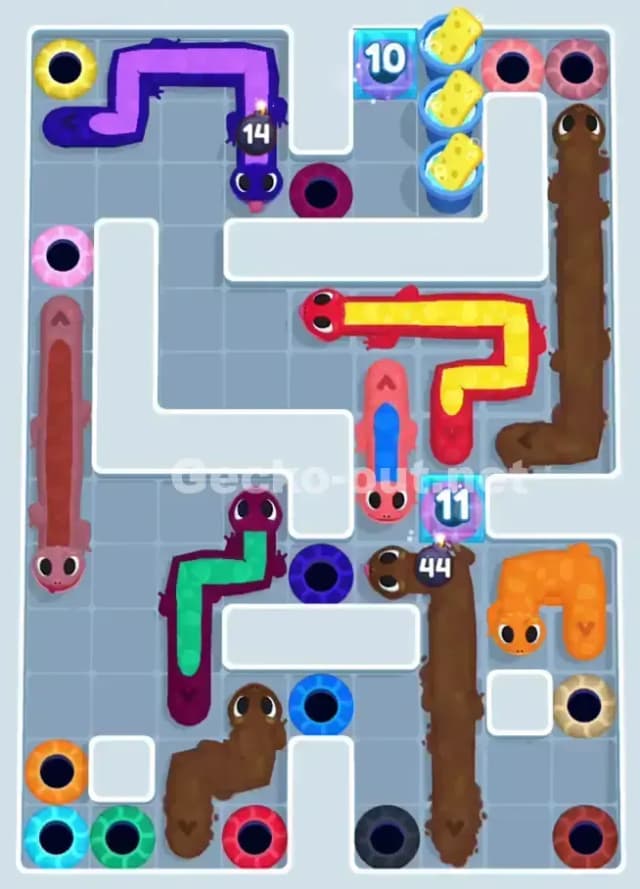
Gecko Out Level 1075 is a densely packed puzzle with six geckos of different colors scattered across a vertical, winding board. You'll see a purple gecko in the upper left, a red-and-blue gang gecko in the upper-middle area, a pink gecko on the left side, a long red gecko stretching down the left column, multiple brown geckos positioned throughout the middle and lower sections, and a green gecko in the bottom right. Each gecko has a matching-colored hole (or set of holes) that serves as its escape route. The board is crammed with white wall barriers that create narrow corridors and forced pathways, making this level feel like a real estate puzzle where every square inch matters.
Win Condition and Timer Pressure in Gecko Out Level 1075
Your job is simple in theory but brutal in execution: drag each gecko's head to guide its body through the maze and into its matching-colored hole before the timer runs out. Gecko Out Level 1075 gives you a fairly tight time window—around 60 seconds or so depending on your device—which means you can't afford to make multiple mistakes or spend time backtracking. Every gecko's body must follow the exact path you drag its head along, so if you accidentally create a route that loops back on itself or blocks another gecko's lane, you've just wasted precious seconds and board space. The level is won only when all geckos have escaped; if even one remains when the clock hits zero, you fail and must restart.
Pathing Bottlenecks and Logical Traps in Gecko Out Level 1075
The Critical Bottleneck: The Red Gecko's Descent
The single biggest chokepoint in Gecko Out Level 1075 is the long red gecko occupying the entire left column. This gecko is essentially a wall unto itself—its body stretches so far down the board that it can block access to multiple holes and force other geckos into awkward detours if you don't exit it early. The red gecko must be one of your first moves, because as long as it's on the board, it's consuming valuable real estate that other geckos desperately need. I remember staring at this level thinking, "How am I supposed to move anything when that red snake is taking up half the left side?" The answer is brutal honesty: you move the red gecko first, or you'll regret it.
Hidden Trap 1: The Purple Gecko's Upper-Left Tangle
The purple gecko in the upper left looks deceptively simple, but its hole is tucked away in a way that forces you to navigate around the yellow center zone. If you drag its head too aggressively to the right, you'll crash into the gang gecko or create a path that blocks the exit corridor for other pieces. The real trap here is thinking you can solve it quickly—you can't, and if you rush, you'll paint yourself into a corner.
Hidden Trap 2: The Brown Gecko Multi-Zone Problem
There are several brown geckos at different positions on the board, and they don't all have obvious exit routes. Some brown holes are in the upper right, others in the lower right, and some brown geckos are positioned so tightly against walls that a single misstep sends them into a dead end. Worse, these brown geckos can block each other if you're not careful about the order you move them. I didn't appreciate how much this level rewards systematic thinking until I realized I'd accidentally locked three geckos into collision courses just by solving one path carelessly.
Hidden Trap 3: The Gang Gecko's Frozen Exit
The red-and-blue gang gecko (or any "linked" pair) moves as one unit, so their combined body length is even more dangerous than a single gecko. If you don't plot their path with extreme care, they'll wedge themselves into a space where one head can reach the exit but the body can't follow. That's an instant lose state.
Turn-by-Turn Path Strategy to Beat Gecko Out Level 1075
Opening: Prioritize and Park
Start by dragging the long red gecko out first. This is non-negotiable. Drag its head downward through the left corridor, curve it carefully to find its red hole, and commit fully to this move. Once it's gone, you've reclaimed the entire left column as usable space. Next, tackle the pink gecko on the left side—it's relatively short and its hole is accessible, so moving it early keeps your options open and prevents it from becoming an accidental blocker later. For the remaining geckos, resist the urge to move them randomly. Instead, "park" them mentally: identify which geckos are least likely to move and leave them alone while you clear high-traffic corridors.
Mid-Game: Unlock the Center Lanes
Once the left column is clear, you have breathing room. Now focus on the gang gecko (red-and-blue pair) in the upper-middle area. Trace a careful path for its head: it needs to navigate around the yellow center zone and thread through the available corridors to reach its exit hole in the upper right. This move is slower and more deliberate than the red gecko opening, so don't rush it. While you're planning this path, keep an eye on the purple gecko—if you haven't moved it yet, now's the time to commit to dragging it leftward and downward, following the wall contours until it reaches its hole.
The brown geckos in the middle and lower sections are your next priority. Tackle the easiest one first—usually the one closest to an obvious exit—to build momentum and clear space. Each brown gecko you successfully remove opens up new pathways for the remaining pieces. If a brown gecko is tightly packed against walls, be extra methodical: trace your finger slowly along its intended path before you commit, imagining the body following the head perfectly.
End-Game: The Final Stretch and Avoiding Last-Second Chaos
With three or four geckos still on the board, you're under real time pressure. The green gecko in the bottom right is often the last to move, but don't ignore it completely—keep track of where its hole is and whether any other gecko's path would accidentally block it. Your second-to-last gecko should be chosen based on which movement opens the most space for the final escape. If you're running low on time (under 20 seconds), don't panic; move decisively but carefully. A slow, accurate drag beats a fast, sloppy one every time.
For your final gecko, you should have a clear lane to its hole with no obstacles. If you don't, you made an error earlier, but don't give up—restart and apply what you've learned. The last gecko should feel like a victory lap, not a white-knuckle scramble.
Why This Path Order Works in Gecko Out Level 1075
Leveraging Head-Drag and Body-Follow Mechanics
The reason this strategy works in Gecko Out Level 1075 is rooted in how the game engine functions. When you drag a gecko's head, the body follows exactly the path your finger traces—it doesn't take shortcuts or reroute itself. This means that by moving the longest geckos first, you're establishing your "physical map" early. Once the red and pink geckos are gone, the board is no longer a Tetris nightmare; it's a set of open corridors where the remaining geckos can move more freely. The gang gecko and brown geckos, while still requiring careful pathing, aren't constantly colliding with the massive red gecko that was eating up space. This order transforms chaos into a series of smaller, solvable puzzles.
Timing: Pause and Read vs. Commit and Move
Gecko Out Level 1075 gives you roughly 60 seconds, which sounds like plenty until you realize how many drag operations you need to perform. My advice is to spend the first 10–15 seconds reading the board, identifying the red and pink geckos, and mentally planning their exits. Don't move yet; just look. Then, commit fully to the red gecko move—don't second-guess yourself mid-drag. The whole operation should take 8–12 seconds. Once that's done, you've proven you understand the board, and the remaining 40-ish seconds will feel more manageable. If you find yourself with 30 seconds left and still three geckos on the board, you're on pace. If it's tighter than that, accept that you might need a second attempt, and use that attempt to refine your timing.
Booster Strategy for Gecko Out Level 1075
Boosters (extra time, hints, or special tools) are optional on Gecko Out Level 1075, not required. If you're struggling after two or three genuine attempts, a Time Booster is your best friend—it extends the timer by 15–20 seconds, which gives you the breathing room to recover from small hesitations. A Hint Booster isn't as useful here because the solution is logical, not hidden. A Hammer Tool could help if a specific gecko is truly stuck, but ideally, you won't need it. My recommendation: solve Gecko Out Level 1075 without boosters first. The satisfaction of cracking it clean is worth the extra attempts.
Mistakes, Fixes, and Logic You Can Reuse in Other Gecko Out Levels
The Five Most Common Mistakes on Gecko Out Level 1075
Mistake 1: Delaying the Red Gecko. Players often try to "solve" other geckos first, thinking they can dodge the red gecko's space. They can't. The fix: move it immediately, no exceptions.
Mistake 2: Dragging Too Fast Without a Plan. Speed feels good, but it leads to sloppy paths that block other geckos. The fix: trace your intended path with your eyes first, then drag slowly and steadily.
Mistake 3: Forgetting the Gang Gecko Occupies Space with Two Heads. A gang gecko's exit must accommodate both its length and its width (it's often thicker or more complex than a single gecko). The fix: test the path mentally by "walking" both heads through the corridor simultaneously.
Mistake 4: Parking Geckos in Traffic Lanes. Some players accidentally leave a gecko's final resting position slightly protruding into a corridor, creating an obstacle for the next gecko. The fix: verify that every "solved" gecko is completely out of bounds—its hole should be off the playable grid.
Mistake 5: Running Out of Time on the Last Two Geckos. The final two geckos feel urgent, so players rush and make errors that force a restart. The fix: maintain steady pacing throughout the level; if you're on track with four geckos remaining at the 30-second mark, you're fine.
Reusable Logic for Other Gecko Out Levels
The principle of "move the longest or most-constrained gecko first" applies to many Gecko Out levels, especially those with gang geckos or multiple long pieces. If a level has a frozen exit or a toll gate that affects one gecko, prioritize unfreezing or clearing that lane before moving other pieces, because the freed-up space will be invaluable for the rest of the level. When you encounter tight corridors or bottlenecks, ask yourself: "Which gecko, if removed, opens the most space for others?" That's your target.
Gecko Out Level 1075 teaches you that visual planning (looking before dragging) is faster than trial-and-error in the long run. Many players think real-time speed is the goal, but on a puzzle like this, strategic thinking beats reflexes.
Final Encouragement
Gecko Out Level 1075 is genuinely tricky, and there's no shame in needing a few attempts. The good news is that once you recognize the red gecko bottleneck and commit to clearing it first, the level becomes dramatically more solvable. You've got the tools, the time, and now the strategy. Go out there, trust your planning, and get those geckos to safety. You've got this!