Gecko Out Level 137 Solution Walkthrough | Gecko Out 137 Answer
How to solve Gecko Out level 137? Get step by step solution & cheat for Gecko Out level 137. Solve Gecko Out 137 easily with the answers & video walkthrough.




Gecko Out Level 137: Board Layout, Rules, and Win Condition
How the Board Looks and What’s Special Here
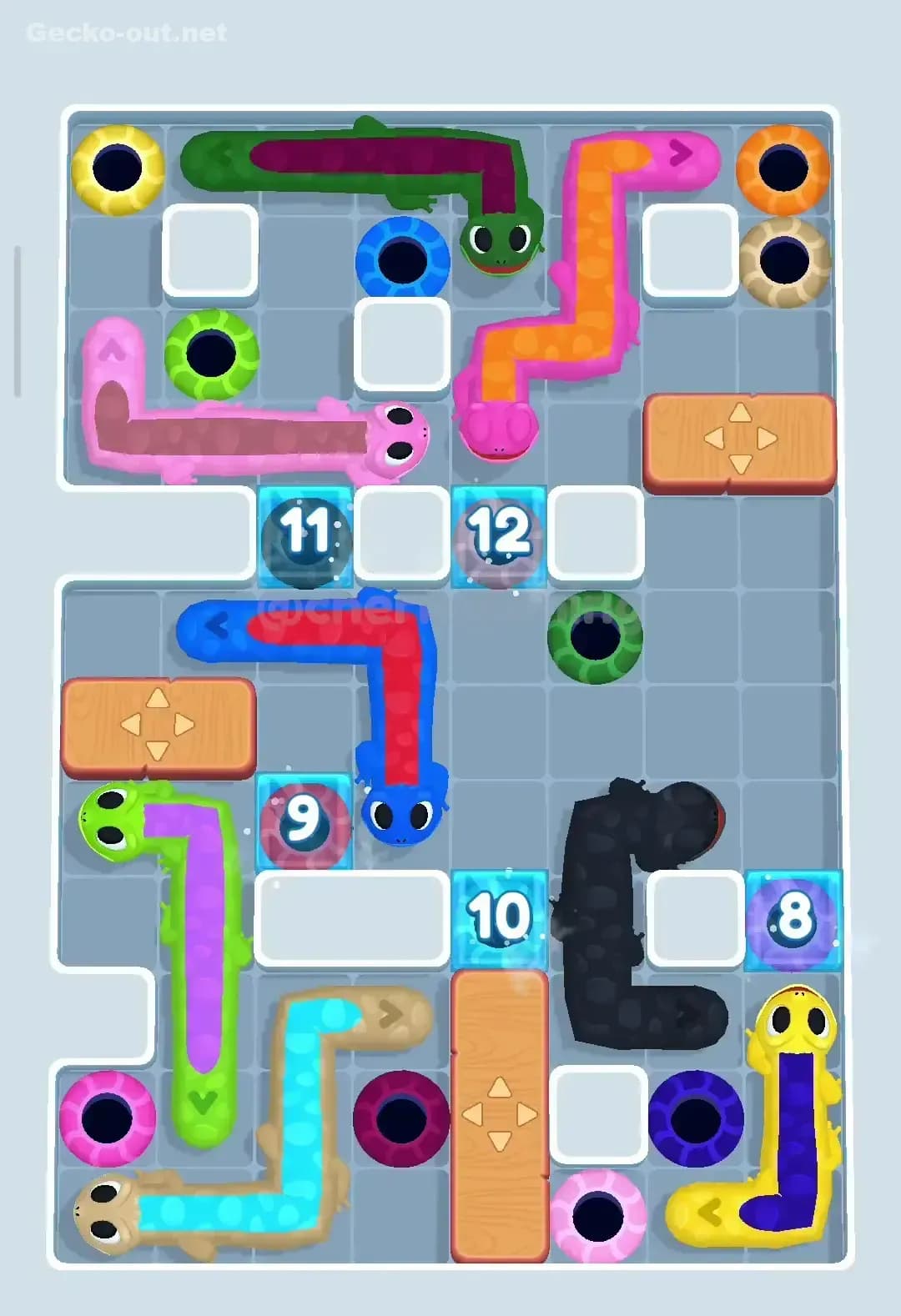
In Gecko Out Level 137 you start with a tight bottom row of eight geckos shoulder‑to‑shoulder. From left to right you have: orange, light blue, purple, pink, lime green, brown, teal/green, and red. They’re all the same length, and there are no split “gang” bodies or frozen geckos here—just a pure pathing puzzle.
Above them is a stepped, pyramid‑shaped arena with open tiles in the middle and five two‑colored holes along the top edge. Each hole has:
- A visible ring color (the active hole color now).
- A little exclamation marker in a different color showing what the next hole color will be once this one is used.
The tutorial text on Gecko Out 137 explains it directly: the exclamation color is the next hole that will appear after you fill the current one. So each two‑colored hole is effectively a pair of exits you trigger in sequence: first the visible ring color, then its partner color that spawns later.
There are no walls or toll gates slicing up the center of the board, but because eight geckos all start in a straight line, the board feels cramped from the first second. Any long, loopy path you draw will snake a thick body through the middle and cut off lanes for everyone else.
Win Condition and Why the Timer Matters So Much
The win condition in Gecko Out Level 137 is straightforward: guide each gecko into a hole that matches its color (including the second‑phase colors that appear after you trigger the two‑colored holes) before the timer runs out. You can’t clip a corner, cross a different gecko’s path, or pass through a hole that’s the wrong color.
The twist is how head‑drag pathing interacts with the timer:
- Your route is exactly the body’s route. If you draw a big S‑curve, the whole body will occupy those tiles.
- Every path takes real‑world time to draw, then more time for the gecko to slither along it.
- If you realize too late that you’ve blocked a lane, there’s usually not enough time to redraw long paths for multiple geckos.
So Gecko Out 137 isn’t about making one perfect fancy route; it’s about planning a short, efficient order of exits and using compact paths that keep the center of the board free as long as possible.
Pathing Bottlenecks and Logical Traps in Gecko Out Level 137
The Main Bottleneck: The Central Corridor
The single biggest bottleneck in Gecko Out Level 137 is the central vertical corridor that runs up from the middle geckos (pink and lime green) toward the top holes. Most geckos will have to pass through some part of that corridor to reach their matching exits or the second‑phase holes that appear later.
If you send a gecko up the middle and then turn sideways across the board, its body becomes a long wall that slices the arena in two. Any gecko trapped on the wrong side has to take a huge detour—if there even is one. That’s why I treat the central lane as “sacred space”: only short, direct climbs, no big sideways sweeps until the last two or three geckos.
Subtle Problem Spots That Catch You Off Guard
There are a few easy‑to‑miss traps specific to Gecko Out 137:
-
Using the wrong color first on a two‑colored hole.
If you absent‑mindedly send, say, the green gecko into a hole that’s currently pink‑ringed with a green exclamation, that exit simply won’t accept it. You lose time, and you might panic‑drag a messy path. -
Parking geckos horizontally in the middle.
It’s tempting to drag a gecko up, then park it sideways across the mid‑board as a “holding pattern.” That almost always blocks at least one other gecko’s ideal route and forces weird wrapping paths later. -
Overusing the bottom row as a parking strip.
If you leave three or four geckos half‑moved but still spanning the entire bottom, you remove your easiest escape lanes. The side geckos (orange and red) especially can either open the board or lock it up, depending on how quickly you clear them.
When the Level Finally Clicks
The first time I played Gecko Out 137 I tried to brute‑force it: drag whichever gecko looked closest to a matching color, spam paths, and hope. That always devolved into spaghetti bodies and a failed timer.
The “aha” moment came when I treated the two‑colored holes as a scripted sequence instead of five separate exits. Once I listed them as color pairs—“this top‑left hole is pink then orange, this next one is purple then green,” and so on—the level turned into a scheduling puzzle. After that, I focused on keeping the middle lane open and exiting geckos in a strict order. Suddenly Gecko Out 137 went from chaos to a neat, almost rhythmic solve.
Turn-by-Turn Path Strategy to Beat Gecko Out Level 137
Opening: First Moves and Safe Parking Spots
In the opening of Gecko Out Level 137, your goal is to create breathing room without drawing any wild paths.
I recommend:
-
Do a 3‑second scan.
Quickly read each two‑colored hole: note the visible ring color and the exclamation color. Mentally pair them with your geckos. -
Clear one side gecko immediately.
Usually the red or orange gecko has a fairly straight shot to a matching top hole or one that will soon match. Drag that gecko up the outer edge (hug the side wall), then curve into the hole with the shortest possible turn. Don’t cross into the middle yet. -
Park one central gecko vertically.
Take the pink or lime green gecko and drag it straight up two or three tiles, then leave it standing vertically, not bent sideways. This opens some gaps on the bottom row so the others can slip past later. -
Avoid horizontal lines in the middle.
Any gecko you move in the first 10 seconds should be either going directly to a hole or standing in a short vertical “parking column.”
Mid-game: Keeping Lanes Open and Managing Long Bodies
The mid‑game in Gecko Out 137 is where most runs die. The trick is to commit to an exit order that matches the two‑color sequence:
-
Follow the two‑color order strictly.
If a hole is pink with a green exclamation, make sure your pink gecko uses it before you worry about that future green exit. Don’t try to force the second color early. -
Work from the edges inward.
After one side gecko is gone, clear the other side next (the opposite edge color). Use the outermost vertical lane so their bodies hug the wall and don’t occupy central tiles. -
Reposition the middle pair last.
Keep the pink and lime geckos mostly vertical in the center until several exits are already used. When it’s time to route them, take the shortest possible S‑curve to their assigned holes, and avoid spirals. -
Use “half paths” as bookmarks.
If you know the teal gecko will later use a newly spawned exit, you can drag its head into a nearby vertical lane and leave it there. That way, when the new hole appears, you only need to add a short extension to complete the route.
End-game: Final Exit Order and Handling Low Time
In the end‑game of Gecko Out Level 137, you’ll usually have 2–3 geckos left and one or two newly spawned, second‑phase holes.
To close it out:
-
Exit any gecko already lined up with a hole.
If a gecko is standing in a column under its matching color, drag a quick straight path and cash that in. Don’t overthink it. -
Use remaining central space for the last long path.
Save the most awkward gecko (often brown or teal) for second‑to‑last, while the board still has enough room to snake a modest curve. The final gecko should have a clean, mostly straight line. -
Low on time? Prioritize shortest path, not perfect order.
If the timer’s red and you have a usable hole that matches one of your last geckos, take the simple path even if it isn’t the “ideal” sequencing you planned. The second‑phase hole will still appear; you just might need a slightly more crooked path for the final gecko.
Why This Path Order Works in Gecko Out Level 137
Using Body-Follow Rules to Untangle the Knot
The path order for Gecko Out Level 137 works because it respects the body‑follow rule:
- Vertical parking keeps bodies narrow and out of the way.
- Edge‑hugging paths turn geckos into harmless borders instead of central walls.
- Clearing side geckos early removes obstructions that would otherwise force everyone to bend sideways.
When you sequence exits to match each two‑colored hole’s first color, you avoid wasted motions where a gecko walks up to the wrong hole and has to retreat. You’re essentially “unlocking” the future holes while the board is still relatively empty.
Managing the Timer: When to Think vs. When to Move
In Gecko Out 137 you actually save time by pausing for a moment at the start:
- Spend the first 3–5 seconds reading the hole pairings.
- Spend the next 10–15 seconds executing three or four very clean, short paths.
- Only once the board is half‑cleared should you speed up and chain moves.
If you rush immediately, you’ll draw sloppy paths that you have to correct, which costs far more time than that initial planning pause.
Boosters: Optional, Not Required
Gecko Out Level 137 is absolutely beatable without boosters. That said:
- An extra‑time booster is most useful if you consistently reach the last two geckos but run out of seconds. Use it right at the start so you’re not panicking.
- A hammer/clear‑path type booster is overkill here; it’s better saved for levels with walls or gang geckos. If you must use it, target the most centrally blocking body late in the level.
But if you follow the pathing plan above, you shouldn’t need any power‑ups to clear Gecko Out 137.
Mistakes, Fixes, and Logic You Can Reuse in Other Gecko Out Levels
Common Mistakes on Gecko Out Level 137 and How to Fix Them
-
Mistake: Ignoring the exclamation colors.
Fix: Before moving anything, read every hole: “current color → exclamation color.” Plan who uses each first and second. -
Mistake: Drawing big spirals in the middle.
Fix: Keep all early paths as straight as possible, especially through the central corridor. Save fancy turns for the very end, when the board’s almost empty. -
Mistake: Parking multiple geckos horizontally.
Fix: Use vertical parking only. If you must turn, do a short L‑shape hugging an edge, not a long zigzag. -
Mistake: Clearing the central geckos first.
Fix: Clear one side, then the other. Leave the central pair for mid‑game when there’s an obvious route to their assigned holes. -
Mistake: Redrawing paths repeatedly.
Fix: Take a breath, visualize the full route, then draw it once. It’s faster to think for two seconds than to redraw for ten.
Reusing This Logic on Other Knot-Heavy Levels
The habits you build on Gecko Out 137 carry over to a lot of later Gecko Out levels:
- Treat multi‑stage or special holes as a sequence, not isolated exits.
- Protect a central “highway” until the last third of the level.
- Use edges for long bodies and center tiles for short, direct climbs.
- Park geckos in compact, vertical shapes while you work others around them.
Whenever you see a row of geckos crammed at the bottom and multiple special exits up top, you can basically replay the Gecko Out Level 137 mindset and you’ll have a huge advantage.
Final Encouragement
Gecko Out Level 137 feels chaotic at first because everything is moving through the same cramped corridors and the two‑colored holes add one more thing to track. Once you slow down, read the color pairs, and commit to clearing the sides first while keeping paths short and vertical, the whole level suddenly becomes calm and predictable.
Stick to that plan, avoid those big horizontal walls of gecko body, and you’ll see Gecko Out 137 flip from “impossible” to “oh, that was actually clean.” It’s a tough level, but it’s absolutely beatable—and once you nail it, the next knotty color‑combo stages will feel a lot less scary.