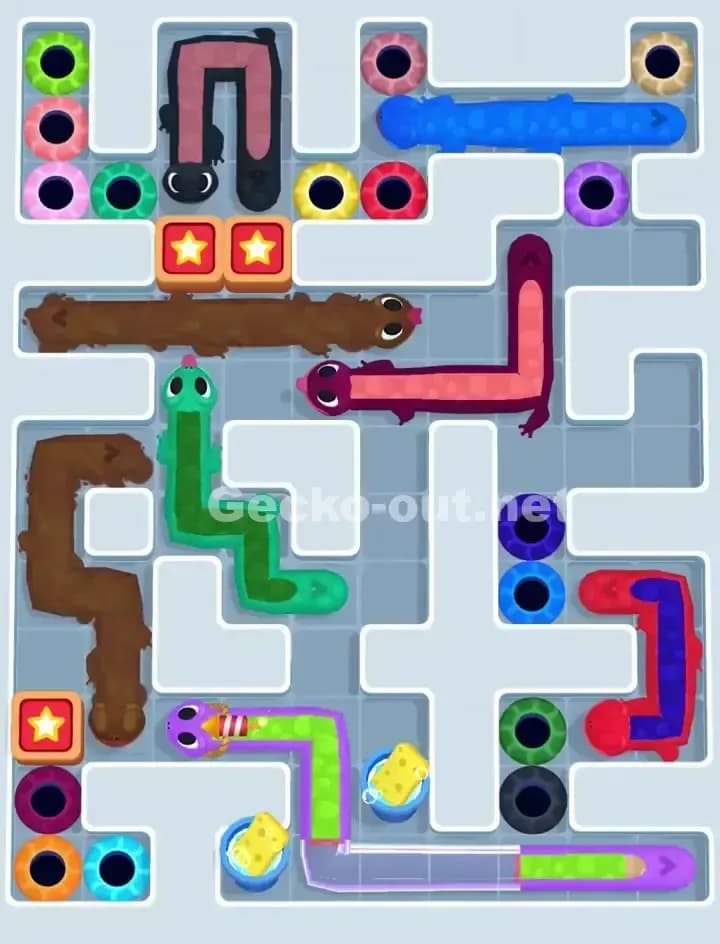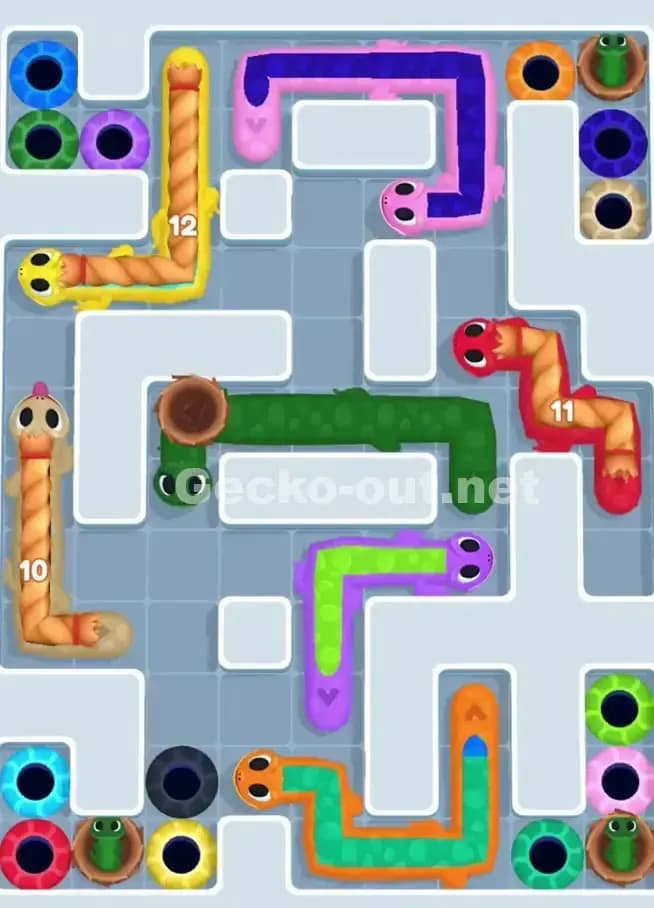
Gecko Out Level 1023 Solution Walkthrough | Gecko Out 1023 Answer
How to solve Gecko Out level 1023? Get step by step solution & cheat for Gecko Out level 1023. Solve Gecko Out 1023 easily with the answers & video walkthrough.
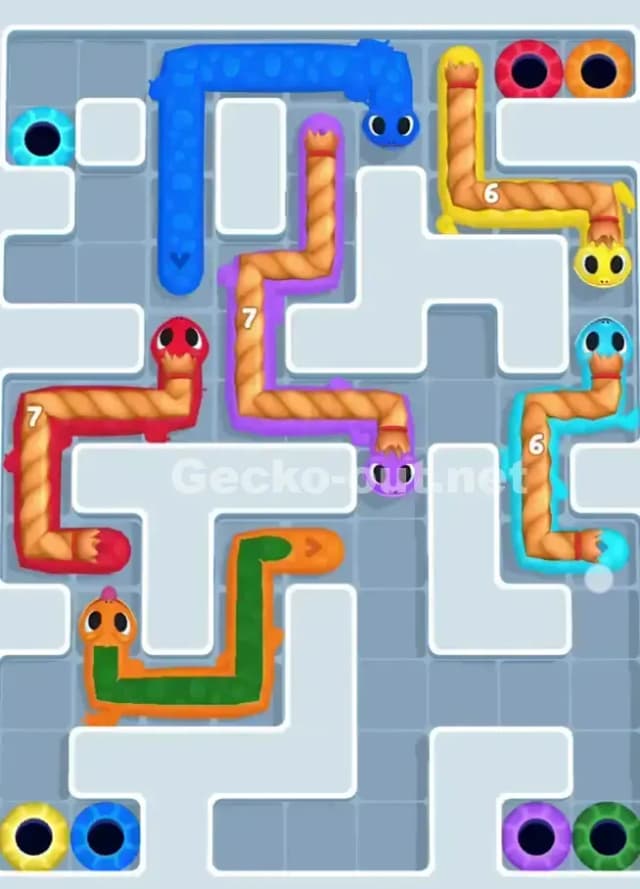
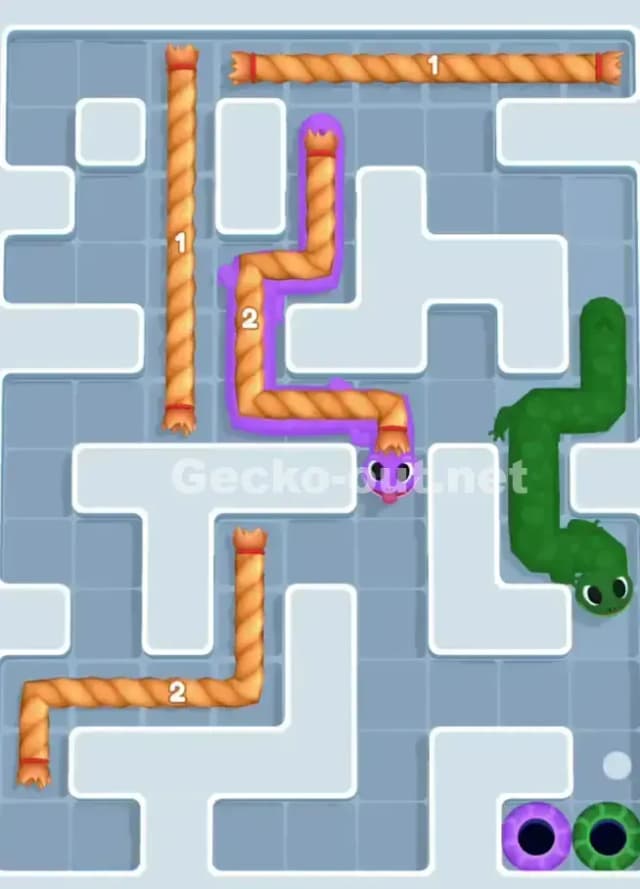
Gecko Out Level 1023: Board Layout, Rules, and Win Condition
Starting Board: Geckos, Colors, and Obstacles
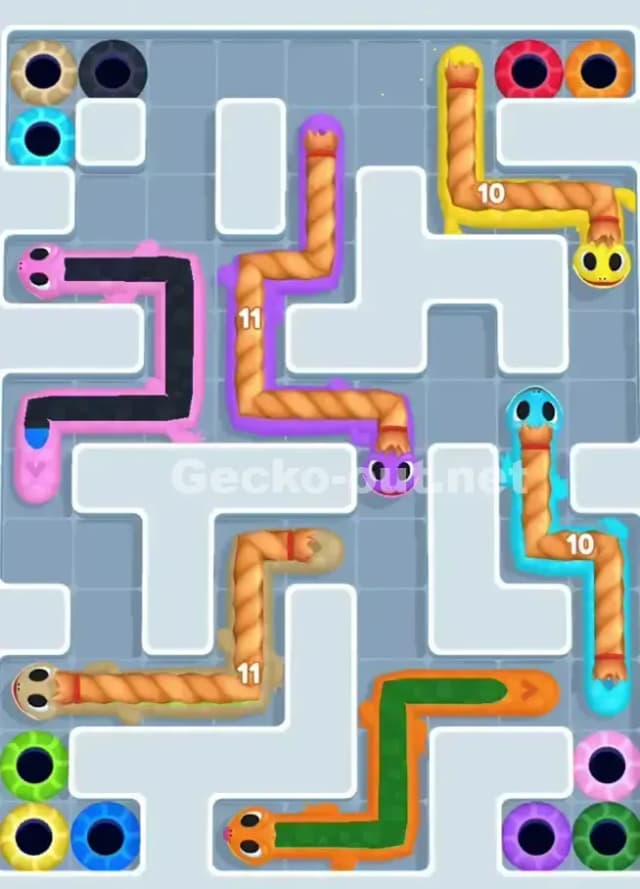
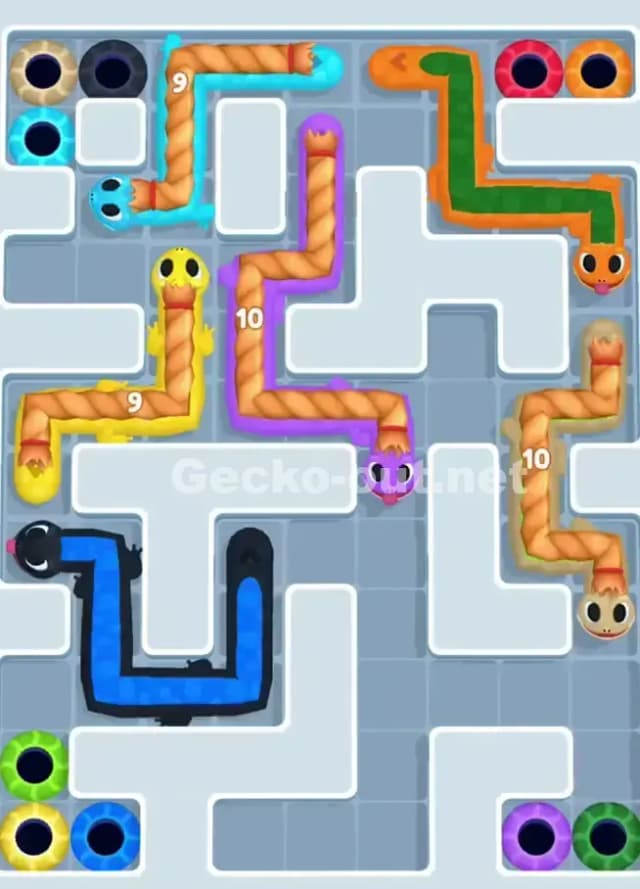
Gecko Out Level 1023 is a densely packed puzzle that'll test your spatial reasoning and patience. You're working with six geckos spread across the board: a dark navy gecko in the top-left corner, a cyan gecko just below it, a pink gecko on the left side, a purple gecko in the center, an orange gecko on the right, and a tan/beige gecko at the bottom. Each gecko has a corresponding colored hole waiting for it—and here's the kicker: the board is crammed with white walls that create a maze-like environment. The geckos aren't just sitting idle either; several of them are long, multi-segment bodies that snake across the grid, which means they're taking up serious real estate. You'll also notice that some geckos are "gang" geckos (linked together), which means they move as a unit and can't be separated. The tight corridors and overlapping body segments make this level feel claustrophobic from the start.
Win Condition and Timer Pressure
To beat Gecko Out Level 1023, you need to guide every single gecko to its matching-colored hole before the timer runs out. The timer gives you a limited window—usually around 60–90 seconds depending on your difficulty setting—so speed and precision matter equally. The drag-path mechanic means you're not just clicking a destination; you're physically drawing the route the gecko's head will take, and the body follows that exact path like a snake. If any part of the gecko's body overlaps a wall, another gecko, or an exit that isn't its color, the move fails and you have to try again. This makes Gecko Out Level 1023 a puzzle where planning beats rushing, even though the timer is ticking.
Pathing Bottlenecks and Logical Traps in Gecko Out Level 1023
The Central Corridor Bottleneck
The biggest bottleneck in Gecko Out Level 1023 is the central vertical corridor where the purple gecko and the pink gecko's body are competing for space. This narrow lane is the only efficient route for multiple geckos to reach their exits, and if you don't clear it strategically, you'll end up with a tangled mess that wastes precious seconds. The purple gecko, in particular, is a gang gecko that occupies a lot of real estate, and its body blocks the path for other geckos trying to move through the middle of the board. If you try to force the orange or tan gecko through before repositioning the purple one, you'll create a collision that forces you to restart the move. This single bottleneck is what separates a smooth run from a frustrating one.
Subtle Problem Spots: The Long-Body Trap
The tan gecko at the bottom is deceptively long—it's an 11-segment gecko that curves across nearly a quarter of the board. When you drag its head toward its exit, you have to account for every single segment following behind it. If you're not careful, the tail will clip a wall or another gecko's body, and the entire move gets rejected. The same issue applies to the orange gecko on the right side, which is also a 10-segment gecko. These long bodies create what I call the "long-body trap": you think you've found a clear path, but halfway through the drag, the tail catches on something and ruins everything. It's frustrating because the head seems to have plenty of room, but the body tells a different story.
The Cyan Gecko's Awkward Position
The cyan gecko in the top-left corner is wedged between walls and other geckos, making it surprisingly hard to extract cleanly. Its exit is in the bottom-right area, which means it has to traverse nearly the entire board. If you move it too early, it'll block the path for other geckos that need to move through the top-left quadrant. If you move it too late, you'll run out of time. This gecko is a timing puzzle within the larger puzzle, and it's easy to misjudge when to prioritize it.
Personal Reaction: The "Aha" Moment
Honestly, Gecko Out Level 1023 frustrated me the first few attempts. I kept trying to move geckos in the order they appeared on the board, and I kept hitting walls (literally). Then I realized I was thinking about it backwards—instead of asking "which gecko should I move first?" I should've been asking "which gecko is blocking everyone else?" Once I identified the purple gecko as the key blocker and moved it out of the way first, the rest of the puzzle fell into place like dominoes. That shift in perspective made the level feel less like a chaotic mess and more like a solvable puzzle.
Turn-by-Turn Path Strategy to Beat Gecko Out Level 1023
Opening: Clear the Central Corridor
Start by moving the purple gang gecko out of the central corridor. Drag its head downward and to the right, guiding it toward its purple exit in the lower-middle area of the board. This move is critical because it opens up the main vertical lane that other geckos need to use. Don't rush this move—take a second to trace the path with your eyes before you commit to the drag. Once the purple gecko is out of the way, you've essentially unlocked the board for everyone else. Park it safely near its exit so it's not in the way of subsequent moves.
Next, move the pink gecko. Drag its head to the left and downward, following the corridor it's already partially occupying. The pink gecko's exit is on the left side of the board, so this should be a relatively straightforward path. By moving it early, you're clearing another major obstacle and creating more breathing room for the longer geckos. The key here is to avoid dragging it through any area where it might collide with the purple gecko you just moved.
Mid-Game: Reposition Long Geckos Safely
Now tackle the tan gecko at the bottom. This is where patience pays off. Drag its head carefully upward and to the left, tracing a path that avoids the walls and the geckos you've already moved. The tan gecko's exit is in the bottom-left corner, so you're essentially moving it in a U-shape around the board. Take your time with this drag—the 11-segment body is unforgiving, and a single wall collision will undo your progress. Once it's safely in its exit, you've cleared a huge chunk of the board.
Move the orange gecko next. Its exit is in the top-right corner, so drag its head upward and to the right, following the eastern edge of the board. The 10-segment body means you need to be extra careful about the tail. Trace the path slowly, and don't be afraid to pause and re-examine the route before committing. Once the orange gecko is out, you're down to three geckos, and the board should feel noticeably less crowded.
End-Game: Final Three Geckos and Time Management
With the long geckos out of the way, move the dark navy gecko from the top-left. Its exit is in the top-left corner as well, so this should be a quick, direct move. Drag its head slightly downward and to the right, then back to its exit. This is a confidence-builder move—it should feel easy after the complexity of the previous steps.
Move the cyan gecko next. Drag its head downward and to the right, navigating it through the now-open corridors toward its cyan exit in the bottom-right area. With most of the board cleared, this path should be relatively clear, though you'll still need to avoid the remaining geckos.
Finally, move the yellow gecko (if there's one I missed in my initial count, or adjust based on your board). By this point, you should have 10–15 seconds left on the timer, which is plenty of time for the final gecko. If you're running low on time, don't panic—just drag the last gecko's head directly toward its exit without overthinking it.
Why This Path Order Works in Gecko Out Level 1023
Head-Drag Pathing and the Body-Follow Rule
The strategy works because it respects the fundamental rule of Gecko Out Level 1023: the body always follows the exact path the head takes. By moving the blocking geckos first, you're essentially creating a cascade of open spaces. Each gecko you move removes obstacles for the next one, so the later moves become progressively easier. If you tried to move geckos in a random order, you'd constantly hit collisions and waste time restarting moves. The head-drag mechanic rewards planning because you can see the path before you commit to it—use that advantage by tracing the route with your eyes first, then dragging with confidence.
Timer Management: Pause and Commit
Here's the thing about Gecko Out Level 1023: the timer is tight, but it's not so tight that you need to rush blindly. Spend the first 10–15 seconds reading the board and identifying the bottlenecks. Pause between moves if you need to—the timer keeps running, but a 5-second pause to plan is better than a 20-second restart because you made a careless mistake. Once you've identified your move order, commit to each drag with confidence. Hesitation and second-guessing mid-drag are what cause failures. Move decisively, but move thoughtfully.
Booster Strategy: Optional, Not Essential
Gecko Out Level 1023 doesn't require boosters if you execute the strategy correctly. However, if you're stuck and running low on time, an extra-time booster can give you the breathing room to complete the final gecko or two. A hint booster is less useful here because the puzzle is more about execution than discovery—you already know where the geckos need to go. If you do use a booster, save it for the end-game when you're close to victory but running out of time. Don't waste it on the opening moves.
Mistakes, Fixes, and Logic You Can Reuse in Other Gecko Out Levels
Common Mistakes and How to Fix Them
Mistake 1: Moving geckos in the wrong order. Players often move the gecko closest to them or the one they notice first, which usually creates more problems than it solves. Fix: Always identify the bottleneck gecko first—the one blocking the most paths—and move that one out of the way before anything else.
Mistake 2: Dragging too fast without tracing the path. Speed feels good, but it leads to wall collisions and failed moves. Fix: Trace the path with your eyes before dragging. Spend an extra second planning, and you'll save 10 seconds on retries.
Mistake 3: Forgetting about the tail. Long geckos have tails that extend far behind the head, and players often forget to account for them when dragging. Fix: Imagine the entire gecko's body as a single unit, and trace the path for the tail, not just the head.
Mistake 4: Parking geckos in the wrong spots. After moving a gecko to its exit, some players leave it in a position where it blocks other geckos' paths. Fix: Once a gecko reaches its exit, it's safe—it won't move again. But while you're moving other geckos, make sure their paths don't intersect with the already-placed geckos.
Mistake 5: Panicking when the timer gets low. With 10 seconds left and one gecko remaining, players often rush and make careless mistakes. Fix: Take a breath, trace the path one more time, and drag with confidence. A clean move takes 3 seconds; a panicked retry takes 15.
Reusing This Logic on Similar Levels
The strategy you've learned on Gecko Out Level 1023 applies directly to other knot-heavy, gang-gecko, or frozen-exit levels. The core principle is always the same: identify the bottleneck, clear it first, and let the rest of the puzzle unravel. On levels with frozen exits, you'll need to use hammers or other tools to unfreeze them before moving geckos through, but the order-of-operations logic remains identical. On levels with toll gates, you'll need to manage your resources, but again, the bottleneck-first approach still applies. Gecko Out Level 1023 teaches you to think systematically about spatial puzzles, and that skill transfers to every level that follows.
Final Encouragement
Gecko Out Level 1023 is genuinely tough—it's a level that separates casual players from puzzle enthusiasts. But it's absolutely beatable with a clear plan and steady execution. You've got this. Take your time, trust the strategy, and remember that every gecko you move successfully is one step closer to victory. The satisfaction of clearing this level is worth every second of effort.