Gecko Out Level 720 Solution Walkthrough | Gecko Out 720 Answer
How to solve Gecko Out level 720? Get step by step solution & cheat for Gecko Out level 720. Solve Gecko Out 720 easily with the answers & video walkthrough.
Gecko Out Level 720: Board Layout, Rules, and Win Condition
Starting Board: A Maze of Tangled Geckos and Narrow Corridors
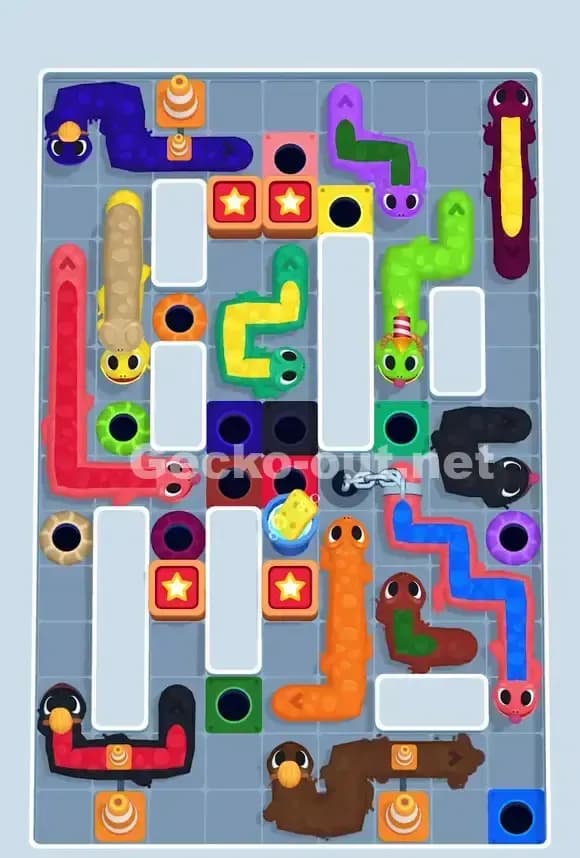
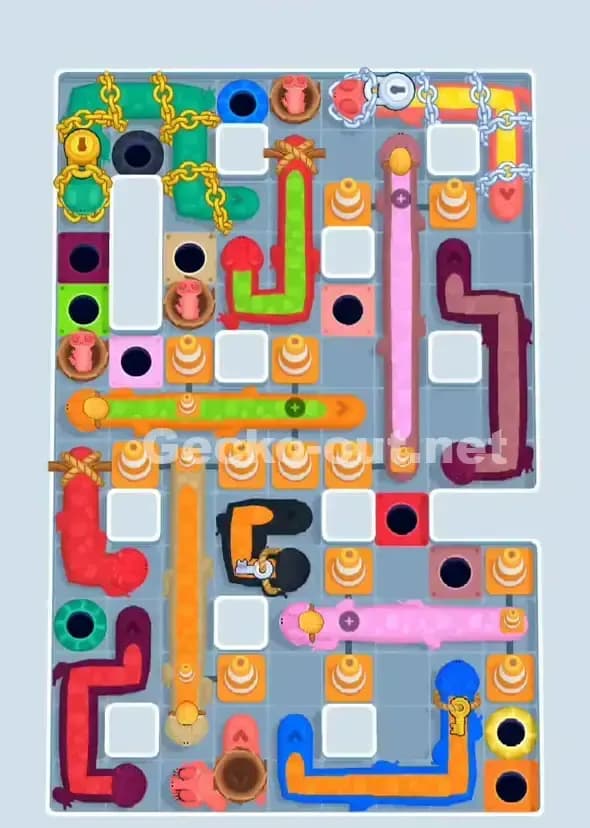
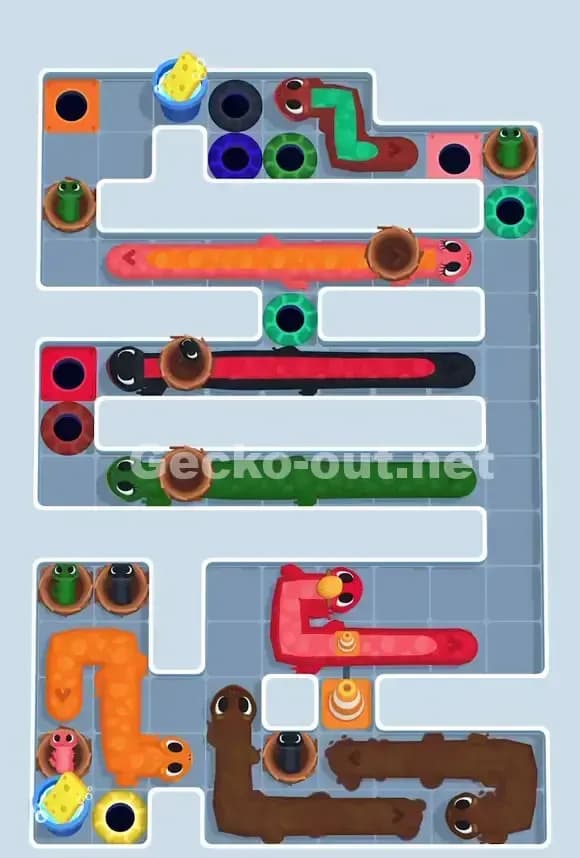
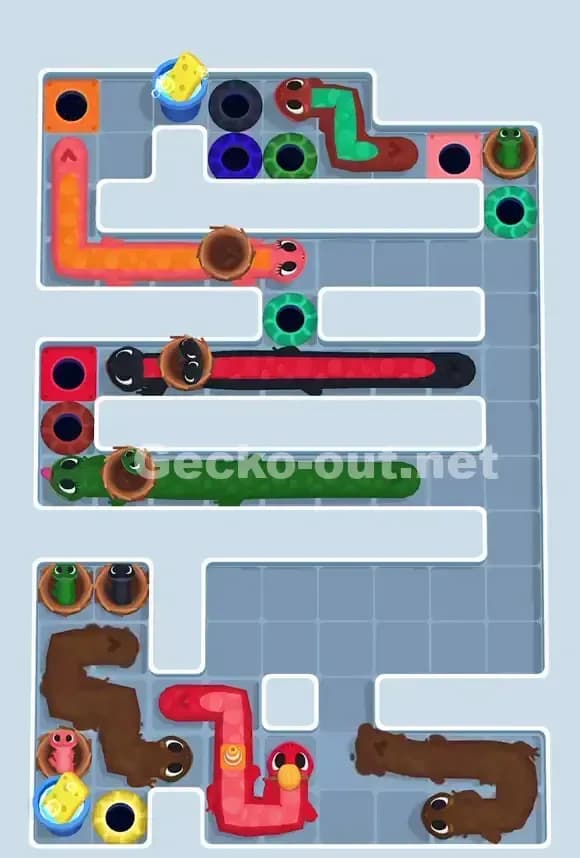
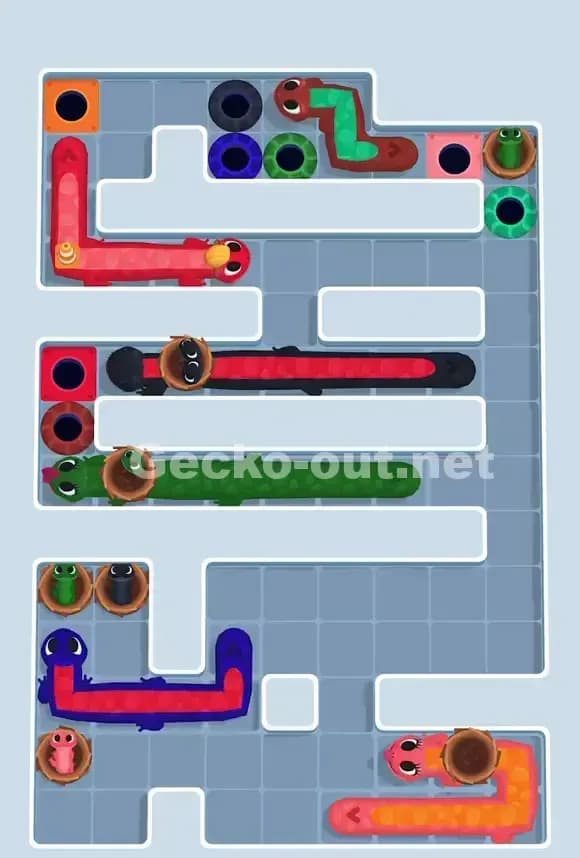
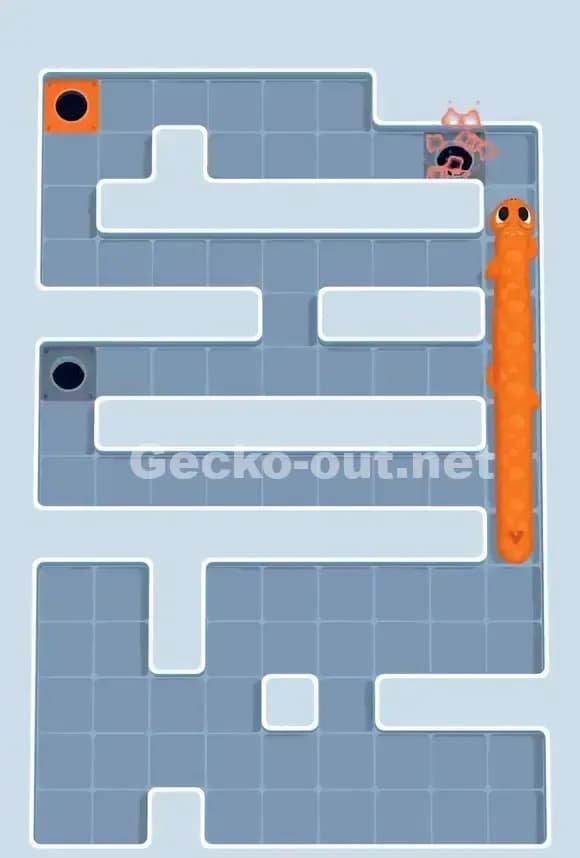
Gecko Out Level 720 is a beast—you're looking at a compact, maze-like board packed with seven geckos of different colors (orange, red, green, brown, and blue among them) squeezed into tight horizontal and vertical lanes. The board's layout is deliberately claustrophobic: multiple geckos are arranged in long, snake-like formations that crisscross and share narrow corridors. You've got orange geckos on the left side, a red gang gecko dominating the middle-upper section, green geckos threading through the right flank, and brown geckos clustered in the lower half. Each gecko must reach its matching-colored hole to escape, but here's the kicker—the holes aren't conveniently placed next to the starting positions. You'll need to drag each gecko head through a winding path, watching the body follow faithfully behind, while avoiding walls, locked exits, and (critically) other gecko bodies that occupy the same grid space.
Win Condition and Timer Pressure
To beat Gecko Out Level 720, all seven geckos must exit through their matching holes before the timer expires. That timer is your constant antagonist: it counts down relentlessly, and even a few seconds of hesitation or a poorly planned path can eat up precious time. The challenge isn't just finding a route for each gecko—it's finding a sequence of routes that keeps the board from becoming a traffic jam. Move one gecko the wrong way, and you might trap another gecko's optimal path, forcing you to backtrack, re-plan, and burn valuable seconds. The win condition forces you to think several steps ahead: which gecko should move first? Where should you "park" them so their bodies don't clog critical pathways? When should you commit to a drag and when should you pause to recalculate? This is why Gecko Out Level 720 demands both strategic thinking and quick execution.
Pathing Bottlenecks and Logical Traps in Gecko Out Level 720
The Central Corridor Deadlock
The single biggest bottleneck in Gecko Out Level 720 is the central horizontal corridor that runs through the middle of the board. This narrow lane is occupied or crossed by at least three geckos—the red gang gecko (a long body), a green gecko threading from right to left, and an orange gecko trying to snake downward. If you move any of these without a clear plan for the others, you'll create an immediate gridlock. The red gecko, in particular, is a traffic hog: it's long, it's strategically positioned, and its body occupies multiple grid cells that other geckos need to cross. This is your primary choke point, and it's the reason Gecko Out Level 720 can feel overwhelming at first glance. You cannot simply bulldoze geckos out in any order; you must carefully orchestrate which gecko moves, when, and in which direction to keep that central corridor navigable.
Subtle Trap: The Green Gecko's Path Ambiguity
The green geckos on the right side seem like they should have straightforward exits, but here's where players get caught: if you drag a green gecko toward what looks like an obvious hole, you might inadvertently block the other green gecko's path or lead yourself into a dead-end corridor that requires backtracking. The board's layout has white-wall choke points that aren't immediately obvious, and the green gecko's body is long enough that even a "direct" route can cause problems if executed in the wrong order. Always ask yourself: "If I move this gecko now, does it leave a clear lane for the other geckos?"
Subtle Trap: The Brown Gecko's Lower-Left Complexity
The brown geckos occupy the lower-left and lower-center areas, and their holes aren't where you'd expect them to be. You might assume a brown gecko can simply move straight out, but the board's lower section has narrow passages and walls that force you to take a longer, more circuitous route. If you move the brown gecko too early or drag its head into the wrong corridor first, you'll realize mid-drag that you've committed to a path that doesn't lead to the exit, wasting time and forcing a restart.
Personal Reaction: Where the Solution Clicked
I'll be honest—Gecko Out Level 720 made me want to throw my phone across the room the first time I tried it. Every gecko seemed to be in the way of every other gecko, and the timer was ticking like a bomb. But then, about halfway through a failed attempt, I noticed something: the red gecko had to move first, and it had to move in a very specific direction to clear the central corridor without trapping anything else. Once I accepted that constraint and stopped trying to find a "clever" workaround, the rest of the board suddenly made sense. It was like untangling headphones—one careful pull in the right direction, and suddenly there's slack everywhere else. That's when Gecko Out Level 720 clicked for me, and I realized it's actually a brilliantly designed puzzle, not a broken mess.
Turn-by-Turn Path Strategy to Beat Gecko Out Level 720
Opening: Prioritize the Red Gecko and Create Breathing Room
Start with the red gang gecko—yes, the long one in the middle-upper section. Your first move should be to drag its head downward and slightly left toward its designated red hole in the lower-right area. This move might feel counterintuitive because you're moving the gecko away from where you'd expect, but it's essential: by moving the red gecko out of the central corridor first, you immediately free up space for the green and orange geckos that are trapped behind or beside it. Don't try to make the red gecko's path perfect on your first move; just get it moving in a direction that clears the board's congestion. Once the red gecko is committed to exiting, you've "parked" its body outside the active play zone, and the board opens up dramatically.
Opening: Secure the Orange Gecko's Exit Route
Next, tackle one of the orange geckos on the left side. The orange gecko's hole is also on the left, but reaching it requires navigating past walls and making sure you don't collide with the red gecko's body (which is now moving or positioned to the right). Drag the orange gecko's head downward and then left toward its hole—this path keeps it out of the central corridor entirely. By securing this gecko early, you prevent it from becoming a secondary bottleneck that complicates your mid-game decisions.
Mid-Game: Reposition Green Geckos and Watch for Choke Points
Now that the red and orange geckos are either exiting or exited, focus on the green geckos. Green geckos occupy multiple positions on the board, and they need to navigate toward their green holes on the right and lower-right sections. Drag the green gecko heads carefully, making sure their bodies don't cross the paths of any remaining geckos. The key mid-game insight is to move the green gecko that's furthest from its hole first—this prevents it from becoming a late-game obstacle. If you move the green gecko closest to its hole first, you risk the far gecko getting blocked later, and you'll have to reorganize everything.
Mid-Game: Keep the Central Corridor Open
As geckos start to exit, resist the urge to "clean up" by moving geckos that are already in safe positions. Instead, focus on geckos that are still in the critical central area. If you see a gecko whose body is still occupying multiple cells in the middle of the board, prioritize moving it, even if another gecko seems like an "easier" target. The timer is always counting down, and every second you spend moving a gecko that's already out of the way is a second wasted.
End-Game: Exit Order for the Last Few Geckos
In the final stretch, you're likely down to one or two brown geckos and maybe a green gecko. These final geckos should have clear, unobstructed paths because you've removed all the other bodies from the board. Drag each remaining gecko head directly toward its hole without hesitation—you've earned the right to move quickly now. However, do not drag blindly; take half a second to verify that the path is truly clear and that you're heading toward the correct color hole. Mistaking a brown gecko's destination for a different hole in the final seconds is a frustrating way to fail Gecko Out Level 720.
End-Game: Managing Last-Second Time Pressure
If you're low on time (less than 10 seconds), commit fully to dragging the remaining gecko head without pausing. Hesitation at this point is more costly than a slightly suboptimal path. The board should be mostly clear, so even a meandering route will work. Your only real concern is ensuring you're heading toward a hole, not into a dead-end wall. If you realize mid-drag that you've made a mistake, don't panic—cancel the drag, reset, and try again. It's better to use a few seconds on a corrected path than to complete a drag that leads nowhere.
Why This Path Order Works in Gecko Out Level 720
How Head-Drag Pathing and Body-Follow Physics Untangle the Knot
The strategy outlined above works because it respects the fundamental physics of Gecko Out Level 720: the body always follows the exact path you drag the head through. By moving the longest geckos (red, then orange, then green) first, you ensure that their bodies exit the board and free up grid cells that shorter geckos need to navigate through. If you tried to move the brown gecko first, for example, you'd find that the longer red gecko's body would still be occupying the central corridor, forcing you to either (a) drag the brown gecko on an absurdly long, time-consuming detour, or (b) realize your path is blocked entirely. The sequence matters because each gecko's exit physically clears space for the next gecko's path. You're not just solving a puzzle; you're solving it in a specific order to minimize backtracking and maximize the use of available space.
Balancing Pause-and-Read Versus Commit-and-Move
Gecko Out Level 720 requires knowing when to pause and study the board versus when to commit and move quickly. Early in the level (opening moves), take 2–3 seconds to identify the red gecko and plan its exit route. Don't rush this. However, once you've committed to a drag, complete the drag smoothly without second-guessing yourself. The worst habit you can develop is starting a drag, then canceling halfway through because you're unsure—this wastes time and leaves geckos in weird intermediate positions. After the red gecko exits, move faster; you've unlocked the board's logic, and each subsequent gecko should flow more smoothly. In the final 15 seconds, move at full speed. In the final 5 seconds, move at emergency speed. The timer is your pacing guide—let it dictate your tempo, not your decisions.
Booster Strategy: Optional But Not Necessary
Gecko Out Level 720 may offer boosters like extra time, hints, or a "hammer" tool that clears obstacles. Here's my take: do not rely on these as your primary solution. The puzzle is absolutely solvable without boosters if you execute the path strategy correctly. That said, if you've failed twice and you're consistently getting stuck at the same bottleneck, a hint booster can help you see a path you've been missing. Extra time is tempting but usually indicates that your path order is wrong, not that you need more seconds. Save boosters for when you're genuinely stuck on a specific gecko, not for "I messed up my opening moves."
Mistakes, Fixes, and Logic You Can Reuse in Other Gecko Out Levels
Mistake 1: Moving Short Geckos First
Many players instinctively move the shortest geckos first because they seem "easier" to navigate. This is backwards in Gecko Out Level 720. Short geckos are harder to move early because they get trapped by longer geckos' bodies. Always move the longest geckos first to clear space; save short geckos for last when the board is open.
Mistake 2: Dragging a Gecko's Head Toward a Hole Without Checking the Path
It's tempting to see a hole and immediately drag a gecko's head toward it. Resist this urge. In Gecko Out Level 720, the path between the gecko's starting position and its hole is never a straight line. Geckos you move second will follow different routes than geckos you move first because the board has changed. Always mentally trace the full path from head to hole before committing to the drag, accounting for walls, other geckos' bodies, and any unexpected dead-ends.
Mistake 3: Over-Complicating the Red Gecko's Route
The red gecko is the star of Gecko Out Level 720, and players often overthink its path. Don't try to move it in the "shortest" route possible; instead, move it in the route that clears the most space for other geckos. A slightly longer red gecko path that frees up the central corridor is infinitely better than a "optimal" red gecko path that leaves other geckos blocked. Gecko Out Level 720 rewards you for clearing congestion, not for micro-optimizing individual gecko routes.
Mistake 4: Underestimating the Timer's Pressure
Many players assume they have plenty of time and move slowly, studying each drag carefully. In Gecko Out Level 720, the timer is tight. You likely have around 90–120 seconds total, and wasting 10 seconds on an overly cautious opening move costs you proportionally more time later. Practice moving with purpose. Your opening moves should take 20–30 seconds combined; your mid-game should take 30–40 seconds; your end-game should take 20–30 seconds. If you're consistently hitting the timer with only one or two geckos remaining, you need to move faster overall, not just faster at the end.
Mistake 5: Forgetting to Verify Color Matches at the Exit
In the chaos of dragging geckos and watching the timer, it's shockingly easy to drag an orange gecko toward a red hole or a green gecko toward a brown hole. Before you complete any final-stage drag, glance at the gecko's color and the hole's color. A one-second color-check can prevent a complete run failure in the last 10 seconds.
Applying This Logic to Similar Levels
The strategy for Gecko Out Level 720 applies beautifully to other knot-heavy, multi-gecko levels. Whenever you encounter a level with long geckos occupying central corridors, apply the "longest first" rule. Similarly, if you encounter levels with gang geckos (linked geckos that move together), use the same philosophy: move the gang gecko first to clear congestion. For frozen-exit levels (where exits are iced and require hammers or extra moves to open), plan your gecko order before you start, because you won't have the luxury of repositioning after you've used your hammer. Gecko Out Level 720 teaches you that sequence and spatial awareness matter more than individual route optimization—this principle scales to virtually every puzzle-game level that involves moving multiple objects through constrained space.
Final Encouragement
Gecko Out Level 720 is genuinely tough, and there's no shame in needing a few attempts to find the solution. The board's visual complexity can deceive you into thinking the puzzle is harder than it actually is. But once you recognize the red gecko bottleneck, prioritize clearing it, and trust the "longest first" strategy, Gecko Out Level 720 transforms from an impossible-seeming mess into a satisfying, solvable puzzle. You've got this. Get in there, move that red gecko, and watch the board open up. The victory on Gecko Out Level 720 is absolutely worth the effort.