Gecko Out Level 1060 Solution Walkthrough | Gecko Out 1060 Answer
How to solve Gecko Out level 1060? Get step by step solution & cheat for Gecko Out level 1060. Solve Gecko Out 1060 easily with the answers & video walkthrough.
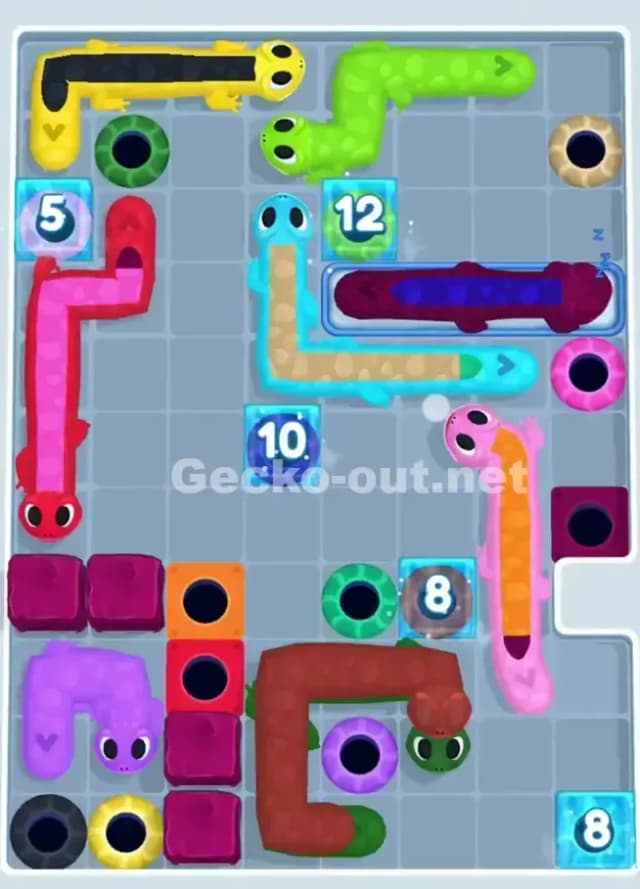

Gecko Out Level 1060: Board Layout, Rules, and Win Condition
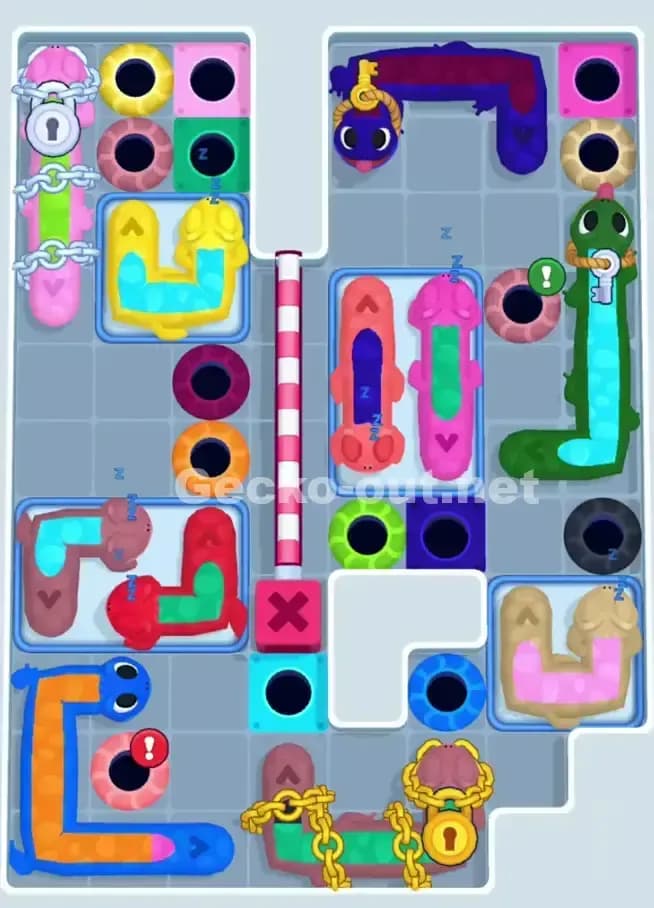
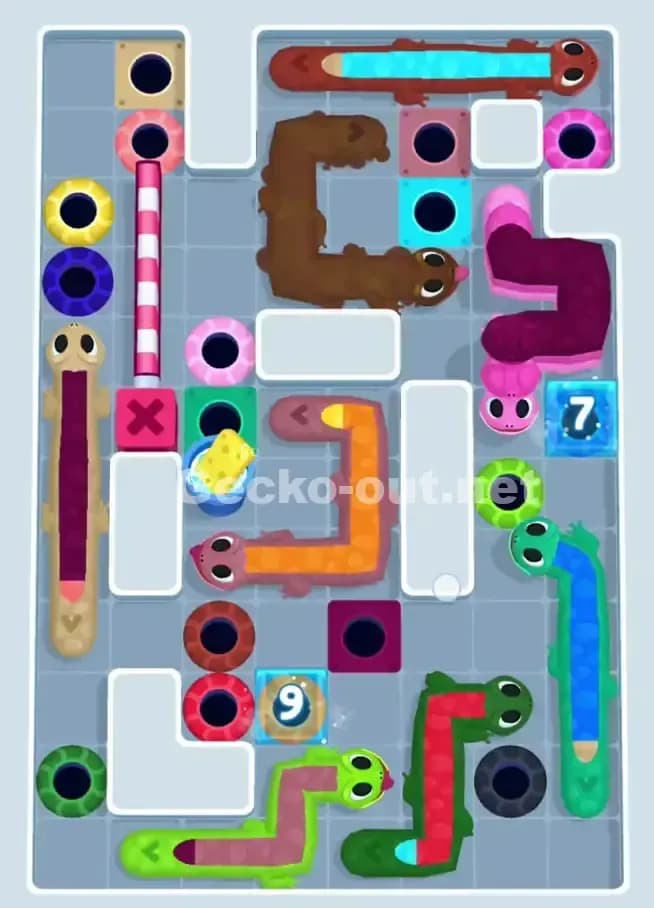
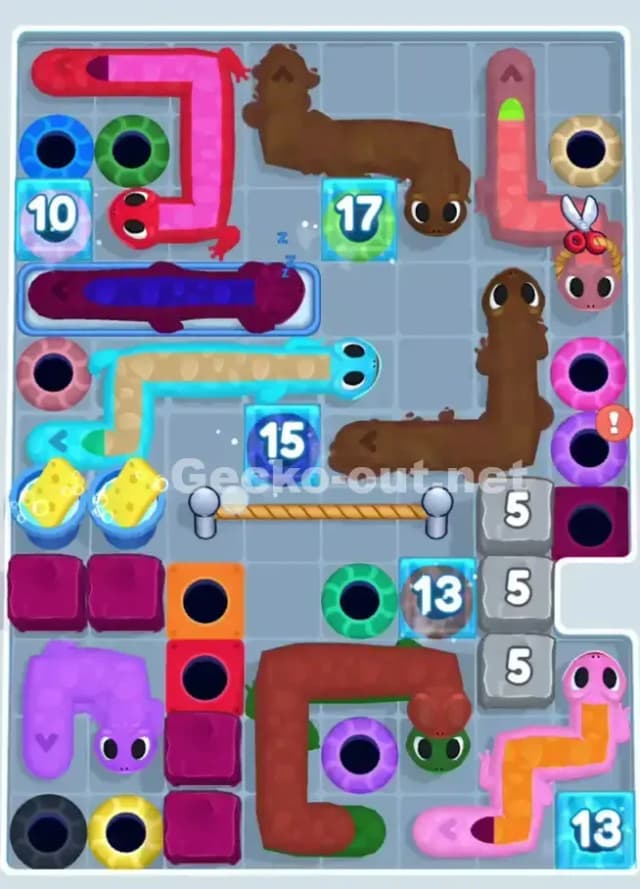
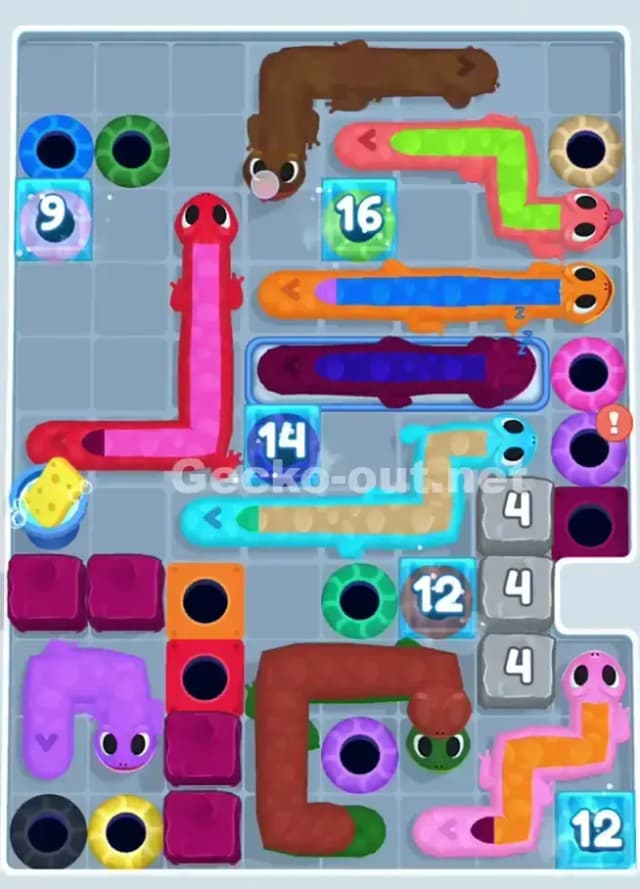
Gecko Out Level 1060 is a dense, multi-gecko puzzle that demands careful planning from the very first move. You're working with at least eight geckos of different colors—reds, blues, greens, pinks, purples, and browns—all crammed onto a tight grid. What makes this level brutally tricky is that several geckos are long-bodied or linked together, meaning they occupy multiple cells at once. The board layout features a nasty central knot where three or four geckos overlap in their starting positions or immediately adjacent cells, creating an instant traffic jam. Additionally, you'll notice colored holes scattered across the grid—some are locked behind toll gates (marked with numbered tokens like "5," "10," or "15"), and some are frozen or blocked by walls. The brown geckos in particular seem to stretch horizontally across the middle, acting as a physical barrier to faster solutions.
The Win Condition and Timer Pressure
You win Gecko Out Level 1060 when all geckos have reached their matching-colored holes before the timer runs out. Each gecko's head must be dragged along a path, and the body follows that exact route—no shortcuts, no jumping. If even one gecko is still on the board when the timer hits zero, you fail and must restart. This timer mechanic is what separates a "solvable" puzzle from a "solvable under pressure" puzzle. You're not just solving Gecko Out Level 1060; you're racing against the clock while untangling a knotted mess of bodies.
Pathing Bottlenecks and Logical Traps in Gecko Out Level 1060
The Central Corridor: Where Everything Wants to Go
The single biggest bottleneck in Gecko Out Level 1060 is the middle corridor where the brown geckos are positioned. These long geckos must move out of the way before almost any other gecko can reach its hole. If you drag a blue or red gecko's head toward its exit without first relocating the brown geckos, you'll find the path blocked or the body will collide with existing gecko bodies. The real trap is that many players see the brown geckos and think, "I'll move them last," not realizing they're the load-bearing walls of the entire puzzle. Moving them first—even though it feels counterintuitive—opens up space for everyone else.
The Toll Gates: A False Economy
Several holes in Gecko Out Level 1060 are blocked by toll gates requiring tokens (5, 10, 15, or 17). A subtle mistake is spending precious time trying to path a gecko to a toll-gated hole when a non-gated exit of the same color exists elsewhere on the board. I've lost runs by fixating on the "obvious" exit only to realize I was paying a resource cost I didn't need to pay. Always scan the entire board for all available exits before committing to a path. The non-tolled exits are your speed route; save the toll gates only if that gecko has no other way out.
Frozen or Blocked Exits: The Deceptive Dead End
Watch out for exits that appear on the board but are inaccessible due to walls or other obstacles. In Gecko Out Level 1060, there are a few holes surrounded by barriers that look like valid targets but will force you to take a much longer detour. I remember the moment I realized this: I was about three moves in, confidently guiding a pink gecko toward what I thought was the nearest hole, only to slam into a wall and realize I'd wasted half my path. Restart and recalculate. The lesson was humbling but essential—always trace the full path in your head before dragging.
Turn-by-Turn Path Strategy to Beat Gecko Out Level 1060
Opening: Unblock the Core First
Start Gecko Out Level 1060 by moving the brown gecko(es) out of the central corridor. These geckos are your priority because they're physically preventing you from reaching other exits. Drag the brown gecko's head carefully along an edge or around the periphery, parking its body in a safe corner where it won't interfere with future moves. This might feel like the "wrong" first move—you'd expect to move geckos that are closer to exits—but it's correct. By clearing the center, you've bought yourself maneuverability. Next, move any purple or magenta geckos that are also tangled in the starting knot, using safe corners as temporary parking spots.
Mid-Game: Keep Lanes Open and Chain Exits
Once the central corridor is clear, identify which geckos have the shortest, most direct paths to non-tolled exits. In Gecko Out Level 1060, prioritize shorter geckos or those with simpler geometries; they're faster to route and less likely to block others. Move one or two of these geckos out quickly to reduce board congestion. As you remove geckos, you'll notice new pathways opening up for the remaining ones. Don't rush the longer geckos or those with gang-gecko links (where two geckos are joined); those need extra thought. For mid-game, your mantra is: one gecko out per move, one less obstacle on the board.
End-Game: The Last Three and the Time Sprint
As you approach the final three or four geckos in Gecko Out Level 1060, the timer will be ticking audibly (or visually). Don't panic. The board is now spacious compared to the start, so movement is faster. For the last few geckos, aim for the nearest available exits, even if they're tolled—you've likely cleared enough space that the detour cost is minimal. If you have a gecko that requires passing through a tight choke point, move it just before you move the gecko that would block it. Avoid the mistake of leaving a long gecko for last; if it's still on the board with 10 seconds left, you're almost certainly going to fail. Plan your exit order so the last gecko(es) have a clear, fast path.
Why This Path Order Works in Gecko Out Level 1060
Body-Follow Physics and Untangling, Not Tightening
The genius of this strategy is that it respects the body-follow rule. When you drag a gecko's head, the body traces that exact path, and the body can't overlap with obstacles or other geckos. By moving the blockading geckos (the brown ones) first, you're not tightening the knot; you're carefully removing the pin that's holding the knot together. Each subsequent gecko now has more space to take a safe route. If you did it in reverse—trying to squeeze a blue gecko past an unmoved brown gecko—you'd likely force a collision or a path so convoluted that you'd run out of time.
Pause, Read, Commit
Gecko Out Level 1060 is fast-paced, but it rewards strategic pauses. Spend the first 10–15 seconds simply reading the board: where are all the exits, which geckos are linked, what's the order of movement? Once you've decided, commit and move quickly. I found that hesitation mid-puzzle (second-guessing after dragging halfway) wastes more time than a deliberate restart. Play with confidence; if you've read the board correctly, you'll win.
Boosters: Optional, Not Required
Gecko Out Level 1060 doesn't require boosters if you follow this plan. However, if you find yourself with 30 seconds left and two geckos still on board, a time booster (extra 30 seconds) would be a lifesaver. Alternatively, a hint booster at the very start can show you the exit positions, which saves mental overhead. I'd say boosters are optional for skilled players but worthwhile insurance if you're new to this level. Don't rely on them; use them only if you're close to winning and just need a few more seconds.
Mistakes, Fixes, and Logic You Can Reuse in Other Gecko Out Levels
Common Mistakes and Fixes
-
Mistake: Moving short geckos first, leaving long geckos for last. This clogs the end-game. Fix: Move long geckos or blockading geckos early so they're not choking the board when time is tight.
-
Mistake: Ignoring toll gates and assuming all exits are free. This leads to wasted time trying to collect tokens. Fix: Always scan for non-tolled exits of the same color first; use tolled exits only as backup.
-
Mistake: Dragging a path without tracing it mentally first. This causes collisions mid-path and forced restarts. Fix: Spend two seconds tracing the path with your eyes before you drag.
-
Mistake: Trying to "optimize" by moving geckos in color order. This ignores the physical structure of the puzzle. Fix: Move geckos in order of blockading potential, not color.
-
Mistake: Panicking and moving frantically when the timer is low. This leads to careless collisions. Fix: Trust your setup. If the first 70% was solid, the last 30% will be fast and clean.
Reusing This Logic on Similar Levels
Gecko Out Level 1060's strategy applies to any puzzle with a central knot or gang geckos. Whenever you see multiple geckos overlapping or touching, ask: Which gecko, if moved, would unlock the most space for others? That's your first move. On frozen-exit levels, the same principle holds—clear obstacles first, then route geckos to exits. The timer mechanic on Gecko Out Level 1060 also teaches you to value speed and simplicity over "perfect" paths; a slightly longer route that's executed quickly beats a theoretically optimal path that you second-guess.
The Payoff
Gecko Out Level 1060 is genuinely tough, but it's not unfair. Once you've beaten it, you'll recognize the board-reading and sequencing skills you've honed. You'll look at future levels and immediately spot the blockading gecko or the tight corridor. That's the mark of a player who's mastered the fundamentals. The puzzle rewards patience and clear thinking, and I'm confident you'll crush it with this plan in hand.