Gecko Out Level 795 Solution Walkthrough | Gecko Out 795 Answer
How to solve Gecko Out level 795? Get step by step solution & cheat for Gecko Out level 795. Solve Gecko Out 795 easily with the answers & video walkthrough.



Gecko Out Level 795: Board Layout, Rules, and Win Condition
The Starting Board: A Colorful, Interlocking Puzzle
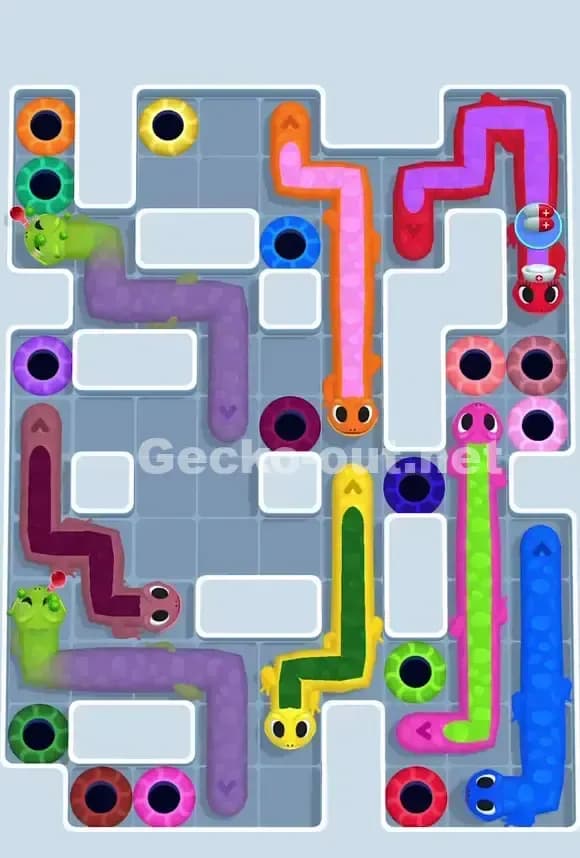
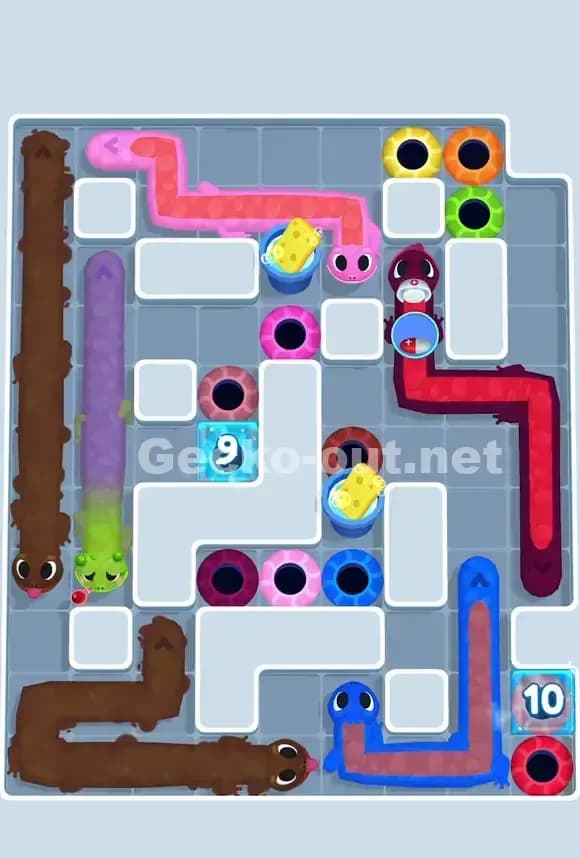
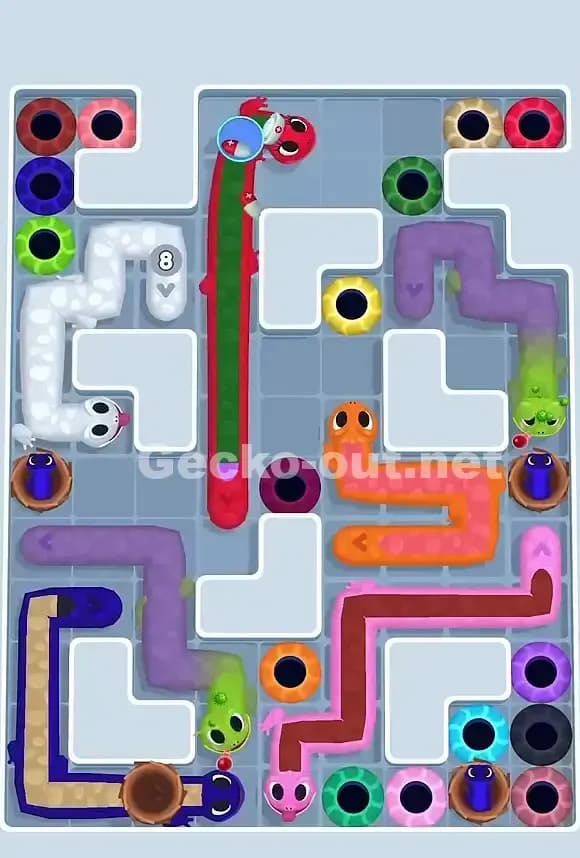
Gecko Out Level 795 presents a densely packed grid with 12 geckos of varying colors—reds, blues, greens, yellows, purples, oranges, and cyans—scattered across a labyrinthine board. You'll notice immediately that this isn't a simple "draw a line and go" level. The board is divided by thick white walls that create narrow corridors, dead ends, and overlapping zones where multiple geckos compete for limited space. Some geckos are linked together as "gang" members (meaning their bodies move as one unit), which adds a layer of spatial complexity. There's also a visible timer showing 8 moves or actions remaining, so every decision matters. The exit holes, color-matched to their corresponding geckos, are positioned around the perimeter and in a few internal alcoves—some easy to reach, others buried behind walls and other gecko bodies.
Understanding the Win Condition and Timer Pressure
To win Gecko Out Level 795, you must guide all 12 geckos to their matching-colored holes before the timer expires. The twist is that you're dragging each gecko's head through the maze, and its body automatically follows that exact path, tile by tile. If a body can't physically fit along the path you've drawn (due to walls, other geckos, or frozen obstacles), the move fails. The timer adds pressure—you can't afford to waste actions on failed attempts or inefficient routes. The narrow white corridors mean that once you commit a gecko to a path, it occupies that space until it exits. If you move one gecko poorly, you might block the only escape route for another, forcing a restart or consuming precious time rerouting.
Pathing Bottlenecks and Logical Traps in Gecko Out Level 795
The Central Red Vertical Corridor: Your Biggest Choke Point
The most obvious bottleneck in Gecko Out Level 795 is the tall red vertical corridor running down the center-left portion of the board. This narrow lane is the fastest escape route for several geckos, but only one gecko's body can occupy it at a time. I found that the red gangster gecko (the large multi-segment gecko in the center-top area) initially blocks this corridor if you're not careful. If you try to move other geckos down this corridor first, they'll collide with the red gang gecko's body, and you'll waste an action. Conversely, if you move the red gang gecko out of the way too early, other geckos behind it might get trapped on the upper portion of the board with no alternate routes. The key insight is recognizing that this corridor controls the pacing of your entire solution—whoever uses it first must exit completely, or the whole puzzle stalls.
Subtle Trap #1: The Blue Gang Gecko and the Left-Side Dead End
In the lower-left corner, there's a blue gang gecko that's partially trapped in a purple L-shaped chamber. This gecko looks like it has a clear exit downward, but if you pull it too early, its long body will wrap around the corner and jam against the purple walls, making it impossible to exit without retracting. The trap is that the exit looks open, but the gecko's body length means you need to clear the entire left side first. Many players waste an action trying to force this gecko out before clearing nearby geckos like the brown gecko at the bottom-left.
Subtle Trap #2: The Orange and Green Gang Geckos in the Lower-Right
On the right side of Gecko Out Level 795, there are orange and green gang geckos tangled together near a magenta exit passage. These two are interlinked—moving one affects the spatial availability for the other. If you drag the orange gecko right without first repositioning the green one, the green body blocks the red exit path. Players often make the mistake of moving one gang gecko independently, forgetting that gang members' bodies move as a single, connected unit, so you're managing two geckos' worth of body space with one move.
Subtle Trap #3: The Purple and Yellow Alcove
The yellow gecko sits alone in a small alcove in the center of the board. Its exit is nearby, but to reach it, you must navigate through a narrow white corridor shared by blue and purple geckos. If you move the yellow gecko too soon, before repositioning the blue and purple units, the yellow body will collide with their bodies mid-path, and the move fails. It's a timing trap—not a spatial impossibility, but a sequencing one.
Personal Reaction: When the Knot Untangles
I'll be honest: my first five attempts at Gecko Out Level 795 felt chaotic. I was dragging geckos randomly, watching bodies collide, and burning through actions. The frustration peaked around move five when I realized I'd created a board state where three geckos were blocked from their exits and the timer was ticking. But then it clicked—I stopped trying to move the big, obvious geckos first and instead focused on clearing the corridors. By moving the smaller, "invisible" geckos (the ones I wasn't thinking about) out of the way first, the board opened up like a lock being turned. That shift from "brute force" to "plan backward from the exit holes" is what makes Gecko Out Level 795 beatable.
Turn-by-Turn Path Strategy to Beat Gecko Out Level 795
Opening Moves: Clearing the Upper Corridors and Parking Non-Urgent Geckos
Start with the blue gecko at the top-center. This gecko is in a relatively open area, and its exit hole (also blue) is accessible if you drag its head upward and to the right. Moving it first clears real estate at the top of the board and prevents it from becoming an obstacle later. Next, address the yellow gecko in the center alcove by dragging it directly downward into the white corridor; it has a clear path to its exit hole once you're moving geckos sequentially. Your third move should be the green gecko on the right side—pull it toward its green exit hole on the right perimeter. These first three moves don't solve the puzzle, but they dramatically simplify the board by removing geckos from the congested center zone. You're not parking them in "safe" spots; you're actually exiting them because their paths are direct and uncontested.
Mid-Game: Untangling Gang Geckos and Managing the Red Corridor
Now that the upper area is clearer, focus on the red gang gecko in the center. This is the big, scary multi-segment gecko that blocks the vertical corridor. Drag its head downward through the red corridor—it will occupy the corridor as its body follows the path, but this is intentional. Once the red gecko exits through its red hole, the corridor is completely free. This move is critical because it signals to you (and the player watching) that you're making progress; the red gecko is one of the largest units, and seeing it escape is psychologically rewarding and practically valuable. After the red gecko exits, you have two moves left (approximately) to exit all remaining geckos. Move the orange gang gecko next, dragging it to the right toward its orange exit hole. Don't overthink this move—gang geckos move as one unit, so you're just finding a clear path from its starting position to its matching exit. Then move the purple and magenta geckos out of the lower-right alcove, using the now-freed space from the orange gecko's exit.
End-Game: Racing Against the Timer with the Last Few Geckos
With approximately two moves remaining, you'll have the brown gecko, cyan gecko, and any remaining blue or purple variants. Drag the brown gecko from the bottom-left corner downward; its brown exit hole is directly below or nearby, so this should be a quick exit. Then handle the cyan gecko in the lower-right area by dragging it into the magenta exit passage and onward to its cyan hole. Finally, if any geckos remain (and the timer is tight), drag them in quick succession without hesitation. The key to ending strong is trusting that if you've followed the strategy above, the remaining geckos will have clear, unobstructed paths. Don't second-guess yourself—commit to the drag, release, and move immediately to the next gecko. If you find yourself with fewer than two moves remaining and multiple geckos still on the board, you've made a sequencing error earlier; restart and prioritize clearing the vertical corridor and alcoves faster.
Why This Path Order Works in Gecko Out Level 795
Head-Drag Pathing and the Body-Follow Rule: Avoiding Tangles
The brilliance of the strategy above is that it respects the body-follow rule: the body moves only along the exact path the head travels. This means that the path you drag is not a "suggestion"—it's a commitment. By moving geckos in the order described (small units first, big units second, remaining units last), you ensure that when you drag a gecko's head toward its exit, no other gecko's body will be in the way. For example, if you try to move the red gang gecko first (before clearing the upper geckos), its long body will wrap around obstacles and collide with other geckos mid-path. By clearing the path before moving the big gecko, you guarantee a smooth, uninterrupted line from head to exit hole. This isn't just efficient; it's the only way to solve Gecko Out Level 795 without burning extra actions on failed moves.
Managing the Timer: When to Pause and When to Commit
Gecko Out Level 795 gives you a strict action budget. You don't have infinite time to stare at the board and plan every micro-move. My recommendation is to spend the first 10–15 seconds analyzing the board layout, identifying the three "problem geckos" (the big gang units and the ones in tight spaces), and tracing their potential exit routes mentally. Once you've done that mental work, commit to the strategy above without hesitation. Pausing between every single move wastes cognitive energy and tempts you to overthink. However, if you reach the mid-game and realize you've made a mistake (e.g., blocked a corridor), pause briefly, acknowledge the error, and restart immediately rather than trying to salvage a bad board state. The timer rewards confident, correct play over indecisive, exploratory play.
Boosters: Optional, Not Necessary
Gecko Out Level 795 is tough, but it's absolutely solvable without boosters. The time booster (which adds extra moves or reduces the timer's countdown speed) can feel tempting, especially if you're nervous about the action budget. I'd recommend saving your booster coins for levels where the puzzle itself is randomized or where you genuinely lack sufficient actions to solve it logically. For Gecko Out Level 795, the puzzle is deterministic—there's always an 8-move solution (or close to it) if you follow the strategy above. Use boosters only if you've failed twice and want to reduce the frustration on attempt three.
Mistakes, Fixes, and Logic You Can Reuse in Other Gecko Out Levels
Mistake #1: Moving Big Gang Geckos First
The Error: You see the red gang gecko and assume it's important, so you drag it immediately toward its exit. Its body wraps around walls and collides with other geckos, and the move fails.
The Fix: Always move small, "invisible" geckos first to clear corridors. Big gang geckos are important, but only move them after the board has been cleared for them. Think of it as "preparing the stage" before the star actor makes an entrance.
Mistake #2: Forgetting That Gang Geckos Have Bodies Twice as Long
The Error: You see a gang gecko and a corridor, calculate that they "should fit," and drag it confidently. The body clips a wall or collides with another gecko's body mid-path because you underestimated its length.
The Fix: Before moving a gang gecko, trace its entire body on the board mentally. Gang geckos occupy roughly twice the space of single geckos, so always err on the side of caution and clear extra space around corridors they'll travel through.
Mistake #3: Not Utilizing the Vertical Red Corridor
The Error: You avoid the red corridor because it looks crowded, and you drag geckos along longer, exterior paths that consume more actions overall.
The Fix: The red corridor is your asset, not your enemy. Once you've cleared it, use it aggressively. Multiple geckos can exit via that corridor sequentially, and it saves actions compared to routing around the board's edges.
Mistake #4: Moving the Yellow Gecko Too Soon
The Error: The yellow gecko looks isolated and "easy," so you move it early. But its alcove is a dead end, and moving it blocks other geckos from accessing the corridors they need.
The Fix: Yellow gecko is easy to move, but it should be one of your second-tier moves, not your first. Identify which geckos are truly blocking corridors (usually the ones whose bodies span entire lanes) and move those first.
Mistake #5: Rushing the End-Game
The Error: With only two moves remaining and three geckos still on the board, you panic and drag geckos haphazardly. At least one collides with a wall or another gecko, and you fail.
The Fix: Gecko Out Level 795 is won in the opening and mid-game. If you've followed the strategy above, the end-game is a formality—just execute clean, confident drags without overthinking. If you find yourself in a panic end-game, it's a sign that your mid-game sequencing was off; restart and follow the strategy more precisely.
Reusing This Logic on Similar Levels
The philosophy behind this Gecko Out Level 795 strategy applies to any Gecko Out level with gang geckos, narrow corridors, or tight choke points. The core principle is: clear the board's scaffolding before moving the largest units. On levels with frozen geckos or locked exits, apply the same logic—frozen units are obstacles, not geckos, so you must route around them rather than trying to move them out of the way. On levels with toll gates, prioritize moving geckos that don't require payment first, so you conserve resources for the truly expensive exits. The body-follow rule never changes, so training yourself to think spatially about body length and corridor clearance will make you better at every Gecko Out level.
Final Encouragement
Gecko Out Level 795 is genuinely one of the tougher levels in the game, and if you've struggled with it, that's completely normal. The puzzle demands spatial reasoning, planning, and a willingness to move geckos you don't immediately understand. But it's also absolutely beatable with a clear strategy. Follow the opening moves, trust the mid-game repositioning, and the end-game falls into place. You've got this—good luck getting those geckos out!