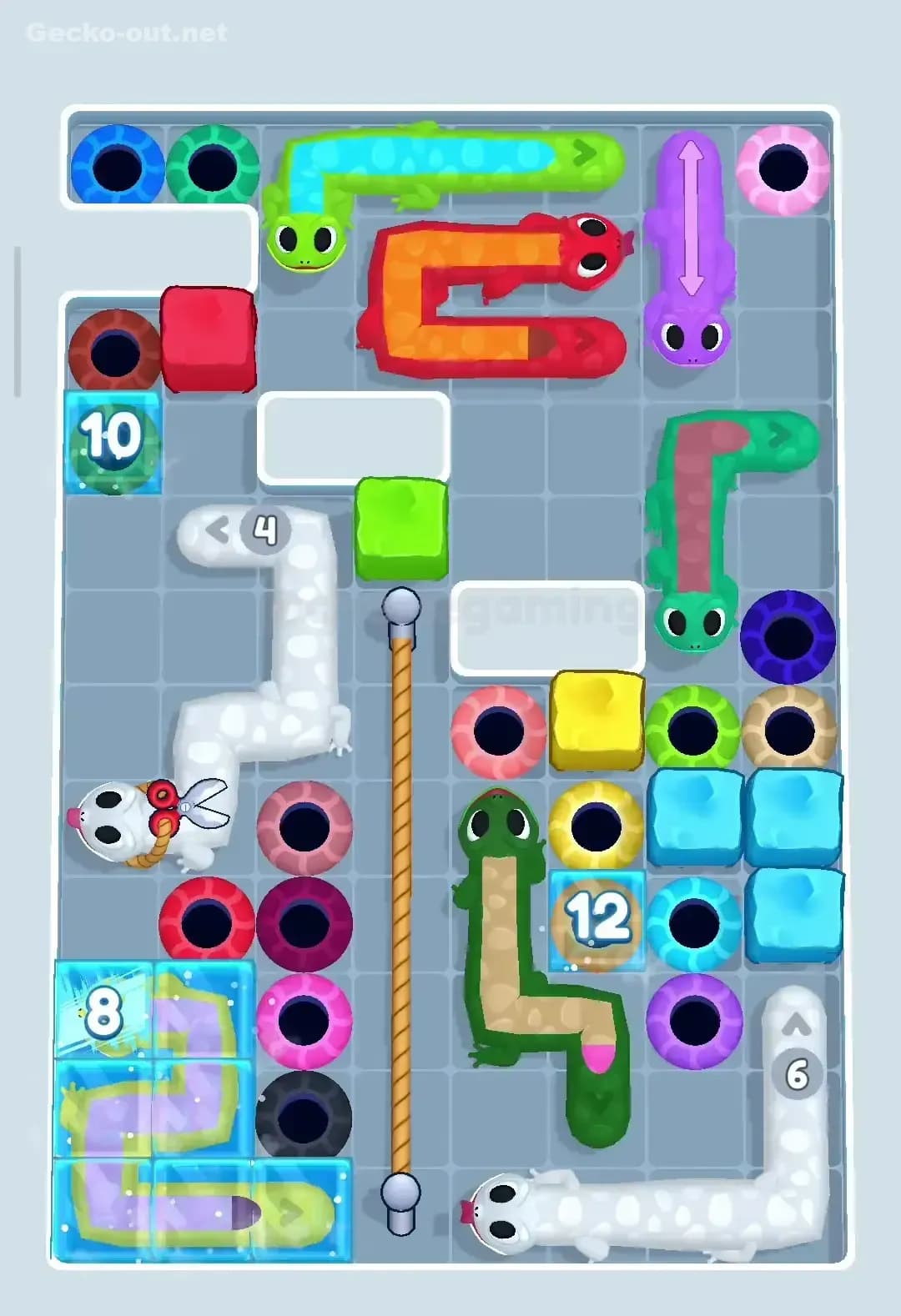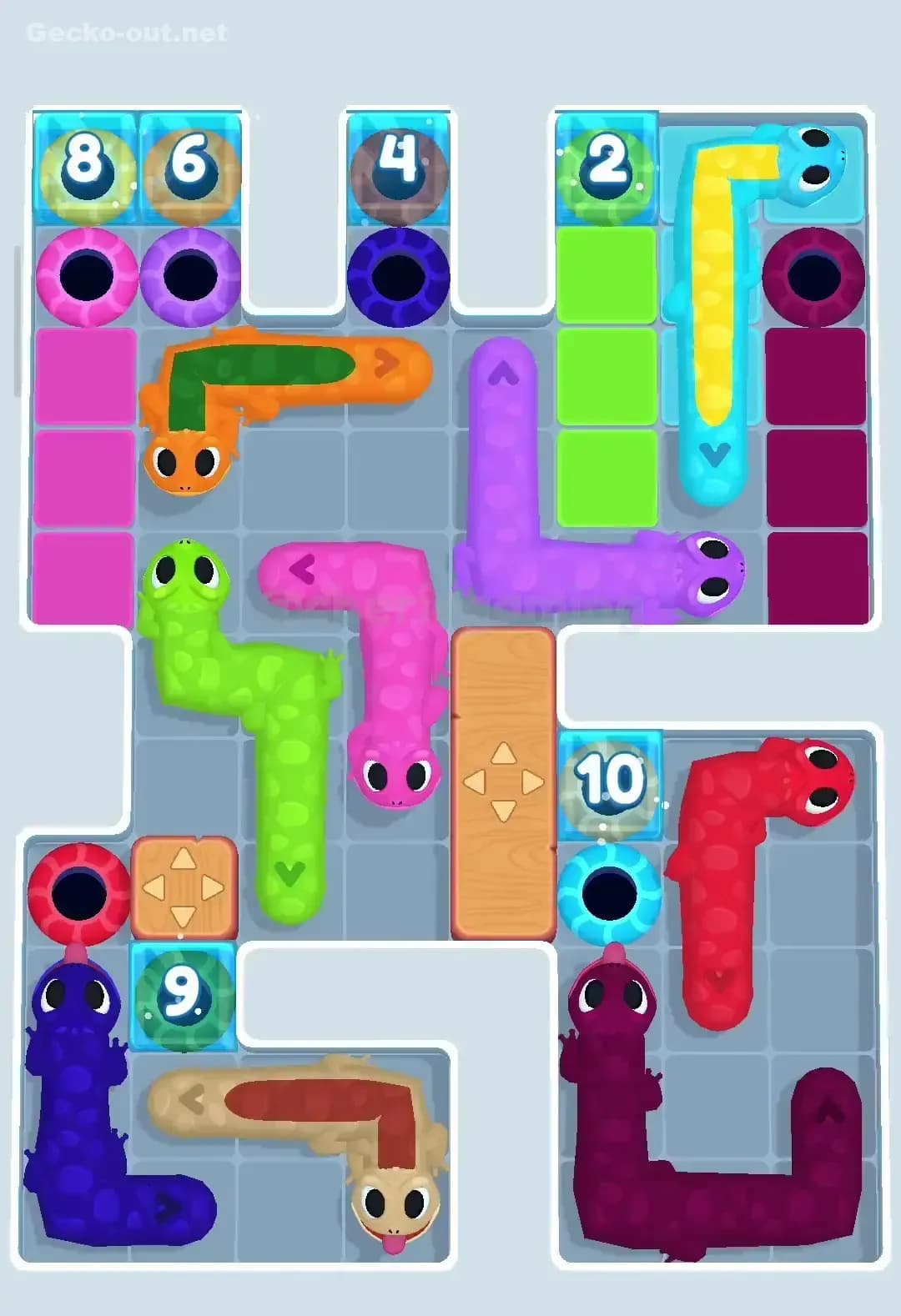
Gecko Out Level 203 Solution Walkthrough | Gecko Out 203 Answer
How to solve Gecko Out level 203? Get step by step solution & cheat for Gecko Out level 203. Solve Gecko Out 203 easily with the answers & video walkthrough.
Gecko Out Level 203: Board Layout, Rules, and Win Condition
What You’re Looking At When Gecko Out 203 Starts
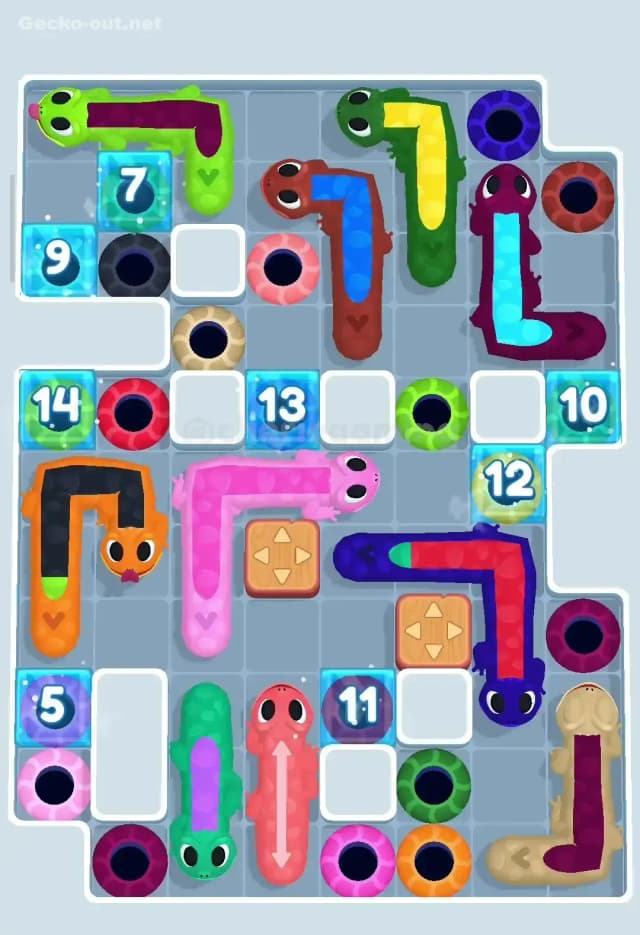
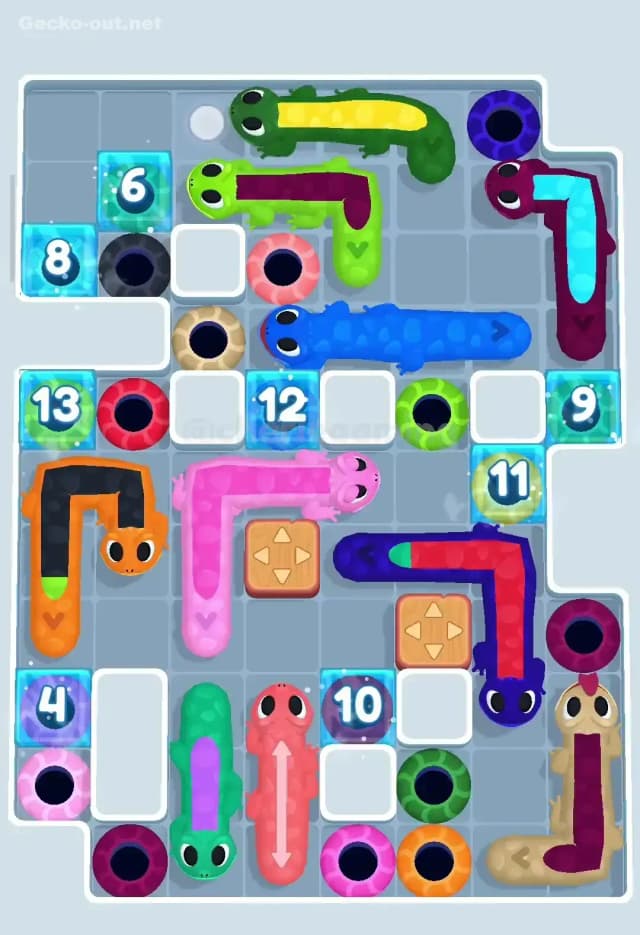
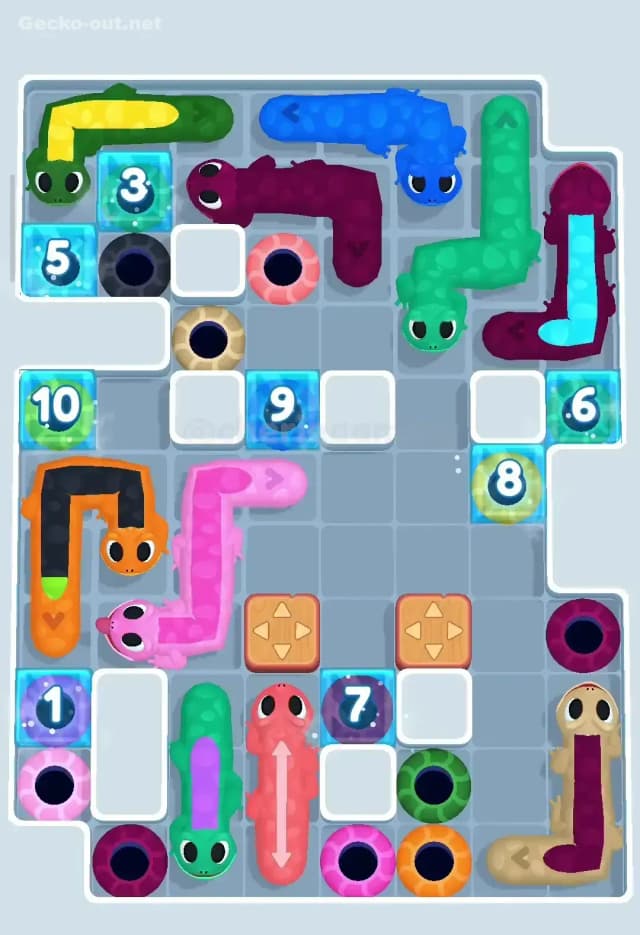
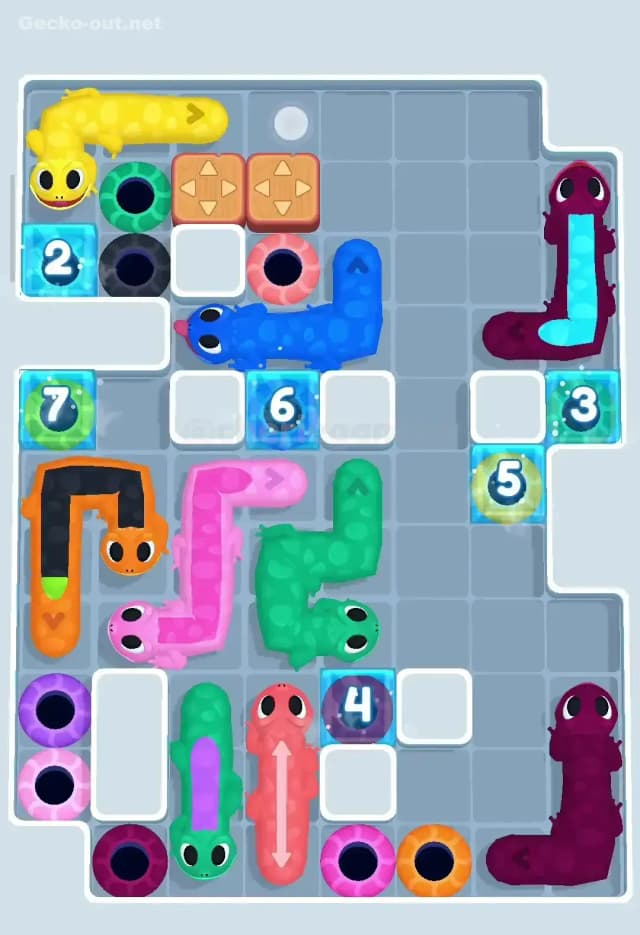
In Gecko Out Level 203 you’re dropped into a very cramped grid with ten geckos of different colors and lengths. The first thing you’ll notice is how many of them are already bent into L‑shapes or jammed into corners:
- Two big green heads at the top fight for space with a chunky brown‑and‑blue L and a tall purple‑blue gecko guarding the right side.
- The center of the board is dominated by a long pink gecko wrapped around a wooden control tile, plus an orange‑and‑black L on the left and a dark blue‑and‑red L on the right.
- The bottom is a knot of three tricky pieces: a small teal gecko, a constrained red gecko that mostly slides up and down, and a tan gecko hugging the lower‑right edge.
Around them are exits in every color, many of them sitting on icy tiles with numbers like 5, 7, 9, 10, 11, 12, 13, and 14. Those numbers basically tell you “not yet”: those exits are locked until the timer reaches that value, so you can’t finish those geckos early even if the path is clear.
The wooden tiles in the middle act as safe parking spots and lane splitters. Because Gecko Out 203 is packed with long bodies, those few open strips of floor between ice and wood are your lifelines for rerouting.
How The Win Condition and Timer Change The Puzzle
The win condition in Gecko Out Level 203 is simple: drag every gecko’s head so its body follows a path into the matching colored hole before the global timer runs out. You can’t:
- Cross walls or leave the grid.
- Pass through other geckos’ bodies or heads.
- Enter any frozen, numbered exit until it’s unlocked.
- Block yourself by drawing a path that boxes in another gecko’s only route.
The twist in Gecko Out 203 is that path‑drawing and the timer are glued together. Long, loopy routes burn time fast, and if you redraw paths too often you’ll hit zero while exits with higher numbers (like 13 and 14) are only just becoming available. That means you need a plan: set up paths that serve multiple geckos, then execute them quickly once their exits thaw, instead of improvising every move.
Pathing Bottlenecks and Logical Traps in Gecko Out Level 203
The Main Bottleneck That Controls Everything
The single biggest bottleneck in Gecko Out Level 203 is the central corridor wrapped by the long pink gecko. When that pink body hugs the wood and inner squares, it blocks routes:
- From the top cluster down to the bottom exits.
- From the left side of the board over to the right.
- Around the frozen exits in the middle (13 and 14).
Until you unwind the pink gecko and park it along an outside wall, every other gecko has to squeeze through tiny gaps, and it feels like nobody can reach their hole without a collision. The whole level opens up the moment pink moves cleanly to the side.
Subtle Problem Spots That Catch You Off Guard
-
Bottom‑middle slider lane (teal + red geckos):
The short teal gecko and the mostly vertical red one share a thin lane that leads to several bottom exits. If you send teal home too early or leave red stuck in the middle, that lane closes for the tan gecko and for any gecko whose exit sits around 10 or 11. -
Top‑right vertical stack:
The tall purple‑blue gecko on the right and the green gecko above it both lean on the same vertical passage. If you pull one of them straight down without thinking, its tail can permanently block the other from reaching its matching hole until you redraw half the board. -
Ice‑number timing trap:
It’s tempting to aim straight for an icy exit as soon as you see the right color, then wait in front of it. In Gecko Out 203, doing that with the high‑number exits (13/14) chokes the central space and wastes timer while that gecko is just hovering, blocking lanes and not actually escaping.
I’ll be honest: the first few runs of Gecko Out Level 203 feel like the board is trolling you. For me, it clicked once I stopped trying to finish whoever was closest to their exit and instead treated pink, tan, and the top‑right geckos as puzzle pieces I had to park neatly along walls before I even thought about sending them home.
Turn-by-Turn Path Strategy to Beat Gecko Out Level 203
Opening: Clearing Space and Parking Safely
In the opening of Gecko Out 203, don’t worry about exits yet. Your goal is to untie the knot:
- Gently drag the pink gecko away from the wooden tile and along the left or bottom wall, tracing a simple U‑shape. You want its body flat against an edge so the middle of the board is empty.
- Nudge the dark blue‑and‑red gecko on the right so it wraps around the lower wood tile and lies mostly horizontally. Again, you’re freeing that interior vertical space.
- Use the new central lane to slide the orange‑and‑black L either deeper into the left side or up against the bottom of the top cluster, avoiding crossings with pink.
- Park the tan gecko in the lower‑right corner, hugging the outer border, not sitting in front of any exit yet. Think of it as a gate that’ll open only near the end.
If you finish the opening correctly, the middle of Gecko Out Level 203 should look surprisingly clean, with most long bodies riding the walls and plenty of straight lanes connecting top and bottom.
Mid-game: Keeping Lanes Open and Avoiding Self-Blocks
In the mid‑game of Gecko Out 203, you start actually scoring escapes, but you still prioritize lane management:
- Look for unfrozen exits with low numbers (like 5, 7, 9, 10). Route their matching geckos using short, direct lines along the walls you already cleared. Avoid zig‑zags; every bend is both time and potential blockage.
- Exit shorter geckos first when they share a lane with a long one. For example, get the teal gecko out before you move the restricted red one into that same column, or you’ll be forced to redraw.
- Keep the central cross‑shaped area around the wood tiles mostly empty. When you must pass a gecko through, move it in one smooth drag straight to a parking wall or its exit; don’t stop halfway or you’ll create a temporary dam.
- When upper exits start unlocking, weave the two top greens and the brown‑blue L out by curling them around the top border, one at a time. Make sure none of their bodies hang straight down into the center when you’re done.
By the end of mid‑game, most of the shorter geckos and low‑number exits in Gecko Out Level 203 should be cleared, leaving you with the large pink, the tan, maybe the vertical red, and one or two of the top cluster.
End-game: Exit Order and Handling Low Time
The end‑game of Gecko Out 203 is all about not creating a last‑second choke:
- Use the central lane to send the restricted red gecko home once its vertical route lines up with its exit and the teal gecko is already gone.
- Next, clear whichever top gecko still remains but has the easiest path down (usually one of the greens). Drag it straight along the outer border to avoid touching the middle.
- Leave the tan gecko for last or second‑to‑last. With everyone else out, you can draw a clean curve from its corner parking spot to its exit without worrying about blocking others.
If you’re low on time in Gecko Out Level 203, stop redrawing routes. Commit to straight, fast drags. As long as the central area is free and you’ve respected the exit‑unlock order, those final runs are literally just “draw an L and done.”
Why This Path Order Works in Gecko Out Level 203
Using Drag-Pathing to Loosen the Knot
This plan works in Gecko Out 203 because it intentionally uses the body‑follow rule to your advantage. By dragging long geckos along the edges early:
- Their bodies redraw into long, smooth rails that define clear corridors.
- The center becomes a neutral zone you can reuse for multiple geckos.
- You avoid the classic mistake where two L‑shapes interlock in the middle, forcing a complete reset.
Whenever you draw, think “how will this body sit when I let go?” If the answer is “flat against a wall,” it’s usually a good move. If it’s “wedged diagonally in the center,” you’re probably tightening the knot.
Timer Management: When to Think Versus When to Move
In Gecko Out Level 203, you win by front‑loading your thinking:
- First 20–30% of the timer: Pause and mentally mark your parking walls, main corridors, and which exits have the lowest numbers. Move slowly and deliberately.
- Middle portion: Execute your preplanned wall‑parking for long geckos and start clearing short ones. You should be moving more confidently now.
- Final stretch: Stop re‑evaluating. You’re mostly running a script—last 2–3 geckos follow known, short routes. Fast, smooth drags beat “perfect but hesitant” here.
Do You Need Boosters in Gecko Out Level 203?
Boosters in Gecko Out 203 are totally optional if you follow this plan. That said:
- An extra time booster helps if you consistently reach the last two geckos with exits 13/14 just opening and only a sliver of time left. Pop it right before you start that final sequence.
- A hammer/clear‑tile booster, if the game offers it, is most valuable on a badly placed frozen exit that’s still locked when you’d like to path through that space. I’d only use it if you mis‑played the early parking and don’t want to restart.
But the level is absolutely beatable clean—no boosters required—once you’re disciplined about central space and exit timing.
Mistakes, Fixes, and Logic You Can Reuse in Other Gecko Out Levels
Common Mistakes in Gecko Out Level 203 (And How To Fix Them)
-
Exiting the nearest gecko first.
Fix: Prioritize clearing the center by wall‑parking long geckos. Escapes come after you’ve built lanes, not before. -
Parking in the middle.
Fix: Never leave a gecko resting across the central cross‑area. If you must stop mid‑drag, stop along a wall or in a corner, not in the traffic zone. -
Ignoring frozen exit numbers.
Fix: Don’t camp a gecko on top of an exit that’s still locked. Park it one turn away along a wall so other geckos can still pass. -
Over‑drawing fancy paths.
Fix: Draw the shortest, straightest path that reaches your goal. Every extra bend is time plus more chance to cage another gecko. -
Moving the red slider gecko too early.
Fix: Treat the constrained red gecko as an end‑game piece. Keep it tucked high or low in its column until the teal and tan geckos are done.
Reusing This Logic on Other Knot-Heavy Gecko Out Levels
What you learn in Gecko Out Level 203 is gold for later stages:
- On any knot‑heavy board, identify one or two “anchor” geckos whose bodies can safely hug edges and turn them into permanent borders.
- On frozen‑exit levels, plan around the highest numbers; pretend those exits don’t exist until late and keep those colors parked, not blocking.
- With slider or constrained geckos, leave them for mid or late game, using them only after other pieces sharing their lane are already solved.
- In gang gecko setups, route the shared lanes first so all linked bodies can move together without clipping others.
Final Encouragement for Gecko Out 203
Gecko Out Level 203 looks overwhelming at first—everything’s long, twisted, and half the exits are locked. But once you treat the pink and tan geckos as movable walls and respect the exit numbers, the puzzle turns into a neat sequence instead of chaos. Stick to parking along the edges, protect the central corridor, and trust your planned exit order. With that mindset, Gecko Out 203 goes from frustrating to one of those levels you clear and immediately think, “Okay, that was actually pretty clever.”