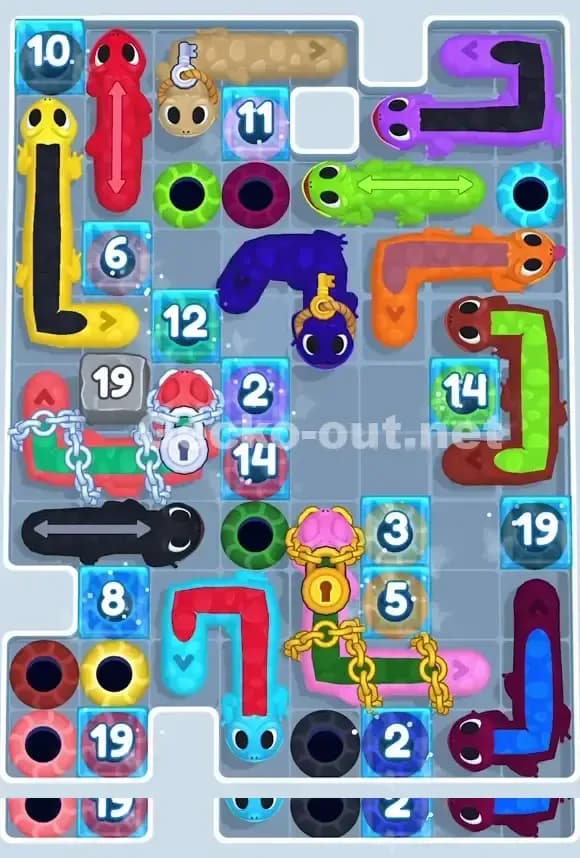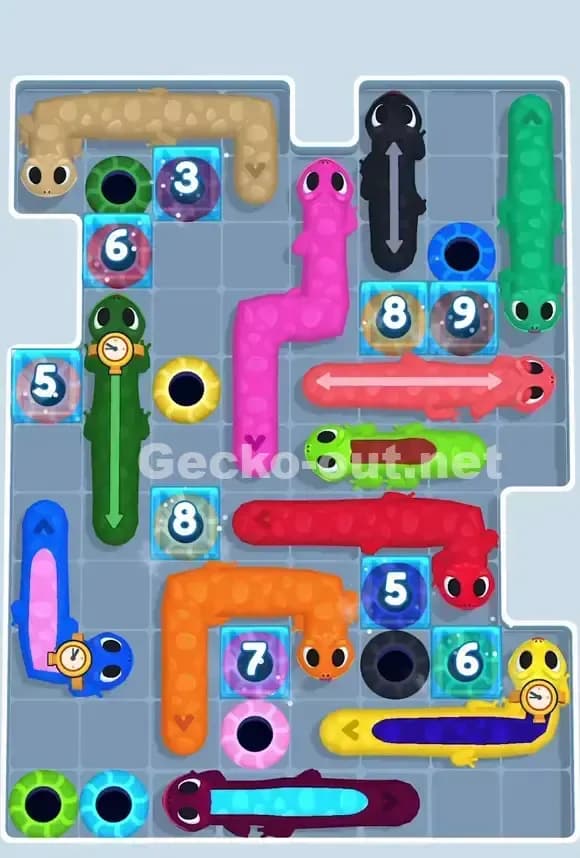
Gecko Out Level 822 Solution Walkthrough | Gecko Out 822 Answer
How to solve Gecko Out level 822? Get step by step solution & cheat for Gecko Out level 822. Solve Gecko Out 822 easily with the answers & video walkthrough.



Gecko Out Level 822: Board Layout, Rules, and Win Condition
Understanding Your Starting Position in Gecko Out Level 822
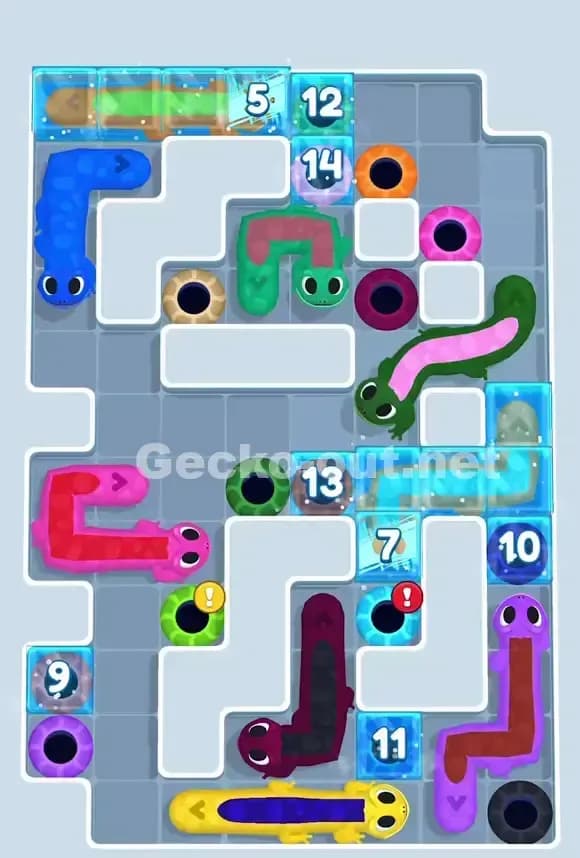
Gecko Out Level 822 throws a lot at you right from the start. You're looking at a dense, multi-colored board packed with eight distinct geckos—blue, orange, green (appears twice), magenta, dark purple, cyan, and yellow—each one needing to reach its matching colored hole before time runs out. The board itself is a maze of white wall corridors that wind through the playing area, creating tight passages and forcing you to think several moves ahead. What makes Gecko Out 822 particularly demanding is that several geckos are medium-to-long bodied, meaning they'll occupy multiple grid squares as they move, and gang geckos (geckos linked together) add extra complexity because moving one affects the other. You'll also notice numbered hole markers scattered across the board, indicating specific exit points that match gecko colors.
The timer sits at the top of the screen, and it's genuinely tight for this level—you don't have room for trial-and-error fumbling. Every drag of a gecko head counts, and every path you draw will lock in that gecko's route through the white corridors until it reaches its exit. If even one gecko hasn't escaped when the timer hits zero, you fail the entire level, so prioritization and sequencing are absolutely critical.
The Win Condition and How Movement Works
Your win condition is refreshingly straightforward: get all eight geckos out through their matching holes before time expires. However, the way Gecko Out Level 822 enforces this rule is unforgiving. When you drag a gecko's head, its body follows the exact path your finger or cursor traces—it doesn't take shortcuts and it doesn't teleport. This means if you paint a route that winds around obstacles inefficiently, you're burning precious seconds and potentially blocking other geckos from moving. The timer doesn't pause, so every second of hesitation counts. Once a gecko is safely in its hole, it's gone and no longer takes up board space, which is your signal that you're making progress. The real satisfaction comes from that moment when the last gecko slides into its hole with just a few seconds to spare.
Pathing Bottlenecks and Logical Traps in Gecko Out Level 822
The Critical Choke Point: The Central White Corridor
The single biggest bottleneck in Gecko Out Level 822 is the central white corridor system that acts as the only efficient path for multiple geckos to reach their exits. Several geckos—particularly the long-bodied ones—need to funnel through this narrow space, and if you route them carelessly, you'll create a gridlock where geckos physically overlap or where one gecko's body blocks another's path entirely. The blue gecko on the left side is especially problematic because it's a long, coiled gecko that, if moved without a clear exit strategy, will sprawl across the board and choke out movement for the green, magenta, and orange geckos. Getting the blue gecko out first might seem logical, but its sheer size means you need to plan its exit path with surgical precision—any wasted grid squares and you'll run out of room for other geckos to follow.
Subtle Trap: The Gang Gecko Coordination Problem
Gecko Out Level 822 includes what appears to be a linked "gang" gecko pairing (look at the green geckos), and moving one means the other moves simultaneously or is affected by the same drag. This creates a secondary bottleneck because you can't independently route each member to their own exit—they move as a unit. Many players try to muscle both out at once, forgetting that gang geckos sometimes need one member to wait in a "parking spot" (a safe dead-end or corner) while the other exits first. If you drag both toward their holes without thinking about this constraint, you'll find them colliding with walls or with other geckos trying to move past.
Another Sneaky Trap: The Frozen or Warning Holes
Some of the numbered holes you see (like holes marked 5, 12, 14, and others) might be warning holes or temporarily frozen exits—they look like valid exits but won't accept a gecko until a certain condition is met or until you've cleared other geckos first. Gecko Out Level 822 doesn't explicitly tell you which holes are "live" and which are locked, so you need to read the visual clues carefully. A hole that looks slightly darker, dimmed, or has a different visual treatment than the others is your hint that it's not immediately available. Dragging a gecko toward a frozen hole wastes precious seconds and leaves you scrambling to reroute mid-level.
Personal Moment: When It All Clicked
I'll be honest—my first three attempts at Gecko Out Level 822 felt chaotic. I was dragging geckos randomly, watching them collide with walls, backtrack, and tangle up in the center. But around attempt four, I realized that the board wasn't actually a puzzle to solve all at once; it was a sequence puzzle. If I could get just the blue gecko out cleanly, the rest of the board opened up like magic. That's when everything shifted from frustration to focus. Gecko Out Level 822 isn't impossible—it just demands that you stop thinking "get everyone out fast" and start thinking "what's the first domino that makes all the others fall naturally?"
Turn-by-Turn Path Strategy to Beat Gecko Out Level 822
Opening Moves: Blue Gecko First, Then Parking Strategy
Start by carefully routing the blue gecko on the left side toward its matching blue exit hole. Don't rush this—trace a clean, efficient path along the white corridors that doesn't backtrack. The blue gecko is your key domino because it's the longest piece on the board, and removing it frees up crucial space for the magenta, green, and orange geckos that follow. Once the blue gecko is committed to its path, immediately shift focus to the orange gecko in the upper right. Route it smoothly toward its exit without letting it drift into the center corridor where it might block the blue gecko's route.
For Gecko Out Level 822, your first "parking move" should be directing one of the green geckos into a safe corner or dead-end zone—not toward its exit yet, but into a holding area where it won't interfere with other geckos' paths. This might feel counterintuitive, but it's genius on a crowded board like this one. You're essentially creating a temporary "out of the way" spot for a gecko that would otherwise become an obstacle. This technique alone saves you 10–15 seconds of untangling later.
Mid-Game: Keep Critical Lanes Open, Reposition Systematically
Once blue and orange are out (assuming you've nailed those paths), the center corridor should feel noticeably less congested. Now route the yellow gecko carefully—it's another longer piece, so give it plenty of space and don't cut corners. The cyan gecko and the dark purple gecko should follow in quick succession using the now-clearer lanes. On Gecko Out Level 822, this is your rhythm phase: you're not in crisis mode, but you're moving steadily and always thinking two geckos ahead.
The gang gecko pair (the two greens) requires special attention here. Unpark the first green gecko and drag it toward its exit, then immediately commit to moving the second green gecko before you forget its location. Many players lose valuable seconds because they route one gang member out and then can't remember where the other one was parked. Use clear, deliberate paths, and don't be afraid to pause for a single breath to mentally map the next two moves.
End-Game: Final Exits and Last-Second Desperation Plays
You're down to the last two or three geckos, and the timer is getting real. Gecko Out Level 822 at this stage demands speed, but not recklessness. Route your second-to-last gecko with confidence, using the wide-open corridors now available. The final gecko should have the clearest possible path—in fact, if you've executed the earlier moves correctly, the final gecko should feel almost trivial to move because there's zero congestion left.
If you suddenly realize you're low on time (say, 5–10 seconds left) and there's still a gecko or two on the board, don't panic. Check if there's a booster available (like a time extension or a hint). Gecko Out Level 822 typically doesn't require boosters if you're efficient, but if you're cutting it close, spending your booster now is smarter than failing and starting over. Alternatively, if there's a gecko stuck in a choke point, see if you can draw a shorter, more direct path to its exit hole by moving it just a few grid squares at a time rather than a long diagonal route.
Why This Path Order Works in Gecko Out Level 822
How Body-Follow Pathing Untangles Instead of Tightens
The genius of this strategy for Gecko Out Level 822 is that it respects the fundamental physics of the body-follow system. When you drag a gecko's head, the body must trace exactly that path—it can't cut across empty space or skip corners. By removing the longest, most space-consuming geckos first (blue, then orange, then yellow), you're eliminating the pieces that would otherwise create bottlenecks for everyone else. Each removal opens new corridors for the remaining geckos. If you tried to route all eight geckos simultaneously or in a random order, you'd be fighting against the body-follow mechanic—longer pieces would inevitably block shorter ones, and you'd spend way more time correcting collisions than actually progressing.
This strategy also leverages "parking"—the technique of moving a gecko into a safe corner without routing it to its final exit. By parking gang gecko members or smaller pieces temporarily, you reduce active congestion on the board while keeping those geckos available for later moves. It's like clearing debris from a construction site before bringing in the heavy equipment.
Balancing Speed and Precision: When to Pause, When to Commit
Gecko Out Level 822 tests your ability to make fast decisions without being careless. The timer is tight enough that you can't afford to restart geckos mid-path, but it's also generous enough that 3–4 seconds of careful planning before a move is always worth it. My advice: pause for a single breath before routing the blue gecko and the gang geckos—these are your critical paths. For the smaller, simpler geckos (like a short, straight gecko), trust your instincts and move immediately. You'll develop a rhythm where you're analyzing and moving almost simultaneously, which is exactly the skill that beats Gecko Out Level 822 consistently.
Boosters: Optional, Not Required
Gecko Out Level 822 doesn't strictly require boosters if you execute the strategy cleanly. A time extension booster is nice insurance if you find yourself with 5 or fewer seconds remaining and one gecko still on the board, but it shouldn't be your plan A. If you're consistently running out of time before finishing the level, the issue isn't the timer—it's that your path order or parking strategy needs tweaking. Hint boosters can be helpful if you're genuinely stuck on board layout, but since you now have the move sequence above, you shouldn't need them.
Mistakes, Fixes, and Logic You Can Reuse in Other Gecko Out Levels
Common Mistakes on Gecko Out Level 822 and How to Fix Them
Mistake 1: Routing the longest gecko last. Players often save the blue gecko or yellow gecko for the end, thinking they'll have more room by then. What actually happens is that the long gecko tangles up the board before you route it, leaving you with an unsolvable knot and zero time to untangle it. Fix: Always route long geckos early, ideally in the first three moves of Gecko Out Level 822.
Mistake 2: Forgetting about gang geckos and moving them both toward exits simultaneously. You drag one green gecko toward its hole, then try to route the other, and suddenly they're colliding or moving in ways you didn't predict. Fix: Mentally "park" one gang gecko member in a dead-end before committing the other to an exit route. Move them out separately, not together.
Mistake 3: Trying to be too clever with diagonal or spiral paths. Some players think fancy routing looks cool and might save time. In reality, Gecko Out Level 822 rewards straight, efficient paths along the white corridors. A gecko doesn't move faster if its path is elegant—it moves at the same speed regardless. Fix: Favor direct routes over artistic ones. Straight paths are faster and less likely to cause collisions.
Mistake 4: Not reading the hole markers. You see a colored hole and assume it's active, but on Gecko Out Level 822, some holes are locked or frozen. You route a gecko toward a dead hole and waste precious seconds. Fix: Before committing to a gecko's exit route, double-check that the hole looks visually "live"—it should be bright, clear, and match the gecko's color without any dimming or warning overlay.
Mistake 5: Losing track of where parked geckos are. You move a gecko into a corner to park it, then 20 seconds later you can't remember which gecko is where. You accidentally route the wrong gecko. Fix: On Gecko Out Level 822, park geckos in visually distinct areas (like a corner or an alcove) so they're easy to spot and retrieve when needed. Consider parking only one gecko at a time to minimize confusion.
Reusing This Logic on Similar Levels
The principles that beat Gecko Out Level 822 work on any crowded, multi-gecko level with long pieces and gang geckos. If you encounter another level with a similar layout—lots of geckos, narrow corridors, long body pieces—apply the exact same strategy: identify your longest geckos, remove them first in order of size, park any gang geckos temporarily, and watch the board open up. This approach scales beautifully because it's based on the fundamental constraint of body-follow pathing, not on the specific layout of Gecko Out Level 822.
For levels with frozen exits or warning holes, take five extra seconds at the start to identify which holes are actually live. Mark them mentally or gesture toward them. For levels with tight choke points or gang geckos, the parking technique is your secret weapon—it's not cheating, it's elegant problem-solving that respects the game's physics.
Final Encouragement: You've Got This
Gecko Out Level 822 is genuinely tough, and if you've struggled with it, you're not alone. But now that you understand the board layout, the bottleneck pattern, and the removal sequence, it's absolutely beatable. The timer isn't cruel—it's just firm. Execute the opening blue gecko move cleanly, trust the parking strategy for gang geckos, and let the mid-game rhythm carry you. You'll hit that final gecko exit with time to spare, and when you do, you'll feel the satisfaction of solving a real puzzle, not just mashing buttons. Gecko Out Level 822 is your next victory waiting to happen.