Gecko Out Level 825 Solution Walkthrough | Gecko Out 825 Answer
How to solve Gecko Out level 825? Get step by step solution & cheat for Gecko Out level 825. Solve Gecko Out 825 easily with the answers & video walkthrough.



Gecko Out Level 825: Board Layout, Rules, and Win Condition
Understanding the Starting Board
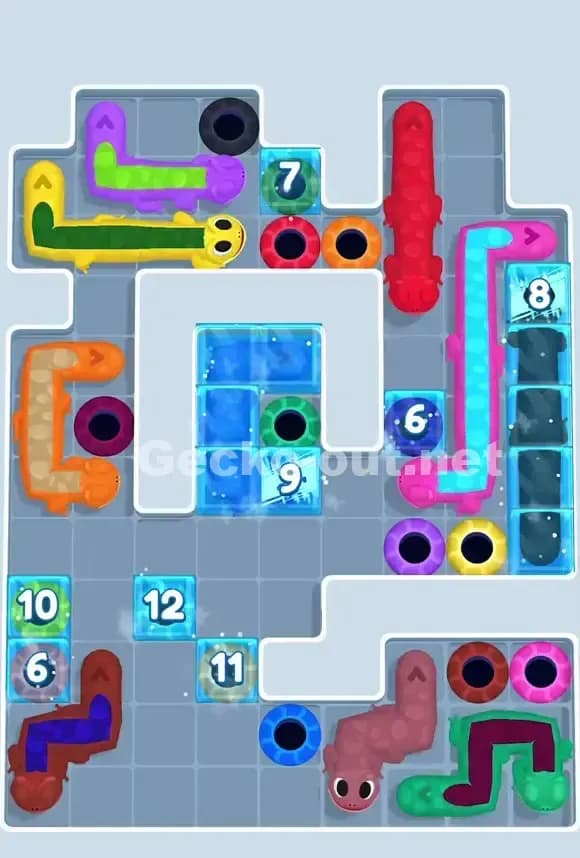
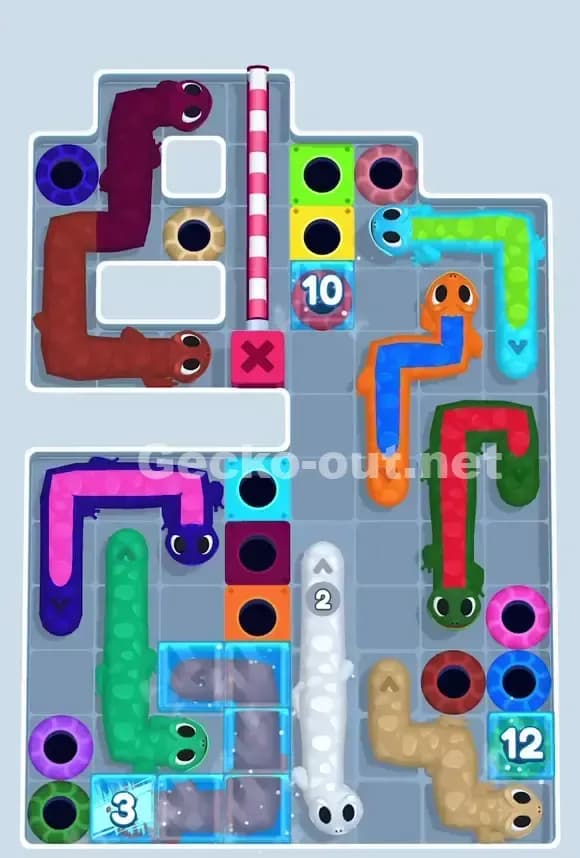
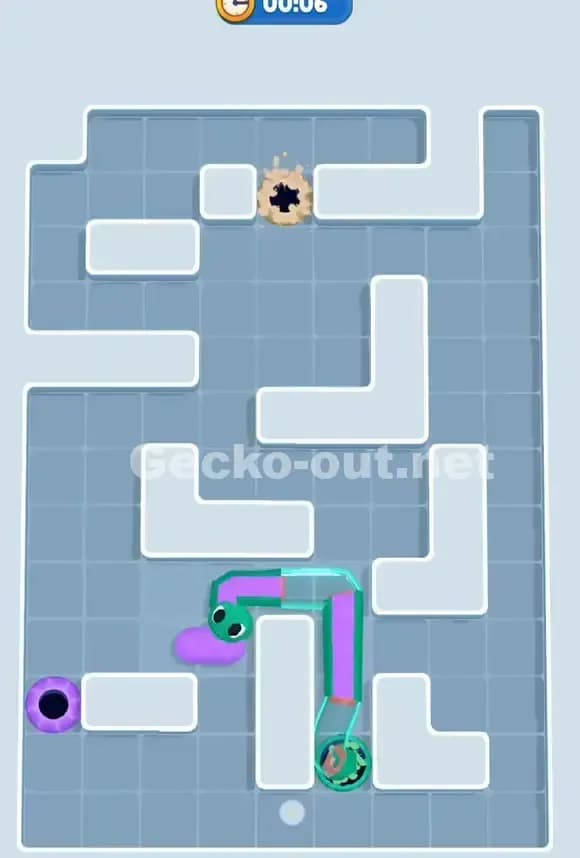
Gecko Out Level 825 is a densely packed puzzle that forces you to coordinate six geckos across a maze of white walls and colored exit holes. You'll start with a yellow gecko stretched horizontally at the top, a green gecko on the left side, a cyan gecko in the upper-middle area, a blue gecko in the center, a brown gecko near the bottom-middle, and a black-and-pink gang gecko occupying the lower-left quadrant. Each gecko must reach its corresponding color hole on the right side of the board before the timer expires. The layout features tight corridors, overlapping paths, and several geckos positioned so close together that even a single wrong drag can cause a chain-reaction jam. The white wall obstacles divide the board into distinct regions, and you'll notice immediately that some geckos are much longer than others—particularly the yellow gecko and the gang gecko—which means they take up valuable real estate as you try to maneuver.
Win Condition and Timer Pressure
Your mission in Gecko Out Level 825 is straightforward: get all six geckos out before the timer hits zero. What makes this challenging isn't just the maze itself, but the fact that each gecko's body follows the exact path you drag its head through. If you draw a path that curves around an obstacle, the entire gecko body traces that curve, which can block other geckos from using nearby lanes. The timer shown at the top starts at roughly two minutes and twelve seconds, which sounds generous until you realize that hesitation, false moves, and repositioning time eats into your cushion fast. You cannot afford to make a major pathing mistake on Gecko Out Level 825 because there's no room to undo and re-drag; you have to restart the level or commit to a workaround that costs precious seconds.
Pathing Bottlenecks and Logical Traps in Gecko Out Level 825
The Central Corridor Choke Point
The single biggest bottleneck in Gecko Out Level 825 is the middle horizontal lane that serves as the main artery for at least four geckos trying to reach the right-side exits. The blue gecko and the cyan gecko both need to thread through this corridor, and because they're separated by white walls, they can't take identical routes. If you move the blue gecko first and its body coils up in the center, you've essentially blocked the cyan gecko from using the shortest path to its exit hole. Even worse, the brown gecko at the bottom also has to navigate around this region, which means you're juggling three geckos through a space that was designed to feel cramped. The yellow gecko at the top seems like it should have an easy time, but its length makes it impossible to ignore—if it snakes down carelessly, its tail can block critical junctions that other geckos desperately need.
Subtle Problem Spots That Trip Most Players
The first trap is underestimating the green gecko on the left. It looks relatively isolated, but its hole is positioned such that you must drag it rightward and downward through a narrow passage. If you move the gang gecko (black-and-pink) before clearing the green gecko's path, you'll find that the gang gecko's bulk creates an impassable wall. The second problem spot is the upper-right corner where the cyan gecko's exit sits near the blue gecko's starting region. These two geckos can easily interfere with each other if you don't plan their routes carefully; dragging one too aggressively can force the other into a dead-end spiral. The third trap is the lower section, where the brown gecko, the gang gecko, and the black-pink partner gecko all compete for routing space. Players often try to rush the brown gecko toward its exit hole without realizing that the gang gecko needs to exit first, otherwise you're boxing in the brown gecko's escape route.
The Moment It Clicked
I'll be honest: my first three attempts at Gecko Out Level 825 felt like organized chaos. I'd get four geckos out cleanly, only to watch the timer tick down while the brown gecko and the gang gecko tangled themselves into an unsolvable knot. That's when I realized I was solving the puzzle backward. Instead of thinking "move gecko A to hole A," I had to think "which gecko must leave first so that the others have space?" The breakthrough came when I plotted the gang gecko's exit path first—because it's the longest and most constraining—and then built everything else around it. Once I committed to that order, the rest of the level unfolded like a logic puzzle rather than a scramble, and I cleared Gecko Out Level 825 with nearly thirty seconds remaining.
Turn-by-Turn Path Strategy to Beat Gecko Out Level 825
Opening: Prioritize the Gang Gecko and the Green Gecko
Start by dragging the gang gecko (black-and-pink) downward and slightly rightward, guiding it toward the pink hole on the left side of the lower-exit column. Don't try to be clever with a shortcut; the direct path keeps its body out of the way and clears the lower-left region in about eight seconds. Immediately follow up by moving the green gecko on the left side upward and then rightward, threading it toward the green hole in the middle-right area. These two moves are your foundation because they remove the two longest obstacles and create breathing room for the remaining four geckos. Park the yellow gecko at the top by leaving it stationary for now; its length makes it a liability if you move it early, so treat it as a parking spot that you'll use only when the board is nearly empty.
Mid-Game: Maintain Open Lanes and Reposition Strategically
Once the gang gecko and green gecko are out, focus on the cyan gecko in the upper-right area. Drag it downward and then rightward toward the cyan hole on the right edge, curving around the white walls as needed. This move opens the top portion of the board. Next, guide the blue gecko through the central corridor, being very careful not to let its body extend into the lanes that the brown gecko will need. Drag the blue gecko rightward first, then downward toward the blue hole in the lower-right corner. As you do this, you'll feel the board tightening slightly—that's normal. The key is to avoid spiraling the blue gecko's body into the center because its tail will block the brown gecko's exit later. If you notice the blue gecko's path is getting tangled, pause for a moment, reset your spatial awareness, and drag it with a smooth, wide curve that respects the existing wall layout.
End-Game: Execute the Brown Gecko and Yellow Gecko in Reverse Order
With four geckos out and roughly thirty to forty seconds remaining on the timer, move the brown gecko. Drag it downward from its current position, then rightward toward the brown hole on the far-right side. The brown gecko should have a clear lane by now because the gang gecko is gone. Finally, tackle the yellow gecko at the top. Even though it's the longest gecko, it should have a nearly straight path down the left side and then rightward toward the yellow hole at the top of the exit column. If you're running low on time during this final stretch, don't panic—keep your drags smooth and direct. Avoid unnecessary curves; just aim the yellow gecko's head toward its hole and trust that the body will follow the grid path.
Why This Path Order Works in Gecko Out Level 825
Leveraging Head-Drag Pathing and Body-Follow Mechanics
The genius of this strategy for Gecko Out Level 825 is that it removes the longest and most constraining geckos first, which means their bodies aren't blocking critical junctions as you maneuver the shorter geckos. When you drag the gang gecko out early, its body isn't sitting in the middle of the board where it would collide with the cyan gecko or the blue gecko. Similarly, by moving the green gecko before the blue gecko, you ensure that the green gecko's final position doesn't interfere with the blue gecko's need to navigate the central corridor. The body-follow rule sounds simple, but it's deceptively powerful: a gecko's body always traces the exact path you drag the head through, which means you can predict where obstacles will end up. This level rewards players who think three moves ahead and visualize the board state after each gecko exits.
Balancing Speed and Careful Planning
Gecko Out Level 825 tests your ability to move quickly without rushing. The timer gives you about two minutes, which is enough time to complete the level methodically, but not enough time to waste on false starts or excessive repositioning. My recommendation is to spend the first ten to fifteen seconds studying the board and identifying the gang gecko and green gecko as your exit priorities. Once you've made that decision, commit to the drags without second-guessing. As you move into the mid-game with four geckos remaining, you'll have more breathing room, so this is when you can afford a slightly longer pause if a cyan or blue gecko drag feels uncertain. Never hesitate during the final stretch; if you've planned correctly, the last two geckos should exit in quick succession.
Booster Usage: When It's Actually Necessary
Gecko Out Level 825 doesn't strictly require boosters if you execute the strategy above. However, if you find yourself with fewer than twenty seconds remaining and two geckos still on the board, an extra-time booster is your safety net. I'd recommend avoiding the hammer tool because it can destroy walls you might need, and instead opt for time extension if you're genuinely struggling with execution. Hints are optional; the level is puzzle-like enough that thinking through the order yourself builds problem-solving skills that carry forward to harder levels.
Mistakes, Fixes, and Logic You Can Reuse in Other Gecko Out Levels
Common Mistakes and How to Correct Them
Mistake One: Moving the yellow gecko early because it looks "easy." Fix this by remembering that the longest gecko is the highest priority for parking, not moving. Mistake Two: Dragging the blue gecko and cyan gecko in the wrong order, causing their bodies to tangle in the central corridor. Fix this by always dragging cyan first, then blue, because cyan's exit is further up the board and won't conflict with blue's lower trajectory. Mistake Three: Ignoring the gang gecko's exit requirement and assuming it can be moved anytime. Fix this by treating gang geckos and multi-colored long geckos as your first priority always; they take up the most board space and create the most conflict. Mistake Four: Trying to save time by dragging multiple geckos in rapid succession without pausing. Fix this by taking a one-second breath between each drag to visually confirm that the gecko has settled and isn't blocking anyone. Mistake Five: Using boosters preemptively because you're afraid you'll run out of time. Fix this by trusting the strategy and only using boosters after you've genuinely made a mistake and lost significant time.
Reusable Logic for Similar Levels
This Gecko Out Level 825 strategy applies perfectly to other levels with gang geckos, frozen geckos, or tight-corridor designs. Whenever you see a long gecko or a linked duo taking up board space, make them your first exit priority. Whenever you see a central corridor or narrow choke point, identify which two geckos will compete for it most intensely, and plan their exit order before you drag a single head. The "parking lot" principle—where you leave some geckos stationary while others clear the board around them—is universally useful. Finally, always drag longer geckos before shorter ones unless the shorter gecko's exit is being directly blocked, because length equals blocking potential.
Final Encouragement
Gecko Out Level 825 is unquestionably tough, but it's also completely beatable with a clear, logical plan. The difficulty here isn't about reflexes or speed; it's about spatial reasoning and the discipline to commit to the right order. Once you've cleared Gecko Out Level 825, you'll feel a genuine sense of accomplishment because you've solved a genuine puzzle. Stick with the strategy, trust your drags, and you'll be celebrating your victory in under two minutes. You've got this.