Gecko Out Level 1043 Solution Walkthrough | Gecko Out 1043 Answer
How to solve Gecko Out level 1043? Get step by step solution & cheat for Gecko Out level 1043. Solve Gecko Out 1043 easily with the answers & video walkthrough.




Gecko Out Level 1043: Board Layout, Rules, and Win Condition
Understanding the Starting Board
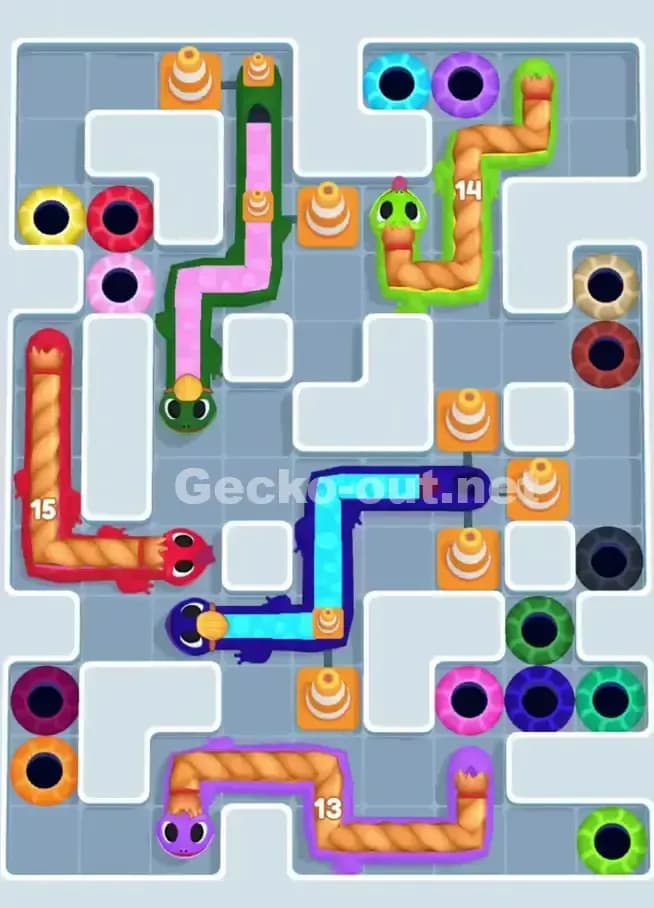
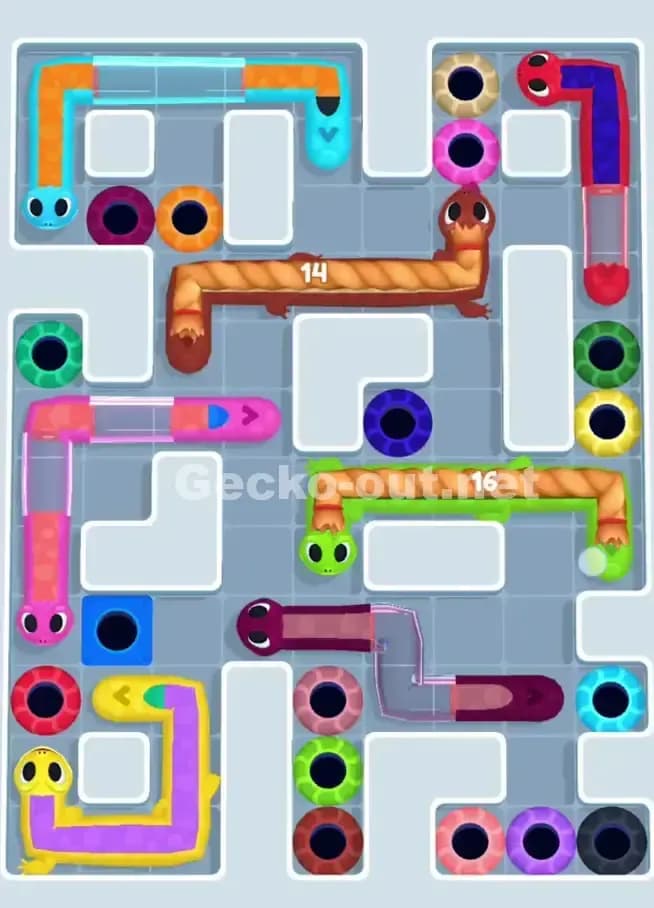
Gecko Out Level 1043 throws you into a complex multi-gecko puzzle with eight different colored geckos scattered across a tight grid. You're dealing with an orange gecko (linked as a long gang), a red gecko, a yellow gecko, a blue gecko, a green gecko, a purple gecko, and several single-tile geckos in brown, pink, and other colors. The board is densely packed with walls creating a maze-like structure, and there's a timer counting down at the top that shows you've got limited moves to orchestrate this escape. Each gecko must reach its matching-colored hole to exit safely, and here's the catch: their bodies follow the exact path you drag their heads along, so one wrong swipe can trap your gecko behind another or lock them into a dead end. The orange gang gecko is particularly tricky because it's long and snakes through the middle of the board, acting as a physical barrier that blocks multiple pathways simultaneously.
The Win Condition and Timer Pressure
To beat Gecko Out Level 1043, you need all eight geckos safely tucked into their matching holes before the timer runs out. That timer isn't forgiving—it's ticking down steadily, and once it hits zero, you lose and have to restart. The pressure is real because you can't just solve the puzzle; you have to solve it efficiently. Every drag counts, and every second you pause to think is a second closer to failure. The body-following mechanic means you can't just yank a gecko head toward the goal in a straight line; you have to map out the actual path their body will travel, accounting for walls, other geckos, and the layout of the corridors. This is what makes Gecko Out Level 1043 genuinely strategic—it's not just about finding the exit, it's about orchestrating a precise sequence so that no gecko blocks another's escape route.
Pathing Bottlenecks and Logical Traps in Gecko Out Level 1043
The Orange Gang Gecko Stranglehold
The biggest bottleneck in Gecko Out Level 1043 is undoubtedly the orange gang gecko snaking through the center of the board. This long gecko currently occupies a critical corridor that multiple other geckos need to traverse to reach their holes. If you don't move the orange gecko first, you'll quickly find yourself in a deadlock where red, yellow, or other geckos are physically blocked by its coiled body. The orange gecko must exit before you can safely route most of the other escapees. Think of it as the key to unlocking the entire puzzle—move it out of the way, and suddenly three or four other geckos have clear paths forward.
Subtle Traps and Pressure Points
Beyond the orange blockade, Gecko Out Level 1043 hides several sneaky obstacles. The red gecko on the right side of the board has a very narrow exit corridor; if you route it too early, its body might accidentally land on top of another gecko's path, creating a jam that wastes precious seconds untangling. The yellow gecko at the bottom-left presents another trap: its hole is accessible, but the route there winds through tight corridors where a single misstep means dragging it into a wall or into the blue gecko's escape route. Finally, the green gecko on the lower-right sits in a position where it's tempting to move it early, but doing so creates a domino effect that blocks the purple gecko behind it. These aren't walls stopping you—they're spatial traps where poor sequencing creates artificial deadlocks.
Personal Moment of "Aha!"
Honestly, my first two attempts at Gecko Out Level 1043 felt like I was playing whack-a-mole, moving geckos frantically and watching them pile up in the middle of the board. But then I realized: I was thinking about individual geckos instead of thinking about lanes. Once I mapped out which gecko absolutely had to move first (orange), second (yellow from the bottom-left), and third (the gang that clears the middle corridor), everything clicked. The puzzle stopped feeling like chaos and started feeling like a choreographed dance where each move created space for the next. That shift from reactive to proactive thinking is what makes Gecko Out Level 1043 solvable.
Turn-by-Turn Path Strategy to Beat Gecko Out Level 1043
Opening: Clear the Orange Blockade and Establish Safe Parking Zones
Start by targeting the orange gang gecko immediately. Drag its head toward the upper-right exit corridor and carefully guide it out without letting its long body loop back and trap itself. This is your priority move because it's the only gecko blocking multiple other pathways. Once orange is out, you've freed up huge portions of the board. Next, move the yellow gecko from the bottom-left corner upward toward its yellow hole at the top-left. This seems counterintuitive, but routing yellow early ensures its long path doesn't later tangle with red or blue. Park the blue gecko in its starting position for now—don't move it yet. The goal in the opening is to clear two major obstacles (orange and yellow) so that the board feels less crowded and you have mental breathing room.
Mid-Game: Keep Critical Lanes Open and Avoid Cross-Blocking
Once orange and yellow are safely exited, you've got breathing room, but don't squander it. The red gecko is next—carefully route it rightward toward its red hole without dragging it through the center where it might collide with green or purple. As you move red, keep an eye on the blue gecko; its path will eventually need to snake through the bottom-left, so don't park any gecko there permanently. The green gecko and purple gecko are linked in terms of sequencing: green must exit before purple because purple's corridor is blocked by green's current position. Route green toward the lower-right exit, then immediately follow up with purple toward the lower-right area as well. This is where timing matters most—you're now executing a three-gecko sequence (green, purple, and the remaining singles) in rapid succession, and the timer is showing real pressure.
End-Game: The Final Rush and Avoiding Last-Second Choke Points
By the end-game, you should have five or six geckos safely exited, leaving three or four stragglers. The brown gecko, pink gecko, and any other single-tile geckos should be your finale because they move quickly and don't create path complications. Route them one by one toward their matching holes. If you're running low on time (say, 10–15 seconds remaining), don't panic—move decisively and trust your pathing. The most common end-game mistake is hesitating, so commit to each drag and keep momentum flowing. If you're dangerously low on time and one gecko is stubbornly stuck, consider using a booster (see below), but ideally you shouldn't need to.
Why This Path Order Works in Gecko Out Level 1043
Using Head-Drag Pathing to Untangle, Not Tighten
The genius of this strategy is that it follows the law of "untangle first, escape second." By moving the orange gang gecko before anything else, you're removing the knot at the center of the board rather than trying to thread other geckos around it. This saves time and reduces the cognitive load of juggling seven simultaneous pathways. The body-follow rule means every gecko's body traces the exact path its head takes, so by moving geckos in an order that creates open space, you're essentially creating "safe corridors" for later geckos. Yellow moves early so its long body doesn't later intersect with blue or red's escape routes. Green moves before purple so purple has a clear lane. It's a cascade of liberation, not a scramble of interference.
Timer Management: Pause Smart, Move Fast
Gecko Out Level 1043 gives you roughly 60–80 seconds depending on your skill level. In the opening 20 seconds, take 5–10 seconds to visually trace each gecko's path before dragging; this prevents costly mistakes. Once orange is exiting, speed up—you've got momentum and the board is becoming clearer, so move with confidence. In the final 20 seconds, don't overthink; drag with purpose. The balance between deliberation and speed is what separates a close win from a time-out loss. If you find yourself stuck mid-game (say, at the 35-second mark with three geckos still on board), pause for one full second, identify the next logical move, and execute. Don't let time pressure turn you into a random clicker.
Booster Strategy for Gecko Out Level 1043
For most players, Gecko Out Level 1043 is solvable without boosters if you follow this path order. However, if you're 5–10 seconds away from timing out with just one or two geckos left, an extra-time booster is warranted—it's not failure, it's insurance. A "hint" booster is less useful here because the challenge isn't figuring out which path works; it's executing multiple paths under time pressure. If you have a "hammer" or similar tool that removes obstacles, save it for a gecko that's genuinely stuck, not for a gecko that just needs a slightly longer path. In most cases, Gecko Out Level 1043 rewards clean play over boosters, so use them sparingly.
Mistakes, Fixes, and Logic You Can Reuse in Other Gecko Out Levels
Common Mistakes and Immediate Fixes
Mistake 1: Moving small single-tile geckos first. Players often target the simplest geckos first, thinking it'll build momentum. Wrong. Small geckos exit quickly but don't free up space, so they should be saved for last. Fix: Always map out which geckos are blocking others, and move those first.
Mistake 2: Trying to route long geckos through tight corridors without clearing other geckos first. The orange and yellow geckos in Gecko Out Level 1043 are long, and squeezing them through narrow gaps when the board is crowded causes them to loop back on themselves. Fix: Clear the board first, then move long geckos.
Mistake 3: Dragging a gecko head too fast without watching the body. If you swipe quickly, you might miss that the gecko's body is colliding with a wall mid-path. Fix: Drag slowly and deliberately, watching the entire body trace the route.
Mistake 4: Parking geckos in "temporary" spots that later become blocking points. A gecko you meant to move in five seconds ends up sitting in a chokepoint for 30 seconds because you forgot about it. Fix: Keep a mental stack of "next three moves" so you always know where each gecko should go.
Mistake 5: Using a booster too early out of frustration instead of restarting and replanning. Boosters are a resource, and wasting them on Gecko Out Level 1043 attempt #2 means you won't have them for attempt #3 if needed. Fix: If you mess up, restart immediately and try the sequence again rather than throwing a booster at a failed playthrough.
Transferable Logic for Similar Levels
This path-sequencing approach works brilliantly on any Gecko Out level with multiple long geckos, gang geckos, or frozen exits. The core principle—clear blockers first, then solve for the rest—applies everywhere. If you encounter a level with a locked or frozen exit, move that gecko last. If there's a toll gate, plan your route to pass through it only when necessary. If you're facing tied-together "gang" geckos, understand that moving one constrains the other, so account for both bodies simultaneously. Gecko Out Level 1043 teaches you to think in sequences rather than individual moves, and that discipline transfers to every harder level you'll face.
Final Encouragement
Gecko Out Level 1043 is genuinely tough—it's a puzzle that punishes hasty play and rewards methodical thinking—but it's absolutely, 100% beatable. The moment you stop seeing eight separate problems and start seeing one choreography, you've won half the battle. Plan your sequence, trust your pathing, manage your time, and you'll clear it. And once you do, you'll have unlocked a mental framework that makes every subsequent level feel a little bit more manageable. You've got this.