Gecko Out Level 273 Solution Walkthrough | Gecko Out 273 Answer
How to solve Gecko Out level 273? Get step by step solution & cheat for Gecko Out level 273. Solve Gecko Out 273 easily with the answers & video walkthrough.

Gecko Out Level 273: Board Layout, Rules, and Win Condition
The Starting Board In Gecko Out 273
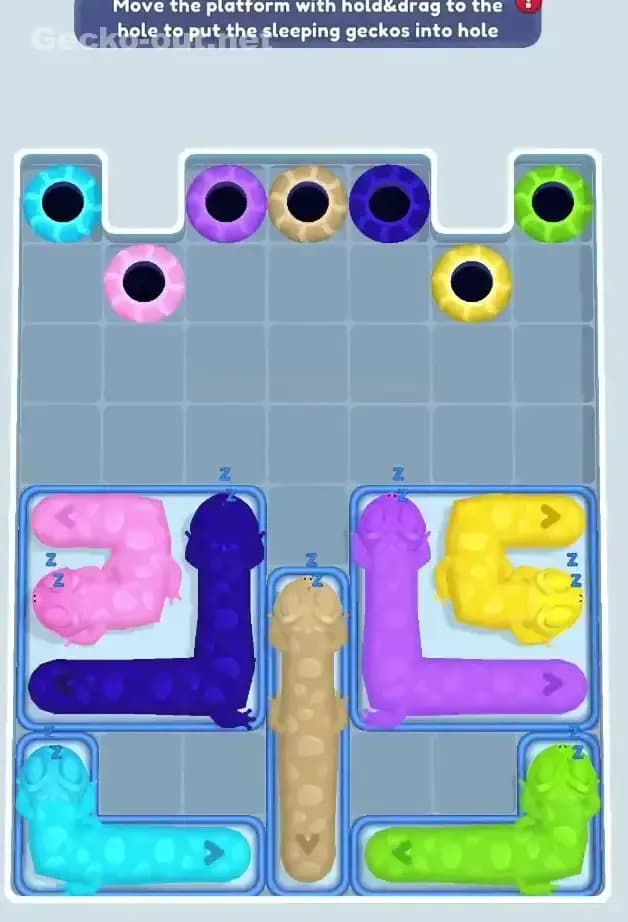
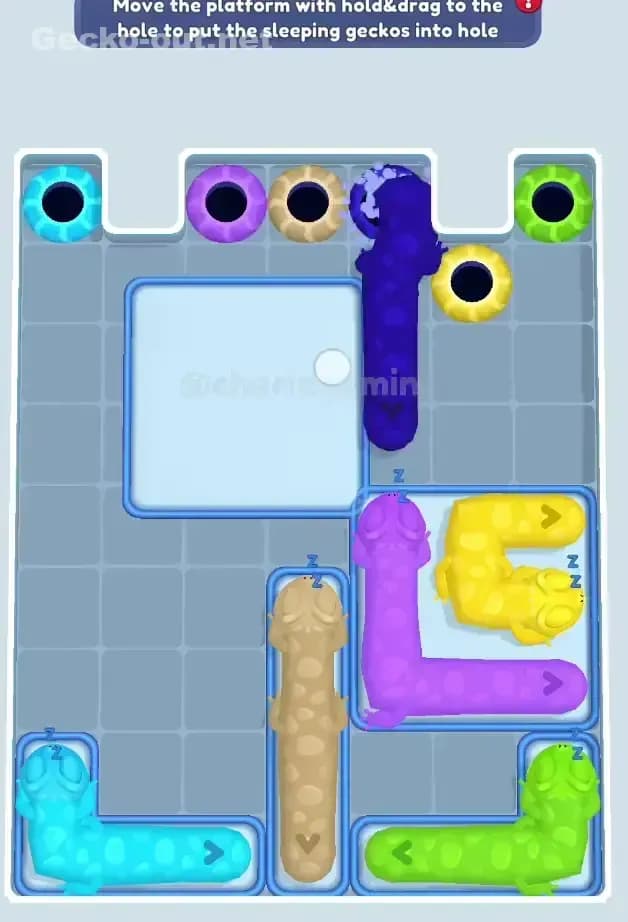
In Gecko Out Level 273 you start with seven sleeping geckos crammed into the bottom half of the board. Every gecko has a matching hole along the top edge in this left‑to‑right order: light blue, pink, tan, dark blue, yellow, and green. The center of the row is where the key fight happens, because the tan and dark‑blue holes sit above the tightest part of the knot.
On the board itself, the geckos are stacked in three dense rows:
- Left side: a short light‑blue L in the bottom corner and a bigger pink L right above it, both hugging the left wall.
- Middle: a tall dark‑blue gecko standing up, and right beside it an even taller tan gecko reaching from the bottom almost to the top of the packed area.
- Right side: a purple L and a yellow L make a thick block in the mid‑right, with a green L tucked into the lower‑right corner.
There are no toll gates or frozen exits in Gecko Out 273, but the shape of the geckos themselves acts like a maze. Most columns are partly “sealed” by these long vertical bodies. At first glance it looks like you’ll never get the central tan and dark‑blue geckos to their holes without trapping someone.
Win Condition And Why The Timer Hurts
To beat Gecko Out Level 273, you must guide every gecko into the hole of the same color before the timer hits zero. Because movement is path‑based, every drag you make draws a literal snake‑like route that the body copies exactly. You can’t cross walls, other geckos, or holes that don’t match the gecko’s color.
That’s what makes Gecko Out 273 tricky: if you draw a nice, safe route for one gecko but its body ends up snaking across the middle of the board, you may accidentally cut off two or three other colors from their exits. The timer pushes you to drag quickly, but if you rush and improvise, you’ll almost always end up with one color stranded behind a wall of bodies. The goal is to plan a path order that clears vertical lanes to the top row, then execute those paths confidently in a few clean strokes.
Pathing Bottlenecks and Logical Traps in Gecko Out Level 273
The Main Bottleneck: The Central Tan Column
The single biggest bottleneck in Gecko Out Level 273 is the tan gecko in the middle. It’s long, it stands vertically, and its matching tan hole is sitting almost directly above it. If any other gecko’s body lies across that central column, the tan one can’t go home without a big detour that steals space from everyone else.
Because of that, the whole level really revolves around getting a clear, straight-ish lane from the tan gecko to its tan hole. Once that’s free, the dark‑blue gecko right beside it can also go straight up to the dark‑blue hole with only a small curve. If you do those two in the wrong order—or worse, if you exit someone else first—it’s very easy to choke the board.
Subtle Problem Spots To Watch
There are a few nasty little traps in Gecko Out 273 that don’t look like traps at first:
- Left‑side cross‑block: If you send the light‑blue gecko straight up too early, its body cuts across the left columns in a way that makes it awkward for the pink and dark‑blue geckos to rotate out of their starting shapes.
- Right‑corner cage: The green gecko in the lower‑right corner looks like an easy early exit, but if you pull it straight up to its green hole, you’ll block a clean curve for yellow and purple to slide toward their own lanes.
- Purple “bridge” trap: The purple L in the middle‑right can act like a bridge across the center. If you park it horizontally in the middle row, you quietly seal the central column for tan without realizing it until it’s way too late.
When The Level Starts To Make Sense
The first few times I played Gecko Out Level 273, I kept trying to free the small corner geckos first because they looked “cheap” in terms of space. Every run, I ended with tan or dark‑blue stuck behind a weave of bodies and no time left on the clock.
The moment the level clicked was when I stopped thinking “shortest gecko first” and started thinking “who controls the longest vertical lanes?” Once I decided tan had to leave very early, and that dark blue should follow right after, the rest of Gecko Out 273 reorganized itself. The side geckos became tools to temporarily open or shield columns instead of random pieces I just tried to clear.
Turn-by-Turn Path Strategy to Beat Gecko Out Level 273
Opening: Create Space Without Exiting Yet
In the opening of Gecko Out Level 273, don’t rush anyone straight into a hole. Your first goal is to loosen the knot and open the middle columns.
- Gently drag the green gecko up and along the right wall, then curve it back down to rest roughly where it started but a bit more vertical. You’re just straightening it enough that it doesn’t bulge into the central area.
- Do the same with light blue on the left: drag it up the left wall, then curl it back so it sits low and snug, leaving as much empty space above the pink and dark‑blue geckos as you can.
- Nudge purple and yellow slightly upward and outward so they hug the right wall and upper‑right corner but don’t cross into the central tan column yet.
At the end of this opening, you want the central middle lane—where tan and dark blue live—to have a clear vertical escape route to the top row.
Mid-game: Tan And Dark Blue Take Priority
The mid‑game of Gecko Out 273 is where you make or break your run.
- Exit tan first. Draw a mostly straight vertical path from the tan gecko’s head to the tan hole, only curving around any small bumps from purple or yellow. Keep the path tight so you don’t swing across neighboring lanes. Once tan is out, that huge body stops clogging the middle.
- Send dark blue next. With tan gone, dark blue should now have room to go up to the dark‑blue hole with a single clean bend. Make sure you don’t drag it in a wide S‑shape—just rise through the central gap and slip directly into its hole.
- Now reposition purple and yellow. Use the empty column where tan was to snake purple around so it points toward its top‑row slot without blocking yellow’s curve. Yellow should be shaped like an L hugging the upper‑right corner, ready to pop into the yellow‑rimmed hole.
Keep checking that the left side remains open enough for pink and light blue to reach their own holes later. If you notice the purple body stretching too far across the board, redraw it immediately to a tighter, wall‑hugging path.
End-game: Clean Exit Order And Timer Safety
For the end‑game of Gecko Out Level 273, focus on minimizing cross‑traffic:
- Exit purple, taking advantage of the central gap you just freed. Draw a direct route into the purple hole with as few turns as possible.
- Exit yellow from the upper‑right. Its best path is a short curve from its parked L into the yellow‑rimmed hole—don’t drop its tail through the center.
- On the left, pink now has space to uncoil. Draw pink up the left side to the pink hole, hugging the wall so you don’t interfere with light blue.
- Finally, light blue goes straight up to its light‑blue hole. If you’ve kept its body mostly on the far left, this is a calm, last move.
If the timer’s getting low, prioritize finishing whichever gecko already has the cleanest line to its exit. It’s better to end Gecko Out 273 with one tricky color unsolved (so you can analyze it next attempt) than to panic and scribble messy paths that teach you nothing.
Why This Path Order Works in Gecko Out Level 273
Using Head-Drag Pathing To Untangle The Knot
The strategy for Gecko Out Level 273 works because it respects the path‑follows‑head rule. You free the biggest vertical “pipes” first—tan and dark blue—so later paths can reuse that empty space instead of crossing it. By keeping early paths straight and narrow, you avoid creating wide body arcs that slice the board horizontally.
Repositioning the small side geckos first gives you just enough flexibility to thread those middle paths without permanent blockages. You’re essentially turning the geckos on the edges into temporary walls that you can redraw as needed, while the central ones act as critical pipes you clear as soon as possible.
Managing The Timer: When To Think, When To Move
In Gecko Out 273, I like to spend the first few seconds doing nothing—just tracing imaginary paths with my eyes: “Tan up here, dark blue beside it, purple then yellow, pink then light blue.” Once I see that flow, I move quickly and commit.
Good rule of thumb:
- Pause and read before exiting tan and dark blue. These two moves shape the whole level.
- Move fast once you’ve removed tan. From that point, most paths are short and you’re mainly executing, not planning.
If you find yourself repeatedly timing out, you probably understand the logic but are hesitating on each drag. Try one run where you deliberately play faster, even if you know it might fail; you’ll learn where your mental plan is still fuzzy.
Boosters: Optional But Nice Insurance
For Gecko Out Level 273, boosters are optional but can help if you’re stuck:
- An extra time booster is the best choice; pop it right before you start moving tan if you tend to overthink that section.
- A hammer/clear style tool is mostly wasted here since there are no single blocking tiles—everything is about path order.
- A hint booster can be interesting once, just to see which gecko the game wants you to move first; usually it highlights tan or dark blue, confirming the strategy.
I’d only rely on boosters after you’ve tried the pure logic approach a few times. This level is very learnable.
Mistakes, Fixes, and Logic You Can Reuse in Other Gecko Out Levels
Common Mistakes In Gecko Out 273 (And How To Fix Them)
- Exiting a corner gecko first. Light blue or green looks tempting, but doing this early often blocks central lanes. Fix: use them as flexible “parked” pieces on the side until tan and dark blue are gone.
- Drawing wide, loopy paths. Big curves feel safe but eat columns you need later. Fix: favor straight or tight‑corner paths that hug walls and avoid the central columns.
- Parking purple horizontally across the middle. This quietly traps tan. Fix: always keep purple either near the right wall or already committed to its upward route.
- Ignoring the hole order. If you forget that tan and dark‑blue holes are nearly centered, you might send another color through that corridor. Fix: quickly note the top‑row order at the start of every attempt.
- Panicking when the timer turns red. Rushed, random drags create worse tangles. Fix: if time’s almost gone and the board is a mess, stop moving, watch what’s stuck, and use that failed run as information for the next.
Reusing This Logic On Other Knot-Heavy Levels
The approach that beats Gecko Out Level 273 translates well to other tough Gecko Out stages:
- Identify which geckos control the longest straight lanes and plan to exit them early.
- Use small or corner geckos as temporary tools, not automatic first exits.
- Keep early paths parallel and wall‑hugging so they don’t slice the board into sections you can’t reconnect.
- Always glance at the hole order and match it to who sits under each lane—this almost always reveals your intended exit sequence.
Whenever you see a “gang” of long bodies stacked vertically, think of Gecko Out 273 and ask which one needs the first clear shot.
Final Encouragement For Gecko Out Level 273
Gecko Out Level 273 looks brutal the first time you see that solid wall of sleeping geckos, but it’s one of those puzzles that feels amazing once the structure clicks. When you treat the tan and dark‑blue geckos as your priority lanes and keep the side geckos tight to the walls, the whole board suddenly opens up.
Stick with that plan, resist the urge to clear the little corners first, and you’ll see Gecko Out 273 go from “impossible knot” to a smooth, almost rhythmic sequence of exits. It’s absolutely beatable—you just need a clear path order and a steady hand on those head drags.