Gecko Out Level 1059 Solution Walkthrough | Gecko Out 1059 Answer
How to solve Gecko Out level 1059? Get step by step solution & cheat for Gecko Out level 1059. Solve Gecko Out 1059 easily with the answers & video walkthrough.



Gecko Out Level 1059: Board Layout, Rules, and Win Condition
Understanding the Starting Board
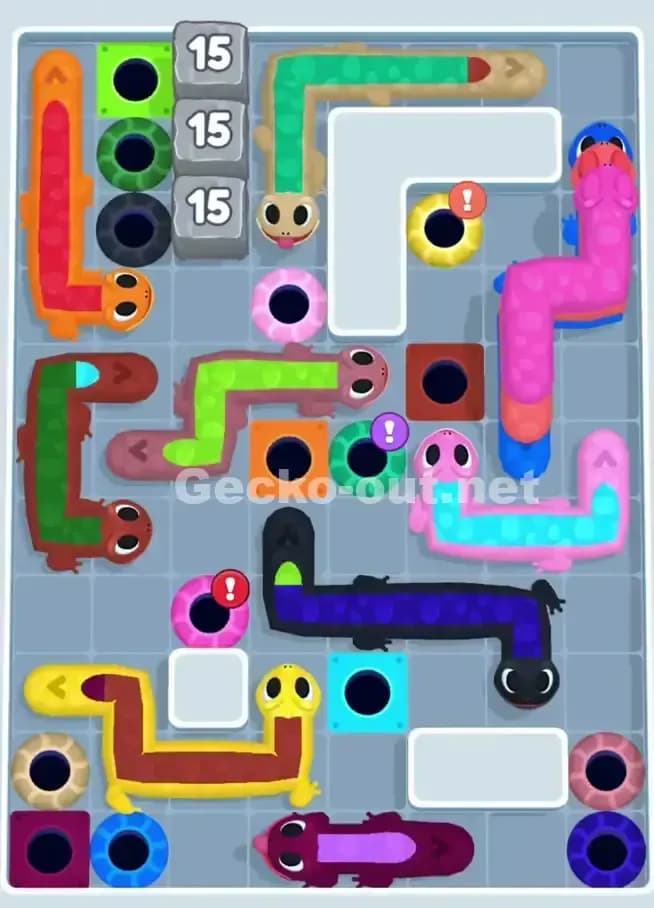
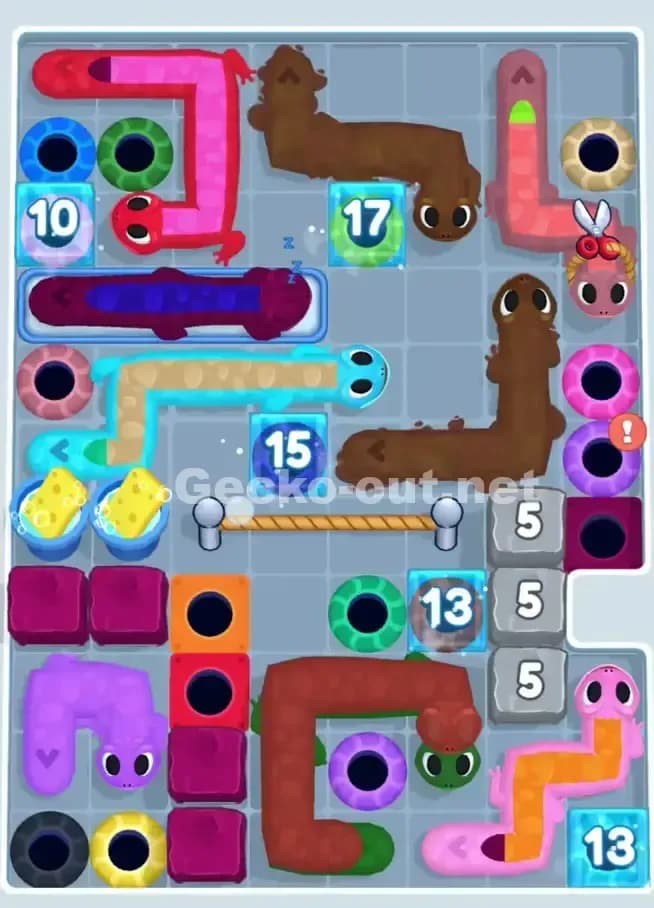
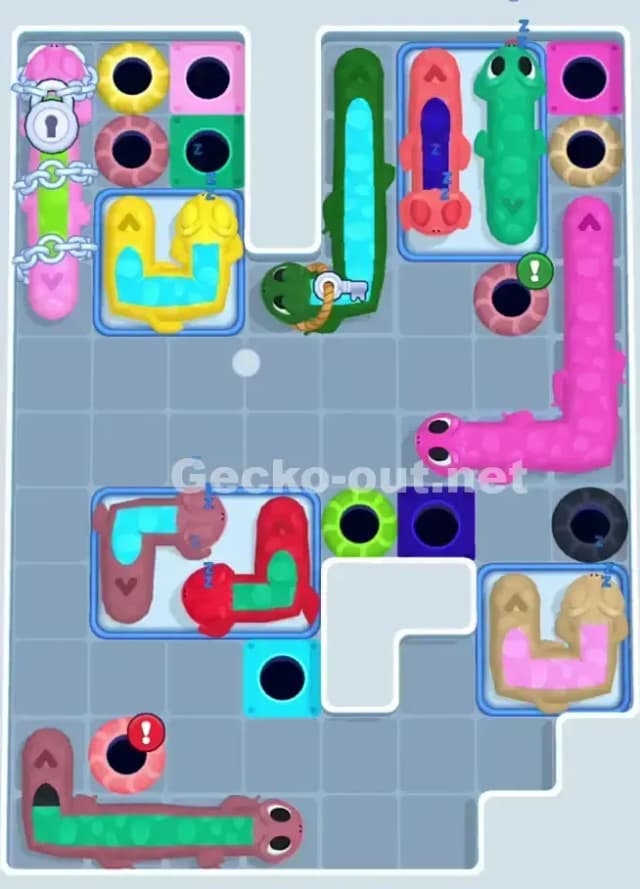
Gecko Out Level 1059 is a densely packed puzzle featuring six geckos across multiple colors: pink, yellow, green, blue, orange, and red. The board is divided into two main regions connected by a narrow central corridor with a toll gate (the red-and-white striped barrier). On the left side, you'll find four locked geckos chained together with gang links—these are the real headache of this level. The right side hosts two free-roaming geckos that seem simpler at first glance, but they're positioned in ways that can quickly block your main escape routes. Each gecko must reach a hole matching its color, and the exits are scattered across the board, some tucked into tight corners and others behind the gang geckos' starting positions. The timer sits at a reasonable but unforgiving duration; you've got enough time if you plan carefully, but every wasted drag costs you precious seconds.
The Win Condition and How the Timer Shapes Your Strategy
To beat Gecko Out Level 1059, all six geckos must pass through their matching colored holes before the timer hits zero. The challenge isn't just finding the paths—it's sequencing them so that earlier geckos don't block later ones. Because the board is so compact and the gang geckos are linked by immovable chains, you can't brute-force your way through. One wrong path early on will lock you out of critical lanes, and suddenly you're stuck watching the timer count down with a gecko trapped behind an unmovable body. The drag-and-follow mechanic means every pixel of movement matters: you must think ahead about where each gecko's body will rest after it escapes, because that final resting spot might be exactly where the next gecko needs to travel.
Pathing Bottlenecks and Logical Traps in Gecko Out Level 1059
The Gang Gecko Knot: Your Biggest Obstacle
The four chained geckos on the left side form the single biggest bottleneck in Gecko Out Level 1059. These geckos are locked together by golden chains, meaning you can't move one without considering the positions of all four. Their holes are positioned such that you must exit them in a very specific order, or their bodies will entangle and block each other's paths. The pink gecko at the top of the chain is the key: if you drag it out too quickly without plotting the subsequent moves, the yellow gecko below it will be wedged against an unusable part of the board. I found myself restarting three times before I realized that the chain geckos need to be exited in a staggered, deliberate sequence rather than one at a time.
Subtle Traps: The Toll Gate and Corridor Crunch
The central toll gate (that red-and-white striped barrier) is a physical choke point, but it's deceptive because it looks like a simple pass-through. In reality, it's so narrow that if a gecko's body occupies the corridor when you need to push another gecko through, you're deadlocked. The green gecko on the right side is particularly problematic here: it starts near the right corridor entrance, and its long, winding body can easily snake back and block the gate if you're not careful with your drag path. Additionally, the bottom section of the board has a tight corner where the blue and orange geckos need to exit. If either of these geckos' bodies ends up coiled in that corner after escaping, the other one has nowhere to go.
The Moment It Clicks
Honestly, Gecko Out Level 1059 frustrated me at first. I kept trying to brute-force the gang geckos out in quick succession, only to watch the second or third gecko clip into its sibling's body and fail. Then I realized that the puzzle isn't about speed—it's about reading the board as a 3D stack of paths, not just a 2D grid. The moment I started planning exits from the inside out (tackling the geckos surrounded by others first, leaving the outer geckos for last) everything clicked. Suddenly those chain links became a guide rather than a prison.
Turn-by-Turn Path Strategy to Beat Gecko Out Level 1059
Opening: Establish a Safe Staging Area
Start by exiting the pink gecko at the top-left corner of the gang cluster. Drag its head downward and to the right, feeding it around the edge of the board toward its pink hole on the upper right. This move accomplishes two things: it removes one of the four chained geckos from the tangle and establishes a clear path along the top edge. Don't rush the pink gecko directly into its hole; instead, position its body so it rests against the right wall after exiting. This creates a "wall" that keeps other geckos from wandering into dangerous territory.
Next, tackle the yellow gecko (second in the chain). This one needs to snake downward and then across toward its yellow hole. Be very intentional with your drag path: bring it down the left side, curve it right at the bottom, and guide it through the lower corridor to avoid crossing the pink gecko's body. Park the yellow gecko's body near its exit hole, but not overlapping any other geckos' escape routes.
Mid-Game: Keep Critical Lanes Open and Reposition Strategically
Once the top two gang geckos are out, you've bought yourself space. Now focus on the green gecko on the right side—not because it's in the chain, but because it's currently occupying the right corridor. If you don't move it soon, it'll become an involuntary roadblock. Drag the green gecko's head upward along the right wall, curve it into its green hole at the top-right corner, and make sure its body settles without crossing the central corridor. This clears the right lane entirely.
The blue gecko (third in the gang chain) is your next priority. This one's trickier because it's still linked to the red gecko below it. Drag the blue gecko down and to the right, feed it through the central corridor (which should now be clear thanks to moving green), and guide it toward its blue hole. Its body will likely rest in the middle-right area—that's acceptable as long as it doesn't block the corridor.
End-Game: Avoid Last-Second Tangles and Commit to the Final Moves
You're now left with the red gecko and the orange gecko. The red gecko (the last of the gang) has the most freedom now that its chain-mate is gone. Drag its head downward, circle it around the lower section, and feed it toward its red hole. The orange gecko at the bottom-left is your final piece. Its path is straightforward compared to the others: drag it to the right, up through the lower corridor, and into its orange hole.
If you're low on time in Gecko Out Level 1059, don't panic—just keep moving and trust your plan. Commit to each drag decisively; hesitation wastes seconds. If you have time remaining and the last gecko is close, take a breath and ensure your final drag path is clean, avoiding any bodies or walls that might force a restart.
Why This Path Order Works in Gecko Out Level 1059
How the Path Sequence Uses Body-Follow Logic to Untangle
The strategy works because it respects the fundamental rule: the body follows the exact path the head traces. By exiting the chain geckos from top to bottom (pink, then yellow, then blue, then red), you're methodically reducing the number of linked geckos occupying the left side of the board. Each exited gecko opens up lateral space for the next one. If you tried to exit them in a different order—say, yellow first—the pink gecko above it would still be occupying the top-left, and its body might curl in a way that blocks yellow's path. The order itself is the untangler.
The free-roaming geckos (green and blue) are tackled before the final linked geckos to clear the right corridor and middle lanes, ensuring that the last two geckos (blue and red from the chain) can navigate without obstruction. This cascading approach means you're not fighting the board; you're working with its geometry.
Managing the Timer: Read vs. Commit
Gecko Out Level 1059 gives you enough time to complete the puzzle if you move steadily, but not if you second-guess yourself. I recommend spending the first 10–15 seconds reading the board: trace each gecko's path mentally before you drag. Once you've identified your target gecko and its destination, commit to the drag—don't stop halfway or adjust mid-path unless you absolutely must. Pausing after each move to admire your work burns time. Instead, take a deep breath before your first move, then flow from one gecko to the next without stopping.
Boosters: Optional, Not Required
You don't need any boosters to beat Gecko Out Level 1059 if you follow this plan. However, if you find yourself stuck or low on time during your attempts, the +30 Second Timer booster is the safest bet—it buys you room for error without changing the fundamental puzzle. A Hint booster could also be valuable if you're unsure about the exact path for the gang geckos, but honestly, this guide should eliminate that uncertainty. Avoid using a Hammer or similar tool; the obstacles here aren't what you need to smash, they're what you need to navigate around.
Mistakes, Fixes, and Logic You Can Reuse in Other Gecko Out Levels
Common Mistakes and How to Fix Them
Mistake #1: Exiting chain geckos in the wrong order. Many players try to clear the bottom gecko first, thinking "fewer links to worry about." This doesn't work because the geckos above it still occupy space. Fix: Always exit from the top of the chain downward. The topmost gecko has no geckos above it, so its path is clearest.
Mistake #2: Dragging a gecko's body into the exact spot where the next gecko needs to travel. After exiting a gecko, you feel relief and stop paying attention to where its body lands. Fix: After every exit, immediately check if the resting body position blocks any remaining gecko's access to the corridor or central area. Adjust your drag path to park bodies along walls instead of in the middle of the board.
Mistake #3: Ignoring the free-roaming geckos (green, blue) until the very end. Because they're not chained, they seem less urgent, so players focus on the gang first and last. Fix: Move the free-roaming geckos second, right after clearing the first one or two chain geckos. They're the ones actually occupying the corridor, so removing them creates space for everyone else.
Mistake #4: Dragging too fast and creating unnecessarily long body paths. A gecko's body follows your drag path exactly, so a sloppy, meandering drag creates a long body that's harder to maneuver around. Fix: Plan the shortest reasonable path from each gecko's head to its hole. Avoid loops, backtracking, and unnecessary zigzags.
Mistake #5: Forgetting about the toll gate's width. It's easy to forget that the central corridor is actually quite narrow. A body occupying it blocks the passage for everyone else. Fix: Before moving any gecko through the corridor, visually clear the path. Make sure no other gecko's body is coiled up in that space.
How to Reuse This Logic on Similar Levels
Any Gecko Out level that features chain-linked geckos benefits from this top-down exit strategy. If you encounter a gang of 3, 4, or 5 linked geckos in a future level, immediately map which gecko is at the top of the chain and start there. The principle is universal: unlock the upper geckos first to free up space for the lower ones.
For levels with narrow corridors or toll gates, the key is to clear high-traffic areas early and park later geckos away from these bottlenecks. Identify which lanes are used by multiple geckos and prioritize freeing those lanes ahead of time.
For frozen exits or obstacles, the same body-awareness applies: every path you create is permanent until the gecko escapes, so think of your drag as carving a groove in stone, not sketching a line in sand.
The Takeaway: Gecko Out Level 1059 Is Tough, But Absolutely Beatable
Gecko Out Level 1059 is a genuinely challenging puzzle that tests your spatial reasoning and planning skills, but it's not impossible. It's the kind of level that feels chaotic the first time you see it—six geckos, chains, a bottleneck corridor, scattered holes—but once you understand that the board has a hidden order (top-down for chains, clear the corridors next, finish the stragglers), the solution emerges clearly. You've got this. Take your time on your next attempt, follow this plan, and you'll see those geckos escape one by one. The satisfaction when the last gecko slides into its hole and the timer still has time left is absolutely worth the effort.