Gecko Out Level 926 Solution Walkthrough | Gecko Out 926 Answer
How to solve Gecko Out level 926? Get step by step solution & cheat for Gecko Out level 926. Solve Gecko Out 926 easily with the answers & video walkthrough.
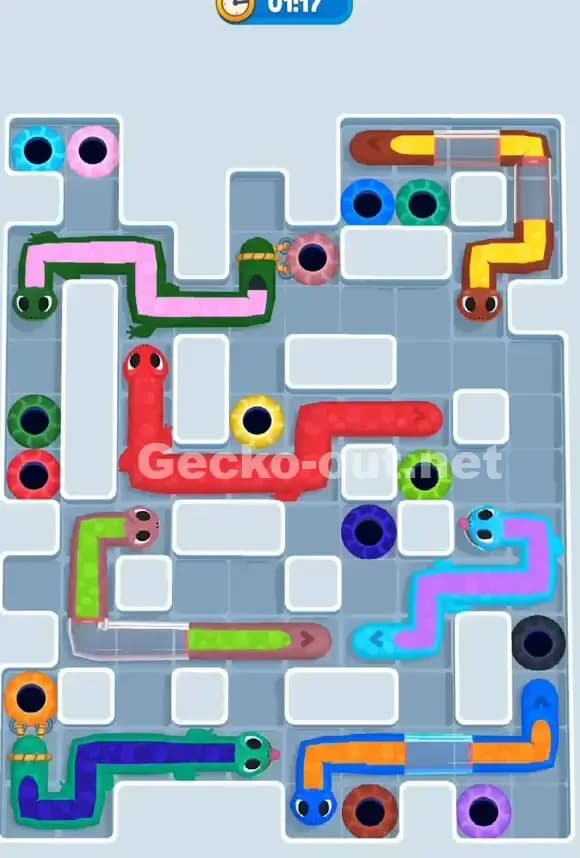
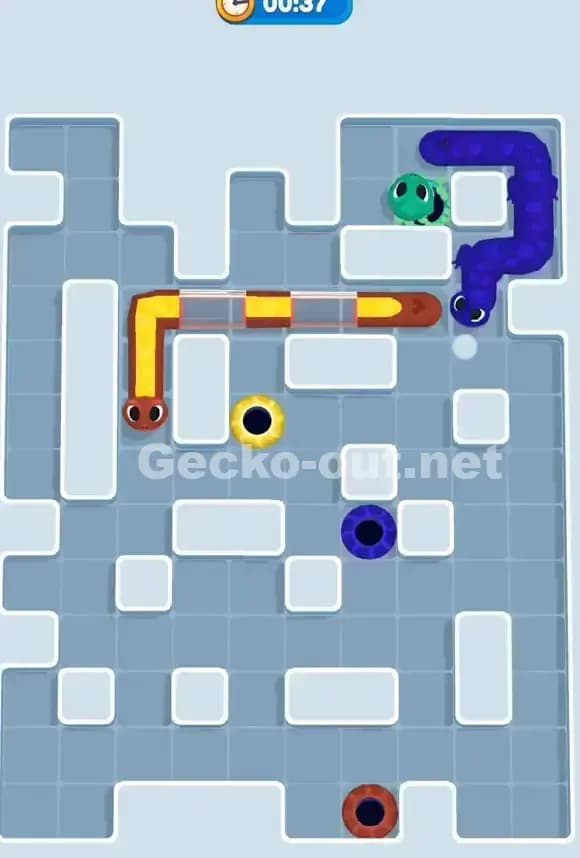
Gecko Out Level 926 Starting Board: Geckos, Colors, and Key Obstacles
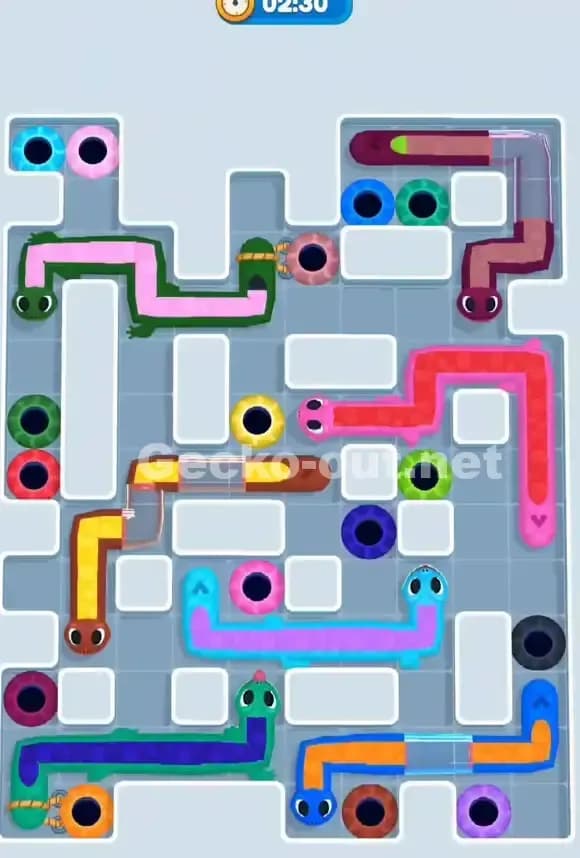
Gecko Out Level 926 is a complex, multi-gecko puzzle that demands careful spatial planning and precise pathing. You're working with approximately 12–13 geckos of different colors spread across the board: cyan, pink, green, yellow, orange, brown, red, blue, and purple. Each gecko has a matching-colored exit hole somewhere on the board, and here's the catch—some geckos are stacked or nested in tight clusters, while others are isolated in corners. The board itself is a maze of white-blocked corridors and open channels, with several toll gates (those yellow-and-brown striped checkpoints) that require you to pass through them in a specific sequence. The timer starts at 02:30, which sounds generous until you realize how long it takes to drag five or six geckos through winding paths without accidentally overlapping them.
The most immediately obvious threat is the clustered mass of geckos in the upper-right and center areas—cyan, blue, and green heads are packed so tightly that moving one without blocking the others feels almost impossible. Below that tangle, you've got a long vertical strip of geckos on the left side (green, red, pink, orange at various heights) that form a secondary knot. Finally, the bottom-right area holds another gang of colorful heads (cyan, blue, red, orange, purple) leading toward the lower-right exit zone. This arrangement means you can't just clear geckos in any order; every single move cascades into the next.
Pathing Bottlenecks and Logical Traps in Gecko Out 926
The Central Corridor Jam
The biggest bottleneck in Gecko Out Level 926 is undoubtedly the central horizontal corridor that connects the left side of the board to the right side. Almost every gecko path will try to use this passage at some point, and if you've got four geckos queued up trying to cross it, you'll quickly run out of time and space. The moment you drag one gecko head across that corridor, its body snakes back and forth, occupying multiple cells. If a second gecko tries to cross immediately after, boom—instant collision. This is where the puzzle's cruelty becomes clear: you can't just rush through it.
The Upper-Right Tangle
Just when you think you've got the central corridor figured out, the upper-right cluster of cyan, blue, and green geckos presents a secondary trap. These three heads are so close to each other that any path you draw for one of them will almost certainly pass right next to another. If you're not careful about the exact pixel-level placement of your drag, you'll accidentally make one gecko follow a route that clips another gecko's starting position or blocks its only viable exit route. I've failed Gecko Out Level 926 multiple times right here because I got greedy and tried to move two geckos in quick succession without fully clearing the first one out of harm's way.
The Toll Gate Sequencing Trap
There's a toll gate in the center-left area of Gecko Out Level 926 that's colored yellow and brown, and it only accepts geckos in a specific order or color. If you send the wrong gecko through it first, you'll lock out the others and waste precious seconds trying to reroute. The real trick is identifying which gecko should go through that gate and when—and if you get it wrong, you might have to drag that gecko all the way back and find an alternate path, which could add 20–30 seconds to your run.
Personal Reaction
Honestly, the first time I tackled Gecko Out Level 926, I felt completely overwhelmed. There are so many geckos, so many walls, and the timer ticking away made me panic and start dragging heads randomly just to feel like I was making progress. But then something clicked: I stopped thinking of it as "get all geckos out" and started thinking of it as "create a safe parking spot for geckos that aren't moving yet." That mindset shift made the level feel way less chaotic, and I realized the solution was hiding there all along.
Turn-by-Turn Path Strategy to Beat Gecko Out Level 926
Opening: Clear the Left Column First
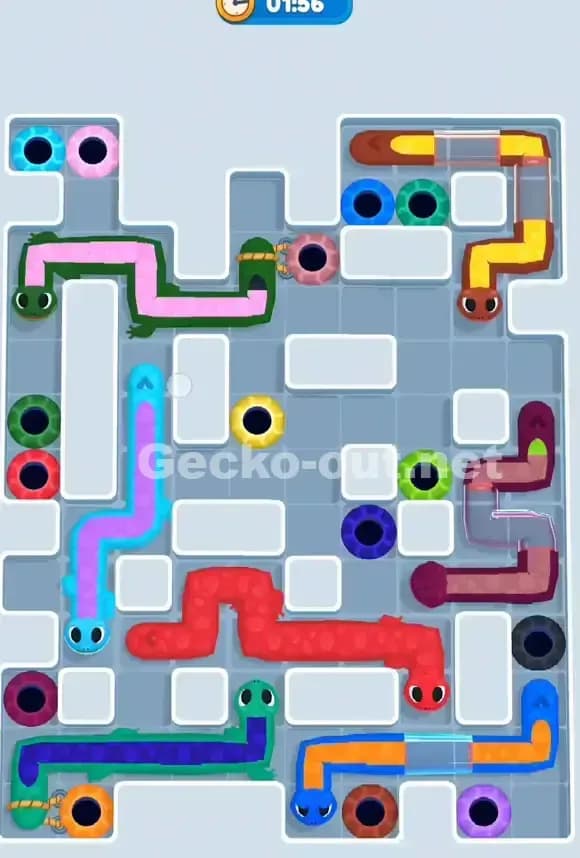
Your opening move in Gecko Out Level 926 should be to tackle the isolated green gecko on the far left side, high up on the board. This gecko has a clear, unobstructed path downward and to the right toward its exit hole (the green one in the lower-left area). By moving this gecko first, you accomplish two things: you remove it from the board, freeing up lateral space, and you establish a safe "movement lane" along the left side that other geckos can avoid. After you've parked the green gecko at or near its exit, immediately move the red gecko below it. The red gecko should follow a similar downward path, curving around to reach the red exit hole in the lower-left corner.
While these two geckos are being repositioned, the upper-right cluster hasn't been touched yet, so there's no conflict. The key is moving deliberately and using the body-follow mechanic to your advantage—drag the head in a smooth arc, and the body will trace that exact path without cutting corners. Once the left column is mostly clear, you've bought yourself breathing room.
Mid-Game: Manage the Upper-Right Cluster and Central Corridor
Now it's time to confront the upper-right tangle. Gecko Out Level 926's cyan and blue geckos are sitting right next to each other, and they both need to exit on the right side of the board. Here's the strategy: move the cyan gecko first. Drag its head down and to the right, guiding it around the white walls and toward the cyan exit hole on the right. Make sure your path takes it away from the blue gecko's starting position—you want to move blue out of the way before cyan has to cross any central corridors.
Once cyan is committed to its path, move blue. This gecko should follow a slightly different arc, perhaps going down first before it heads right, so that it doesn't retrace cyan's exact route and create a traffic jam. If done correctly, cyan will exit first, and blue will exit second without ever colliding. Now you've opened up real estate in the upper-right area, which means the green gecko sitting in the center-right can finally move without worrying about bumping into blue or cyan.
For the central corridor itself, adopt a strict one-at-a-time rule. After cyan and blue have exited, move the center-right green gecko through the corridor toward the green exit. Don't start moving the next gecko until this one has fully exited the board. Yes, it costs a few seconds, but it's infinitely better than trying to overlap two geckos through a tight space and failing.
End-Game: Priority Exit Order and Time Management
You're probably looking at 45–60 seconds remaining when you hit the end-game phase of Gecko Out Level 926. At this point, you should have 4–6 geckos still on the board, mostly clustered in the lower-center and lower-left areas. Your priority should be the yellow and orange geckos, because they often have winding paths that take longer to execute. Move yellow next, dragging its head through the toll gate (if you've correctly sequenced the gates) and down toward the yellow exit hole in the lower-center area.
After yellow, move orange. By this point, you should know the central corridor pretty well, so thread orange through it and toward the orange exit in the lower-center or lower-right. Then tackle the remaining geckos—pink, purple, red (if any haven't exited yet)—in order of how direct their paths are. Save the most straightforward exits for last, because if you're running low on time, you want to be dragging geckos through short, simple paths rather than trying to negotiate a complex multi-turn route with 10 seconds on the clock.
If you're within 5 seconds of zero and still have one gecko left, resist the urge to panic-drag it. Take a breath, plot the shortest possible route, and execute it cleanly. Gecko Out Level 926 is unforgiving, but a calm, deliberate final move is way more reliable than a frantic one.
Why This Path Order Works in Gecko Out Level 926
Head-Drag Pathing and Body-Follow Logic
The reason this strategy works comes down to how the game engine handles movement. When you drag a gecko's head, its entire body follows that exact path—it doesn't take shortcuts, it doesn't phase through walls, and it doesn't magically compress itself. By moving geckos in a specific order (left-side first, then upper-right, then central, then bottom), you're essentially "untangling" the knot layer by layer. Each gecko that exits the board becomes fewer obstacles for the remaining geckos, which means each successive path becomes easier and faster to plot. If you tried to move geckos randomly, you'd end up with a situation where gecko A's body is blocking gecko B's only viable path, and you'd be stuck.
Additionally, the body-follow rule means you can use the longer geckos as intentional blockers. If a gecko is 4 or 5 cells long and you drag it diagonally across the board, its body will occupy multiple cells and create a temporary "fence" that actually protects other geckos from accidentally wandering into danger. Once that gecko exits, the fence disappears, and the board becomes available again.
Timing: Pause, Read, Commit
Gecko Out Level 926 rewards a specific rhythm of play. When you've just gotten a gecko out and you see a big chunk of the board has suddenly opened up, take literally two seconds to pause and visually scan where the remaining geckos are. Identify the next gecko that has the clearest path to its exit hole, and move that one. Don't overthink it, but don't rush either. The timer is long enough that a few two-second pauses won't hurt you, and those pauses prevent catastrophic missteps.
When you do commit to a path, drag confidently and smoothly. Jerky, hesitant drags sometimes cause misclicks or veer off course. A smooth, deliberate drag is more likely to follow your intended route and reach the exit hole accurately on the first try. In Gecko Out Level 926, time is measured in seconds, and so a smooth drag that works on the first attempt beats three panicked, failed attempts by a huge margin.
Boosters: Optional, Not Required
Gecko Out Level 926 can be solved without boosters, but here's the honest take: if you've got an extra-time booster (usually a clock icon), using it once can take a lot of pressure off during end-game. However, it's not necessary if you nail the mid-game sequencing. Hammer tools or "hint" boosters are less valuable here because the puzzle requires spatial intuition more than raw problem-solving, and hints won't help you move faster. Save boosters for your second or third attempt if you're still struggling; on your first attempt, try to beat Gecko Out Level 926 without them and see how close you get.
Mistakes, Fixes, and Logic You Can Reuse in Other Gecko Out Levels
Mistake 1: Moving Multiple Geckos Into the Central Corridor Simultaneously
Fix: Queue them one at a time. Drag gecko A all the way to exit, wait for the exit animation to complete, then drag gecko B. It feels slow, but it's faster than having to restart because two geckos collided mid-corridor.
Mistake 2: Not Identifying Toll Gate Sequencing Before You Start
Fix: Before you make any moves in Gecko Out Level 926, take 10 seconds to examine any toll gates. Check the color or pattern on the gate and match it to the geckos nearby. Plan which gecko will go through first, and commit to that plan. If you realize mid-puzzle that you've chosen the wrong gecko, you may not have time to reroute it.
Mistake 3: Dragging Long Geckos Across Tight Spaces Too Hastily
Fix: Long geckos (4+ cells) need more care. Drag them slowly and deliberately, watching where their body is curling on the screen. If their body is starting to wrap around a wall in an unexpected way, release the drag, undo, and try a different path. A 3-second do-over is better than committing to a path that gets stuck.
Mistake 4: Forgetting That Parking a Gecko at Its Exit Hole Doesn't Immediately Exit It
Fix: In Gecko Out Level 926, you have to complete the drag motion. If you let go of the gecko's head before it's fully inside the exit hole, the gecko will stay on the board. Always drag all the way to the hole and confirm the gecko exits with the little animation.
Mistake 5: Not Using the Left Side of the Board as Your "Safe Zone"
Fix: The left side of Gecko Out Level 926 tends to have more open space. Use it as a holding area for geckos you're not moving yet. By parking inactive geckos on the left, you keep the center and right sides clearer for the geckos you're actively guiding toward their exits.
Reusing This Logic on Similar Levels
Any Gecko Out level with 10+ geckos, a complex corridor system, or toll gates benefits from this "left-to-right, layer-by-layer" approach. If you encounter another puzzle with a central choke point, apply the same principle: identify the bottleneck, move one gecko at a time through it, and never try to overlap two geckos in a tight space. Levels with frozen exits or locked geckos are trickier, but the core logic remains: untangle outer layers first, then work inward.
Final Encouragement
Gecko Out Level 926 is genuinely one of the tougher puzzles you'll face in the game, and if it took you three or four attempts to beat it, that's completely normal. The level teaches you patience, spatial reasoning, and the value of planning ahead. Once you've cleared Gecko Out Level 926, you'll have the mental toolkit to handle almost any other complex gecko puzzle the game throws at you. You've got this.