Gecko Out Level 667 Solution Walkthrough | Gecko Out 667 Answer
How to solve Gecko Out level 667? Get step by step solution & cheat for Gecko Out level 667. Solve Gecko Out 667 easily with the answers & video walkthrough.

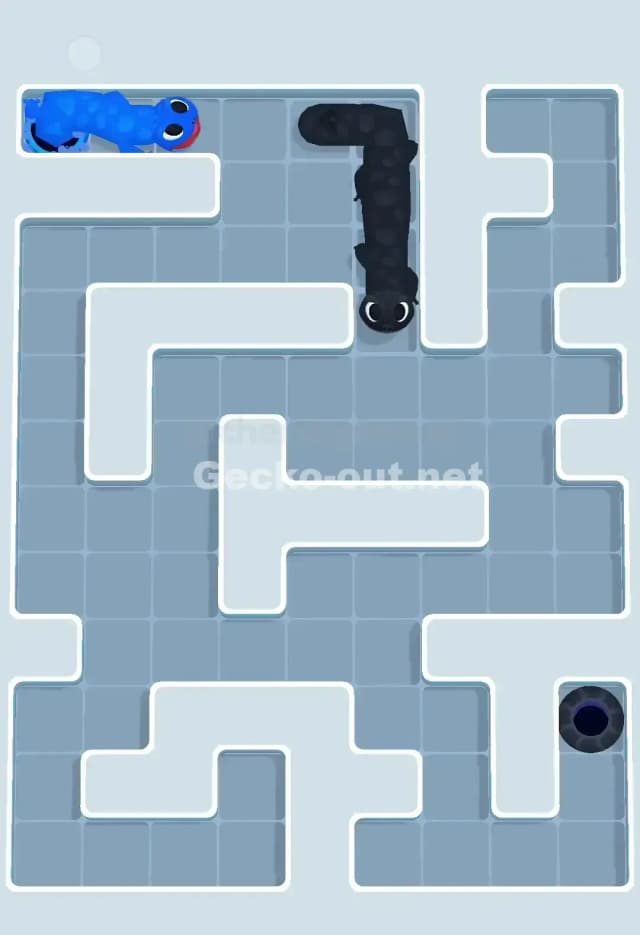
Gecko Out Level 667: Board Layout, Rules, and Win Condition
The Starting Board: What You're Up Against
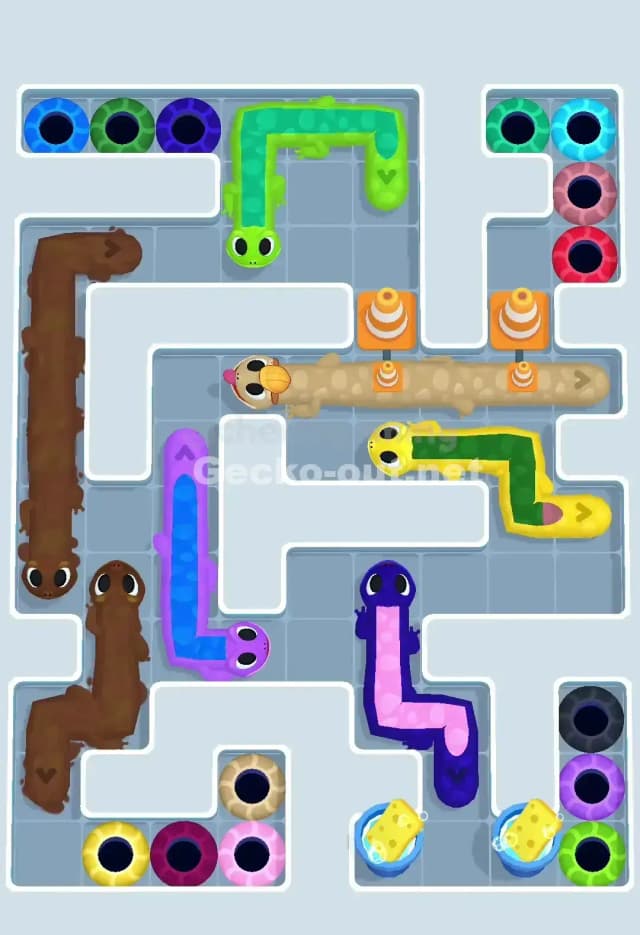
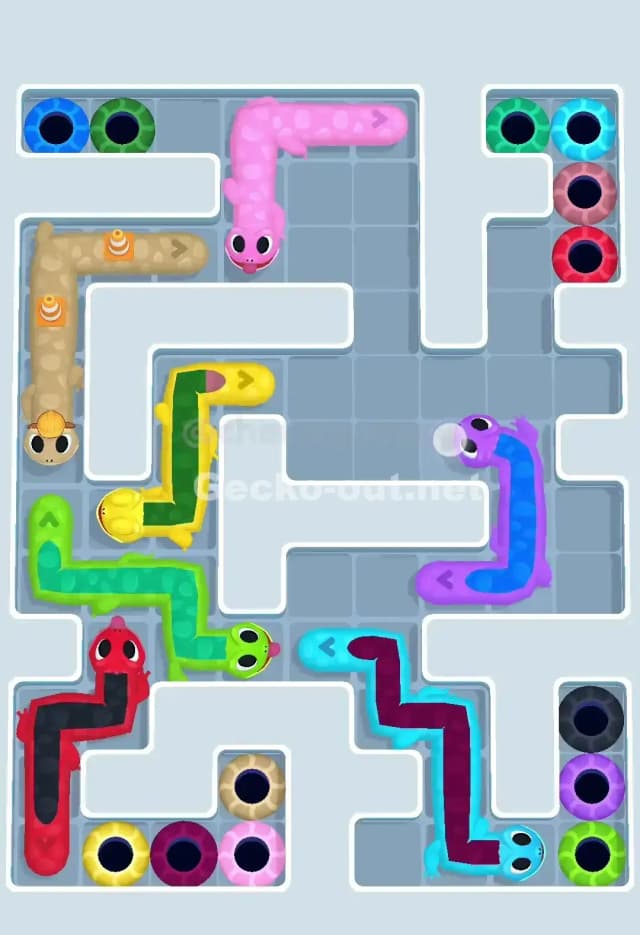
Gecko Out Level 667 is a dense, multi-gecko puzzle that'll test your spatial reasoning and path-planning skills. You're working with seven geckos spread across the board: three small geckos in the top-left staging area (blue, green, and purple), a long brown gang gecko running vertically down the left side, a tan-colored gecko with a long horizontal body in the middle corridor, a yellow gecko snaking through the right-center area, and finally a purple-and-pink gang gecko occupying the lower-middle section. Each gecko needs to reach its matching colored hole to escape safely. The board is crammed with narrow corridors, multiple toll gates (those orange concentric circles), and a few strategic warning holes scattered throughout. The white walls form a complex maze that forces you to think several moves ahead before committing to any single drag path.
Win Condition and Timer Pressure
You win Gecko Out Level 667 when all seven geckos have found and entered their matching colored holes before the timer expires. The clock is your real enemy here—there's no room for trial-and-error fumbling. Every drag you make must count. The tight corridors mean that if you move one gecko poorly, you'll create a traffic jam that blocks another gecko's only viable exit route, forcing you to restart. Your goal isn't just to find any path for each gecko; it's to orchestrate a sequence where each exit happens in an order that keeps the board from deadlocking.
Pathing Bottlenecks and Logical Traps in Gecko Out Level 667
The Critical Bottleneck: The Brown Gang Gecko
The biggest choke point in Gecko Out Level 667 is the long brown gang gecko on the left side. This creature's body spans nearly the entire vertical depth of the board, and because gang geckos can't be split or repositioned mid-game, moving it is an all-or-nothing commitment. Here's the trap: its exit hole is in the lower-left corner, but to reach that hole, the head must navigate past several wall configurations. If you move the brown gecko too early, its lengthy body will block the middle-left corridor that the purple-and-pink gecko must pass through to reach its exit. Conversely, if you wait too long, you'll run out of time. The brown gecko must be one of your first moves, but you have to drag its head on a specific path that threads around the wall geometry without the body cutting off any remaining escape routes.
Subtle Problem Spot #1: The Tan Gecko's Horizontal Corridor
The tan-colored gecko sprawls horizontally across the middle of the board, and its exit is to the right. The trap here is that this gecko's body occupies the only east-west passage in its row for several cells. If you've already positioned another gecko in that corridor before you move the tan gecko out, you've created a hard deadlock. You must clear this gecko's path before routing any other gecko through that horizontal lane. It's an easy mistake to overlook when you're focused on the flashier gang geckos.
Subtle Problem Spot #2: The Yellow Gecko's Twisted Route
The yellow gecko on the right-center has a body that curves and loops awkwardly through multiple corridors. Its exit hole is in the bottom-right area, but reaching it requires navigating around both the orange toll gates and the purple-pink gecko's territory. The yellow gecko can't be moved until the purple-pink gecko is partially out of the way, yet the timing window is razor-thin. Move it too soon and it'll block the purple gecko; move it too late and you're out of time.
Subtle Problem Spot #3: The Top-Left Staging Area Jam
The three small geckos (blue, green, purple) start bunched in the top-left corner. Getting them out in the right sequence is essential because their exit routes diverge sharply, and they can't occupy the same grid cells. You need to route them one at a time in an order that doesn't leave the third gecko stranded with no legal path to its hole.
Personal Reaction: The "Aha!" Moment
I'll be honest—Gecko Out Level 667 frustrated me for a solid five attempts. I kept trying to move the flashy gang geckos first, thinking that clearing the big obstacles would open up the board. That strategy backfired spectacularly; I'd end up with two geckos jammed in the middle corridor and 10 seconds left on the timer. The breakthrough came when I stopped thinking about individual geckos and started thinking about corridors as shared resources. Once I realized that the horizontal middle passage was a bottleneck that needed clearing before anything else, the solution clicked into place. It's a level that punishes gut instinct and rewards deliberate planning.
Turn-by-Turn Path Strategy to Beat Gecko Out Level 667
Opening: Route the Tan Gecko First
Your opening move in Gecko Out Level 667 should be the tan gecko with the long horizontal body. Drag its head to the right, following the corridor eastward until it reaches its tan-colored exit hole on the right side of the board. This move accomplishes two critical things: it clears the middle horizontal corridor that would otherwise become a bottleneck, and it removes one of the longest bodies from the board, giving you more maneuvering room. Don't second-guess this—commit to the drag and move on.
Next, route the brown gang gecko downward. Drag its head from the top-left, guiding it down the vertical corridor on the far left, threading past the wall junctions until it reaches the brown exit hole in the lower-left corner. The brown gecko's massive body will now occupy the left edge, but that's fine because it's parked in its exit. One down, six to go.
Mid-Game: Manage the Staging Area and Prepare the Purple-Pink Exit
With those two out of the way, shift your focus to the three small geckos in the top-left staging area. Route the blue gecko first by dragging its head downward and then navigating it through the available corridors toward the top-right area where blue exit holes are located. The blue gecko's path should not interfere with green or purple. Once blue is clear, move the green gecko, which should route rightward through a different corridor to reach the green exit holes on the upper right.
Now comes the delicate part: the purple gecko from the staging area needs to exit too, but the board is getting crowded. Drag its head carefully, avoiding the already-parked brown and tan geckos, and route it toward the purple exit in the lower-left region. This requires precision, but the earlier evacuations have opened up enough space.
After these three are gone, tackle the purple-and-pink gang gecko in the lower-middle area. This is a two-headed gang gecko, meaning it has a purple head and a pink head. Here's where you need to read the board carefully: which exit should it target? The purple exit or the pink exit? Check your remaining unpaired geckos. Drag this gang gecko toward whichever matching exit is still open and matches one of its heads, then route the other head toward its paired exit afterward, or execute both simultaneously if the board geometry allows it.
End-Game: Yellow Gecko and Final Exits
By now, the yellow gecko is your last major obstacle. Drag its head rightward and downward, threading around any remaining obstacles and toll gates until it reaches a yellow exit hole in the bottom-right region. The path will be tight—the board is crowded with parked geckos—but the methodical evacuation you've done should have left just enough room.
If you're running low on time (under 15 seconds), don't panic. Commit to your final drags and trust that the earlier sequence has set you up for success. Avoid the temptation to "just nudge" a gecko slightly; make full, decisive moves. The timer rewards speed and confidence, not hesitation.
Why This Path Order Works in Gecko Out Level 667
Body-Follow Pathing and Untangling the Knot
The genius of the path order for Gecko Out Level 667 is that it respects the fundamental rule: the gecko's body follows the head's exact drag path. By moving the widest, longest geckos first, you prevent their bodies from becoming traps that immobilize shorter geckos later. The tan gecko's long horizontal body would clog the middle corridor if left to last; moving it early clears space. The brown gecko's vertical body dominates the left side; parking it in its exit removes it as a variable. The smaller geckos from the staging area are naturally more flexible and can navigate around obstacles that would deadlock a gang gecko. This isn't coincidence—it's the inherent geometry of Gecko Out Level 667 revealing the optimal play order.
Reading the Board vs. Moving Quickly
Gecko Out Level 667 demands that you pause before you start dragging, not during. Spend the first 10–15 seconds reading the corridors and tracing potential paths mentally. Ask yourself: "Where does each gecko exit?" and "What corridors do they share?" Once you've mapped that, move decisively. Pausing mid-drag to "think about the next move" wastes precious seconds and breaks your momentum. I recommend doing a 30-second planning phase, then committing to the first five moves without hesitation. After the fifth gecko is out, reassess the board with the remaining two or three, and execute again with conviction.
Boosters: Optional, Not Required
Gecko Out Level 667 doesn't require boosters, but an extra-time booster (typically +30 seconds) is a solid safety net if you've already attempted it twice and keep running out of time by just a few seconds. However, the level is absolutely beatable without them if you follow the path order above. A hammer-style tool to smash obstacles isn't necessary because the maze itself is the challenge, not the obstacles within it. Save your boosters for genuinely brutal levels; Gecko Out Level 667 is tough but fair.
Mistakes, Fixes, and Logic You Can Reuse in Other Gecko Out Levels
Common Mistake #1: Moving Gang Geckos First
Players often tackle the big, flashy gang geckos first because they look like the main problem. In Gecko Out Level 667, moving the brown or purple-pink gecko before clearing the corridor they occupy is a trap. Fix: Identify which single-bodied gecko occupies a shared corridor, move that gecko first, and let the gang geckos follow. This logic applies to any level with mixed gecko sizes.
Common Mistake #2: Insufficient Planning
Dragging without a mental map of all seven exit holes is a recipe for disaster on Gecko Out Level 667. Fix: Before you touch any gecko, trace each color's path from start to exit using your eyes. Ask, "Does this path cross another gecko's body?" If yes, reorder your moves.
Common Mistake #3: Ignoring the Staging Area Sequence
The three small geckos in the top-left corner look simple, but their exit order matters hugely. Moving them in the wrong sequence jams the third one. Fix: Choose the gecko whose exit is furthest away as your first exit, and work backward. The gecko with the shortest path to its hole should go last.
Common Mistake #4: Forgetting to Check Gang Gecko Head Colors
The purple-and-pink gang gecko has two exits, and you might accidentally route it to a hole that doesn't match one of its heads. Fix: Zoom in or trace the path carefully to confirm the head color matches the exit hole color before you drag.
Common Mistake #5: Running Out of Time on the Last Gecko
Nervousness leads to slow, tentative final drags. Fix: If you're under 20 seconds with one gecko left, commit to a straight-line drag even if it's not perfectly optimal. A slightly suboptimal path that succeeds beats a perfect path attempt that times out.
Reusing This Logic on Similar Levels
Gecko Out Level 667 teaches a principle that scales to other puzzles: identify bottleneck corridors first, clear them early, then expand outward. Any level with gang geckos, frozen exits, or tight choke points benefits from this approach. Long, horizontal or vertical geckos should almost always be moved before small, nimble ones. If a corridor is shared by multiple geckos, the one occupying it longest should be first to exit. These principles will unlock dozens of tough Gecko Out puzzles.
Final Encouragement
Gecko Out Level 667 is genuinely challenging—it's the kind of level that teaches you to think like a puzzle architect rather than a casual player. But it's absolutely beatable with the strategy above. The satisfaction of orchestrating all seven geckos to their exits in perfect sequence, with seconds left on the timer, is one of the best moments in the game. You've got this. Plan deliberately, execute confidently, and Gecko Out Level 667 will fall.