Gecko Out Level 1122 Solution Walkthrough | Gecko Out 1122 Answer
How to solve Gecko Out level 1122? Get step by step solution & cheat for Gecko Out level 1122. Solve Gecko Out 1122 easily with the answers & video walkthrough.
Gecko Out Level 1122: Board Layout, Rules, and Win Condition
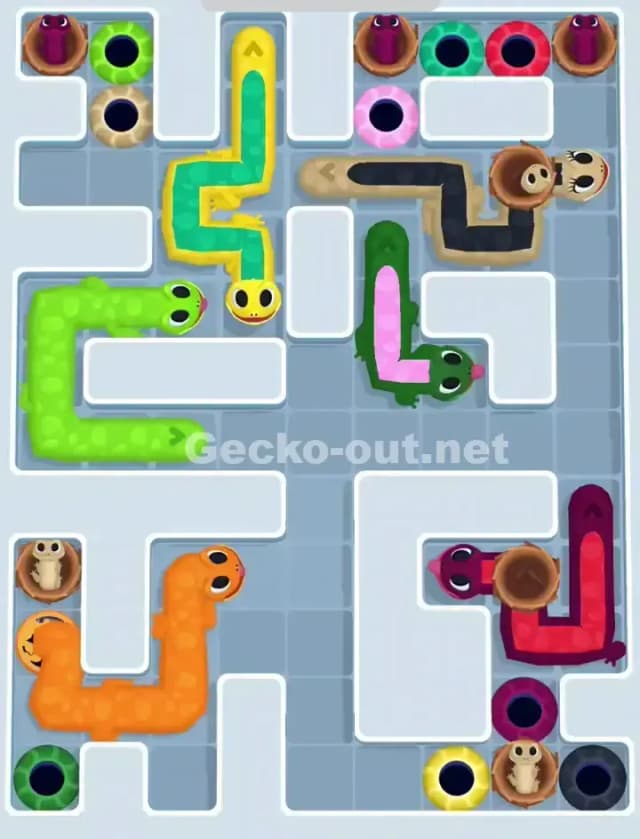
The Starting Board: Geckos, Colors, and Layout
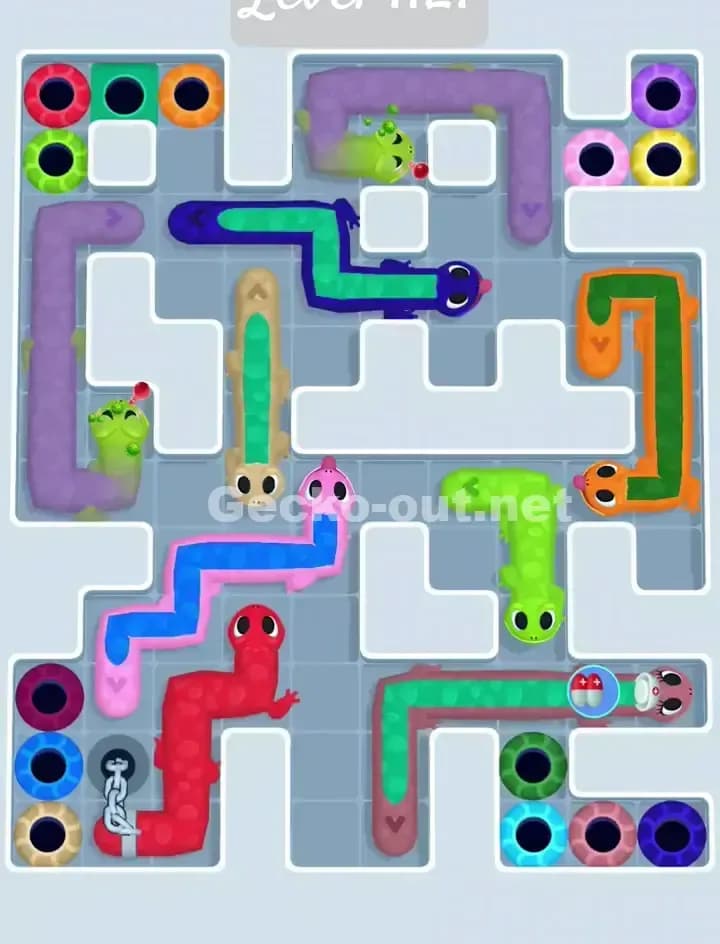
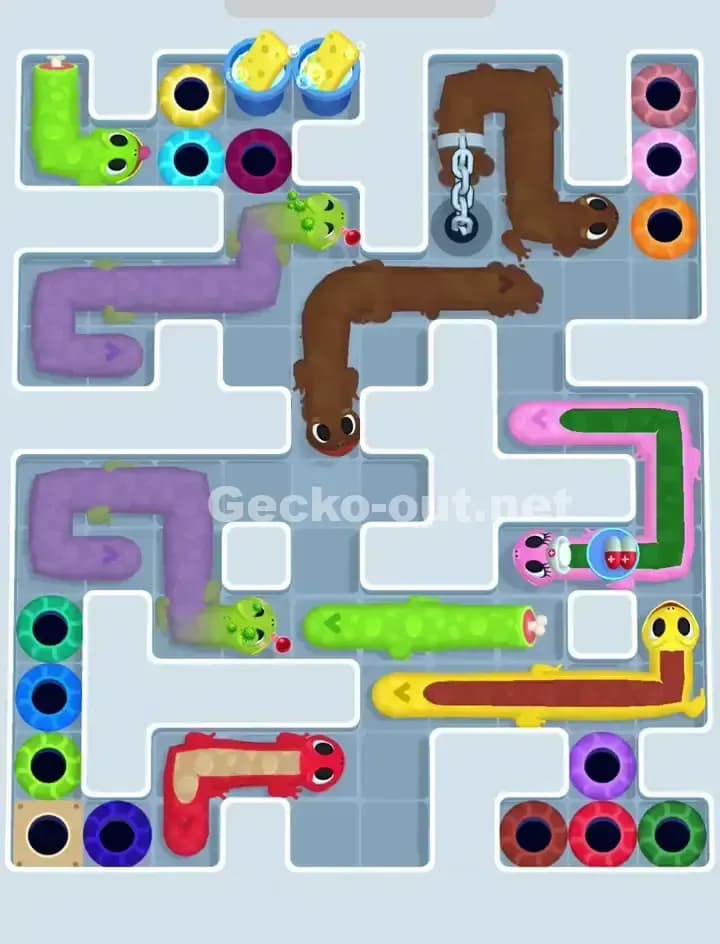
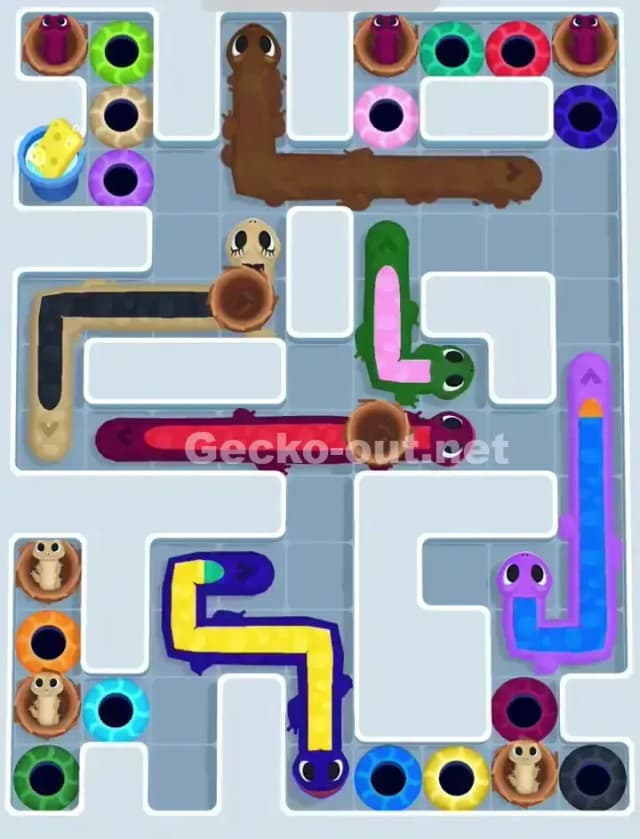
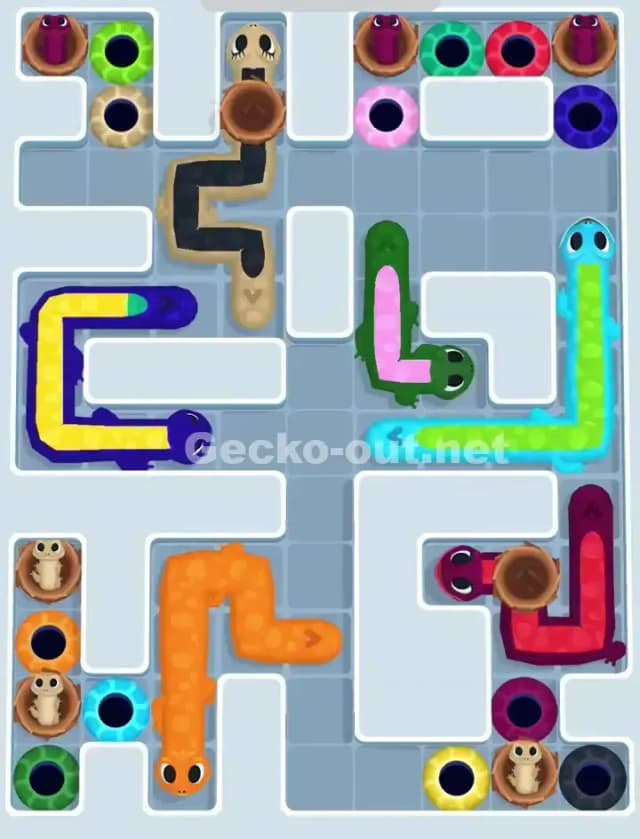
Gecko Out Level 1122 is a densely packed puzzle that will test your patience and spatial reasoning. You're working with ten individual geckos spread across the board in various colors: purple, green, pink, brown, orange, cyan, yellow, and blue. The real kicker? Several of these geckos are linked together as a "gang"—meaning when you drag one, its connected partners move as a single long body. This creates the level's primary challenge: the board is already crowded, and the gang geckos take up even more real estate once they start moving.
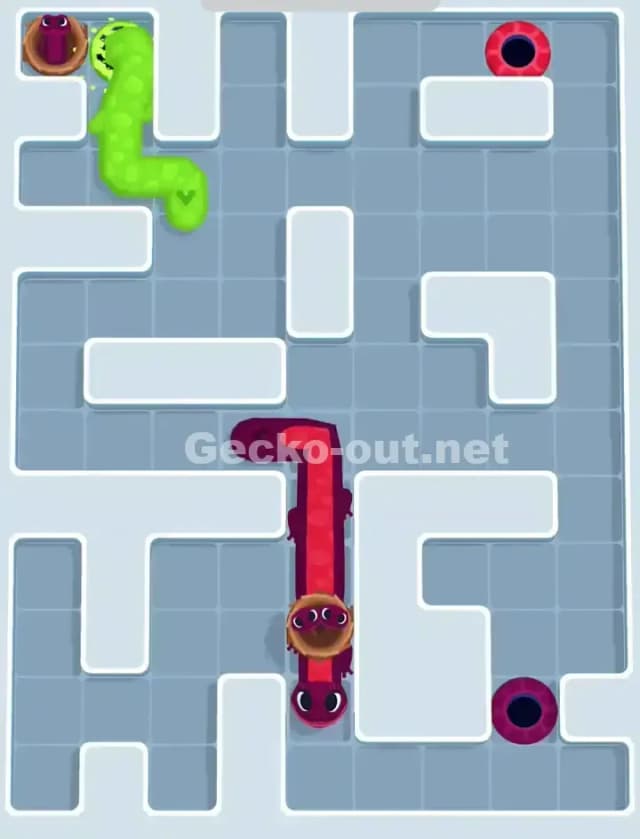
The layout itself is a maze of white walls that create narrow corridors and tight choke points. You'll notice geckos positioned in corners, along edges, and bunched near the center of the board. The holes they need to reach are scattered throughout—some tucked into corners, others accessible only through winding paths. There's no obvious "easy lane," which means you can't just drag geckos one by one without thinking ahead. The timer is strict, and every second counts. If you haven't guided all geckos to their matching-color holes before time runs out, you fail the entire level.
The Win Condition and Path-Movement Challenge
Your goal in Gecko Out Level 1122 is straightforward: each gecko's head must reach a hole of the same color. However, the way geckos move—following the exact path you drag their head along—makes this harder than it sounds. You can't teleport or push geckos through walls. The body will trace your finger's path precisely, which means if you create a curved route, the entire gecko body curves with it. If another gecko or wall is in the way, you're stuck.
The timer adds serious pressure. You typically have under two minutes to untangle this knot and get everyone out. That's enough time if you plan carefully, but zero margin for error if you start making random drags. The real puzzle isn't just finding the exit routes—it's figuring out the order in which to move geckos so that earlier exits don't block later ones, and so that gang geckos don't trap solo geckos behind them.
Pathing Bottlenecks and Logical Traps in Gecko Out Level 1122
The Central Corridor Bottleneck
The biggest single bottleneck in Gecko Out Level 1122 is the horizontal brown gang gecko that runs across the upper-middle portion of the board. This gang is long and immovable—it's essentially a wall itself. Because it's locked in place at the start, any gecko that needs to travel upward or around it must navigate carefully to avoid collision. The moment you try to move one of the solo geckos near it, you quickly realize that the brown gang controls traffic flow. If you're not careful, you'll create a domino effect where moving one gecko blocks two others from reaching their holes.
What makes this worse is that multiple geckos need to pass through or around this gang's position to reach exits on the upper side of the board. You can't just bulldoze them through; you have to choreograph their movement so that the path stays open for others.
Two Subtle Problem Spots
First, the pink gecko and the green gecko on the right side occupy a cramped L-shaped corner. The pink hole is accessible, but the green gecko's exit is slightly offset. If you move the pink gecko first without calculating the green gecko's path, you might box the green gecko into a dead end. You need to either move the green gecko out of the way first, or find a path for pink that doesn't rely on using that shared corridor later.
Second, there's a tricky pair of linked geckos (likely orange and cyan) on the left side that are closer to walls than others. These two can only move downward or in a very specific spiral. If you move them too early, they'll occupy the bottom corridor and prevent other geckos from exiting smoothly. Timing their exit for near the end of the level is crucial.
The Moment It Clicks
Honestly, my first two attempts at Gecko Out Level 1122 felt chaotic. I was dragging geckos left and right, watching the timer tick down, and getting increasingly frustrated as one gecko after another got stuck. But then it hit me: I was thinking about this like a race, not like a puzzle. Once I paused, zoomed out mentally, and drew a map of which gecko needed to go where and in what order, the solution became obvious. The board suddenly felt less like a trap and more like a solvable knot. That shift in perspective—from "move fast" to "move smart"—is what separates a failed run from a clean victory on Gecko Out Level 1122.
Turn-by-Turn Path Strategy to Beat Gecko Out Level 1122
Opening: Clear the Corners First
Start with the purple gecko in the upper-left corner. This solo gecko has a relatively clear path downward and then toward its purple hole, which is positioned nearby on the left side of the board. Moving it first accomplishes two things: it frees up that corner so you have room to reposition other geckos, and it removes one gecko from the mental load. Don't rush the path—draw it smoothly around any walls, and make sure the body doesn't clip the wall edges.
Next, move the cyan gecko on the left side. It's paired with the orange gecko, but you want to get it as far down and to the right as possible without committing to its final exit. "Park" it in a safe zone—maybe a corridor where it won't block anyone else. This prevents the gang from occupying critical space later.
Mid-Game: Untangle the Knot Carefully
Once you've cleared the corners, tackle the right-side geckos: the pink and green pair. Move the green gecko first since it has the more constrained exit path. Drag its head down and around the walls, aiming for its green hole on the right edge. Be deliberate—this gecko's long body can easily snag on walls if you're not precise. Once green is out, pink has much more room to move. Its exit should be straightforward after green clears the area.
Now focus on the upper geckos: the purple gang members and the brown solo gecko. The brown gecko is the one that looks like a shield or rounded shape in the upper-middle area. Since it's not part of a gang, it should have a clear downward path or side path to a brown hole. Move it next to keep upper passages clear.
For any remaining solo geckos in the middle of the board, move them in order of constraint: geckos with one clear exit path before geckos with multiple options. This preserves flexibility for the last few moves.
End-Game: Race Against the Clock
When you're down to the final three or four geckos, move the ones with the longest paths first. A gecko that needs to spiral around half the board should exit before one that has a straight shot. By the time you're dragging your last gecko, the board should be nearly empty, and that gecko should have a direct, unobstructed route to its hole.
If you're running low on time (under 20 seconds left), don't panic and drag carelessly. One misclick that sends a gecko the wrong way can waste your final seconds. Instead, take one deep breath, identify the fastest remaining path, and commit to a smooth, deliberate drag. More often than not, Gecko Out Level 1122 can be cleared with a few seconds to spare if you've executed the mid-game correctly.
Why This Path Order Works in Gecko Out Level 1122
Head-Drag Pathing and Body-Follow Logic
The strategy works because you're leveraging the body-follow rule to your advantage. By moving corner geckos and constrained geckos first, you're removing the "walls" that would otherwise trap later geckos. The brown gang gecko can't move (it's a fixed obstacle), so every other gecko must route around it. By clearing the corners and sides first, you create a cascade effect: each gecko you remove opens a corridor for the next one.
When you move the green gecko on the right side before pink, you're not just randomly choosing an order—you're respecting the physical layout. Green's hole is harder to reach, and green takes up more space while moving. Once it's gone, pink's path becomes almost trivial, and you save precious seconds that you can use on trickier geckos.
Timer Management: Pause vs. Commit
Here's the honest truth about Gecko Out Level 1122: you should never feel rushed. The timer is long enough that if you know your plan, you'll finish comfortably. So use your first 15–20 seconds to really study the board. Trace paths mentally. Ask yourself, "If I move this gecko, where will the others go?" Once you've made a decision, commit and move smoothly. Don't hesitate mid-drag or second-guess yourself—that wastes time and introduces errors.
The moment the geckos start moving, stop pausing and start executing. Trust your plan, move methodically, and you'll beat Gecko Out Level 1122 with time to spare.
Booster Strategy: When (If Ever) to Use Them
Gecko Out Level 1122 does not require boosters if you follow this strategy. Time boosters (extra seconds) can be nice insurance, but they're not the solution. If you're struggling to beat this level even with a booster, the issue is the move order, not the timer. A hammer-style tool to break or remove obstacles also isn't necessary here—there are no icy exits or locked gates to worry about. Save your boosters for levels that truly demand them, and treat Gecko Out Level 1122 as a logic puzzle, not an endurance test.
Mistakes, Fixes, and Logic You Can Reuse in Other Gecko Out Levels
Five Common Mistakes on Gecko Out Level 1122
Mistake 1: Moving gang geckos before clearing solo geckos. Gangs are hard to reposition once they move because their long bodies create new obstacles. Fix: always clear at least half the solo geckos first, so you have space to maneuver the gangs into their holes.
Mistake 2: Dragging gecko heads too quickly without tracing walls. A fast drag often clips a corner wall, and the gecko gets stuck halfway. Fix: slow down, trace a mental path that leaves a pixel or two of clearance, and drag at a steady pace.
Mistake 3: Committing to an exit path without checking if another gecko needs that corridor later. You move one gecko to its hole, only to realize you've now blocked a second gecko's only way out. Fix: before moving any gecko, scan the board and confirm that its exit path won't trap others. A five-second mental check saves 30 seconds of frustration.
Mistake 4: Ignoring the brown gang gecko and moving geckos behind it without a plan. The brown gang is immobile, so it's a permanent obstacle. Moving geckos near it without calculating around it guarantees collisions. Fix: always route geckos around the brown gang's path, not through it.
Mistake 5: Leaving the longest or most constrained gecko for last. Panic sets in when you're down to one gecko with 10 seconds left, and you make a careless move. Fix: exit long or constrained geckos in the mid-game while your mind is fresh, and save the easy exits for the end.
Reusing This Approach on Similar Levels
This strategy applies to any Gecko Out level with gang geckos, fixed obstacles, or crowded boards. The logic is always the same: remove constraints first, move complex units early, and save simple moves for the end. If you encounter a level with frozen exits or linked geckos, ask yourself the same question you'd ask on Gecko Out Level 1122: "What's the single biggest obstacle, and which gecko must move first to get around it?"
Levels with toll gates (where you have to pay or time a move) are slightly different, but the core principle holds: plan the entire route before committing, and move in order of constraint.
Final Encouragement
Gecko Out Level 1122 is tough, yes. The crowded board, the gang gecko, the tight corridors—they all create a satisfying puzzle that takes real thought. But it's absolutely beatable. The moment you stop seeing it as a race and start seeing it as a choreography problem, you'll beat it. Every gecko has a path out, and the order I've outlined here is the most efficient way to find all of them. Trust the plan, move carefully, and you'll clear Gecko Out Level 1122 with seconds to spare. You've got this.