Gecko Out Level 1126 Solution Walkthrough | Gecko Out 1126 Answer
How to solve Gecko Out level 1126? Get step by step solution & cheat for Gecko Out level 1126. Solve Gecko Out 1126 easily with the answers & video walkthrough.
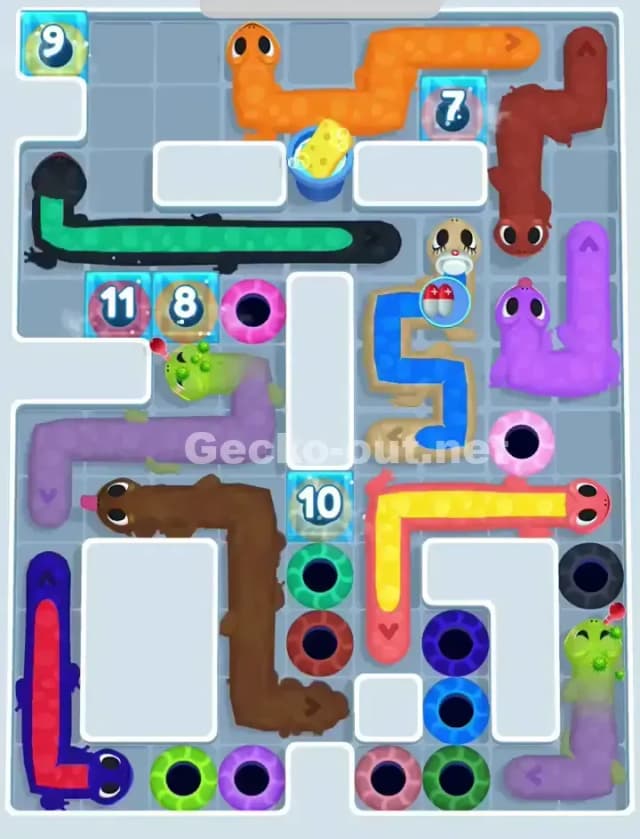
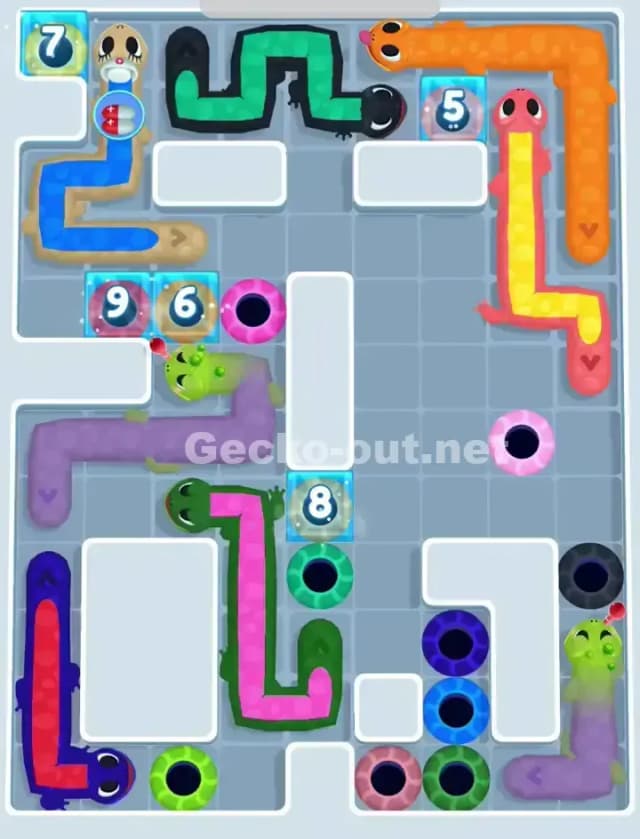

Gecko Out Level 1126: Board Layout, Rules, and Win Condition
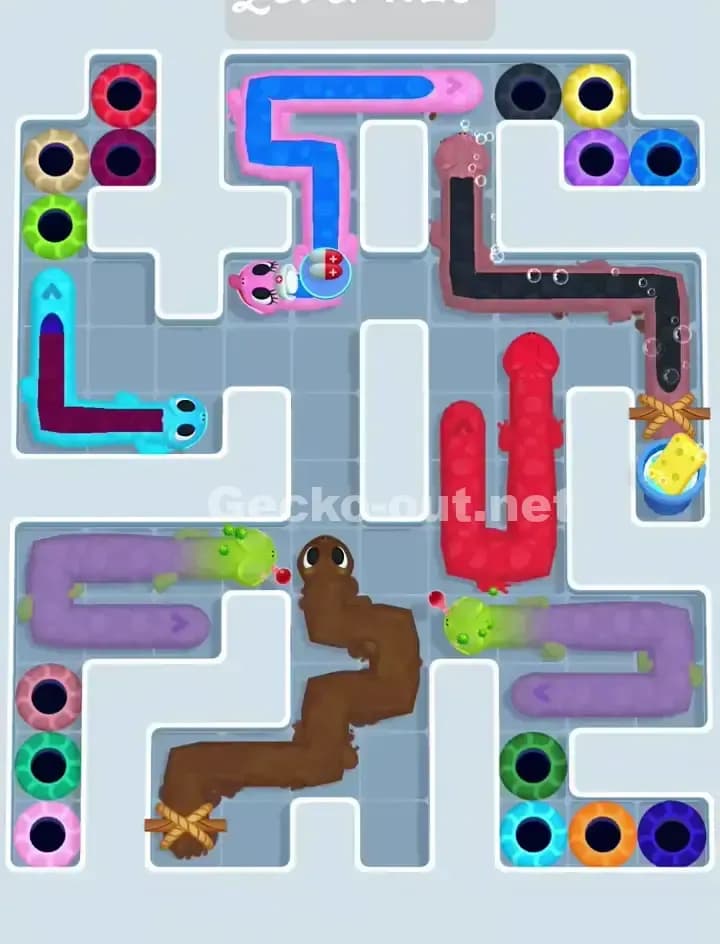
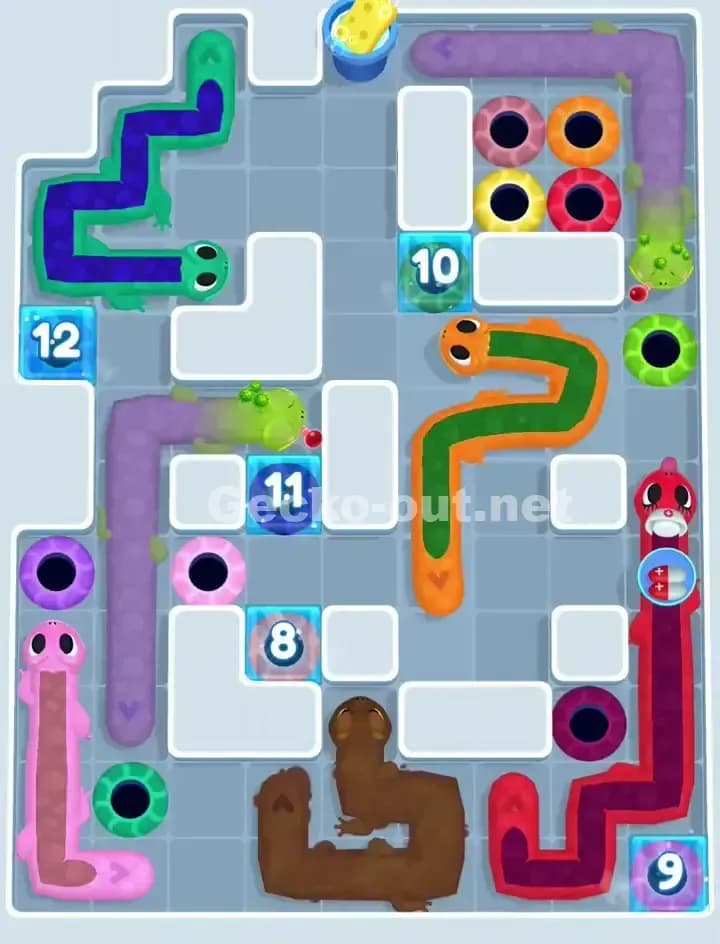
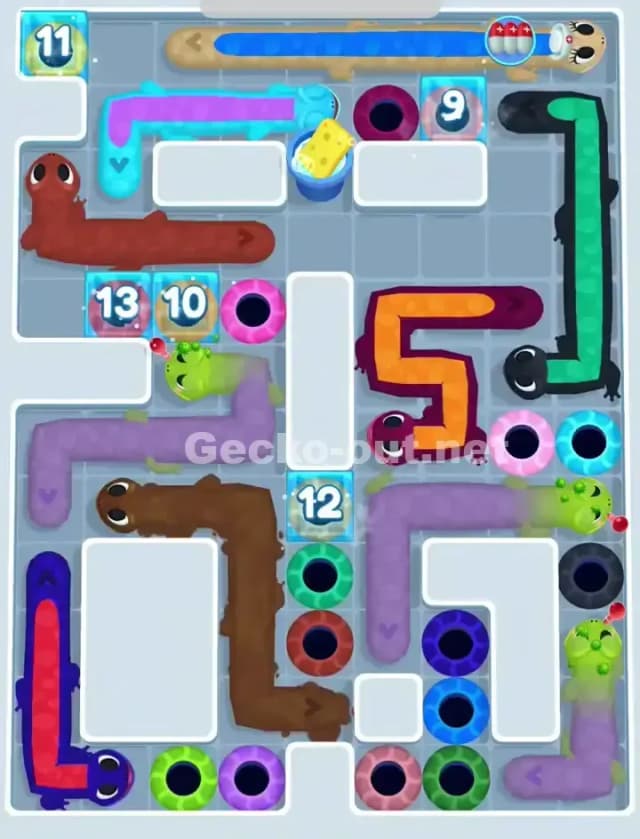
Gecko Out Level 1126 is a medium-difficulty puzzle that demands careful sequencing and precise pathing. You're working with multiple geckos of different colors scattered across a densely packed board with several white obstacle barriers creating a labyrinth-like structure. The board features a red gecko on the left, a brown gecko occupying a large L-shaped path in the center-lower area, a cyan gecko in the upper-left region, a green gecko on the right side, and several smaller geckos positioned throughout. Each gecko must find its matching-colored hole to escape the level, and here's the kicker: you've got 11 seconds on the clock to pull it off.
The win condition is straightforward but merciless: all geckos must reach their corresponding exit holes before the timer hits zero. If even one gecko is still on the board when time expires, the entire level fails. This means Gecko Out Level 1126 isn't about finding a perfect solution—it's about finding a fast solution. You can't dawdle on the board reading every possible path; instead, you need to identify the critical flow and execute it with confidence. The timer creates constant pressure, transforming what might otherwise be a spatial puzzle into a race against the clock.
Pathing Bottlenecks and Logical Traps in Gecko Out Level 1126
The biggest bottleneck in Gecko Out Level 1126 is undoubtedly the brown gecko and its massive body occupying the center-lower portion of the board. This long gecko essentially locks down the vertical corridor on the left-center area, and until you route it to its exit, almost every other gecko's path becomes cramped. The brown gecko's hole is positioned below and to the left, which means its body will linger in critical space for longer than any other gecko. If you don't move the brown gecko early and decisively, you'll find yourself in a situation where other geckos are queued up waiting for space, burning precious seconds.
The second subtle trap is the white obstacle barriers themselves. They create a maze-like feel that makes it tempting to trace elaborate, winding paths. However, Gecko Out Level 1126 punishes over-complicated routing. If you drag a gecko's head on a long, meandering journey, the body follows every single pixel, and suddenly you've consumed three or four seconds on one gecko alone. The cyan gecko in the upper-left and the red gecko on the left side both have relatively direct routes to their holes, but it's easy to accidentally snake them around obstacles unnecessarily, eating up clock time.
I'll be honest: the first time I tackled Gecko Out Level 1126, I felt a spike of frustration when I realized the timer was ticking down faster than I could react. I started second-guessing myself, dragging paths slowly and carefully, which only made things worse. But then it clicked—I realized that the board actually wants you to move fast and commit to simple, direct routes. Once I stopped overthinking and started trusting my spatial instincts, Gecko Out Level 1126 transformed from stressful to satisfying. The solution was always there; I just needed to have the confidence to execute it.
Turn-by-Turn Path Strategy to Beat Gecko Out Level 1126
Opening: Clearing the Brown Gecko and Establishing Flow
Your first move should be to drag the brown gecko directly to its exit hole. Don't hesitate on this one. The brown gecko's path runs down and slightly left, moving it out of the central corridor and freeing up space for every other gecko to maneuver. By solving the brown gecko in the opening seconds (roughly 1–2 seconds of the 11-second timer), you've solved your biggest spatial jam and gained breathing room for the rest of the puzzle. As the brown gecko exits, you'll notice the board suddenly feels less claustrophobic, and the remaining geckos have cleaner lanes to navigate.
Mid-Game: Sequencing the Remaining Geckos
Once the brown gecko is gone, you should immediately focus on the red gecko on the left side. The red gecko has a fairly direct path to a red hole, and moving it next keeps the left portion of the board open for other geckos. This is strategic positioning: you're solving geckos in an order that progressively unclogs the board rather than creating new jams. After the red gecko is secured, move the cyan gecko in the upper-left region. The cyan exit is accessible without too much winding, so keeping this gecko's path simple and direct is key.
The critical mid-game moment happens when you're managing the green gecko on the right side and any remaining smaller geckos. By this point, you should have roughly 4–5 seconds remaining, which is tight but manageable if you've been executing crisply. Avoid the temptation to "optimize" paths further; instead, draw the most obvious route to each gecko's matching hole and commit immediately. In Gecko Out Level 1126, hesitation and over-optimization will cost you more time than a slightly longer but faster-executed path.
End-Game: Final Geckos and the Clock Crunch
In the final 2–3 seconds, you're relying purely on momentum and instinct. The last gecko or two should have the clearest board access because you've systematically removed obstacles (other geckos) throughout the mid-game. If you're down to the final gecko and have more than one second remaining, you've paced yourself well. Drag its head quickly but accurately toward its hole, and avoid any last-second fumbles. If you find yourself in the final second with a gecko still on the board, it's usually a sign that you made a routing error earlier, not that the end-game itself is unsolvable.
Why This Path Order Works in Gecko Out Level 1126
This strategy works because it respects the fundamental rule of Gecko Out Level 1126: the body always follows the exact path the head traces. By moving the brown gecko first, you're strategically repositioning the board state to favor faster subsequent moves. Each gecko you remove is one less body occupying grid space, one less obstacle for the next gecko's path to navigate around. This cascading effect—where solving one gecko makes the next gecko's puzzle easier—is the key to beating Gecko Out Level 1126 within the timer.
Managing the timer is about knowing when to pause and when to commit. You should take a full second at the very beginning to visually map out which gecko is blocking the most space and which exit is most accessible. After that initial read, you commit hard. Every move should be executed within 1–2 seconds per gecko. If you're spending more time than that on individual routing, you're overthinking. Gecko Out Level 1126 rewards confidence and directness, not paralysis by analysis.
Regarding boosters: honestly, you shouldn't need them on Gecko Out Level 1126 if you execute the brown-first strategy. However, if you find yourself failing repeatedly, a time booster (extra seconds) is the logical safety valve rather than a hint or a hammer tool. A time extension gives you breathing room to re-think your approach, whereas a hint might not clarify the sequencing issue you're really facing. That said, the level is absolutely beatable with just the starting 11 seconds if you move decisively.
Mistakes, Fixes, and Logic You Can Reuse in Other Gecko Out Levels
Mistake #1: Solving geckos in random order. Players often grab whichever gecko they notice first, leading to accidental body-blocking situations later. Fix: Always identify the gecko that's occupying the most critical board real estate (usually the longest one or the one in the center) and move it out of the way first. This "blocking gecko removal" strategy applies to any crowded Gecko Out level.
Mistake #2: Drawing overly complex paths to avoid walls. The white obstacles in Gecko Out Level 1126 tempt you to find elaborate workarounds, but often a simpler path exists. Fix: Trace the most direct line from gecko head to its exit hole, using walls as hard boundaries rather than reasons to loop around. On similar levels, simplicity is speed.
Mistake #3: Not accounting for the body's length while dragging. Players sometimes drag a gecko's head without realizing its body is still partially blocking another gecko's exit route. Fix: Before you finish a drag, mentally trace where the body will end up after the head completes its journey. In Gecko Out Level 1126 and comparable gang-gecko or linked-body levels, this body-awareness prevents late-game traps.
Mistake #4: Panic-dragging in the final seconds. As the timer dwindles, some players start making sloppy drags, missing optimal paths and overshooting holes. Fix: If you've paced well through the mid-game, the final gecko(s) should feel routine. Keep your hand steady and your target sharp. This mindset applies across all timed Gecko Out levels.
Mistake #5: Ignoring timer cues. Players often get so focused on pathing that they don't notice how much time remains. Fix: Glance at the timer every 2–3 gecko moves. If you've solved three geckos in 6 seconds, you're on pace. If you've only solved two geckos in 6 seconds, it's time to speed up or re-evaluate your strategy.
This logic—prioritizing large/central geckos, favoring direct paths, maintaining body awareness, and trusting your instincts under pressure—is reusable across any crowded, time-limited Gecko Out level. Whether you're facing frozen exits, gang geckos, or tight choke points, the core principle remains: clear the bottleneck first, then execute decisively.
Gecko Out Level 1126 is tough, no question. But it's absolutely beatable, and once you've solved it with a clear plan, you'll feel genuinely accomplished. The key is trust yourself, move fast, and remember that the simplest path is often the fastest one. Good luck out there, and may your gecko heads find their holes before the clock runs out!