Gecko Out Level 1106 Solution Walkthrough | Gecko Out 1106 Answer
How to solve Gecko Out level 1106? Get step by step solution & cheat for Gecko Out level 1106. Solve Gecko Out 1106 easily with the answers & video walkthrough.

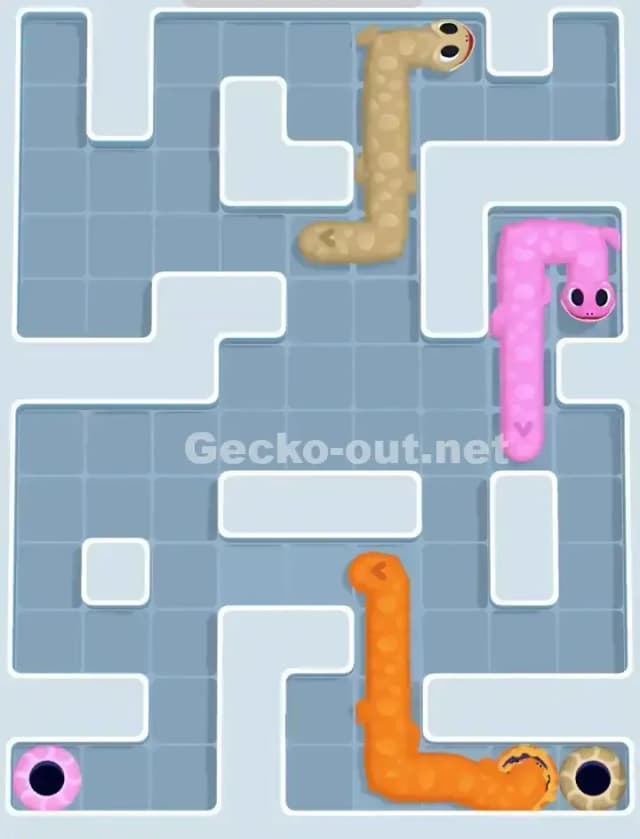
Gecko Out Level 1106: Board Layout, Rules, and Win Condition
Starting Board: Geckos, Colors, and Key Obstacles
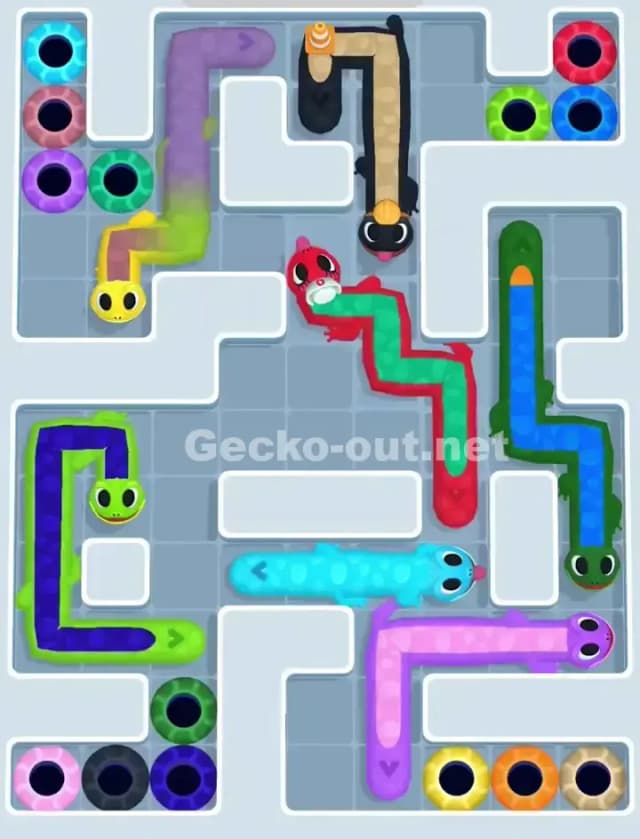
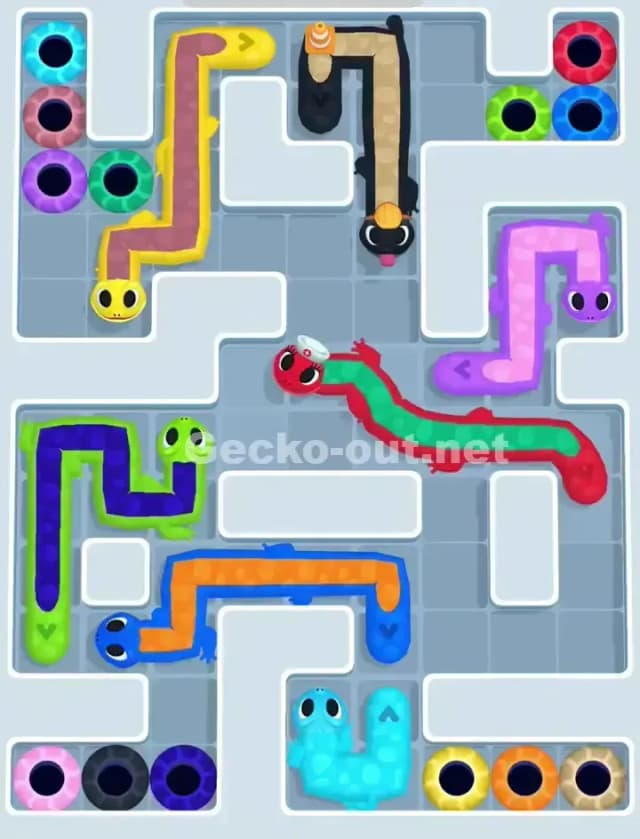
Gecko Out Level 1106 is a densely packed puzzle with seven geckos of different colors spread across a complex, maze-like grid. You've got a cyan gecko, a red gecko, a green gecko, a blue gecko, a purple gecko, a yellow gecko, and a dark blue gecko—each one needs to find its matching colored hole to escape. The board is crammed with white wall obstacles that create narrow corridors and tight turns, making this level feel like a real traffic jam waiting to happen. There's also a gang gecko (a multi-segment linked gecko) that takes up significant board real estate, which means you'll need to be extra careful about how you route it without tangling it around other geckos or walls. The exit holes are positioned around the perimeter, but they're not all equally accessible—some require long, winding paths that'll eat up your timer if you're not strategic.
Win Condition and Timer Pressure
To beat Gecko Out Level 1106, you need to guide all seven geckos to their matching colored holes before the timer runs out. The timer is your real enemy here; it's not generous, and every wasted move or backtrack costs you precious seconds. The drag-path mechanic means that once you commit to a route by dragging a gecko's head, its body follows that exact path—no shortcuts, no mid-route corrections. This makes planning absolutely critical. If you drag a gecko down a dead-end corridor or accidentally block another gecko's exit route, you'll have to undo and restart, burning time. The level demands that you think three or four moves ahead, visualize how each gecko's body will occupy the grid after it moves, and ensure that your exit sequence doesn't create a gridlock situation where the last gecko can't reach its hole.
Pathing Bottlenecks and Logical Traps in Gecko Out Level 1106
The Central Corridor Bottleneck
The biggest bottleneck in Gecko Out Level 1106 is the central corridor that connects the upper half of the board to the lower half. This narrow passage is where multiple geckos need to pass through, and if you route them poorly, you'll create a traffic jam that's nearly impossible to untangle. The gang gecko is particularly problematic here because its long body can block the entire corridor if you're not careful about the angle and timing of its exit. I'd recommend treating this corridor as a one-way street for most of your moves—decide which gecko goes through first, ensure its path is completely clear, and then move on to the next one. Don't try to thread multiple geckos through simultaneously; it'll only create overlaps and force you to restart.
Subtle Problem Spots: The Upper-Left Cluster and the Right-Side Maze
The upper-left corner of Gecko Out Level 1106 has a cluster of four geckos (cyan, pink, purple, and green) stacked in a tight formation. Getting them all out without them blocking each other is trickier than it looks. The cyan gecko, in particular, has a long body that can easily wrap around the purple gecko if you're not precise with your drag path. You need to exit the cyan gecko first, then carefully route the others so their bodies don't occupy the same grid cells. On the right side of the board, there's a multi-turn maze that leads to the blue and green exit holes. This maze has several dead-end corridors that look like they might be shortcuts but actually lead nowhere. It's easy to accidentally drag a gecko head into one of these traps, waste time, and then have to backtrack.
The Moment It Clicked
Honestly, my first two attempts at Gecko Out Level 1106 felt chaotic. I was dragging geckos randomly, trying to brute-force my way through, and I kept hitting the timer with three or four geckos still on the board. But then I realized I was thinking about the problem backwards. Instead of asking "where can this gecko go?" I started asking "what's the optimal exit order that keeps the board open for everyone else?" Once I mapped out a sequence that prioritized the geckos with the longest bodies and the most constrained paths, everything fell into place. The level went from frustrating to satisfying in about thirty seconds.
Turn-by-Turn Path Strategy to Beat Gecko Out Level 1106
Opening: Clear the Upper-Left Cluster First
Start by exiting the cyan gecko from the upper-left cluster. Drag its head down and around the white wall obstacles, routing it toward the cyan exit hole in the upper-right corner. This move clears valuable board space and prevents the cyan gecko's long body from becoming a permanent obstacle. Once the cyan gecko is out, immediately move the pink gecko next. Its exit hole is on the left side of the board, so drag its head down the left corridor and out. This two-gecko opening move should take you about 15–20 seconds and will dramatically reduce the congestion in the upper-left area. Park the remaining upper-left geckos (purple and green) mentally—don't move them yet. They're safe where they are, and moving them now would only create new obstacles.
Mid-Game: Route the Gang Gecko and Manage the Central Corridor
Once the upper-left is partially cleared, tackle the gang gecko. This is the most time-consuming move in Gecko Out Level 1106, so commit to it fully. Drag its head carefully through the central corridor, avoiding any overlaps with the remaining geckos. The gang gecko's exit hole is on the right side, so your path should curve around the board's perimeter rather than cutting through the middle. This might seem like a longer route, but it's actually faster because it keeps the central corridor open for the other geckos. After the gang gecko is out, you'll have much more breathing room. Now move the purple gecko from the upper-left. Its exit hole is in the lower-left area, so drag it down the left side of the board. Be careful not to overlap with the path the pink gecko took—geckos can't occupy the same cells, even if they're already exited. Finally, move the green gecko from the upper-left toward the green exit hole on the right side. This should be a relatively straightforward path now that the upper-left is mostly clear.
End-Game: Exit Order and Last-Second Timing
You should now have three geckos left: the red gecko, the blue gecko, and the yellow gecko. The red gecko has a long body and a somewhat constrained path, so move it next. Drag it toward the red exit hole in the upper-right area. The blue gecko should follow, routing toward the blue exit hole on the right side. Finally, move the yellow gecko last—it's typically the most flexible and can navigate around whatever paths the other geckos have taken. If you're running low on time (say, under 30 seconds remaining), don't panic. Move quickly but deliberately; a rushed mistake will cost you more time than a careful, methodical approach. If you're genuinely stuck and can't find a path for the last gecko, consider using a booster (like a hint or extra time) at this point—it's better than failing outright.
Why This Path Order Works in Gecko Out Level 1106
Head-Drag Pathing and Body-Follow Logic
The strategy works because it respects the fundamental rule of Gecko Out Level 1106: the body follows the head's exact path. By exiting the longest and most constrained geckos first, you're removing the biggest obstacles from the board before they can block anyone else. The cyan gecko's long body, for example, would be a nightmare to work around if it were still on the board when you're trying to route the gang gecko. By getting it out early, you've essentially "unlocked" the board for everyone else. The gang gecko is moved mid-game rather than last because its size makes it a natural traffic controller—once it's out, the central corridor is clear, and the remaining geckos have much more flexibility. This order minimizes the number of times you need to recalculate paths or undo moves, which directly translates to saving time.
Timer Management: Pause, Read, Commit
Gecko Out Level 1106 rewards deliberate planning over frantic clicking. Spend the first 10–15 seconds just reading the board, tracing potential paths with your eyes, and identifying the bottlenecks. Don't move anything yet. Once you've got a mental map, commit to your opening move (cyan gecko out) and execute it smoothly. After each gecko exits, pause for 2–3 seconds to reassess the board. Has anything changed that affects your next move? Are there new paths that are now open? This pause-and-reassess rhythm keeps you from making reactive mistakes. As you get closer to the timer running out, you can speed up, but never sacrifice accuracy for speed. A wrong move near the end will cost you more time than a careful move would have saved.
Boosters: Optional, Not Required
Gecko Out Level 1106 is absolutely beatable without boosters if you follow this strategy. However, if you find yourself with one gecko remaining and fewer than 20 seconds on the clock, an extra-time booster is a reasonable safety net. A hint booster is less useful here because the puzzle is more about execution than discovery—you already know where the holes are; the challenge is routing the geckos there without collision. I'd recommend saving any boosters you have for later, tougher levels. This one is meant to be solved with pure strategy.
Mistakes, Fixes, and Logic You Can Reuse in Other Gecko Out Levels
Common Mistakes and How to Fix Them
Mistake 1: Moving the gang gecko too early. Players often try to get the gang gecko out first because it's visually intimidating. This actually makes the puzzle harder because the gang gecko's body blocks the central corridor for everyone else. Fix: Move smaller, more flexible geckos first to clear space, then tackle the gang gecko when the board is less congested.
Mistake 2: Dragging geckos through dead-end corridors. The right-side maze in Gecko Out Level 1106 has several false paths that look like shortcuts but lead nowhere. Fix: Before dragging, trace the path with your eyes all the way to the exit hole. If it doesn't connect, don't move.
Mistake 3: Overlapping gecko bodies. Players sometimes forget that two gecko bodies can't occupy the same grid cell, even if one gecko has already exited. Fix: After each move, visually confirm that the gecko's body doesn't overlap with any walls or other gecko bodies. If it does, undo immediately.
Mistake 4: Rushing the final gecko. With the timer ticking down, players often make sloppy moves on the last gecko, forcing a restart. Fix: The final gecko is usually the most flexible. Take your time, even if the timer is low. A careful move beats a panicked one.
Mistake 5: Not planning the exit sequence. Players move geckos randomly and hope it works out. Fix: Before you start, mentally map out the order in which you'll exit each gecko. Prioritize long geckos and geckos with constrained paths first.
Reusing This Logic on Similar Levels
The strategy you've learned from Gecko Out Level 1106 applies directly to other gang-gecko and bottleneck-heavy levels. Whenever you see a level with a long gecko and a narrow central corridor, use the same principle: clear the board first, then move the big obstacle. On frozen-exit levels (where some holes are temporarily locked), apply the same pause-and-read approach—identify which geckos can exit immediately and which ones need to wait, then plan your sequence accordingly. On levels with multiple clusters of geckos, treat each cluster as a mini-puzzle and solve them in order of complexity, hardest first.
Final Encouragement
Gecko Out Level 1106 is genuinely tough, but it's absolutely beatable with a clear plan and a bit of patience. The level teaches you that sometimes the fastest solution isn't the most direct one—it's the one that keeps the board open and flexible for everyone else. Once you've beaten it, you'll have the mental tools to tackle even more complex puzzles. You've got this!