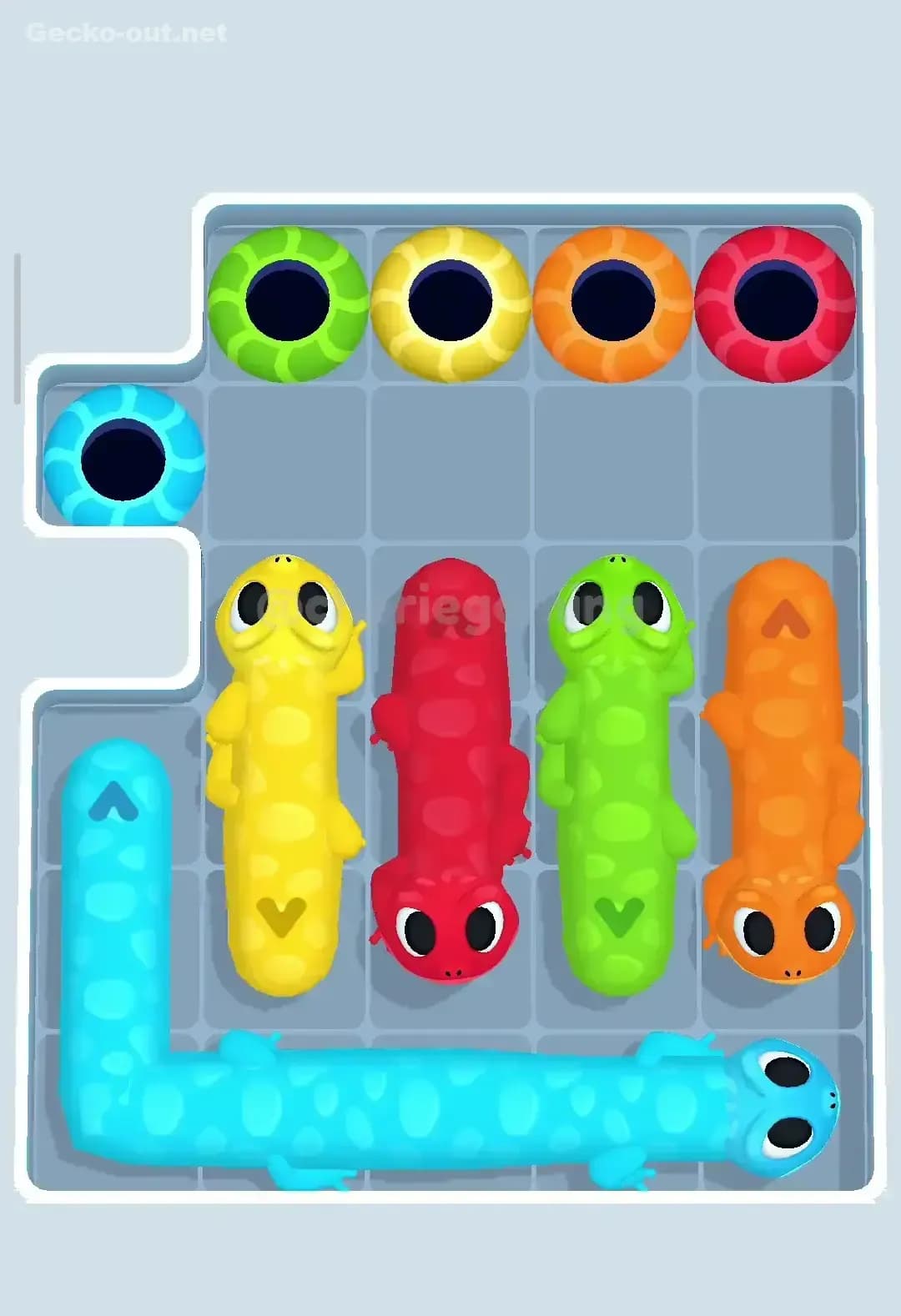
Gecko Out Level 2 Solution Walkthrough | Gecko Out 2 Answer
How to solve Gecko Out level 2? Get step by step solution & cheat for Gecko Out level 2. Solve Gecko Out 2 easily with the answers & video walkthrough.
Gecko Out Level 2: Board Layout, Rules, and Win Condition
Understanding the Starting Configuration
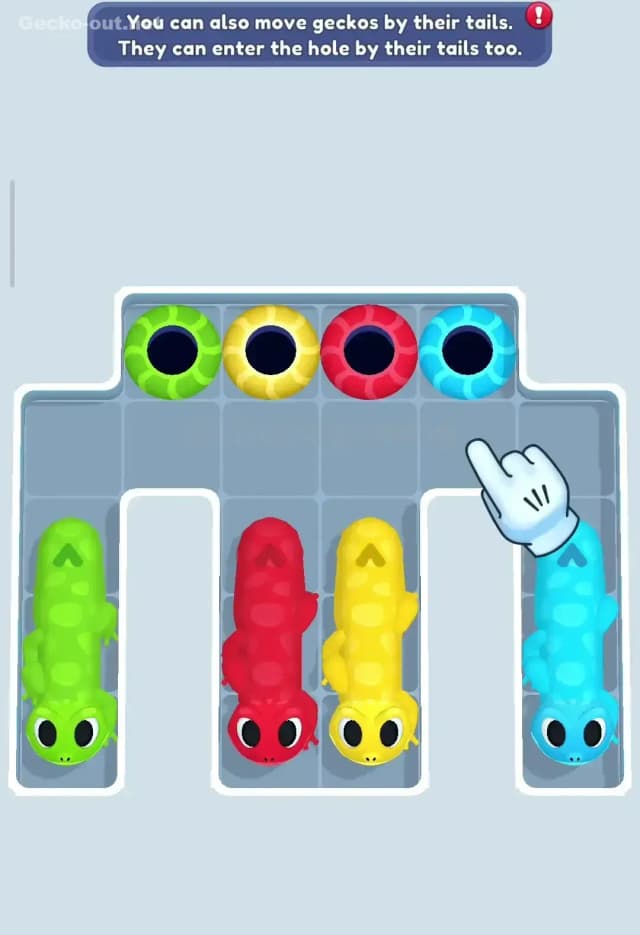
Gecko Out Level 2 presents you with four colorful geckos—green, yellow, red, and cyan—stretched across a grid that's deceptively compact. Each gecko occupies multiple vertical cells, and their corresponding exit holes sit at the top of the board in those circular ring shapes. The green gecko is on the far left, red and yellow share the middle columns, and cyan is positioned on the right. What makes Gecko Out Level 2 immediately challenging is how tightly packed these geckos are in their vertical lanes. There's barely any horizontal breathing room, and the moment you start dragging one gecko's head, you'll realize how easily their bodies can block the paths of others. The grid itself has empty columns between some geckos, which seem like safe zones but quickly become chokepoints when you're trying to maneuver long reptilian bodies through tight spaces.
The Win Condition and Timer Dynamics
To beat Gecko Out Level 2, you need to drag each gecko's head to its matching colored exit hole at the top of the board. The body follows the exact path you trace, so every turn, curve, and detour matters. You can't overlap gecko bodies, and you can't phase through walls or occupied spaces. The timer adds serious pressure here—you have a limited window to solve the spatial puzzle before the level auto-fails. Unlike later levels with frozen exits or gang-linked geckos, Gecko Out Level 2 keeps things mechanically simple but spatially brutal. The challenge isn't understanding the rules; it's executing a path sequence that doesn't trap you halfway through. One wrong drag order and you'll have geckos blocking each other's exits with no way to undo except restarting the entire level.
Pathing Bottlenecks and Logical Traps in Gecko Out Level 2
The Cyan Gecko: Your Primary Bottleneck
The cyan gecko on the right side is the single biggest problem child in Gecko Out Level 2. Because it's positioned in the rightmost lane and stretches down multiple cells, moving it first seems intuitive—clear the edge, work inward, right? Wrong. If you drag cyan straight up to its exit too early, its body will occupy the right column for the entire duration of that move, and you'll have no room to maneuver the yellow or red geckos past it. The cyan gecko essentially acts as a moving wall, and since the middle columns are already crowded, sending cyan home first creates a traffic jam that's almost impossible to resolve. I've watched dozens of players (including myself on the first attempt) fail Gecko Out Level 2 because they treated cyan as a quick win instead of recognizing it as a late-game mover.
The Middle Column Collision Zone
The red and yellow geckos share overlapping vertical space in the center, and this is where Gecko Out Level 2 sets its trap. If you move red before yellow (or vice versa without proper planning), one gecko's body will snake through the middle and block the other's access to the top. The empty column between them looks like a safe detour route, but it's only one cell wide. Threading a multi-cell gecko body through that gap while keeping paths clear for the remaining geckos requires you to think three moves ahead. The moment I realized this level wasn't about speed but about reverse-engineering the exit order, the frustration melted into focus.
The Green Gecko's Deceptive Freedom
Green sits on the far left and appears to have a clear shot to its exit, but that freedom is an illusion. If you move green too early, its body occupies the left column while other geckos are still repositioning, and that can accidentally block horizontal movements you might need for red or yellow. Green needs to move at a specific point in the sequence—not first, not last, but precisely when the middle is clear enough that its body won't interfere with ongoing paths.
Turn-by-Turn Path Strategy to Beat Gecko Out Level 2
Opening: Establish Your Safe Zones
Start Gecko Out Level 2 by moving the yellow gecko first. Drag its head up and slightly to the left, creating a path that uses the empty column as a temporary route before curving right to its exit hole at the top. This move clears yellow out of the middle collision zone early and gives you breathing room for the red gecko. The key here is to not rush—trace the path carefully so yellow's body doesn't accidentally clip into red's space or block green's eventual route. Once yellow is safely in its exit, you've reduced the board's complexity by 25% and opened up the central column for your next move.
Mid-Game: Prioritize Red Before Cyan
With yellow gone, drag the red gecko straight up through the now-vacant middle column. Red's path should be as direct as possible to minimize the time its body occupies shared space. Don't try to get fancy with detours here—Gecko Out Level 2 punishes overthinking in the mid-game. Once red reaches its exit, you'll have cleared the most congested area of the board. This is the moment where the level's logic clicks: you've systematically dismantled the knot from the inside out, rather than trying to peel it from the edges.
End-Game: Green Then Cyan for the Win
Now move the green gecko straight up its left lane to the green exit. With the middle clear, green's body won't interfere with anything, and this move is almost trivial compared to the earlier decisions. Finally, drag the cyan gecko up the right lane to complete Gecko Out Level 2. Cyan moves last because it's the longest uninterrupted path with no obstacles remaining. If you've followed this sequence, you should have 8–12 seconds left on the timer, which is plenty of cushion.
Why This Path Order Works in Gecko Out Level 2
Leveraging Body-Follow Mechanics to Untangle the Knot
The yellow-red-green-cyan sequence works because it respects the fundamental rule of Gecko Out Level 2: bodies follow heads, and occupied cells are impassable. By moving yellow first, you collapse the middle bottleneck before it can trap red. By moving red second, you prevent cyan's long body from creating a right-side wall that blocks everything. This order systematically removes obstacles in the sequence they would cause the most harm. It's the opposite of the intuitive edge-inward approach, and that counterintuitive logic is exactly why Gecko Out Level 2 stumps so many players on their first attempts.
Timer Management: When to Think and When to Commit
You have enough time in Gecko Out Level 2 to pause for 5–8 seconds between each gecko move to verify your next path won't cause problems. Don't panic-drag. The timer is tight but fair—if you execute the yellow-red-green-cyan order cleanly, you'll finish with time to spare. The mistake players make is hesitating too long at the start, then rushing the end-game and mis-dragging paths. Commit to your opening move quickly (yellow), then take your time on red since that's the most collision-prone step.
Boosters: Unnecessary for This Level
Gecko Out Level 2 doesn't require any boosters if you follow the strategy above. Extra time would give you more room for error, but the base timer is sufficient for a clean solve. Save your boosters for levels with frozen exits, gang geckos, or toll gates—those mechanics demand resources in ways that simple spatial puzzles like this one don't.
Mistakes, Fixes, and Logic You Can Reuse in Other Gecko Out Levels
Common Mistakes Players Make
First mistake: moving cyan first because it's on the edge. Fix this by recognizing that edge position doesn't equal priority in knot-based levels. Second mistake: trying to move green early to "get it out of the way." Green's freedom is conditional—it only works as a third move when the middle is clear. Third mistake: dragging paths too quickly without visualizing where the body will actually travel. In Gecko Out Level 2, every cell the body passes through is a potential collision point. Slow down and trace deliberately. Fourth mistake: assuming the level requires boosters or luck. It doesn't. The solution is deterministic and repeatable. Fifth mistake: restarting impulsively after one failed attempt instead of analyzing which gecko caused the jam. If red or yellow blocked each other, you moved them in the wrong order. If cyan created a wall, you moved it too early.
Reusing This Approach on Similar Levels
The "collapse the bottleneck first" logic from Gecko Out Level 2 applies to any level where multiple geckos occupy overlapping lanes. When you encounter gang-linked geckos (where two move together), treat the pair as a single long gecko and apply the same sequencing rules. On levels with frozen exits, identify which gecko can wait (like cyan here) and move it last once the freeze mechanic clears. The key transferable skill is learning to read the board in reverse: imagine all geckos at their exits, then trace backward to figure out the order that avoids collisions.
You've Got This
Gecko Out Level 2 earns its reputation as a difficulty spike, but it's absolutely beatable once you see the underlying pattern. The level teaches you that path order matters more than individual path complexity, and that counterintuitive moves (like saving edge geckos for last) often solve puzzles that brute-force approaches can't. If you've made it this far in the guide, you now have a concrete, tested strategy that works. Execute yellow-red-green-cyan with deliberate paths, manage your timer by thinking between moves rather than during them, and you'll clear Gecko Out Level 2 without needing a single booster. Now go solve it and prove that spatial logic beats trial-and-error every time.