Gecko Out Level 477 Solution Walkthrough | Gecko Out 477 Answer
How to solve Gecko Out level 477? Get step by step solution & cheat for Gecko Out level 477. Solve Gecko Out 477 easily with the answers & video walkthrough.
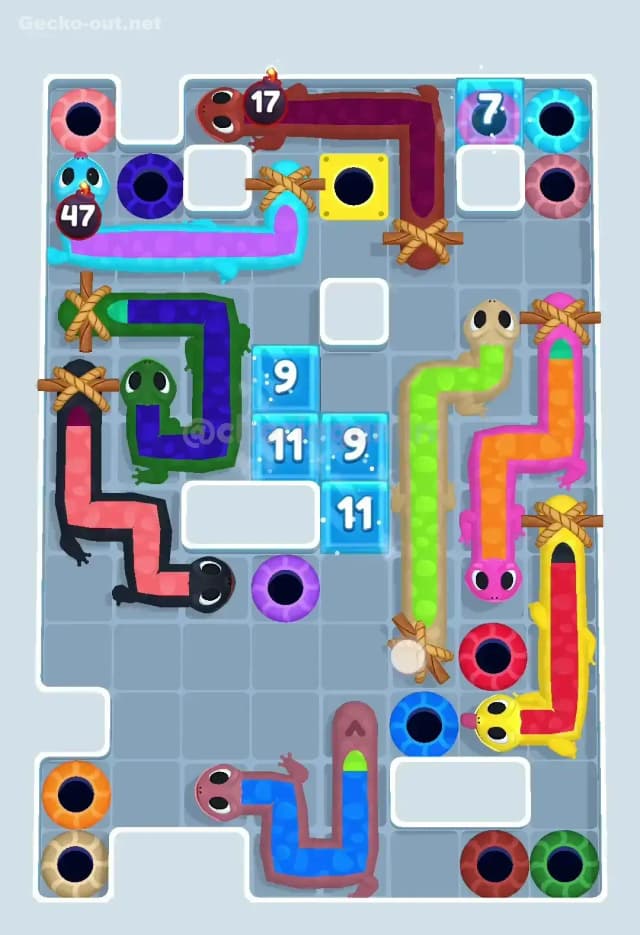
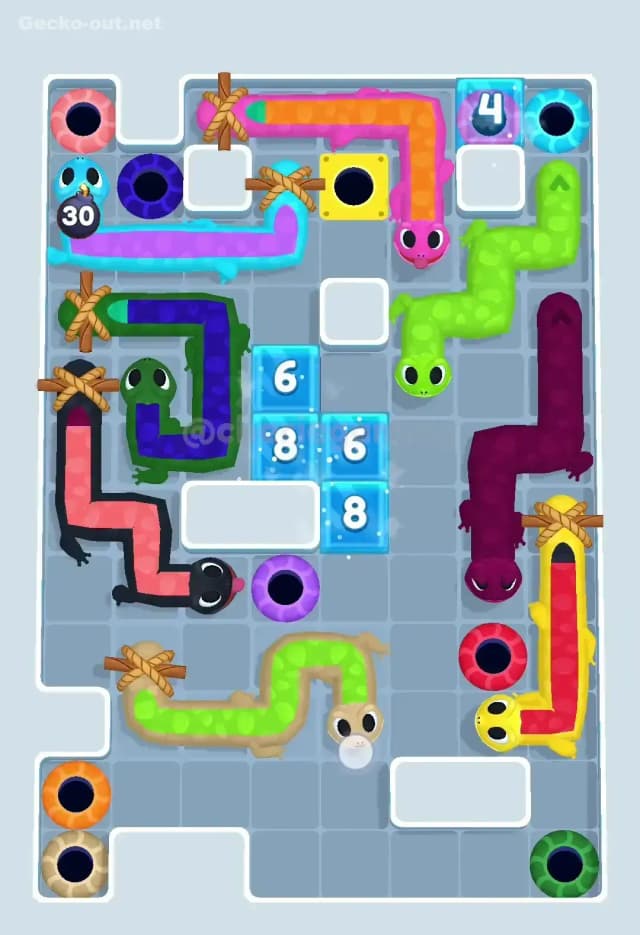
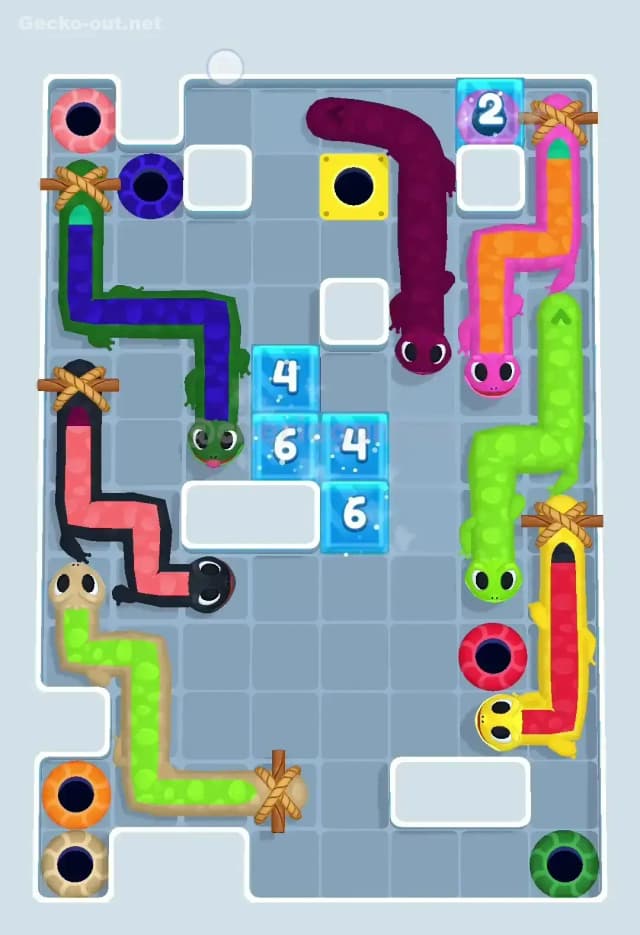
Gecko Out Level 477: Board Layout, Rules, and Win Condition
What You’re Dealing With On This Board
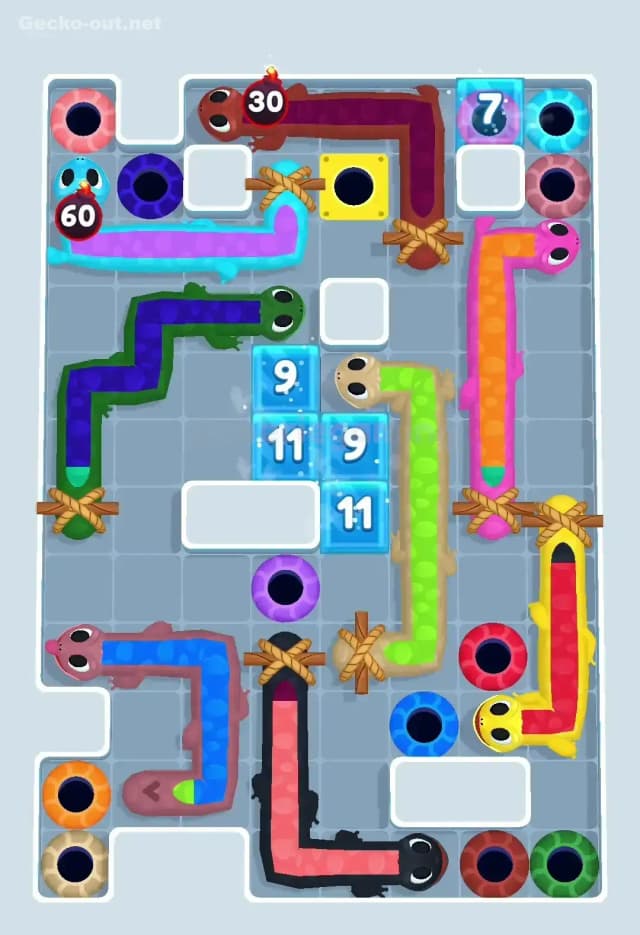
Gecko Out Level 477 drops you into a very cramped, very vertical layout. You’ve got a mix of long and short geckos in almost every color, and they’re threaded through each other like spaghetti.
Key pieces to notice:
- A long burgundy gecko runs along the top, with its head on the left side of the top corridor and its body curling toward the center.
- A long lime‑green gecko stands almost the full height of the middle-right side, acting like a sliding wall between the left half and right half of the board.
- On the far right you’ve got two tall geckos (orange and pink) stacked in the same vertical lane, plus a yellow L‑shaped gecko near the bottom-right corner.
- On the left, a zig‑zagging dark‑purple/green gecko locks down the lower-left, and a short blue/pink gecko wraps around the bottom-left exits.
- Several exits are tied up with straw/rope, which means they’re locked or “toll” exits that only open after some interaction (usually clearing ice or moving geckos off linked tiles).
- In the center there’s a block of blue ice cubes with numbers (9/11). These are multi-hit ice blocks that eat up pathing space until you run bodies across them enough times.
On top of that, you see bomb-style timers on a couple of geckos and tiles (like 60, 30, 7). They’re your reminder that Gecko Out Level 477 is strict about time; you don’t have the luxury of endless fiddling.
How The Win Condition Shapes Your Play
As always, the win condition for Gecko Out 477 is simple to say and annoying to execute: every gecko must slither into the hole that matches its color before the timer runs out. They can’t overlap walls, other geckos, ice, or locked exits.
The twist on this level is how drag-path movement interacts with the cramped layout. When you drag a head, the body traces the exact route you drew. If you draw a long, wiggly path through the center, that body becomes a permanent wall until you move it again. In Gecko Out Level 477, one sloppy line can turn a narrow corridor into a dead end for half the board.
That’s why the timer and the pathing rules combine to create pressure. You can’t just brute‑force paths by trial and error—there isn’t enough time. You need a clear plan: which gecko leaves first, which corridors stay open, and where each body “parks” temporarily while other geckos slip past.
Pathing Bottlenecks and Logical Traps in Gecko Out Level 477
The Main Bottleneck: The Middle-Right Wall Of Tails
The single biggest bottleneck in Gecko Out Level 477 is the vertical mess on the right side: the long lime‑green gecko in the middle-right and the tall orange and pink geckos on the far right. Together they form a sliding wall that can completely block:
- Access to the right-side exits (pink, yellow, blue).
- Access from the lower half of the board up to the top-right area.
- The central lanes that you need to reach the frozen middle.
If you move the green gecko straight down or straight up without thinking, you can trap the orange and pink geckos in place—or worse, lock your own access to the central corridor. So I treat that green gecko as a “door”: you only move it when you know which side needs to be open.
Subtle Problem Spots That Mess You Up
There are a few less obvious traps that kept annoying me:
- Parking in front of locked holes. Some exits have straw around them. If you park a gecko body right across a locked exit, you might later unlock it but be unable to use it without completely redrawing the parked body, wasting precious seconds.
- Over-using the ice area early. That center ice block looks tempting as a shortcut, but if you drag multiple geckos across it randomly, you leave bodies frozen across what should become your escape highway later.
- Short geckos that feel “low priority.” The little geckos near the bottom look harmless, so it’s tempting to ignore them. But their exits sit right in key junctions; if you don’t clear them at the right moment, they become tiny plugs in major traffic lanes.
When The Level Starts To Make Sense
Gecko Out 477 feels chaotic at first. I remember thinking, “There is no way all of these bodies can move without someone getting stuck.” The turning point for me was when I stopped trying to free geckos in color order and instead focused on corridor order.
Once I treated the board as three lanes—left, middle (ice), and right—and decided which lane needed to be cleared first, everything clicked. The moment I realized the middle-right green gecko should act as a movable barrier, not a piece to rush out, the whole puzzle softened up. From there, a consistent path order made the level feel tight but fair instead of impossible.
Turn-by-Turn Path Strategy to Beat Gecko Out Level 477
Opening: Clear The Urgent Timers And Set Parking Spots
In the opening of Gecko Out Level 477, your priorities are:
- Handle the smallest timer first. Get the gecko or tile with the “7” timer dealt with immediately. Usually this means a short, direct path to its exit or a quick step onto/off a toll tile. Don’t overthink; draw the cleanest path that doesn’t wrap through the central ice.
- Slide the green middle-right gecko just enough. Nudge the long green gecko so that one side of the board opens up (I like opening the top-right first), but don’t stretch it across the center. Think of it as swinging a door half open.
- Park long bodies along walls. For the top burgundy gecko and the tall orange/pink geckos, draw simple L‑shapes that hug the outer walls and stay away from exits and the ice cluster. You want them out of the central flow, not weaving through it.
If you do this right, you end the opening with the urgent timers safe, outer lanes mostly clear, and a clear approach to the frozen center without any ridiculous knots.
Mid-game: Managing Lanes And Breaking The Ice
Mid-game in Gecko Out 477 is where you either win or completely choke the board.
- Use one gecko as your “ice breaker.” Pick a gecko whose final exit isn’t in the center and drag its head back and forth across the ice blocks to chip them down. Keep its path as straight and repeatable as possible so you’re not redrawing from scratch each time.
- Keep a vertical lane open. Between the middle-right green gecko and the right-side orange/pink pair, always leave one full vertical lane open from top to bottom. That’s your highway for late exits. I usually park one tall gecko against the far right wall and keep the adjacent lane clear.
- Start freeing the small junction geckos. Clear the blue/pink gecko at the bottom-left and the yellow/black gecko near the lower center once the path to their exits doesn’t cut across your ice-breaker’s route.
By the end of mid-game, the ice should be mostly or fully gone, transforming the center into a huge, flexible corridor. Most rope-locked exits should be accessible or nearly unlocked, and you should still have at least one clean vertical lane on the right side.
End-game: Exit Order And Last-Second Chokes
End-game in Gecko Out Level 477 is all about not panicking with 10–15 seconds left.
Here’s the exit order that felt smoothest to me:
- Finish off any short geckos near the bottom whose tails sit in junctions; you don’t want them plugging intersections later.
- Send the yellow and pink/orange geckos on the right through their exits using the open vertical lane. Make sure the middle-right green “door” is swung to the opposite side when you do this so they aren’t blocked.
- Exit the long green middle-right gecko second-to-last. With the others gone, you can draw a simple, direct path to its hole.
- Finish with the top burgundy gecko once the path to its matching hole is completely clean.
If you’re low on time in Gecko Out 477, commit to straight, minimal paths. Don’t reroute through the center if you can bang out a slightly awkward but direct L‑shape that still fits.
Why This Path Order Works in Gecko Out Level 477
Using Body-Follow Pathing To Untangle, Not Tighten
This plan works because it respects the body-follow rule instead of fighting it. By hugging walls early and keeping central routes simple, every long body you move actually creates space instead of stealing it.
- Parking tall geckos on the outer edges means their bodies never cut through the center.
- Using a single “ice breaker” gecko to chew through the frozen tiles makes the ice damage predictable, and its body always returns to a known parking shape.
- Leaving one vertical lane deliberately open ensures that when you finally move the middle-right green gecko, it doesn’t become a permanent, immovable wall.
You’re turning each gecko into a movable barrier you control, rather than a random snake that gets in the way.
Balancing Reading Time Versus Moving Fast
In Gecko Out Level 477, the trick is to think hard once and then move quickly. I’d recommend:
- Spend the first 10–15 seconds just reading the board and mentally choosing your “door” gecko (the middle-right green one) and your “ice breaker.”
- Once you commit, avoid mid-run rethinking. Drag confidently with short, clean paths.
- Pause very briefly when the ice is almost gone to reassess end-game exits; then execute in your chosen order without hesitation.
This style keeps the timer from owning you. You’re allowed one planning pause; after that, you’re in execution mode.
Are Boosters Needed On Gecko Out 477?
Boosters are optional on Gecko Out Level 477, but I’ll be honest: a small time booster can turn a stressful clear into a comfy one.
- Time boost: If you’re struggling, drop this right after the ice is mostly gone and you’re entering end-game. It buys you breathing room while you send out the long geckos.
- Hammer/clear tool: Not really necessary here. The board is tight, but no single tile is so evil that it must be destroyed.
- Hint: If you’re completely lost on move order, one hint can show which side of the board the game expects you to clear first, but don’t rely on it for every run.
I’d save boosters for when you’ve understood the logic but your fingers just need a bit more time.
Mistakes, Fixes, and Logic You Can Reuse in Other Gecko Out Levels
Common Mistakes On Gecko Out Level 477 (And Fixes)
-
Rushing the middle-right green gecko to its exit.
Fix: Treat it as a sliding door until the last phase. Keep it in the middle, not plastered across the entire board. -
Crossing the ice with three or four different geckos.
Fix: Assign one ice breaker and leave everyone else off the frozen tiles. This keeps the central corridor clean later. -
Parking on top of locked exits.
Fix: Park along walls and empty corners instead. Always leave a one-tile clear buffer around any exit, locked or not. -
Ignoring short bottom geckos.
Fix: Clear them in mid-game once their exits are reachable. They’re tiny, but they block huge junctions. -
Overdrawing fancy paths.
Fix: Prefer straight lines and simple L‑shapes. Shorter paths mean fewer chances to self-block.
Reusing This Logic On Other Knot-Heavy Levels
The approach that cracks Gecko Out Level 477 is reusable across a lot of Gecko Out levels:
- Identify one or two “door” geckos that control major corridors and delay exiting them.
- Use a dedicated pathing gecko to interact with special tiles (ice, toll gates) instead of spreading the job around.
- Park long bodies along outer walls, never across the board’s “spine” lanes.
- Plan exits by lanes, not by color—clear one traffic lane at a time.
Once you start thinking in corridors and doors, not just colors, knot-heavy or gang‑gecko levels feel much more manageable.
Final Encouragement For Gecko Out 477
Gecko Out Level 477 looks brutal, but it’s absolutely beatable once you respect the bottlenecks and plan around the middle-right corridor and central ice. Give yourself one calm read of the board, choose your door gecko and ice breaker, and then commit to clean, wall-hugging paths.
After a couple of tries, you’ll feel the rhythm of the level, and those tangled bodies start to make sense. Stick with the plan, and you’ll watch every gecko dive into its hole with seconds to spare.