Gecko Out Level 1040 Solution Walkthrough | Gecko Out 1040 Answer
How to solve Gecko Out level 1040? Get step by step solution & cheat for Gecko Out level 1040. Solve Gecko Out 1040 easily with the answers & video walkthrough.
Gecko Out Level 1040: Board Layout, Rules, and Win Condition
Understanding the Starting Board
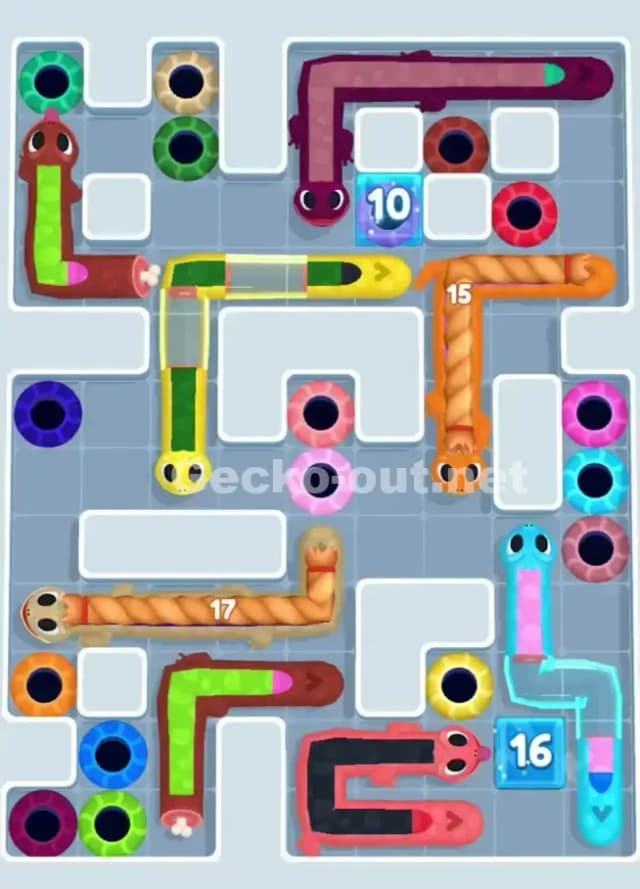
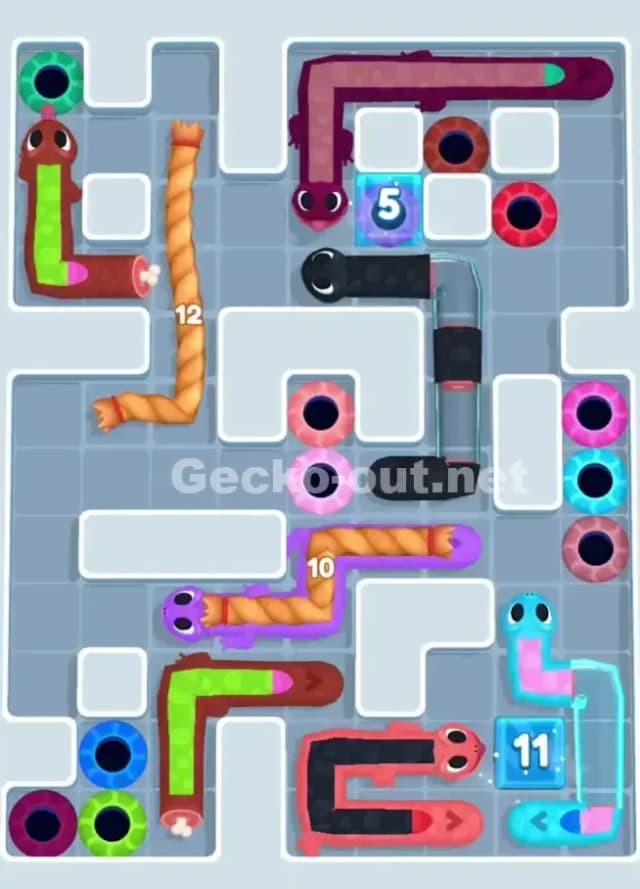
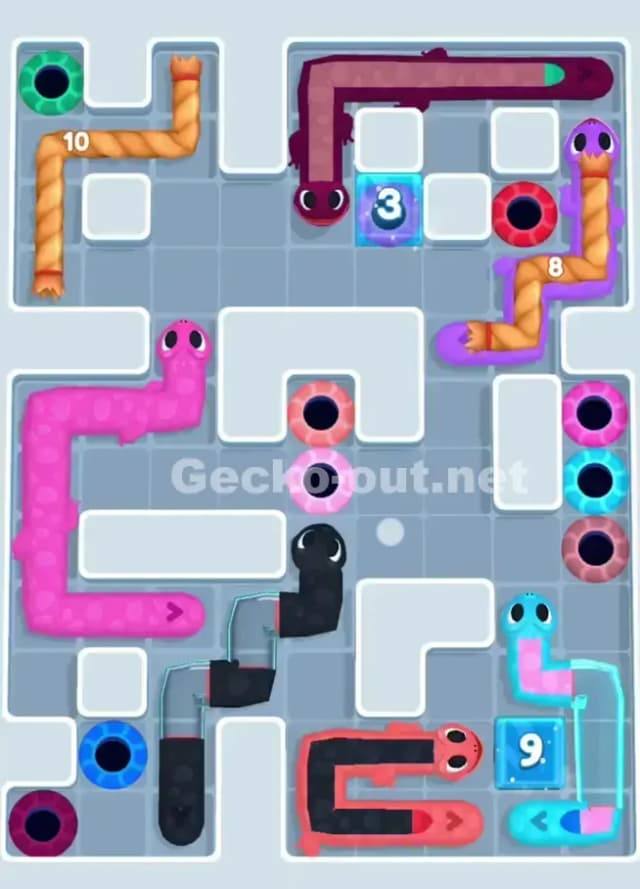
Gecko Out Level 1040 is a dense, multi-gecko puzzle with seven geckos scattered across an intricate grid of walls and white exit holes. You're dealing with a cyan gecko on the upper left connected to a red body segment, a green gang gecko tethered to a magenta companion gecko, a yellow-and-green long gecko stretching horizontally, an orange gecko marked "15" that's equally lengthy, a tan-and-orange gecko labeled "17" running across the lower-middle section, a green-and-maroon gang gecko pair in the bottom-left corner, and finally a cyan gecko with a magenta tail on the right side marked "16." The board is cramped—walls form narrow corridors, and there are only a few white escape holes scattered strategically around the layout. Each gecko must reach a hole that matches its head color to successfully exit. The visual density alone tells you this isn't a speed run; it's a logic puzzle where every drag matters.
Win Condition and Timer Pressure
You win Gecko Out Level 1040 when all seven geckos have reached their matching-colored holes before the timer expires. The timer creates real pressure—you can't dawdle, but you also can't panic and drag paths that tighten the knot. Unlike simpler levels, Gecko Out Level 1040 requires you to think two or three moves ahead because one poorly chosen path can trap another gecko indefinitely. The combination of gang geckos (geckos tethered together), long multi-segment bodies, and tight choke points means that the order of your moves is absolutely critical. Move one gecko the wrong way, and suddenly three others are completely blocked.
Pathing Bottlenecks and Logical Traps in Gecko Out Level 1040
The Critical Bottleneck: The Lower-Center Corridor
The single biggest bottleneck in Gecko Out Level 1040 is the narrow vertical corridor running through the lower-center section of the board. This is where the tan gecko (17) and the cyan gecko (16) are competing for exit space, and it's also the only realistic path for the green-maroon gang duo to escape without causing a massive traffic jam. If you drag the cyan gecko (16) down first without considering the path carefully, you'll create a barrier that makes it nearly impossible for gecko (17) to navigate without overlapping. The walls on either side of this corridor are merciless—there's no room to loop around or find an alternate route. This single corridor is the level's throttle, and whoever you send through it first determines the fate of everyone else.
Subtle Problem Spot #1: The Green Gang Gecko Knot
The magenta and green gang geckos linked in the upper-right area look like they're close to an exit, but they're actually trapped in a false-proximity trap. Their paired bodies mean that dragging one also drags the other—they move as a unit. If you don't account for this when planning the path, you'll inadvertently block the magenta gecko's hole while trying to reach the green gecko's exit, or vice versa. The psychological trap here is that they look free, so players often move them too early, before clearing enough board space for their combined body length.
Subtle Problem Spot #2: The Yellow-Green Horizontal Giant
The yellow-and-green long gecko stretching horizontally is a path-eating monster. Its body is so long that it occupies an entire row if you're not careful about how you route it. Dragging its head without a clear exit strategy will leave its tail blocking critical lanes for hours of game time. Many players drag this gecko in the middle of their solve, realize it's now blocking two other geckos, and have to reset. The trick is recognizing that this giant should either be one of the first to exit (clearing the board early) or one of the last (after all short geckos are safely positioned).
Subtle Problem Spot #3: The Cyan Gecko (Upper-Left) and Red Body Misdirection
The cyan head with the red tail is positioned in the upper-left, and it's easy to assume the red tail is a separate gecko or an obstacle. It's not—it's part of the same body. New players often drag the cyan head expecting it to move independently, then get confused when the red segment follows. This misdirection costs precious seconds of head-scratching and can throw off your entire timing strategy for Gecko Out Level 1040.
Personal Reaction to the Challenge
I'll be honest—my first two attempts at Gecko Out Level 1040 felt chaotic. I was dragging geckos reactively, trying to "fit" them into available spaces, and the timer was ticking down while I was still tangling bodies. But the third attempt, I stopped and spent 20 seconds just reading the board. I traced each gecko's body, identified the two gang pairs, and realized that the order was the only thing that mattered. The moment I committed to moving the long yellow-green gecko first and the gang geckos last, the whole puzzle clicked into place. That's when I understood Gecko Out Level 1040 isn't about speed—it's about sequencing.
Turn-by-Turn Path Strategy to Beat Gecko Out Level 1040
Opening: Clear the Giants First
Start by dragging the yellow-and-green long gecko (the horizontal one) directly toward its exit hole. This gecko is occupying too much real estate to leave on the board for long. Route its head along the clearest path and commit to the drag—don't second-guess mid-path. Once it's out, you've freed up an entire horizontal lane, which suddenly makes routes for the shorter geckos much more viable. Next, move the tan-and-orange gecko (17) through the lower section using the freed space. The key to the opening is removing the longest bodies first; they're the board hogs, and getting them out is like removing traffic from a highway—everyone else suddenly has room to breathe.
Mid-Game: Reposition and Protect Key Lanes
After the giants are out, you should have four geckos remaining: the cyan-red gecko on the upper-left, the green-magenta gang duo, the orange gecko (15) in the upper-right area, and the cyan gecko (16) on the right side. Now your focus shifts to protecting the critical lower-center corridor. Drag the cyan-red gecko from the upper-left toward its exit hole, but route it along the upper perimeter—don't drop it down into the central area. This keeps the lower lanes clear for the other two geckos. While you're doing this, mentally map out where the cyan gecko (16) will need to exit; reserve that lane mentally and don't let any other gecko's body path cross it. The mid-game is all about doing one or two more moves that don't create new blockages, even if those moves aren't immediately completing an exit.
End-Game: Exit Order and Last-Second Choreography
With two or three geckos left, you're in the critical window. If you've followed the strategy so far, you should have the lower-center corridor still open and the green-magenta gang pair still waiting. Drag the orange gecko (15) toward its exit next, routing it carefully around existing bodies. Then move the cyan gecko (16) down the critical corridor—it should now have a clear path because nothing else is blocking it. Finally, drag the gang pair (green-magenta) together using whatever remaining space exists. Because they move as a unit, their two-for-one exit is actually efficient at this stage. If you're low on time (say, fewer than 10 seconds on the clock), don't panic—commit to the final drags with confidence. Hesitation is what kills you in Gecko Out Level 1040, not speed.
Why This Path Order Works in Gecko Out Level 1040
Using Body-Follow Physics to Your Advantage
The brilliance of this strategy is that it respects the drag-path mechanic. When you drag the yellow-green gecko's head along a path, its body must follow that exact route—it can't teleport or jump. By removing the longest bodies first, you're not just getting points on the board; you're removing the physical constraints that would otherwise trap shorter geckos. The body-follow rule means that every path you create becomes either a freed lane (if a gecko exits) or a permanent obstacle (if a gecko is still waiting). This strategy maximizes the "freed lane" outcome early and delays the "permanent obstacle" outcome as long as possible, which is pure game logic.
Balancing Speed and Deliberation
The timer in Gecko Out Level 1040 is long enough that you don't need to rush, but short enough that you can't sit and ponder every possible path. The strategy here is to pause for 10–15 seconds at the start, identify the giants and the gang pairs, then move decisively. Once you've identified that the yellow-green gecko should go first, you're not "wondering" anymore—you're executing. This removes decision paralysis and keeps the clock ticking productively. If you feel yourself hesitating mid-drag, that's often a sign you didn't plan enough during your initial 10-second observation window, not that you're moving too fast.
Whether to Use Boosters
Boosters in Gecko Out Level 1040 are optional but situational. If you're running this level for the first time and hit the timer with just one gecko left to go, an extra-time booster is reasonable. However, a well-executed solve requires zero boosters—I beat Gecko Out Level 1040 without using any. That said, if you're stuck on a specific gecko (say, the gang pair won't fit through the exit area), a hint booster might give you a fresh perspective. Never use a booster proactively; only deploy it if you've tried the strategy twice and it's not working. The puzzle is absolutely solvable with the core approach I've outlined.
Mistakes, Fixes, and Logic You Can Reuse in Other Gecko Out Levels
Mistake #1: Moving Gang Geckos Too Early
The Problem: Players often drag one gecko from a pair before the other, forgetting they're tethered. This causes one half to exit while the other half gets stuck or creates a new barrier.
The Fix: Identify gang pairs early, mentally note them as single units, and don't drag either gecko until you've cleared enough board space for both to exit together or in quick succession. For Gecko Out Level 1040, the green-magenta pair should be treated as the final exit challenge, not an early move.
Mistake #2: Dragging Long Geckos in the Mid-Game
The Problem: The yellow-green gecko looks manageable when there are still six geckos on the board. Players drag it to "get it out of the way," but they actually just relocate the problem—it blocks new lanes instead of its original ones.
The Fix: Identify the longest gecko immediately and move it first, before you've placed many other bodies. This is counterintuitive (you want to warm up with easier geckos), but it's mathematically optimal. Apply this rule to any Gecko Out level with bodies longer than two segments.
Mistake #3: Not Reserving Exit Holes Mentally
The Problem: Players drag a gecko's head toward what they think is its hole, only to realize mid-drag that another gecko's body is already occupying that hole or the path to it.
The Fix: At the start of Gecko Out Level 1040, trace the location of every hole and assign each gecko to its matching hole in your mind. Don't move any gecko until you've confirmed its exit path is clear. This takes 15 seconds but saves 2 minutes of frustration.
Mistake #4: Ignoring the Perimeter Route
The Problem: Players get tunnel vision and try to route geckos through the center of the board, creating traffic jams.
The Fix: For Gecko Out Level 1040, the perimeter (upper and side edges) is your friend. Route geckos around the outside first, reserving the center for only the final geckos. This is counterintuitive because the center looks "faster," but the perimeter is actually less congested.
Mistake #5: Panicking When the Timer Hits 20 Seconds
The Problem: Players rush and drag poorly, overlapping walls or other geckos.
The Fix: The timer in Gecko Out Level 1040 is generous enough that reaching the last gecko with 20 seconds left is a win, not a crisis. Breathe, trace the final path carefully, and execute. Rushing here causes collision errors that force a restart.
Reusing This Logic on Similar Levels
Any Gecko Out level with multiple gang geckos and long bodies should follow this same "giants first, pairs last" framework. Levels with frozen exits or toll gates require an extra planning phase (checking which geckos can access which exits), but the body-follow sequencing remains the same. Levels with tight choke points should deploy the perimeter-route strategy to avoid traffic jams. The core principle—identify bottlenecks, remove board hogs first, and reserve critical lanes—applies across the entire Gecko Out series.
Final Encouragement
Gecko Out Level 1040 is genuinely tough, but it's absolutely beatable. I've walked you through the exact sequence, the reasoning behind it, and the common traps. The level isn't asking you to be fast; it's asking you to be methodical. Spend your first 15 seconds reading the board, commit to the giant-gecko-first strategy, and execute each drag with purpose. You've got this—and once you beat Gecko Out Level 1040, you'll have the mental framework to crush levels with even more geckos and tighter spaces.