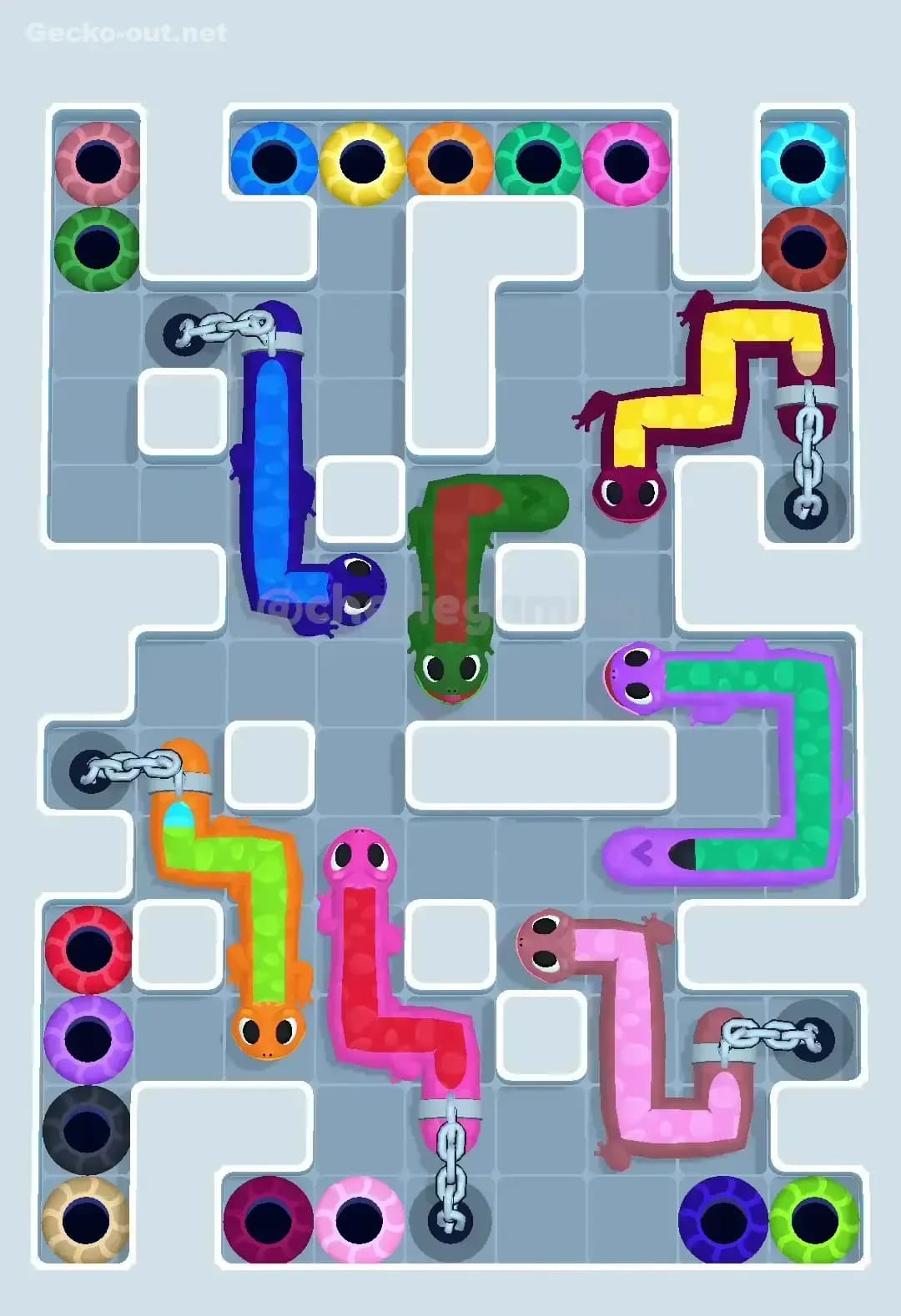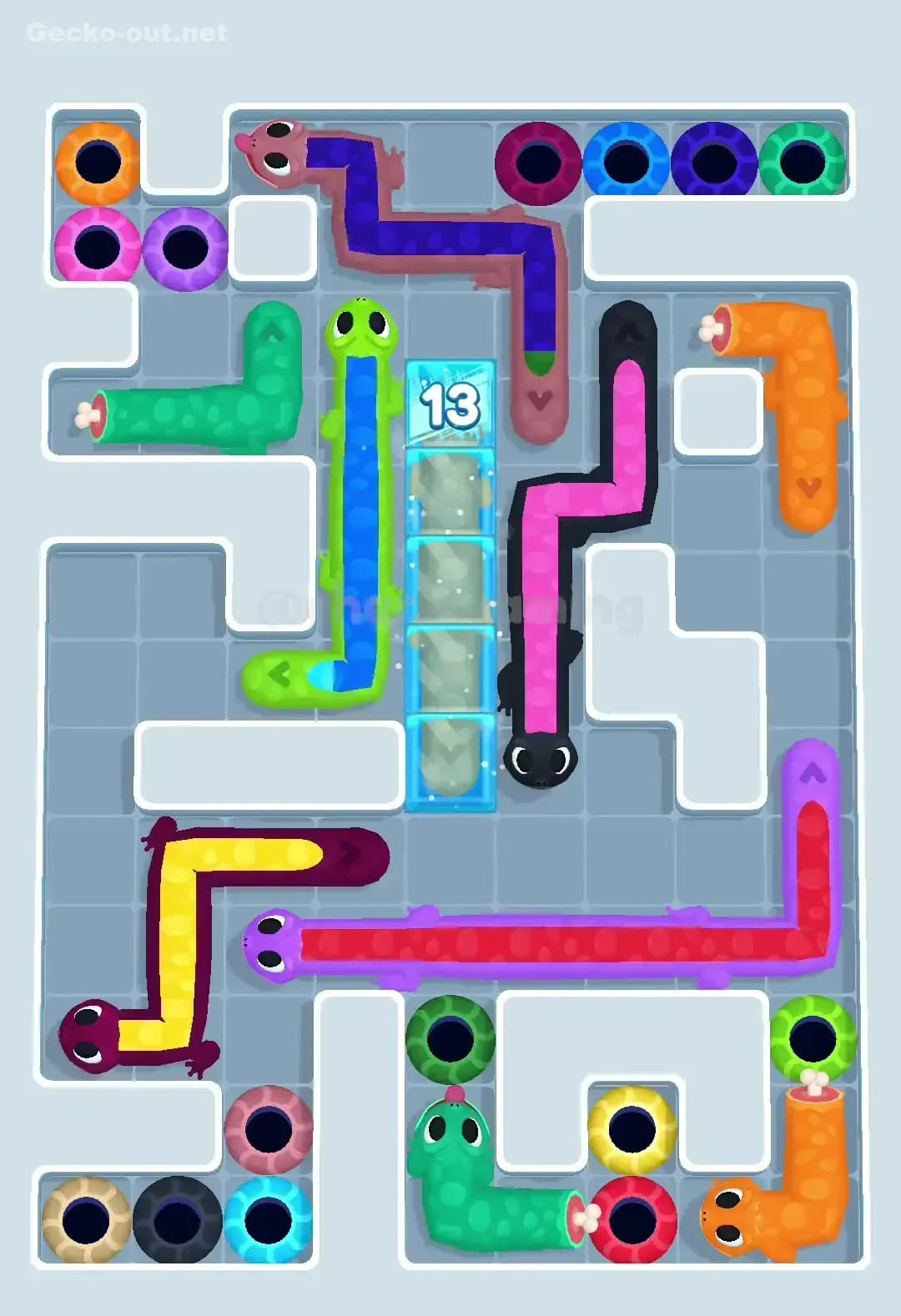
Gecko Out Level 535 Solution Walkthrough | Gecko Out 535 Answer
How to solve Gecko Out level 535? Get step by step solution & cheat for Gecko Out level 535. Solve Gecko Out 535 easily with the answers & video walkthrough.
Gecko Out Level 535: Board Layout, Rules, and Win Condition
The starting tangle
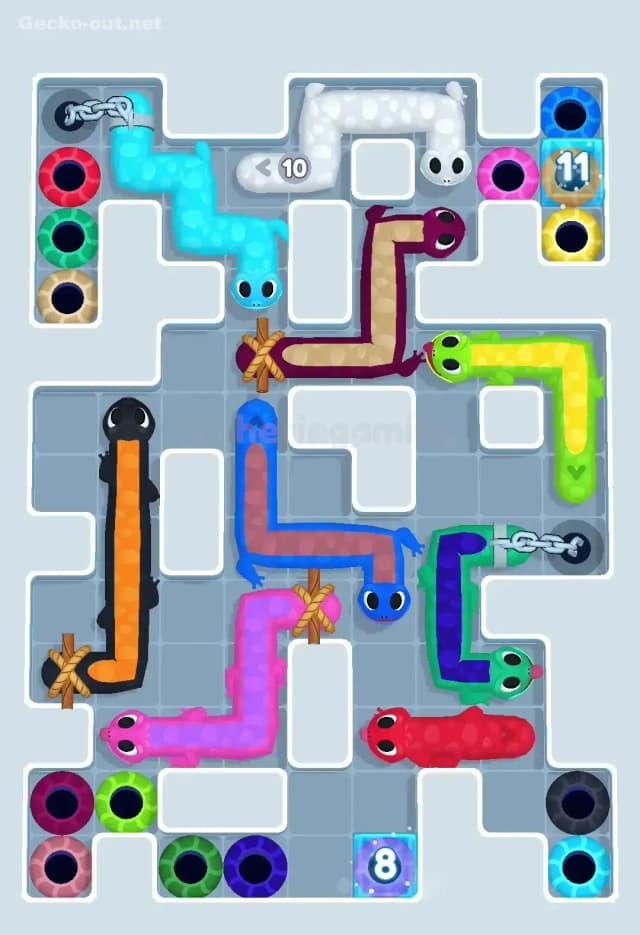
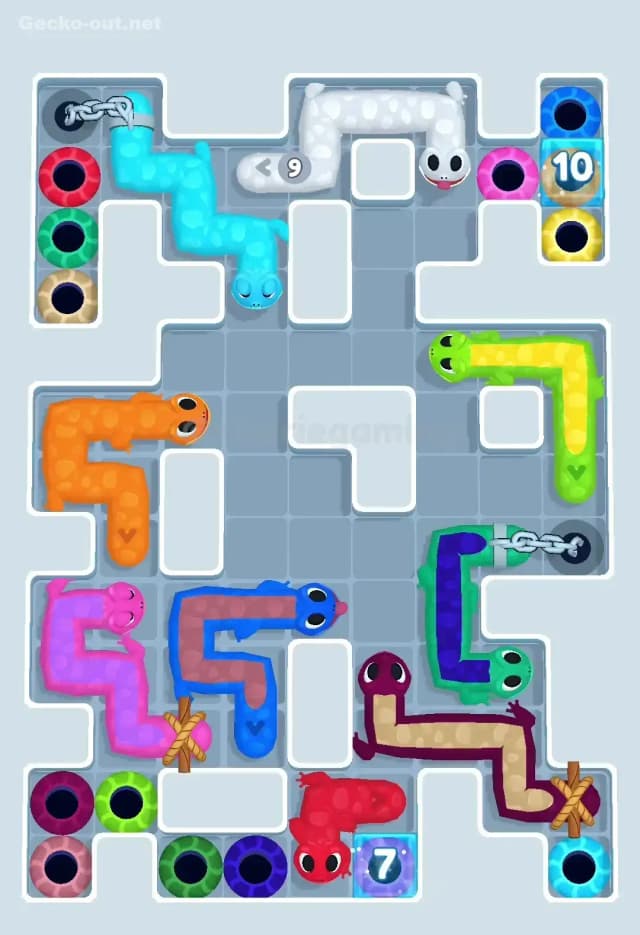
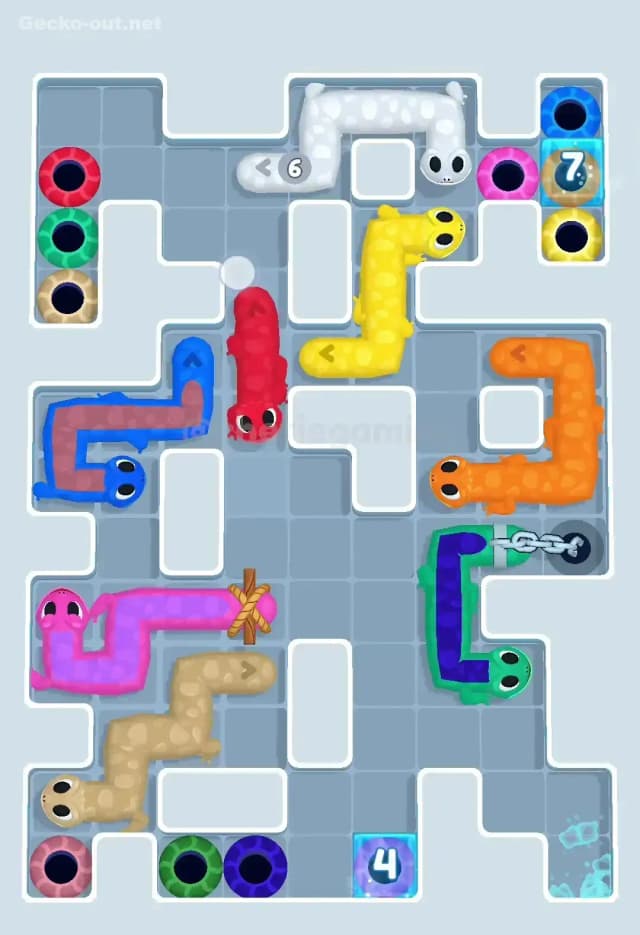
Gecko Out Level 535 drops you into a tall, narrow board absolutely packed with geckos. You’ve got a mix of standard geckos and special types:
- A long light‑blue gecko zigzagging around the top‑left.
- A chunky white frozen-looking gecko resting along the very top.
- Three rope‑tied “gang” geckos with beige centers and different outer colors, stretched through the top, middle, and lower sections.
- Several solo geckos in strong colors (orange, lime-yellow, red, blue, green/purple) guarding the side corridors.
Exits are grouped in color clusters along the bottom-left, top-left, and right side. Some exits are normal, while a couple of critical ones sit behind chains or ice, making them unusable until you clear the matching gecko or route around them. The result is a level where nearly every lane is occupied from the start; there’s no “free” corridor you can casually drag through.
What makes Gecko Out 535 feel tricky is that most geckos are already threaded through each other. Any careless drag that curves across the middle will instantly lock out exits for two or three other colors. So right away, you have to think in terms of which gecko is safe to move now and which ones must stay parked as living walls until late in the run.
Timer, pathing, and what counts as a win
Like other stages, the win condition in Gecko Out Level 535 is simple on paper: every gecko has to reach a hole of its own color before the timer hits zero. The drag‑to‑draw mechanic matters here: wherever you drag the head, the body follows that exact path, segment by segment. If your path snakes around unnecessarily, you waste both time and space that you’ll desperately want later.
The timer in Gecko Out 535 is strict enough that you don’t get to experiment freely on a single run. You’re expected to treat your early attempts as “scouting,” then execute a clean, mostly pre‑planned sequence. Because bodies retrace your drawn paths, every move needs to serve two purposes: get that specific gecko closer to an exit and avoid painting yourself into a corner for the rest.
Pathing Bottlenecks and Logical Traps in Gecko Out Level 535
The main choke lane
The single biggest bottleneck in Gecko Out Level 535 is the central vertical lane where the gang geckos and that tall orange gecko stack up. The orange gecko on the left side acts like a sliding door between the bottom exit cluster and the upper half of the board. Move it too soon or park it badly and you’ll block the beige gang and the lower exits at the same time.
On top of that, each beige‑center gang gecko is threaded through this same area. Moving any one of them shifts all the tied segments, which can instantly plug the narrow gaps around the center. That’s why the correct strategy revolves around treating this middle lane as sacred. You only commit the gang geckos once most of the solo geckos are already out.
Hidden traps that ruin clean runs
There are a few subtle problem spots that cause most failed attempts:
- The top‑right corner, where the lime‑yellow gecko curls near a stack of colored exits, is deceptively tight. If you drag it straight down without thinking, you often block the path that another color needs to reach the same cluster.
- The lower-right U‑shaped green/purple gecko looks easy to clear, but if you exit it too early it can strand the red gecko or force the gang into awkward, looping paths.
- The light‑blue zigzag near the top-left loves to sprawl over the approach lane to the left exit column; a sloppy curve there basically shuts down that entire side of the board for everyone else.
None of these look like hard traps when you’re just glancing at Gecko Out 535, but they add up. A single overlong turn in one of these areas can make the final gecko literally impossible to route without crossing another body.
When the level finally clicks
For me, Gecko Out Level 535 went from “this is impossible” to “oh, that’s actually clever” the moment I realized I shouldn’t rush the gang geckos at all. Once I treated them as movable barriers instead of desperate priorities, the level opened up. First I focused on clearing the solo geckos that could exit along the edges with minimal interference, using short, straight paths.
As soon as I did that, I could see a clean skeleton of lanes left behind: one safe path through the right side, one through the bottom, and a late-game rotation through the middle for the tied gang. That’s the mental shift that makes Gecko Out 535 manageable—you’re not trying random paths; you’re respecting the bottlenecks and saving the ugliest knot for last.
Turn-by-Turn Path Strategy to Beat Gecko Out Level 535
Opening: creating breathing room
In the opening of Gecko Out Level 535, ignore the ropes and the chains for a moment. Your priority is to free up space by removing the easy solo geckos:
- Start with the red gecko near the bottom section. Draw the shortest possible path into its matching red hole in the lower cluster. Keep the path tight against the border so you don’t steal central tiles.
- Next, clear the lime‑yellow corner gecko at the top-right. Route it directly into its matching yellow exit on that side, being careful not to swing its tail across the central column.
- Then move the green/purple U‑shaped gecko on the right, sending it straight down or up (depending on its closest hole) with a smooth arc that hugs the outer wall.
After those three are gone, the board suddenly feels much less claustrophobic. The orange gecko on the left and the light‑blue zigzag on top can stay parked for now; they’re acting as temporary walls that keep the gang segments from drifting into bad angles.
Mid-game: rotating the knot without tightening it
The mid‑game of Gecko Out 535 is where you manage the traffic around the central lane. Your big goals here are keeping one clean vertical corridor and preparing the gang geckos for a final sweep.
- Gently reposition the light‑blue top-left gecko so it lines up with its exit column without spilling into the middle. If possible, slide it along the top edge first, then tuck it down into the left exits.
- Once blue is gone, you can safely slide the white frozen-looking gecko across the top into its matching exit. Because this one is chunky, you want its path to be almost a straight bar so it doesn’t create a long snake in the middle row.
- Only after the top is mostly clear do you start nudging the orange vertical gecko. Move it just enough to open a gap for the gang, then park it tight against a wall so its body isn’t cutting the board in half.
At this point you should have most of the solo geckos out and a fairly open center. The three beige‑center gang geckos are still in, but their routes are much safer: you can now drag one head in a large, gentle curve toward its matching hole cluster while the other tied segments follow through already‑emptied lanes.
End-game: clean exits under pressure
The end‑game in Gecko Out Level 535 is all about exiting the gang geckos in a specific order and avoiding last‑second crossings. A good order is: central gang segment first, then the upper, then the lower.
- Start by dragging the head of the gang segment that has the most direct line to an open exit cluster (often the middle one). Draw a deliberate, compact S‑curve that leads straight into the correct hole. Watch how the other tied bodies sweep; you want them to travel through zones that are already cleared.
- After that first gang member exits, the remaining tied segments shorten, which gives you more elbow room. Use it to swing the top gang segment into the nearest matching exit without touching the central lane again.
- Finally, finish with the lowest gang gecko. By now most of the board is empty, so you can afford a slightly longer path if you’re careful.
If you’re low on time at this stage, don’t panic. It’s better to draw three short, slightly imperfect paths than to hesitate and try to optimize every tile. Gecko Out 535 is tuned so that once you reach the final three geckos with a clean board, you can finish in time with reasonably quick, confident swipes.
Why This Path Order Works in Gecko Out Level 535
Using head-drag rules to your advantage
The entire plan for Gecko Out Level 535 leans on how bodies follow the exact route you draw from the head. By exiting the solo geckos first with straight, wall‑hugging lines, you’re “cleaning” lanes that the gang bodies will later slide through. When the gang moves, its trailing segments simply trace paths that were already proven safe.
Conversely, if you move the gang early, each roped body paints extra loops across the board. Those loops then become permanent obstacles for everyone else. The recommended order prevents that: solo geckos draw minimal paths, then the gang uses those tracks instead of creating new ones in dangerous areas.
Reading first, then committing moves
Managing the timer in Gecko Out 535 is about rhythm. At the start of each attempt, it’s worth spending a few seconds just looking: identify which exits are open, which are chained, and how the gang segments are threaded. Once you’ve recognized the layout, move decisively through the opening and mid‑game sequence rather than stopping after every move.
The key is to pause only at transition moments—right before you touch the orange bottleneck gecko, and right before you start the gang exits. That’s where a 2‑second check saves you from a completely wasted run.
Boosters: nice to have, not required
Boosters in Gecko Out Level 535 are optional. You don’t need them if you follow the path order above, but they can smooth things out:
- An extra‑time booster is best used at the start of a serious attempt, not in the middle. It buys you thinking time during the critical mid‑game.
- A hammer‑style tool (if available in your version) is overkill here; the chains and ice are part of the puzzle, not hard blockers. Save that for much nastier levels.
- Hints can be useful once just to see which gecko the game expects you to move first, but don’t rely on them—they often show a single step, not the full logic.
Mistakes, Fixes, and Logic You Can Reuse in Other Gecko Out Levels
Common errors specific to Gecko Out Level 535
Players tend to repeat a few patterns on Gecko Out Level 535:
- Moving the gang geckos first and filling the board with needless loops. Fix: treat the gang as end‑game pieces and clear solo geckos along the edges before touching the ropes.
- Dragging wide, decorative paths because there seems to be space. Fix: hug the outer walls and keep every route as straight and short as possible.
- Parking the orange left‑side gecko across the central lane. Fix: when you do move it, slide it up or down flush with a wall so the lane remains open.
- Exiting the right‑side geckos in the wrong order, blocking exits for others. Fix: clear red and lime‑yellow before committing the green/purple U‑gecko, so it doesn’t trap anyone.
- Panicking at low time and redrawing paths. Fix: trust your plan—once you’ve practiced the sequence, move quickly and accept minor inefficiencies.
Reusing this approach on other tough stages
The logic that beats Gecko Out 535 translates well to other knot‑heavy and gang‑gecko levels:
- Identify the true bottleneck lane and protect it until late.
- Clear “cheap” exits first: short, straight paths that don’t cross the center.
- Treat long or roped geckos as end‑game tools; move them after you’ve sculpted clean corridors with other pieces.
- Always think about where the trailing body will sweep, not just where the head ends up.
Any time you see frozen exits or chained holes in other levels, remember how Gecko Out Level 535 plays: they’re usually signals to plan around timing and order, not reasons to burn boosters immediately.
Final encouragement
Gecko Out Level 535 looks brutal at first glance, with ropes, chains, and almost no free tiles, but it’s absolutely beatable once you respect its bottlenecks. If you approach it as a careful untying of the outer solo geckos followed by a controlled sweep of the gang, the whole level starts to feel elegant instead of chaotic.
Stick with the plan—edges first, center last, short paths always—and Gecko Out 535 goes from a wall to one of those stages you’ll remember as “hard, but fair.” Once it clicks, you’ll breeze through similar levels that used to feel impossible.