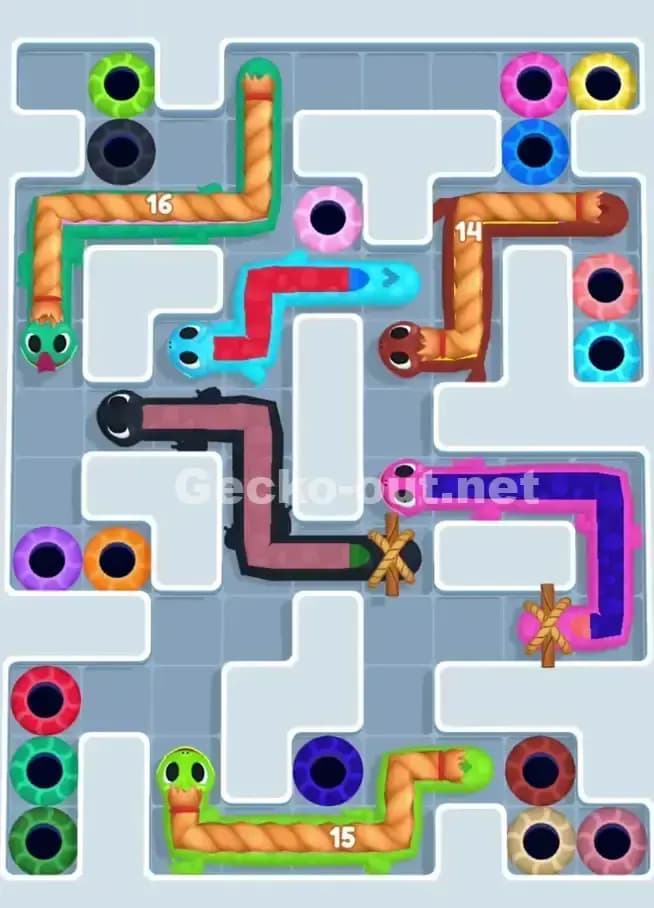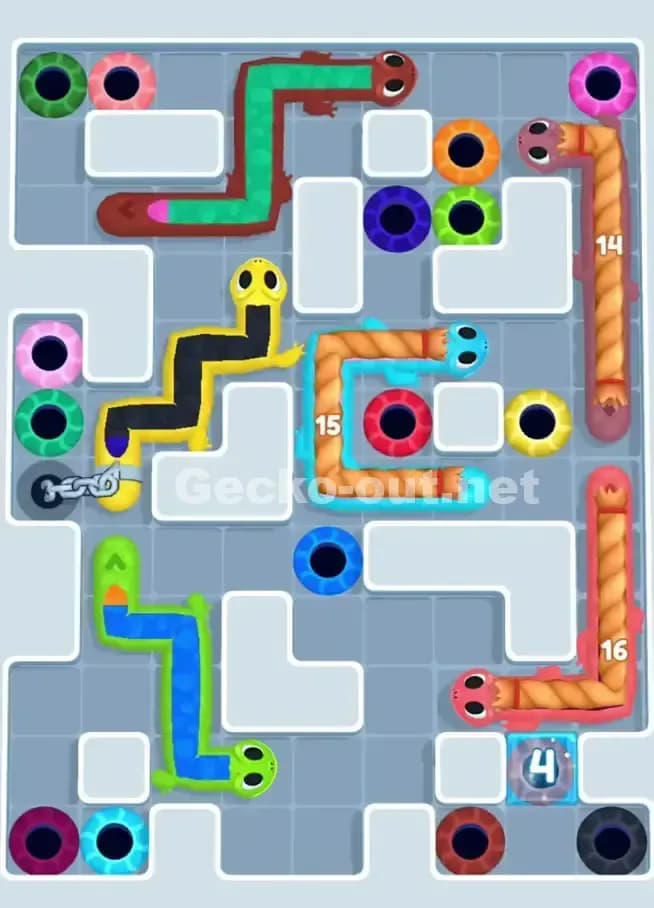
Gecko Out Level 1034 Solution Walkthrough | Gecko Out 1034 Answer
How to solve Gecko Out level 1034? Get step by step solution & cheat for Gecko Out level 1034. Solve Gecko Out 1034 easily with the answers & video walkthrough.
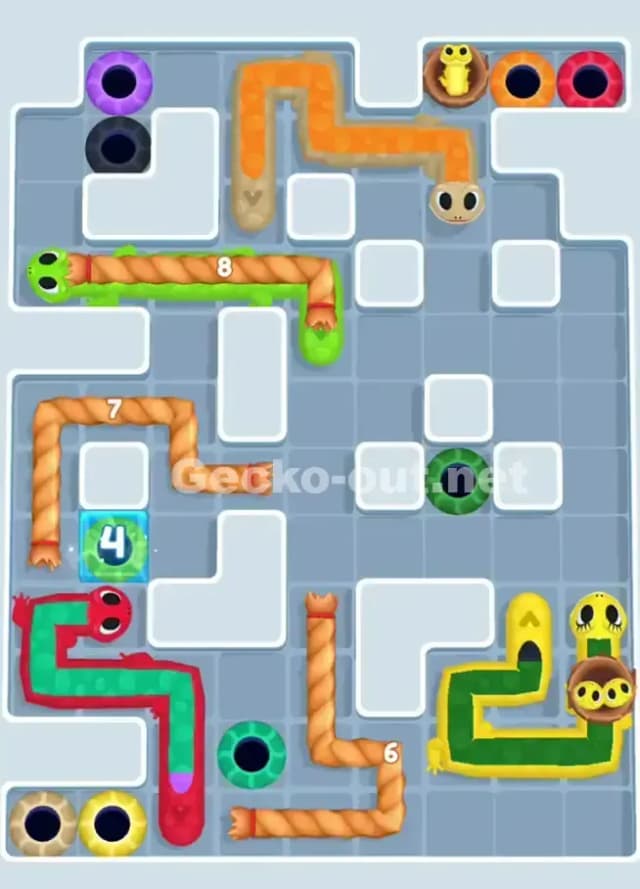

Gecko Out Level 1034: Board Layout, Rules, and Win Condition
Understanding the Board Structure
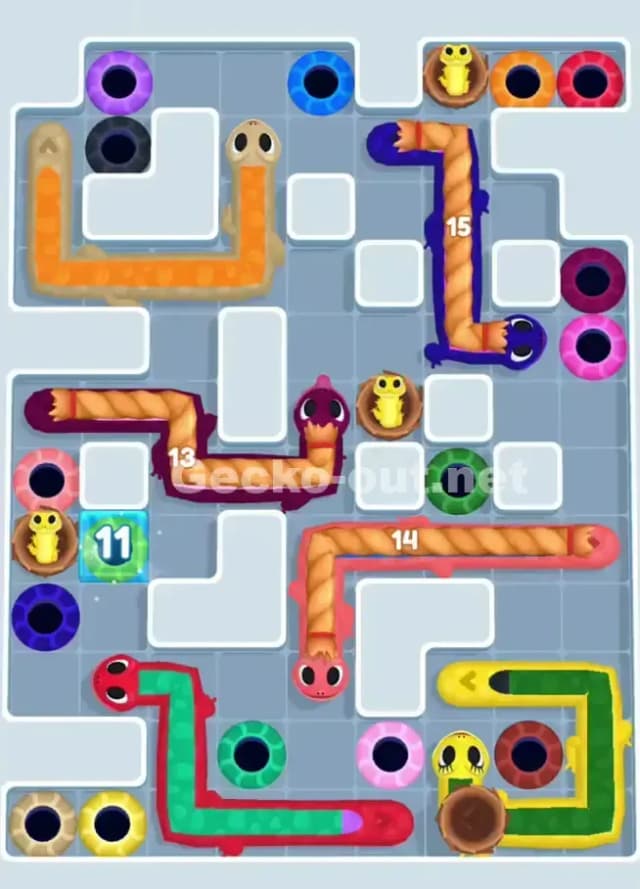
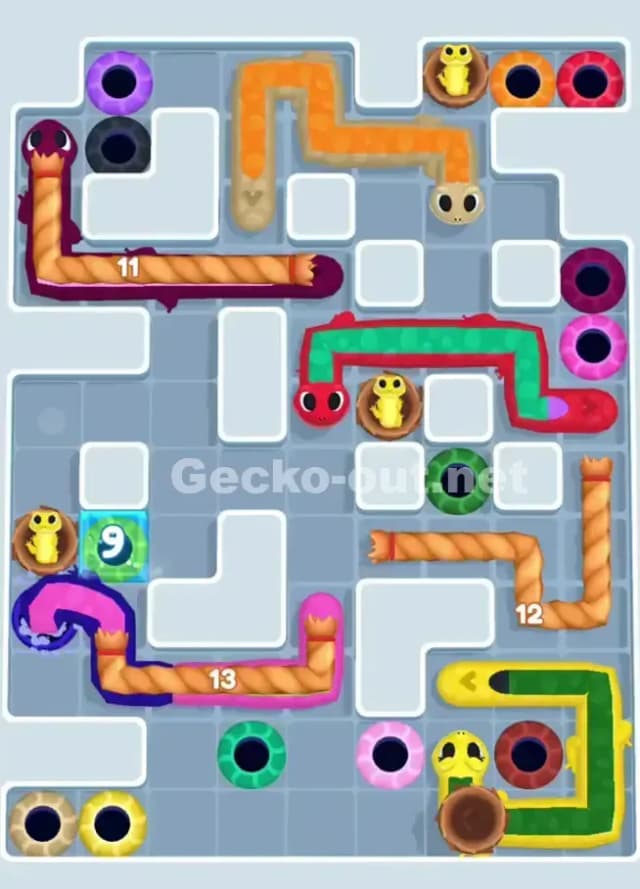
Gecko Out Level 1034 is a densely packed puzzle featuring seven geckos of different colors scattered across a complex, multi-chambered grid. You'll spot orange, purple, blue, red, green, yellow, and pink geckos, each with a corresponding hole of the same color waiting to receive them. The board is compartmentalized by white walls that create isolated chambers and narrow corridors, forcing you to navigate geckos through tight passages. Several geckos are long, segmented bodies that require careful head-dragging to avoid tangling, and two or three of them are linked as "gangs" that move together when you drag one head. There are also numbered geckos (marked 11, 13, 14, and 15) that suggest sequential movement or special positioning rules. The timer is your adversary—you've got roughly 90–120 seconds depending on booster use—so every drag decision must be deliberate and efficient.
The Win Condition and Timer Pressure
Your job is to guide every single gecko to its matching-colored hole before the clock hits zero. Unlike simpler levels, Gecko Out Level 1034 doesn't let you escape one or two geckos and still pass; all seven must be gone. The timer creates genuine pressure: you can't afford to undo bad moves repeatedly, and you can't waste time experimenting with random paths. The drag-and-follow pathing mechanic means once you commit to a route, the gecko's entire body traces that exact path. If you accidentally block a corridor with a parked gecko or force a body through a space too tight for the next gecko to pass, you'll hit a dead end and have to restart. This level teaches you that planning beats reflexes—you need a mental roadmap before you even touch the first gecko.
Pathing Bottlenecks and Logical Traps in Gecko Out Level 1034
The Central Corridor Choke Point
The single biggest bottleneck in Gecko Out Level 1034 is the narrow central corridor that connects the left side of the board to the right side. Multiple geckos need to pass through this corridor to reach their holes, but it's only wide enough for one or two geckos at a time. If you route a long gecko (like the orange or red gang members) through this corridor first without parking it in the correct final chamber, you'll physically block shorter geckos from reaching their exits. I found this out the hard way: I guided the red gecko through the center corridor early, only to discover that the green gecko couldn't reach its hole on the right side because the red body was still occupying the corridor space. The lesson? Route the shortest, most compact geckos through the central bottleneck first, and keep longer geckos parked in their local chambers until the final moments.
The Gang Gecko Entanglement Risk
Two or three of the geckos in Gecko Out Level 1034 are linked as gangs, meaning when you drag one head, its companion(s) follow along the same path. This is deceptively dangerous. If you drag a gang gecko's head into a narrow chamber expecting to leave just one gecko there, you'll suddenly have two or three bodies filling the space, and now you've blocked access for other geckos. I nearly failed Gecko Out Level 1034 when I realized the numbered gecko 13 and its gang mate were welded together—I had to restart and rethink their entire route to give them enough space.
The Frozen Exit and Warning Holes
Several holes on the board are either frozen (indicated by an icy effect) or marked as warning holes (where geckos can't exit). These are traps disguised as exits. If you mindlessly drag a gecko toward what looks like a hole but is actually a warning hole or a frozen barrier, you've wasted precious time and may have blocked the gecko's path to the real exit. Gecko Out Level 1034 includes at least two of these false exits, deliberately placed near real exits to catch distracted players. Always double-check that a hole's color matches the gecko and that there's no icy overlay before committing your drag.
My Moment of Clarity
Honestly, Gecko Out Level 1034 felt like an unsolvable knot the first two times I attempted it. I was dragging geckos randomly, watching the timer tick down, and panicking as bodies piled up in wrong chambers. But then I stopped, backed out, and looked at the board as a whole system rather than individual geckos. I realized that the numbered geckos (11, 13, 14, 15) were probably meant to be moved in a specific sequence, not all at once. Once I accepted that I needed to move gecko 11 first, then 13, then 14, then 15, and finally the remaining geckos, the entire puzzle unraveled. That's when Gecko Out Level 1034 clicked for me—it's not chaos; it's choreography.
Turn-by-Turn Path Strategy to Beat Gecko Out Level 1034
Opening: Secure the Numbered Geckos in Sequence
Start by moving the lowest-numbered gecko—gecko 11—directly to its hole. Don't overthink it; just drag its head in a straight line to the matching exit. This accomplishes two things: it clears one body off the board and establishes a rhythm. Next, move gecko 13, then gecko 14, then gecko 15 in strict order. By handling the numbered sequence first, you create breathing room on the board and reduce visual clutter. The reason this works is that numbered geckos are usually positioned in less-congested areas and can be routed quickly without disrupting the larger puzzle. Parking other geckos while you clear numbered ones keeps the central corridors open. After the numbered geckos are gone, you'll have roughly 60–75 seconds left and much more board space to maneuver.
Mid-Game: Untangle the Gang and Long Geckos
Once the numbered geckos are out, turn your attention to the longest single gecko and the gang-linked pairs. For Gecko Out Level 1034, the orange and red geckos are especially long, and moving them early means their bodies won't interfere with other geckos' paths later. Drag the orange gecko's head first, carefully routing around the white walls and into its chamber, then exit it. Do the same for the gang-linked geckos—move one pair at a time, and always ensure you're leaving a clear lane behind them for compact geckos to use next. The purple and blue geckos are usually shorter and more flexible, so "park" them temporarily in safe zones while you're maneuvering the big bodies. The key insight here is that long geckos should never occupy the central corridor or cross-paths unless they're exiting; once they're safely in their final chamber, they should be moved out immediately.
End-Game: The Final Sprint
With 30–45 seconds left, you should have only two or three geckos remaining. At this point, the board is mostly clear, so routing becomes simpler. Move the remaining compact geckos (green, yellow, pink) directly to their holes without overthinking. If you're cutting it very close on time, use a quick drag without tracing a perfect path—these final geckos usually have open routes and can tolerate slightly suboptimal movement. If you do hit a jam at the last moment (one gecko blocked by another), don't panic; just drag the blocking gecko out first, then finish the last gecko. Gecko Out Level 1034 is designed to be tight but not impossible; if you've cleared the board of at least five geckos by the 30-second mark, you should comfortably finish the last two before the timer expires.
Why This Path Order Works in Gecko Out Level 1034
Head-Drag Logic and the Body-Follow Rule
The reason the numbered-gecko-first strategy works is that it respects the body-follow pathing mechanic. When you drag a gecko's head, its body traces the exact route your finger (or mouse) traveled. Longer geckos create longer traces, occupying more board real estate. By moving numbered and compact geckos first, you're placing shorter traces on the board, leaving maximum room for longer geckos to maneuver later. Once a gecko exits, its body disappears entirely, freeing that corridor for the next gecko. In Gecko Out Level 1034, the numbered geckos sit in relatively isolated areas, so moving them first doesn't disrupt the central pathways. Contrast this with moving a long gang gecko first—that would immediately fill a corridor and trap other geckos behind it. The sequence exploits the geometry of the board, not fighting it.
Pacing and Timer Management
Don't rush; don't dawdle. Gecko Out Level 1034 rewards calm, deliberate movement. Spend the first 15–20 seconds identifying which gecko is numbered 11 and tracing a clear mental path to its exit. Then execute that drag in one smooth motion. Repeat for geckos 13, 14, and 15. By the 40-second mark, you should be halfway done. This pacing gives you a comfortable buffer; if something goes wrong, you have time to recognize the problem and correct it before the timer runs out. Conversely, if you hesitate or second-guess every move, you'll burn time without making progress. The sweet spot for Gecko Out Level 1034 is moving deliberately every 8–12 seconds per gecko, which leaves 30+ seconds of contingency time.
Booster Strategy for Gecko Out Level 1034
Honestly? You don't need boosters to beat Gecko Out Level 1034 if you follow this plan. The "extra time" booster is nice insurance (it adds 30 seconds), but it's not required if you execute the numbered-gecko-first strategy efficiently. However, if you're consistently running out of time on your fourth or fifth attempt, spending coins on extra time is a fair safety net—it removes the time pressure and lets you focus on the pathing puzzle itself. The "hint" booster is less useful here because the puzzle isn't obscure; the issue is execution speed, not hidden knowledge. Skip the hint and grab the extra time if you must grab anything.
Mistakes, Fixes, and Logic You Can Reuse in Other Gecko Out Levels
Common Mistakes and How to Fix Them
Mistake 1: Routing long geckos through the center early. This immediately clogs the main corridor and traps other geckos. Fix: Always move compact geckos first, and leave long geckos for mid-game or end-game when board space is abundant.
Mistake 2: Confusing warning holes or frozen exits for real exits. You drag a gecko toward what you think is its exit, but it's a fake, and now you've wasted time and broken your path. Fix: Before every drag, double-check that the target hole is (a) the correct color and (b) not frozen or marked as a warning. A half-second verification saves 10+ seconds of frustration.
Mistake 3: Parking geckos in the central corridor or main pathways. You think you're temporarily holding a gecko out of the way, but you've actually blocked the only route other geckos can use. Fix: Park geckos in corner chambers, not corridors. Identify "safe zones" on the board—isolated pockets where a gecko can wait without disrupting traffic—before you move anyone.
Mistake 4: Moving gang geckos as if they were solo. You drag a gang gecko's head and forget its companion is following, so you overshoot or get tangled. Fix: Remember that gang geckos occupy multiple board spaces. Trace their route mentally, accounting for their full length and the attached body, before dragging.
Mistake 5: Ignoring the numbered sequence. You think numbered geckos are just cosmetic labels and move them randomly. Fix: Treat numbered geckos as a hard priority queue. Always move the lowest number first, then the next lowest, and so on. This isn't guesswork; it's the level's built-in hint about the optimal sequence.
Transferring This Logic to Similar Levels
Gecko Out Level 1034 is part of a family of knot-heavy, multi-gecko puzzles. If you encounter another level with numbered geckos, gang geckos, or narrow central corridors, apply the same framework: (1) identify the most compact, least disruptive gecko, (2) move it first to clear space, (3) repeat with progressively longer geckos, and (4) save the most complex bodies for last when you have maximum room. For levels with frozen exits or warning holes, always verify hole colors and icy status before committing. For gang geckos on any level, think of them as a single long object, not two separate things; this reframes the puzzle from "how do I move two geckos" to "how do I navigate one long shape," which is much clearer.
Final Encouragement
Gecko Out Level 1034 is legitimately tough—it's a mid-to-late-game challenge that respects your intelligence by not holding your hand. But it's absolutely beatable with a clear plan and a few minutes of focused practice. Once you nail it, you'll feel genuinely accomplished, and you'll have unlocked a powerful problem-solving strategy that carries forward to every knot-heavy level after this. You've got this; now go drag those geckos home.