Gecko Out Level 1000 Solution Walkthrough | Gecko Out 1000 Answer
How to solve Gecko Out level 1000? Get step by step solution & cheat for Gecko Out level 1000. Solve Gecko Out 1000 easily with the answers & video walkthrough.
Gecko Out Level 1000: Board Layout, Rules, and Win Condition
The Starting Board and Key Obstacles
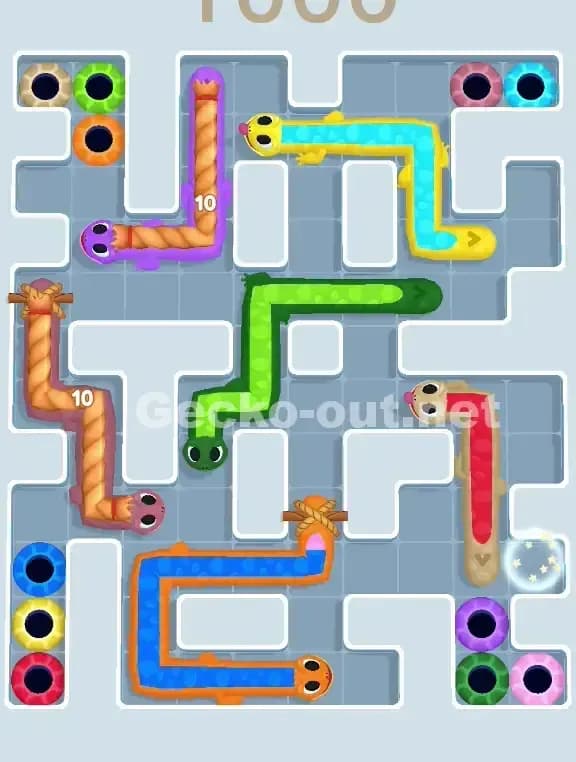
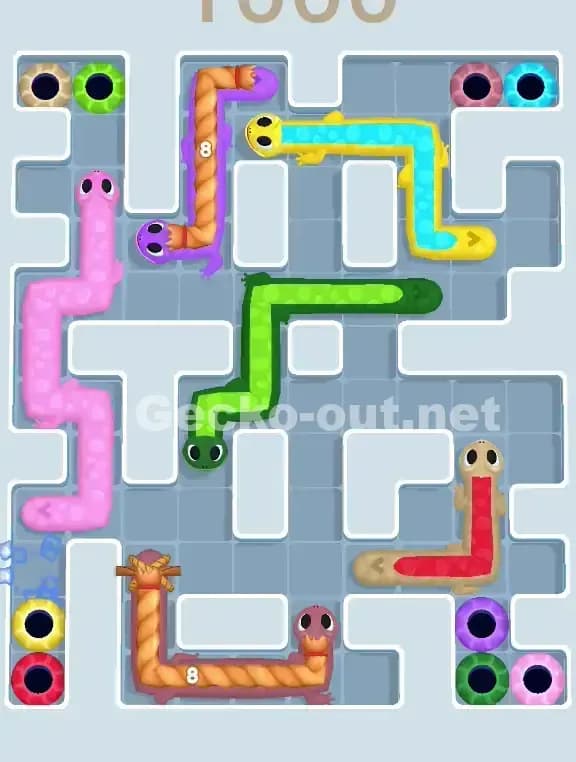
Gecko Out Level 1000 is a packed, sprawling puzzle that throws six distinct geckos at you, each one a different color and length. You've got a black-and-white pair in the top left, an orange gecko below them, a lengthy purple gang gecko snaking down the left side with the number "10" stamped on it (marking it as a linked multi-segment unit), a yellow gecko paired with cyan in the top right, a green gecko curving through the center-right area, a red gecko on the right flank, and finally a blue-orange pair at the bottom center with an orange gecko nearby. Each gecko must reach its matching-colored hole to escape, and there's a strict timer counting down. The board is riddled with white wall obstacles creating narrow corridors and forcing every path to be deliberate—there's almost zero wasted space, which is exactly what makes Gecko Out Level 1000 so diabolically clever.
The Win Condition and Timer Pressure
You win Gecko Out Level 1000 when all geckos have exited through their respective colored holes before the timer hits zero. The challenge here is that the board is so tangled that if you move carelessly, you'll create a domino effect of blocking geckos that can't escape. The timer isn't overly stingy—you've got enough seconds to think and execute—but it's tight enough that you can't afford to undo the same move twice. Every drag of a gecko head sets the body into motion along that exact path, and if that path later becomes blocked by another gecko's body, you're locked into a failed state. This is why Gecko Out Level 1000 demands a full mental map before you start moving.
Pathing Bottlenecks and Logical Traps in Gecko Out Level 1000
The Critical Choke Point: The Purple Gang Gecko and Left Corridor
The purple gang gecko on the left side is the single biggest bottleneck in Gecko Out Level 1000. It's long, it's marked as a "10" gang unit (meaning it moves as one locked body), and it occupies a vertical corridor that other geckos need to traverse. If you don't move this purple beast early and efficiently, the black, white, and orange geckos trapped in the top-left corner will have nowhere to go. The purple gecko's exit hole is in the bottom-left area, but to get there, it has to unwind itself through a narrow vertical space. If you miscalculate its path or try to move other geckos first, you'll find yourself in a situation where the purple gecko is half-out and blocking everything else. I found this out the hard way on my first attempt—I got cocky and tried to move the orange gecko first, and suddenly the whole left side became a gridlocked nightmare.
Subtle Problem Spot One: The Yellow-Cyan Knot and Right Corridor
The yellow and cyan geckos in the top right look straightforward at first glance—they're short, they're paired together, and their exit holes are nearby. The trap? They're positioned in a way that if you drag the yellow gecko carelessly toward its hole, its body will swing across the cyan gecko's intended path, creating an accidental block. The corridor on the right is also tighter than it appears, and there's an easy mistake of dragging a gecko body across the boundary into the white walls, which causes an immediate jam. On Gecko Out Level 1000, one misread of the geometry costs you the entire attempt.
Subtle Problem Spot Two: The Green Gecko's Winding Route Through the Center
The green gecko curves through the middle of the board in a long, looping shape. Its hole is on the bottom side, and the only way to get it there is to drag its head through a specific S-curve that avoids the white walls and doesn't cross the paths of the blue and orange geckos at the bottom. I actually felt a moment of clarity when I realized the green gecko's path on Gecko Out Level 1000—it wants to go down and left, not right, which is counterintuitive given its starting position. The frustration hit when I first tried dragging it rightward, thinking I'd save space, and it immediately collided with the red gecko's body.
Subtle Problem Spot Three: The Red Gecko and Bottom-Right Escape
The red gecko on the right side is deceptively long and occupies the bottom-right corridor. Its exit is on the right, but to get there, the head has to navigate around the green gecko's path without overlapping. Since the green gecko is moving through the center, you have a narrow window where both can coexist without blocking each other. The red gecko's path on Gecko Out Level 1000 is almost a mirror of the green gecko's, and getting both of them out without a collision requires precise sequencing.
Turn-by-Turn Path Strategy to Beat Gecko Out Level 1000
Opening: The Purple Gang Gecko First, Then Top-Left Unstacking
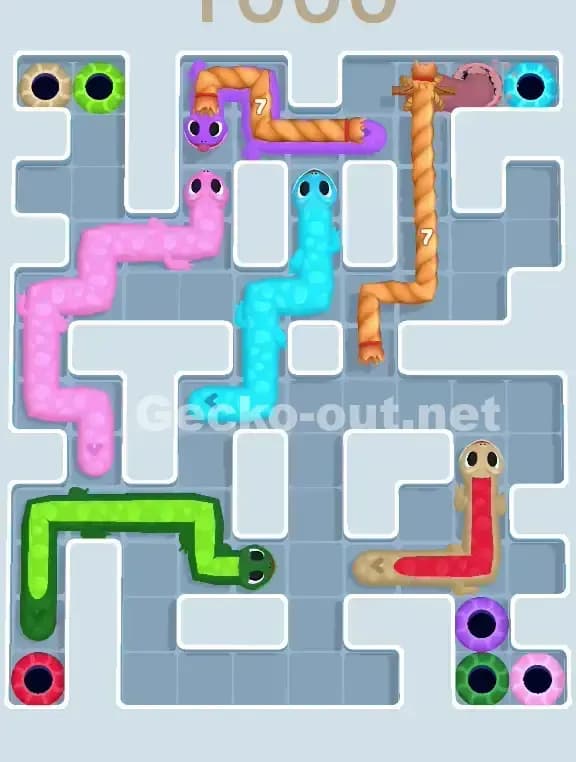
Start by moving the purple gang gecko out of the left corridor. Drag its head downward and slightly rightward, guiding it toward its purple-colored hole in the lower-left region. This move is your opening sacrifice—it's slow, it takes focus, but it immediately frees up the vertical space that the black, white, and orange geckos desperately need. Once the purple gecko is exiting, you'll have breathing room. Next, move the orange gecko upward and rightward out of the top-left corner. Its hole is in the upper-left area, so a short upward drag should suffice. By clearing these two, you're establishing a clear board state and buying yourself mental space to focus on the larger knots ahead.
Mid-Game: Keeping Lanes Open and Repositioning Strategically
With the left side cleared, move the black and white geckos next—they're short and easy to manage once the purple gecko is gone. The black gecko's hole is in the top-left corner, and the white gecko's is also near the top. These moves are confidence builders because you can see immediate results on Gecko Out Level 1000. Now comes the critical sequence: the yellow-cyan pair in the top right. Drag the yellow gecko first toward its hole on the top-right side, being very careful to keep the path tight and avoid swinging the body across the cyan gecko's area. Once yellow is out, cyan has a clear lane to its hole (also on the right side, slightly lower). The key on Gecko Out Level 1000 at this point is to commit to these moves without second-guessing the geometry. If you hesitate, you'll run the timer down without progress.
End-Game: Green, Red, and Blue-Orange Finale
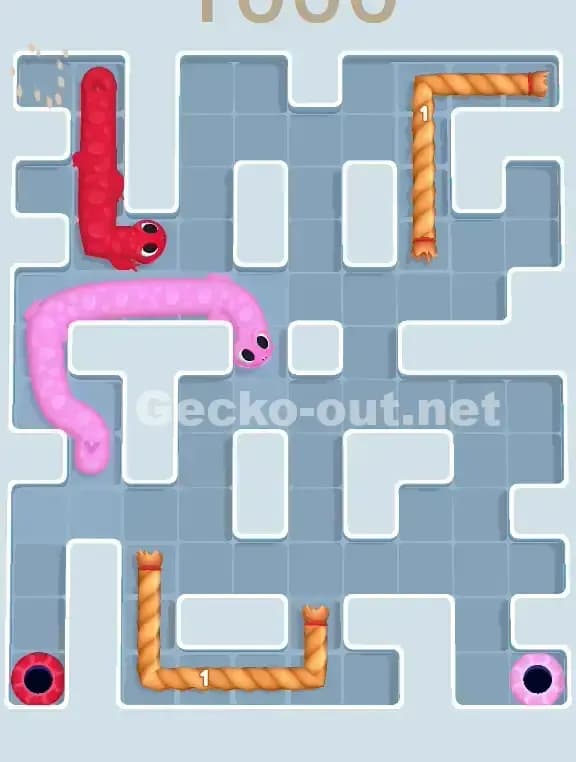
After the top is cleared, focus on the green gecko. Drag its head downward and leftward in a smooth S-curve that threads between the white walls and the blue-orange pair at the bottom. The green gecko's exit is on the bottom-center-left, and this move is your longest drag of the game—steady your hand and commit to the path. Once green is exiting, the red gecko on the right suddenly has room to move. Drag it downward and leftward, wrapping around the now-empty center space, toward its red hole on the lower-right area. Finally, you're left with the blue-orange pair at the bottom center. The blue gecko's hole is in the bottom-left corner, and the orange gecko's is nearby. These final moves are almost anti-climactic on Gecko Out Level 1000 because the board is finally open, and you can drag them straight to their exits. Watch your timer as you approach the finish line—if you're under 10 seconds remaining, move quickly but don't panic; you've already solved the hard part.
Why This Path Order Works in Gecko Out Level 1000
Leveraging Head-Drag Pathing to Untangle Instead of Tighten
The genius of this strategy on Gecko Out Level 1000 is that it respects the body-follows-head rule and uses it to your advantage. By removing the long, blocking geckos first (purple, orange), you shrink the effective occupancy of the board, which makes every subsequent move simpler. Shorter geckos in open spaces are trivial to route; long geckos in congested spaces are nightmares. This order inverts that equation. Each gecko you remove multiplies your degrees of freedom for the next gecko, creating a cascading effect of increasing control rather than increasing chaos. On Gecko Out Level 1000, this is the difference between feeling lost and feeling in command.
Timer Management: Pause, Read, Commit, Move
The timer on Gecko Out Level 1000 is generous enough for a methodical approach but punishing enough to penalize dithering. I recommend spending the first 15–20 seconds just reading the board with your hands off the controls—trace each gecko's path mentally, identify the bottlenecks, and commit to your opening move. Once you start dragging, accelerate your rhythm. Don't pause between each gecko; the momentum of solving one quickly builds confidence for the next. If you find yourself stalled (a gecko is blocking an exit or a path looks impossible), pause, take a breath, and mentally rotate your perspective—sometimes a gecko's exit isn't where you think it is, and a fresh look reveals the solution. On Gecko Out Level 1000, time lost to panic is time you don't get back, so discipline beats speed.
Booster Usage: Optional, But a Hammer Comes in Handy
Gecko Out Level 1000 doesn't strictly require boosters if you execute the strategy above cleanly. However, if you're down to three geckos and the timer is under 20 seconds, a time-extension booster can salvage a run that would otherwise fail due to a small mistake earlier. Alternatively, if you get truly stuck and can't find a path for the green gecko, a hint booster can point you in the right direction. A hammer-style tool is useful if you accidentally created an ice-frozen exit and need to crack it open, but ideally, you won't need it. Treat boosters as insurance, not crutches.
Mistakes, Fixes, and Logic You Can Reuse in Other Gecko Out Levels
Mistake One: Moving Short Geckos Before Long Ones
Players often start with the easier-looking short geckos and assume they'll circle back to the long ones later. On Gecko Out Level 1000, this creates a traffic jam. Fix: Always identify the longest, most obstructive gecko and move it first. Long geckos are blockers; short geckos are nimble. Get the blockers out of the way, and everything else cascades.
Mistake Two: Dragging a Path Without Checking Its Wake
When you drag a gecko's head, you're not just moving the head—you're defining a corridor that the entire body occupies. Many players forget this and drag a head toward a hole without ensuring the body's path doesn't clip walls or other geckos. Fix: Before you drag on Gecko Out Level 1000, trace the expected body path with your eyes. Does it clear all white walls? Does it avoid other gecko bodies currently on the board? If the answer is no, rethink the route. This discipline prevents collision mistakes that snowball.
Mistake Three: Assuming an Exit Is Where the Hole Appears
The colored holes on Gecko Out Level 1000 are positioned on the periphery of the board, and sometimes the route to them isn't intuitive. A gecko's hole might be directly above or to the left, but the path might need to go right and then loop back. Players often drag a gecko toward its hole in a straight line and hit walls, then blame the puzzle. Fix: Trace the full legal path to each hole before moving the gecko. Use the white walls as a guide—they define the navigable space, and every path must follow that space.
Mistake Four: Forgetting That Gang Geckos Move as One Unit
The purple "10" gecko is a gang—it's locked together and moves as a single body. Players sometimes assume they can move part of it independently and get confused when the whole thing moves. Fix: Read the gecko's label. If it's marked with a number like "10," it's a gang unit, and you drag only its head. The entire linked body follows.
Mistake Five: Running Out of Time on the Final Gecko
Players get most geckos out successfully, then rush the last one or two and accidentally block them with a bad drag. On Gecko Out Level 1000, the final 30 seconds are as critical as the opening moves. Fix: Save the easiest gecko for last. This way, even if you're low on time, you can execute the final drag quickly and cleanly. Blue and orange short geckos are ideal final-stage geckos because they're fast to route.
Reusing This Logic on Similar Levels
This bottleneck-first, short-geckos-last approach works on any Gecko Out level with a long, obstructive gecko blocking a central corridor. Whether you're facing a gang gecko, a frozen gecko that needs to be thawed before moving, or a multi-colored knot, the principle remains: remove barriers, then fill in the rest. Levels with tight choke points and warning holes (holes that look like they're an exit but aren't) especially benefit from this "read the board fully before moving" discipline. You'll start to recognize the signature of a Gecko Out puzzle—the bottleneck gecko is always more dangerous than it looks, and the path around it is always less obvious than your first instinct.
Gecko Out Level 1000 is unquestionably one of the toughest levels you'll encounter, but it's absolutely beatable with a clear plan. The frustration I felt during my first few attempts completely evaporated once I committed to solving the bottleneck first and trusted the cascading freedom that followed. You've got the strategy now—trust the process, move deliberately, and remember that every gecko you remove opens the board further. You've got this.