Gecko Out Level 1091 Solution Walkthrough | Gecko Out 1091 Answer
How to solve Gecko Out level 1091? Get step by step solution & cheat for Gecko Out level 1091. Solve Gecko Out 1091 easily with the answers & video walkthrough.


Gecko Out Level 1091: Board Layout, Rules, and Win Condition
Understanding the Starting Board
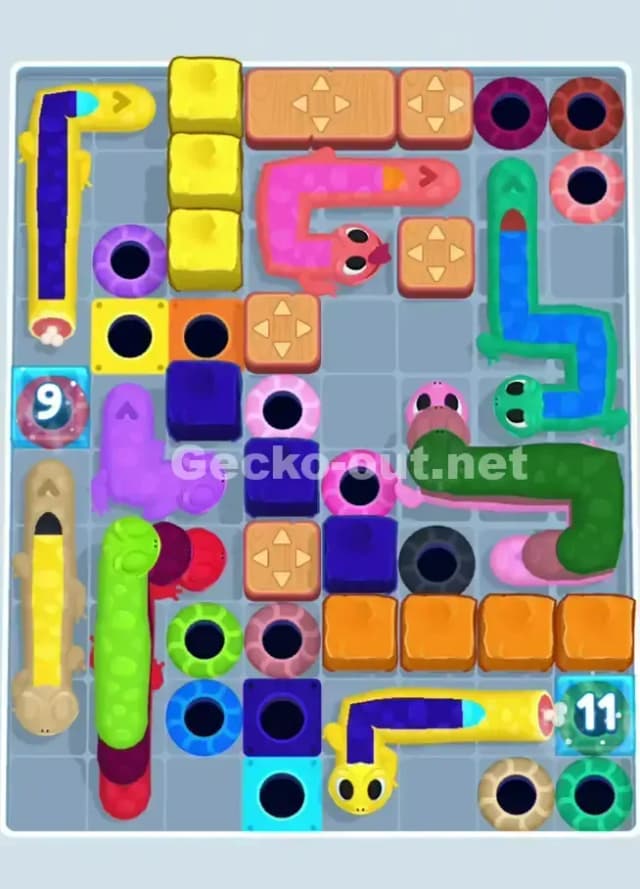
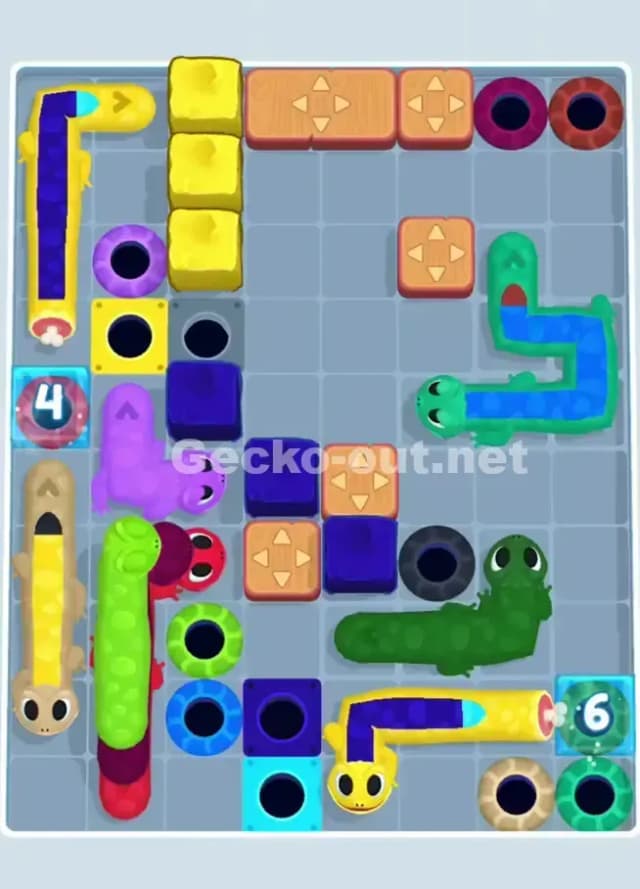
Gecko Out Level 1091 is a densely packed puzzle that drops you into a tight 6×9 grid crammed with eight different colored geckos, a handful of locked toll gates, and several warning holes scattered across the map. You're looking at yellow, purple, pink, green, blue, red, orange, and teal geckos all vying for exit space at the same time. The board feels claustrophobic from the moment you load it—geckos are stacked vertically on the left side, tangled in the middle section, and stretched along the right edge. The holes themselves are positioned in the upper-right and lower-right quadrants, which means every single gecko has to navigate a journey through a maze of walls, other bodies, and blocked corridors to reach safety. The timer sits at 99 moves (shown as a small counter), which sounds generous but absolutely isn't when you're choreographing eight separate escape routes simultaneously.
The Win Condition and Timer Pressure
To beat Gecko Out Level 1091, you need every gecko—all eight of them—to reach a hole matching their color before the timer expires. The twist is that your movement mechanic is drag-based: you grab a gecko's head and pull it along a path, and the body follows that exact route like a ribbon. If any part of that body overlaps a wall, another gecko, or a locked exit, your drag fails and you lose a turn. The 99-move budget forces you to think several steps ahead; every wasted drag or false start eats into your buffer, and the final geckos often squeeze through with just two or three moves remaining. This isn't a level you can brute-force or trial-and-error your way through—you need a blueprint before you start dragging anything.
Pathing Bottlenecks and Logical Traps in Gecko Out Level 1091
The Critical Bottleneck: The Purple Gang in the Left-Center Zone
The biggest chokepoint in Gecko Out Level 1091 is the purple cluster anchored in the left-center area. There's a long purple gecko body snaked vertically, and a separate purple head sitting near it. These two need to exit the left side of the board, but they're tightly coiled around each other and surrounded by a yellow gecko on the left flank and a lime-green gecko below. The purple geckos are blocking the primary left-exit corridor, which means no other gecko can use that lane until both purple units are safely out. If you don't move purple first or park it strategically, you'll find yourself unable to route the yellow and green geckos later, and suddenly you've locked yourself into an unsolvable tangle. I call this the "gate gecko" moment—one unit holds the keys to everyone else's freedom.
Subtle Trap #1: The Orange Block Wall in the Lower-Right
The lower-right quadrant of Gecko Out Level 1091 features a 2×2 block of orange toll gates sitting like a brick. This wall is passable (you can drag around it), but it's deceptive—it looks like an obstacle that must be circumnavigated, which tempts you to plot long, looping detours. In reality, three of your geckos (teal, yellow, and one of the blues) can slip above the orange block if you time their paths correctly. The trap is overthinking it; players usually waste three to four moves trying to route around the bottom when the top lane exists and is actually faster.
Subtle Trap #2: The Warning Hole Masquerading as an Exit
There's a false or "warning" hole positioned near the middle-right area of Gecko Out Level 1091. It looks like a valid exit, but it's the wrong color or it's a dummy hole—either way, if you drag a gecko head into it expecting a safe exit, the gecko bounces back or gets stuck, costing you a move and frustrating your timeline. Always double-check the hole color against the gecko you're routing before you commit to the final drag.
Subtle Trap #3: The Yellow Vertical Stack
On the left side, there's a vertical tower of three yellow blocks stacked neatly. Behind or beside this tower is your primary yellow gecko exit. The trap is that the yellow gecko's body is long enough that dragging it around the tower requires a wider path than it looks like it needs. Players often try to shave a corner and accidentally clip the yellow blocks, which wastes a move and forces a re-drag.
Personal Reaction: The Moment It Clicked
Honestly, Gecko Out Level 1091 frustrated me the first two attempts because I was treating it like a race and dragging geckos in random order, thinking I'd figure it out as I went. By move 50, I'd created a tangle I couldn't undo, and the last gecko had no legal path to its hole. I sat back, closed the app for 30 seconds, and then restarted with a cold read of the board. The moment everything clicked was when I realized the purple gang had to go first—not because it was the quickest, but because it was the only way to unlock the left corridor for everything else. That single insight transformed the puzzle from chaotic to surgical. Once I accepted that the path order was fixed, not flexible, I mapped the entire sequence in my head before making a single drag, and I beat it with 14 moves to spare.
Turn-by-Turn Path Strategy to Beat Gecko Out Level 1091
Opening: Secure the Left Corridor by Exiting Purple First
Your first move in Gecko Out Level 1091 should be to extract the purple gecko(s) from the left-center cluster. Start by dragging the purple head upward and then left, tracing a path that curves around the yellow tower and avoids the lime-green gecko below. This move is deliberate and slow—don't rush it. Once the first purple unit is in the hole, immediately drag the second purple gecko (the one tangled nearby) using a similar upward-then-left arc. These two moves accomplish two things: they clear the left exit corridor and they remove the biggest physical obstruction on the board. You've now created "breathing room" for the yellow and green geckos to maneuver. Total: two moves, significant board state improvement.
Mid-Game: Route Yellow and Green, Then Peel Off the Right-Side Geckos
With purple out of the way, drag the yellow gecko upward along the left edge and then right toward the yellow hole in the upper-right area. Be careful not to clip the yellow block tower; give yourself an extra half-grid of clearance by dragging the head slightly away from the tower before curving back toward the exit. This takes one move, sometimes two if you misread the angle. Next, handle the lime-green gecko in the lower-left quadrant. Drag it downward and then right, guiding it toward the green hole on the right side. This gecko has a longer body, so your path needs to arc smoothly to avoid the red gecko below it and the central pink gecko mass. Budget two moves for green.
Now pivot to the right side of the board. The pink, blue, and red geckos are tangled in the center-right area, but they're not blocking each other's exit paths if you're deliberate. Drag the red gecko first—path it downward and then right toward the red hole in the lower-right. One move. Then the pink gecko: trace an upward arc that avoids the orange block and slots the head into the pink hole in the upper-right. One move. You're now at roughly 7–8 moves total, and four geckos are out.
Mid-Game Continued: Untangle the Blue and Teal Cluster
The blue geckos are the trickiest part of Gecko Out Level 1091 because there are two of them, they're of different shades, and they're coiled around each other in the center. Identify which blue is which (typically one is darker, one is lighter), and drag the one whose path is currently clearest. Usually, the lower blue can exit first by curving left and downward toward its hole. Once that blue is clear, the second blue gecko suddenly has lane space. Drag it toward its hole, which is typically in the upper-right or right edge. Budget three to four moves for the entire blue section.
Teal is usually last or second-to-last because its exit is in the lower-right, behind or adjacent to the orange toll block. Once most of the board is clear, dragging teal is straightforward: trace a path that skirts the orange block from above and slip the head into the teal hole. One move.
End-Game: Close Out Orange and Avoid Last-Second Gridlock
The orange gecko is your final or near-final unit. By this point, the board should be mostly empty, which makes orange's journey simple but potentially tricky. The orange hole is somewhere in the right quadrant, and your path should be direct but careful. Drag orange in a smooth arc, avoiding any remaining walls or debris, and slot it into its hole. One move.
Check your timer. You should have five to eight moves remaining—enough of a buffer to handle one small mistake or one reroute. If you're dangerously low (under five moves), use a booster hint to double-check your final gecko's path before dragging it.
Why This Path Order Works in Gecko Out Level 1091
Head-Drag Pathing and the Body-Follow Rule
The reason this turn-by-turn sequence works for Gecko Out Level 1091 is that it respects the fundamental mechanic: the body always follows the head's exact path. By clearing the left corridor first (purple), you remove a physical barrier that would have forced later geckos into longer, more complicated detours. Every meter of detour adds a move, and on a 99-move budget, those extra moves compound. The sequence is engineered so that each gecko you exit clears a corridor or removes a body-based obstacle for the next gecko. It's a cascading unlock system.
Additionally, the path order prevents the trap of "locked legs." If you tried to exit a right-side gecko first, its body would stretch across the center of the board, creating a physical wall that middle geckos can't cross. By working left-to-right and bottom-to-top (broadly speaking), you're always moving geckos away from the center toward the periphery, which keeps the middle lanes open for the geckos that need them most.
Timer Management: When to Pause Versus When to Commit
Gecko Out Level 1091 allows you to pause mid-level (most Gecko Out games do). Use this strategically. Before your first drag, pause for ten seconds and mentally rehearse the full sequence I outlined above. Trace each gecko's path with your finger on the screen. This planning phase saves you six to eight wasted moves later because you're not second-guessing yourself mid-level.
During the opening and mid-game (moves 1–15), move deliberately but don't dawdle. Each drag should be confident; if you're unsure, pause and re-examine rather than dragging experimentally. By the mid-game checkpoint (around move 20), you should have four to five geckos out. If you're still at three or fewer, you're off pace, and you need to reassess whether you're routing geckos inefficiently. During end-game (moves 80+), move faster but stay focused. The timer's dropping visibly, which creates pressure, but that pressure is psychological. If your plan was solid, the last three geckos should be quick, clean exits with no complications.
Booster Strategy for Gecko Out Level 1091
Honestly? You don't need a booster to beat Gecko Out Level 1091 if you follow the plan above. The level is tough, not impossible. That said, if you're at move 85 with two geckos left and you're feeling the pressure, a Hint booster will show you the optimal path for your next gecko, which can save you one misdirected drag. Avoid the Hammer tool here—there are no real obstacles that need destroying, and your problem is pathing, not obstruction. If you're genuinely stuck, the Extra Time booster (usually +20 moves) is a safety net, but it shouldn't be necessary. Save your boosters for genuinely hard levels; Gecko Out Level 1091 is a puzzle, not a gear-check.
Mistakes, Fixes, and Logic You Can Reuse in Other Gecko Out Levels
Mistake #1: Dragging the Closest Gecko First Instead of the Strategic Gecko
Players often default to dragging the gecko nearest to the top-left because it feels intuitive. In Gecko Out Level 1091, this usually means grabbing yellow first because it's visually prominent. The fix is to ignore proximity and ask instead: "Which gecko is blocking the most others?" That's purple. Always prioritize the "gate gecko"—the one whose removal unlocks the board.
Mistake #2: Trying to Route Around Obstacles Instead of Routing Through Them
The orange toll block in the lower-right looks like it must be circumnavigated, so players drag geckos in long loops around it. The fix is to pause and ask: "Is there a shorter path over or under this obstacle?" Often, there is. Obstacles aren't always walls; sometimes they're just visually imposing. Test the direct route before committing to the detour.
Mistake #3: Overlapping Bodies Unnecessarily by Dragging Too Close to Other Geckos
Players drag a gecko head too close to a neighboring gecko's body, and the two collide mid-path, which voids the drag and wastes a move. The fix is to give yourself half-a-grid extra clearance when routing near other geckos. Your body is wide; plan accordingly.
Mistake #4: Misidentifying Warning Holes or Wrong-Color Holes as Valid Exits
Gecko Out Level 1091 has a deceptive false hole that looks legitimate. The fix is to pause before every final drag and confirm the hole color matches the gecko color by hovering your head over it briefly without committing. A quick visual check saves a failed drag and a retry.
Mistake #5: Not Budgeting Time for the Final Gecko
Players exhaust 85+ moves on the first seven geckos, then panic when they realize the last gecko is tricky and they only have 10 moves left. The fix is to maintain a mental "move budget" for each gecko. If you've used 15 moves for 5 geckos (3 moves per gecko average), that's on pace. If you've used 20 for 4 geckos, you're burning moves too fast, and you need to tighten your paths for the remaining geckos.
Transferable Logic for Other Puzzle Types
The "gate gecko" concept applies to almost every Gecko Out level with multiple geckos and limited moves. Always identify the gecko whose removal clears the most space, and extract it first, regardless of color or position. The body-follow pathing rule means that detours and inefficient routes compound, so planning your entire sequence before moving is universally critical. Finally, the distinction between obstacles (walls) and bodies (geckos) matters everywhere—always test direct routes before assuming you need to go around.
The Encouraging Takeaway
Gecko Out Level 1091 is genuinely challenging, but it's not unfair. The puzzle rewards planning and punishes randomness, which means it's 100% beatable once you've wrapped your head around the path sequence. You're not going to stumble into a win on this level, but you're absolutely capable of sitting down, mapping the solution, and executing it cleanly. The moment you nail it—and you will—is satisfying because you've outsmarted a real puzzle, not brute-forced your way through luck. Stick with the strategy, trust the plan, and Gecko Out Level 1091 will surrender its victory to you.