Gecko Out Level 1019 Solution Walkthrough | Gecko Out 1019 Answer
How to solve Gecko Out level 1019? Get step by step solution & cheat for Gecko Out level 1019. Solve Gecko Out 1019 easily with the answers & video walkthrough.
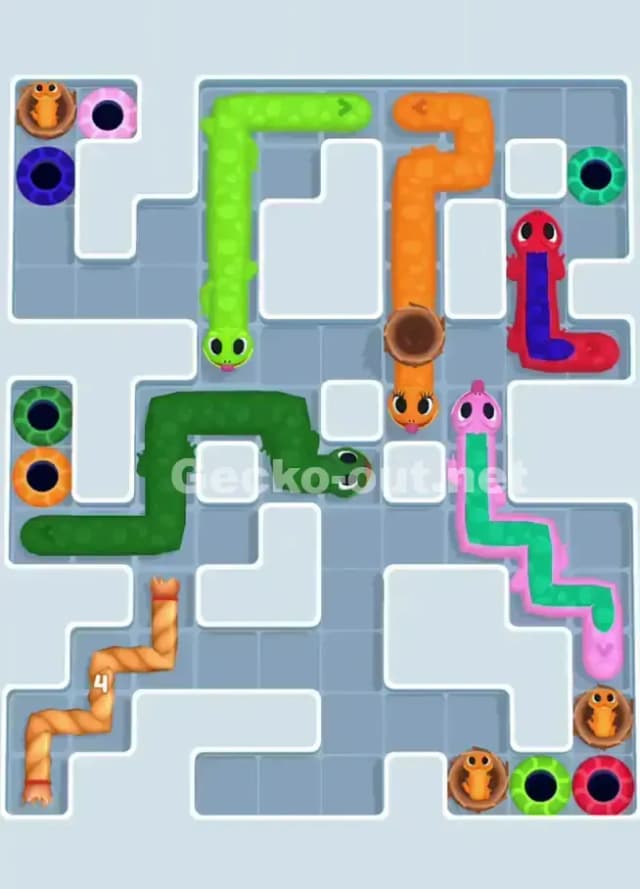
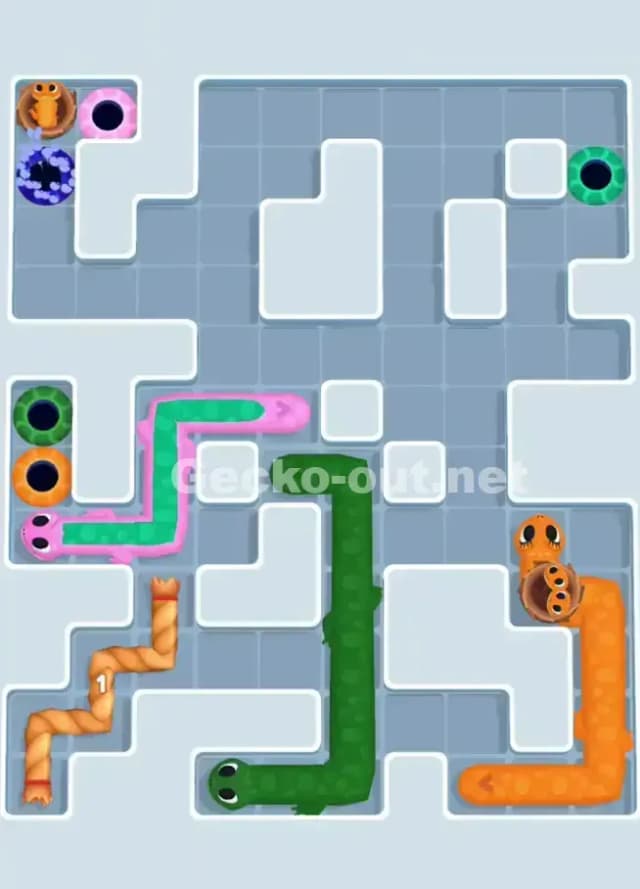
Gecko Out Level 1019: Board Layout, Rules, and Win Condition
Understanding the Board Setup in Gecko Out Level 1019
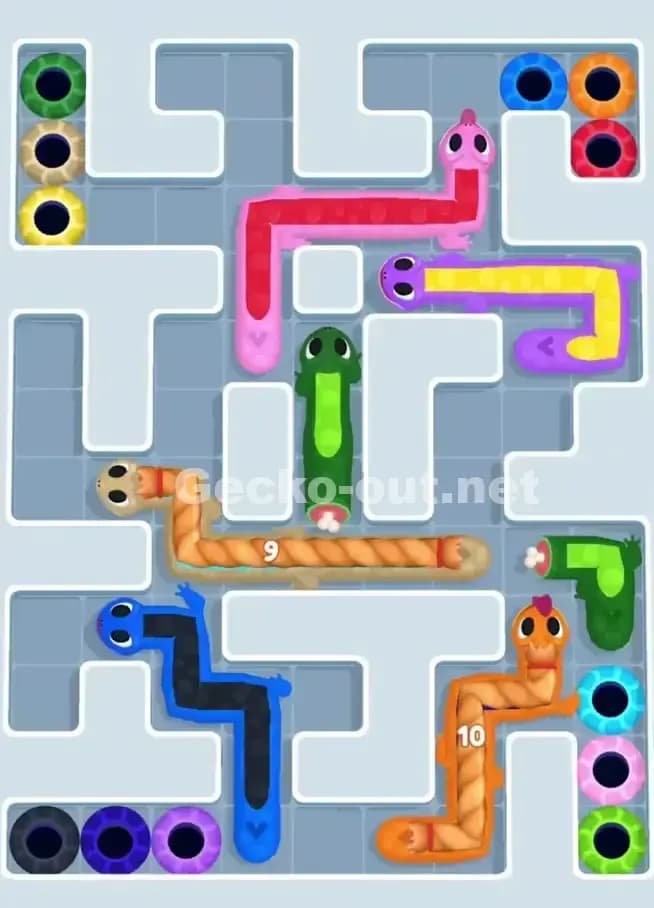
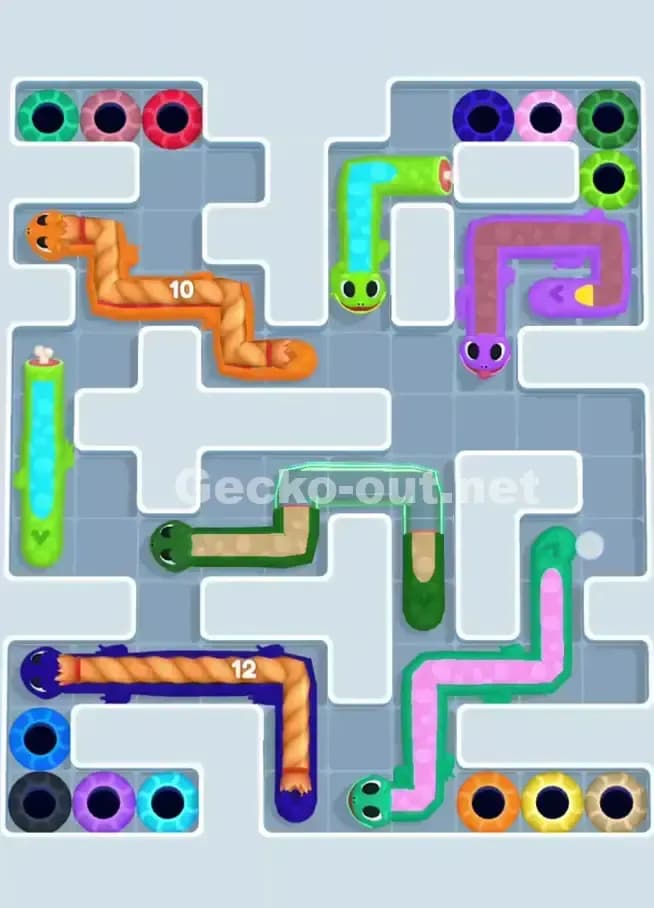
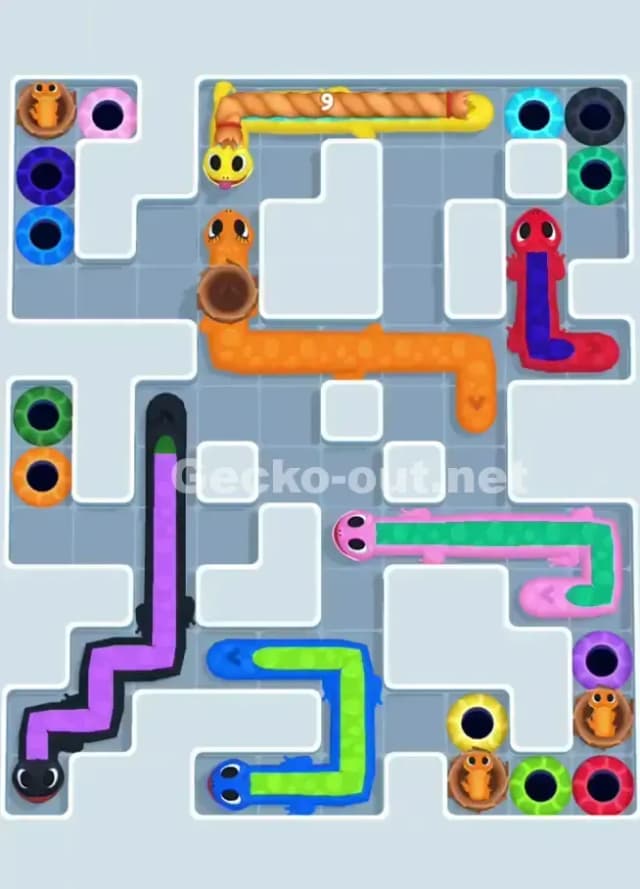
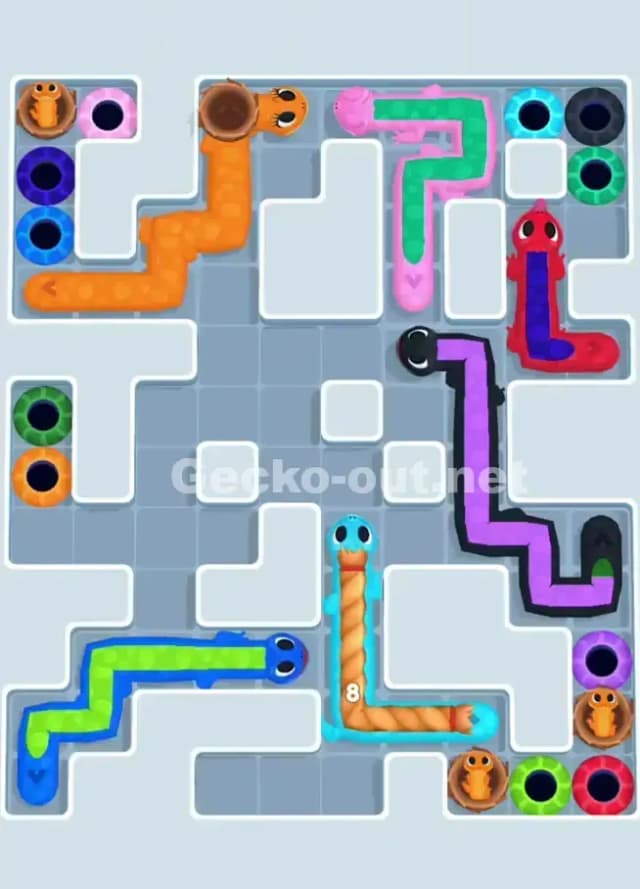
Gecko Out Level 1019 is a densely packed puzzle with nine geckos of different colors all competing for space on a complex, winding board. You'll see an orange gang gecko that's already partially deployed across the middle-left section, a red gecko on the right side, a pink gang gecko that spans horizontally across the lower-right quadrant, a purple gang gecko snaking down the left-center area, a blue gecko in the bottom-middle section, green and yellow solo geckos positioned at the bottom, and additional colored heads scattered around the left and top edges. The board is split into tight corridors and open pockets by white wall barriers, which means there's almost nowhere safe to "park" a gecko without it blocking another one's exit route. Obstacles include narrow choke points, overlapping gang geckos whose bodies are already locked in place, and holes of matching colors that are often tucked into awkward corners. The timer sits at nine seconds, which is tight for a level this tangled.
Win Condition and How the Timer Shapes Strategy
To win Gecko Out Level 1019, you must drag each gecko head to guide its body through the maze and into a hole of the same color before time runs out. Every gecko must escape, or you fail—there's no partial credit. The nine-second timer creates real pressure because you can't afford to make a wrong move and have to undo it; hesitation costs precious seconds, and restarting a path wastes even more time. The drag-based pathing system means the body follows the exact route your finger traces, so if you draw a path that traps another gecko or blocks a critical corridor, you've just locked yourself out of a solution. This is why planning ahead—even for just a few moves—is absolutely crucial on Gecko Out Level 1019.
Pathing Bottlenecks and Logical Traps in Gecko Out Level 1019
The Orange Gang Gecko Gridlock
The biggest bottleneck on Gecko Out Level 1019 is the orange gang gecko sprawling across the middle section. Its long body is already stretched horizontally, and its head is in an awkward position that forces you to decide: do you thread it around the other geckos to reach its pink hole in the upper-middle area, or do you pull it downward into a tangled mess? The real trap is that if you move the orange gecko too early without first clearing the purple and pink gang geckos out of the way, you'll instantly block access to multiple exit corridors. I've restarted this level dozens of times because I got impatient and dragged orange before thinking three moves ahead. Once I realized the orange gecko had to wait until the purple and pink corridors were partially clear, the puzzle suddenly felt solvable.
The Pink and Purple Gang Overlap
The pink gang gecko forms an L-shape across the lower-right section, and the purple gang gecko snakes down the left side, and their bodies occupy nearly forty percent of the board's usable space. Here's the trap: both of these geckos need to move toward their exits almost simultaneously, but their paths cross or run parallel so closely that if you move one even slightly in the wrong direction, it locks the other into a dead end. The pink gecko's head is tucked at the end of its horizontal arm, and the purple gecko's head is at the bottom of its vertical snake, so you have to be extremely precise about the angle and direction of each drag. One wrong millimeter means collision, which means restart.
The Blue-Yellow Tangle at the Bottom
The blue and yellow geckos at the bottom-center of Gecko Out Level 1019 sit in a compact box formation with limited exit routes. They're surrounded by walls on three sides, which means the only way out is a narrow corridor that leads upward or sideways—and that same corridor is the only route several other geckos must also use to reach their holes. If you move blue or yellow too early, you clog the bottleneck and strand the gang geckos. If you move them too late, the timer runs out while you're still untangling the middle of the board. This is a classic choke-point trap where order matters more than technique.
Turn-by-Turn Path Strategy to Beat Gecko Out Level 1019
Opening: Clear the Edge Geckos First
Your first move on Gecko Out Level 1019 should be to extract the green gecko from the bottom-left corner and guide it to its matching green hole. This solo gecko has a straightforward path with minimal obstacles, and removing it immediately opens up real estate and mental clarity. Follow this with the yellow gecko at the bottom-center—it has a direct upward route to its yellow hole at the top, and clearing it takes pressure off the blue gecko below it. These first two moves should take about two seconds combined. Next, grab the orange gecko at the top-left and drag it to its pink hole in the upper-middle area; its path curves around the gang geckos but doesn't cross them if you're careful. By clearing three solo and semi-solo geckos in the first three seconds, you've reduced the board chaos significantly and bought yourself breathing room.
Mid-Game: Untangle the Gangs Strategically
With the edges clear, focus on the purple gang gecko. Drag its head downward and to the left, threading it into its purple hole on the far left side. This move is critical because it removes a major obstacle blocking the pink gecko's eventual escape route. Immediately follow by moving the pink gecko to the right; its horizontal body should slide cleanly toward its pink hole on the right side now that the purple snake isn't in the way. Don't rush the pink gecko all the way to the hole yet—instead, position its head at a midpoint where it's "staged" and ready but not locked in. This staging technique prevents last-second collisions and gives you flexibility if the blue gecko below needs an extra inch of space.
End-Game: Execute the Final Exits in Reverse Order
With the gangs repositioned, you've entered the final phase of Gecko Out Level 1019. Move the blue gecko upward into its blue hole (it should have a clear path now), then immediately drag the remaining solo geckos—any reds or other colors—into their respective holes. If you're running low on time at this point (say, two to three seconds remaining), don't second-guess yourself; commit to each drag and trust that your earlier setup work has cleared the corridors. The last gecko to exit should be one of the simpler ones, such as a solo gecko with a nearby hole, so you're not scrambling to route a complex path under extreme time pressure.
Why This Path Order Works in Gecko Out Level 1019
Head-Drag Pathing and Body-Following Logic
Gecko Out Level 1019's puzzle works because the body always follows the exact path the head traces. By moving edge geckos first, you're not just removing obstacles; you're "teaching" the remaining geckos where they can and cannot go. The orange gecko's path becomes clear once yellow is gone. The blue gecko's exit opens up once green is out of the way. This cascading liberation is the key to solving Gecko Out Level 1019 without restarting. You're essentially solving the puzzle backwards—figure out which gecko must move last (usually a gang gecko that was blocking others) and work backwards from there to determine the optimal sequence. This reverse-engineering mindset prevents the trap of moving a blocker too early or too late.
Timing: When to Pause and When to Commit
On Gecko Out Level 1019, you should spend the first one to two seconds studying the board and identifying the three or four geckos you'll move first. Pause briefly after each move to visually confirm the new corridor that's opened up, but don't overthink it—you have about one second to commit to each drag before the timer starts eating your buffer. Once you've moved four or five geckos, the remaining exits become obvious, and you should move faster, trusting your setup work. If you find yourself with more than three seconds remaining after seven geckos are out, you're in great shape and can take an extra second to position the final one or two carefully. If you're down to two seconds with three geckos still on the board, you're cutting it close, but it's still winnable if those geckos have direct paths—which they should, if you've been executing the sequence correctly.
Booster Usage: Optional but Useful as Insurance
You don't need a booster to beat Gecko Out Level 1019 if you nail the path order and timing. However, if you're consistently failing with two to three seconds left and one gecko stranded, an extra time booster (adding three to five seconds) is a smart safety net on your second or third attempt. Alternatively, if you're uncertain about a specific gang gecko's routing, a hint booster can show you the correct path and save you from a restart. I'd recommend trying Gecko Out Level 1019 three times without boosters first; if you're losing only because of time pressure (not incorrect paths), then use a booster and focus on moving faster rather than second-guessing your choices.
Mistakes, Fixes, and Logic You Can Reuse in Other Gecko Out Levels
Common Mistakes and How to Fix Them
Mistake 1: Moving gang geckos before clearing adjacent solo geckos. Fix: Always extract solo geckos from the board's edges first. They take seconds and immediately increase your available maneuvering space. On Gecko Out Level 1019, moving orange before yellow or green is guaranteed to cause a jam.
Mistake 2: Dragging a head in a perfectly straight line when a slight curve would avoid collision. Fix: Zoom in mentally on each path and imagine the body following behind; if it would clip a wall or another gecko, adjust the curve slightly. Gang geckos especially require curved, not linear, pathing.
Mistake 3: Forgetting that the timer doesn't pause while you're dragging. Fix: Commit to your drag speed. Slow, hesitant drags waste time and don't offer any accuracy benefit over confident, fluid drags. On Gecko Out Level 1019, moving quickly but deliberately is faster than overthinking.
Mistake 4: Staging geckos in the middle of the board instead of fully exiting them. Fix: Once you've dragged a gecko to its hole, let it complete the exit before moving on. Partially completed exits can block incoming geckos if they're in tight spaces.
Mistake 5: Not mapping a "staging zone" for long gang geckos. Fix: Identify one or two safe spots on the board where a long gecko can be positioned temporarily without blocking critical corridors. On Gecko Out Level 1019, the upper-middle area works as a staging zone for medium gang geckos before their final push to a hole.
Reusable Logic for Similar Levels
This Gecko Out Level 1019 strategy—clear edges first, untangle gangs in reverse-dependency order, execute finals under time pressure—is directly transferable to any level with gang geckos and tight corridors. Whenever you encounter a board with one or more gang geckos occupying significant space, follow the same principle: identify which solo gecko is most in the way, move it first, then work inward toward the center bottleneck. If a level has frozen exits or locked geckos, prioritize clearing those corridors early so you don't discover a dead end with five seconds left. Gecko Out Level 1019's narrow timer is also a hint that this puzzle is about decisiveness and sequence, not pixel-perfect precision—trust this principle on future levels, and you'll pass them faster.
Final Encouragement
Gecko Out Level 1019 is genuinely tough—I'd rate it a solid 8 out of 10 for difficulty—but it's absolutely beatable once you stop trying to muscle all the geckos out at once and instead think of it as a cascading domino sequence. The first time you clear Gecko Out Level 1019, you'll feel the satisfaction of having solved a real puzzle, not just mashed buttons. Your next gang-gecko level will feel easier because you've internalized the untangling logic. Stick with the edge-first strategy, trust the staging zones, and move decisively. You've got this.