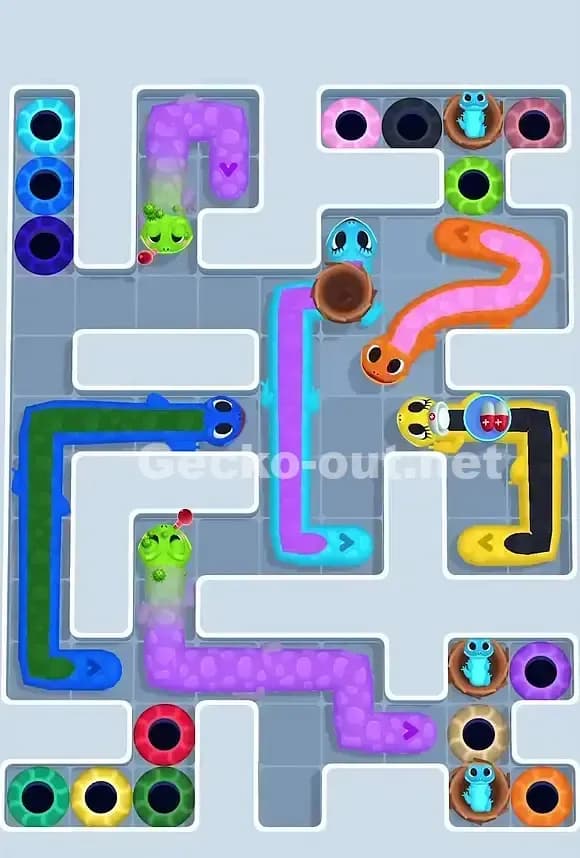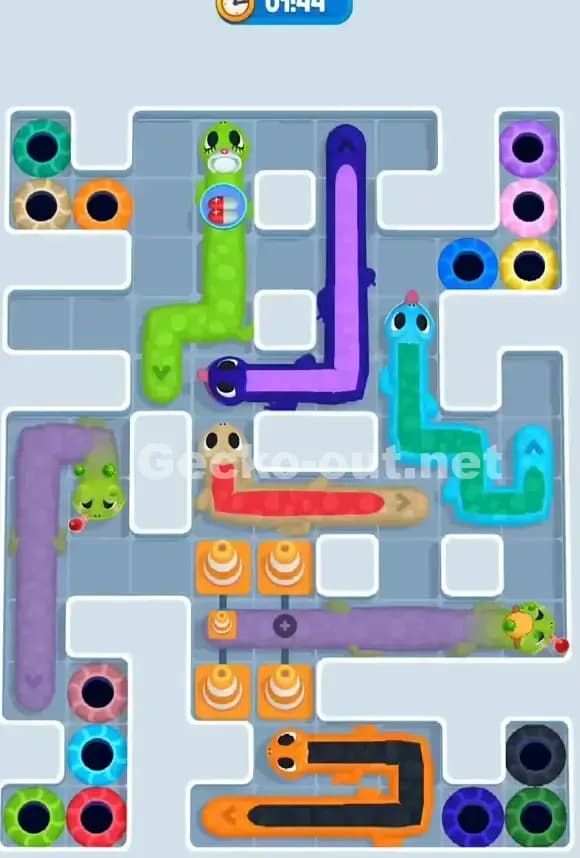
Gecko Out Level 746 Solution Walkthrough | Gecko Out 746 Answer
How to solve Gecko Out level 746? Get step by step solution & cheat for Gecko Out level 746. Solve Gecko Out 746 easily with the answers & video walkthrough.
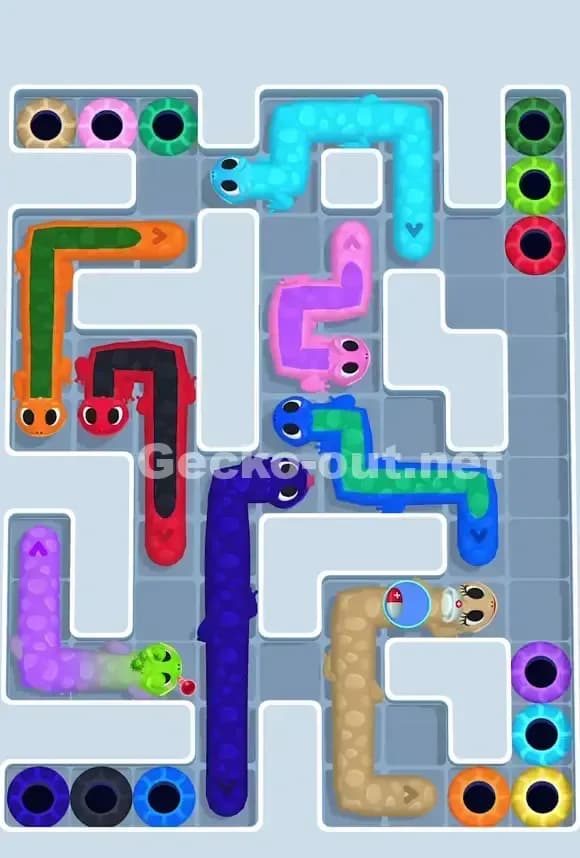
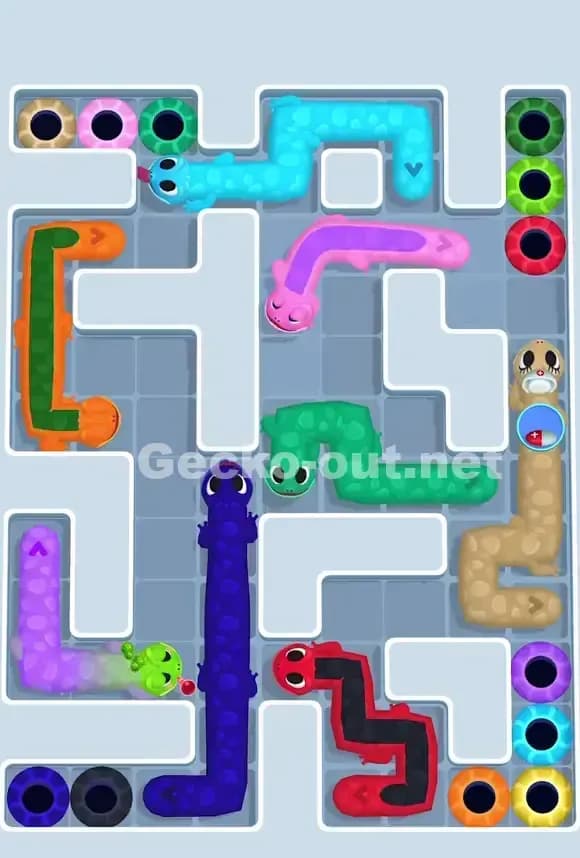
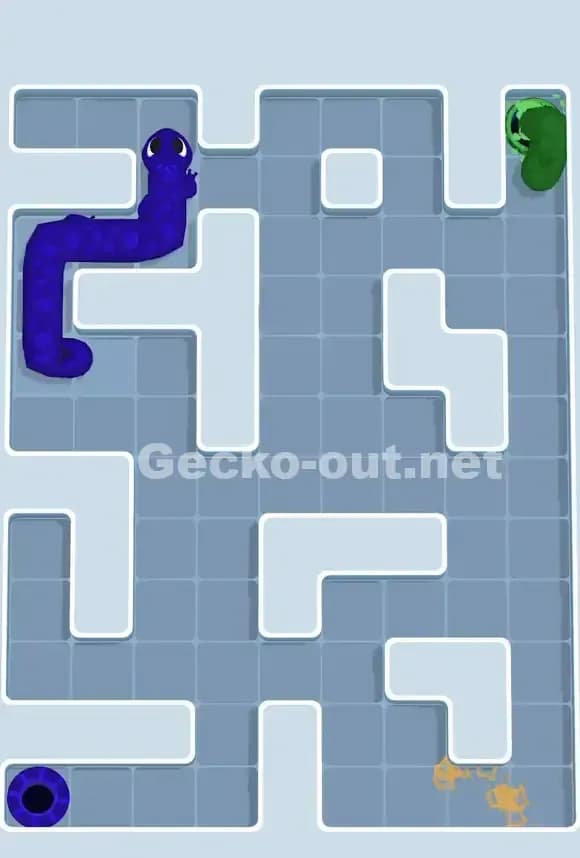
Gecko Out Level 746: Board Layout, Rules, and Win Condition
The Starting Board and Your Cast of Characters
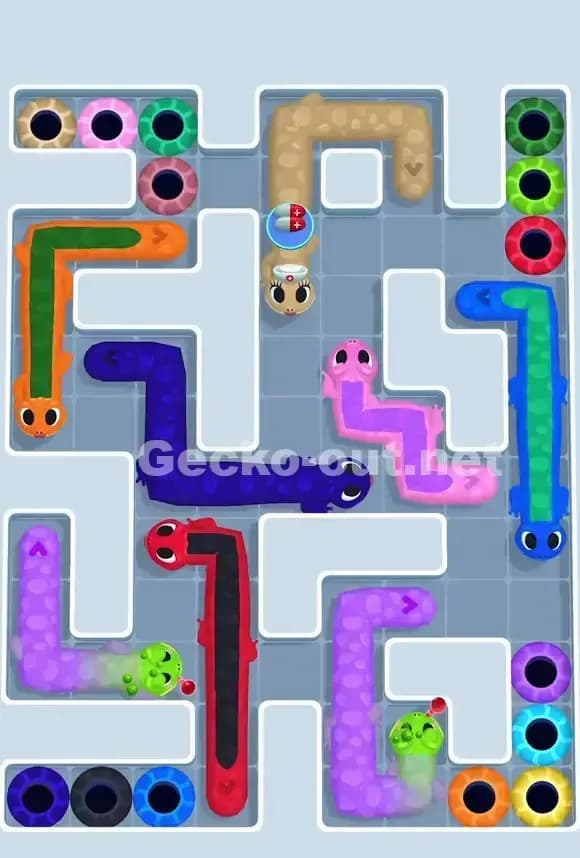
Gecko Out Level 746 is a densely packed puzzle that demands spatial awareness and careful sequencing. You're looking at eight geckos in total: a yellow, pink, and green trio clustered in the top-left corner; an orange gecko on the left side; a purple gecko anchoring the bottom-left; a dark blue gecko sitting in the middle-lower area; a red gecko positioned vertically in the center; and a green gecko on the right edge. Each gecko has a corresponding colored exit hole scattered across the board, and the challenge is that the board layout creates multiple choke points and spatial constraints. The white walls form a maze-like structure that forces you to plan each path carefully, because there's almost no room to maneuver once a gecko's body occupies certain corridors.
The Win Condition and Timer Pressure
Your job is to drag each gecko's head through the white-wall corridors until it reaches its matching colored hole and exits. The timer adds urgency—you're not racing against a clock in the traditional sense, but every second counts because each path you draw has to be precise and efficient. If you miscalculate even one gecko's route, you may end up creating a tangle that blocks access to critical exits for others, and that bottleneck could cost you the level.
Pathing Bottlenecks and Logical Traps in Gecko Out Level 746
The Central Corridor Squeeze
The most critical bottleneck in Gecko Out Level 746 is the central vertical passage where multiple geckos need to pass through or near the same corridor to reach their exits. The red gecko in particular sits in a position where its long body occupies valuable real estate, and if you're not careful about when and how you move it, you'll lock other geckos out of their escape routes. The dark blue gecko also competes for this space, and these two alone can create a traffic jam if you don't sequence them correctly.
Subtle Problem Spots You'll Encounter
The first subtle trap in Gecko Out Level 746 is the trio of geckos in the top-left corner. They look like they might be easy to route out, but their proximity to one another means that moving the pink or green gecko carelessly will position their bodies directly in the path of the other two. The second trap is the purple gecko on the bottom-left—it seems isolated and straightforward, but its exit requires a path that nearly mirrors the dark blue gecko's route, so timing matters. The third problem is the green gecko on the right edge; it's far from the others, but its long body creates a barrier if you move it too early, preventing quick repositioning of the red gecko below it.
The Moment It Clicks
Honestly, Gecko Out Level 746 frustrated me the first few attempts because it felt like I was always one move away from success, but the board was just too cramped. Then I realized the solution wasn't about solving for all geckos at once—it was about treating the puzzle as a series of sequential unlocks. Once I identified which gecko had to move first to free up space for everyone else, the rest of the paths became obvious.
Turn-by-Turn Path Strategy to Beat Gecko Out Level 746
Opening: Tackle the Top-Left Trio and Create Space
Start by moving the green gecko (top-right of the trio) out first. Drag its head downward and then to the right, finding the green exit hole on the upper-right edge of the board. This move is critical because the green gecko's body is the shortest obstruction among the three, and clearing it immediately opens up horizontal space for the yellow and pink geckos to maneuver. Don't rush—ensure your drag path avoids the white walls and gives the pink gecko room to move without overlapping.
Next, move the pink gecko toward its exit. The pink exit is in the middle-upper area, and dragging the pink gecko's head leftward and slightly downward will route it safely without crossing the yellow gecko's path. Park the pink gecko exactly at its exit hole; don't send it through yet if you suspect you'll need that corridor for another gecko later.
Finally, in this opening phase, route the yellow gecko to the top-left exit hole. Its path is straightforward once the pink and green are out of the way—drag it left and up to complete the top-left mini-clearing.
Mid-Game: Keep the Critical Lanes Open
Once the top-left is clear, you've bought yourself precious board space. Now focus on the orange gecko on the left side. Drag it downward along the left wall, then direct it toward the orange exit near the bottom-right of the board. This path is longer but intentional—by moving the orange gecko early, you prevent its body from becoming a barrier later when you need to move the purple and red geckos.
Next, route the purple gecko from the bottom-left toward its exit. The purple exit is to the right, and the purple gecko's body is fairly long, so drag its head carefully rightward, ensuring it doesn't collide with the orange gecko's trajectory. The key here is patience: wait until the orange gecko is far enough along its route that the paths don't intersect.
End-Game: The Red, Dark Blue, and Green Sprint
With the outer geckos cleared, you now have access to the central corridor. Move the dark blue gecko next, dragging it from its central position toward the blue exit on the bottom-left. Its path will be vertical and then horizontal, and this move should feel less cramped now that you've cleared the surrounding area.
The red gecko is long and occupies the center column, so handle it carefully. Drag its head toward the red exit (which should be accessible once the dark blue gecko is out), and trace a path that uses the newly opened space without doubling back on itself.
Finally, move the green gecko on the right edge toward its green exit. By this point, the board should feel mostly clear, and this should be one of your fastest moves—a simple downward or leftward drag to its hole.
Why This Path Order Works in Gecko Out Level 746
The Head-Drag, Body-Follow Logic
The strategy exploits the fundamental rule of Gecko Out Level 746: the body follows the exact path the head traces. By moving shorter geckos out first, you reduce the total "mass" occupying the board, which means longer geckos can later use routes that would have been blocked before. The red and dark blue geckos benefit enormously from this, because they're the longest and most disruptive if moved early. By the time you drag them toward their exits, the board is a highway, not a parking lot.
Balancing Speed and Precision with the Timer
You won't need to move at breakneck speed throughout Gecko Out Level 746, but you should move decisively once you've identified the correct path. Pause for 2–3 seconds after each gecko exits to scan the remaining board and plot the next route. This rhythm—move, pause, assess, repeat—prevents panic and ensures you're not backtracking or creating new obstacles.
Do You Need Boosters?
Gecko Out Level 746 doesn't require boosters if you follow this sequence. However, if you're struggling with the timing toward the end, an extra time booster (if available) is a practical safety net. A hint booster early on could also save frustration if you're unsure about the top-left trio's sequence. Skip "hammer" or damage tools—they're not useful here because the puzzle is about routing, not destruction.
Mistakes, Fixes, and Logic You Can Reuse in Other Gecko Out Levels
Common Pitfalls and How to Dodge Them
Mistake 1: Moving the red or dark blue gecko too early because they seem blocked. Fix: Always clear the outer geckos first to create space; inner geckos should be your second priority.
Mistake 2: Dragging a gecko's head through a path that leaves its body blocking a critical exit corridor. Fix: Before dragging, mentally trace where the body will rest once the head reaches the hole. If it's blocking another exit, adjust the route.
Mistake 3: Trying to move multiple geckos whose paths would intersect. Fix: Sequence geckos by their spatial priority—the gecko currently taking up the most "blocking" space should go first.
Mistake 4: Panicking when the timer drops below 30 seconds. Fix: The remaining geckos are usually the easiest to move by this point; trust that you've already solved the hard part.
Mistake 5: Not using the pauses between moves to identify the next gecko. Fix: Every time a gecko exits, immediately note which gecko will go next and roughly sketch its path in your mind.
Reusing This Strategy on Future Levels
The logic from Gecko Out Level 746 applies directly to any level with a cramped central area, multiple geckos competing for the same corridors, or gang geckos that need untangling. When you encounter a level where the board feels like a knot, ask yourself: "Which gecko is currently the biggest obstacle?" Answer that, and the rest will unravel. This methodology has saved me countless times on crowded boards.
Final Thoughts
Gecko Out Level 746 is tough, no question. The spatial constraints and the sheer number of geckos make it easy to feel stuck on your first or second attempt. But it's absolutely beatable once you realize that the puzzle rewards patience and sequencing over speed or luck. Trust the plan, move deliberately, and watch as each gecko's exit creates space for the next one. You've got this.