Gecko Out Level 798 Solution Walkthrough | Gecko Out 798 Answer
How to solve Gecko Out level 798? Get step by step solution & cheat for Gecko Out level 798. Solve Gecko Out 798 easily with the answers & video walkthrough.



Gecko Out Level 798: Board Layout, Rules, and Win Condition
The Starting Board: A Complex, Color-Coded Maze
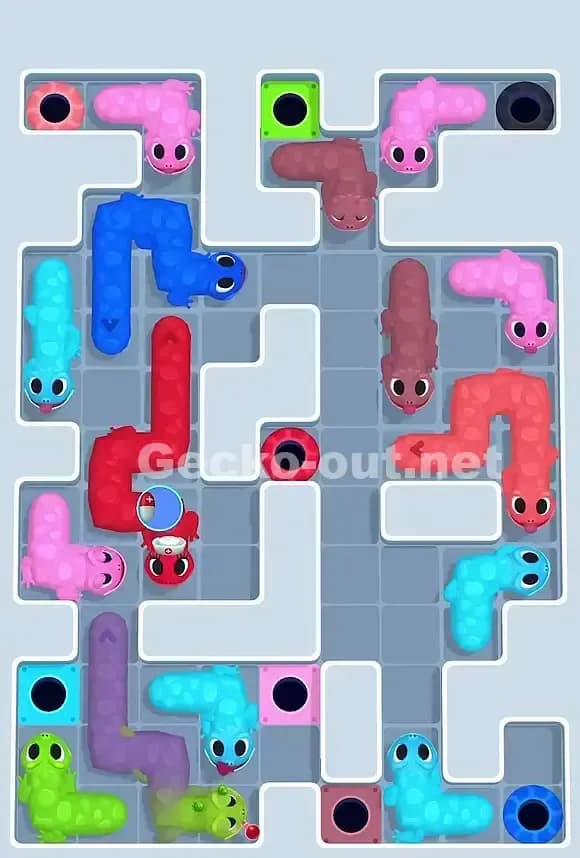
Gecko Out Level 798 is no joke—you're looking at a densely packed board with eight geckos in five different colors (cyan, pink, lime green, burgundy/maroon, and purple), each one snaking through a labyrinthine grid of corridors and dead ends. The geckos range in length from short three-cell bodies to sprawling five-plus-cell chains that twist through tight vertical and horizontal channels. What makes Gecko Out 798 particularly gnarly is that several geckos are parked in what look like safe positions but are actually blocking critical pathways that other geckos desperately need to escape. The board itself has multiple white wall sections creating U-turns, narrow choke points, and a few slightly wider hub areas where multiple geckos converge. You'll notice colored holes (the exit points) scattered around the edges—some in corners, some mid-wall—and they're positioned far enough from their matching geckos that every single path requires careful, intentional navigation. The timer gives you a reasonable but not infinite window to get everyone out, which means sloppy pathing or hesitation will cost you.
Win Condition and the Timer's Role
To beat Gecko Out Level 798, all eight geckos must exit through their corresponding colored holes before the clock runs out. That's non-negotiable: if even one gecko is still on the board when time's up, the level fails and you're back to square one. The timer reinforces that this isn't a puzzle you can solve by trial and error alone—you need a mental roadmap before you start dragging heads. The movement mechanic itself is elegant but demands respect: when you drag a gecko's head, its body follows exactly the path your finger traces, cell by cell. That means if you accidentally route a gecko through a space that's too narrow or already occupied, it will jam, and you'll need to reset and repath. This is where the real challenge lives: not just in finding exits, but in sequencing your moves so that early gecko movements don't lock later ones into impossible situations.
Pathing Bottlenecks and Logical Traps in Gecko Out Level 798
The Central Choke Point: The Burgundy Gecko Bottleneck
The single biggest traffic jam on Gecko Out Level 798 is the burgundy/maroon gecko in the center-right area. This medium-length gecko is positioned in a way that it either needs to move first to clear the path for others, or it becomes a permanent roadblock that traps the cyan geckos and lime-green geckos behind it. What makes it worse is that its exit hole is on the opposite side of the board, meaning it has to traverse nearly the entire width of the level, and its body is long enough that it'll occupy multiple critical lanes simultaneously. If you try to move other geckos before routing the burgundy one out, you'll find their paths suddenly blocked by its tail, and you'll be forced to undo and restart. I recommend addressing this gecko early, but not first—more on that in the strategy section.
The Cyan Gecko Pile-Up on the Left Edge
On the left side of the board, you've got two cyan geckos of similar length stacked almost on top of each other, running vertically down the left corridor. The problem? They share nearly the same exit zone, but their holes are in slightly different locations, and they're positioned so tightly that if you route one incorrectly, it'll physically block the other's path to freedom. This is a classic "gang gecko" scenario where two same-colored geckos are linked by proximity, not by game mechanics, but the effect is just as constraining. You'll need to solve for both simultaneously in your head before you move either one.
The Lime-Green Multi-Gecko Tangle
Gecko Out Level 798 has three lime-green geckos scattered across the board—upper area, middle-right, and lower-left sections. The trap here is that they don't directly block each other, but their exits all funnel through or near the same corridor systems. If you route one lime-green gecko inefficiently, it'll eat up board space that another lime-green gecko later needs, and since you can't have two geckos occupying the same cell, you'll hit a dead end. This requires mental patience: map out all three lime-green paths before committing to the first drag.
My First Attempt: Frustration and the Breakthrough
Honestly? My first time tackling Gecko Out Level 798, I felt the classic frustration of a multi-gecko knot: I'd get five geckos out, congratulate myself, and then realize the last three were locked in by my own early decisions. The breakthrough moment came when I stopped thinking about "getting each gecko out" and started thinking about "which gecko's movement unlocks the most space for others." That mindset shift—from isolated gecko logic to board-state logic—is what cracked the level open for me.
Turn-by-Turn Path Strategy to Beat Gecko Out Level 798
Opening: Clear the Burgundy Gecko and Protect the Left Edge
Start by routing the burgundy gecko in the center-right area out toward its hole on the right side of the board. This isn't a casual first move; it's the keystone that prevents everything else from jamming. Drag its head carefully along the rightmost available path, avoiding overlap with the pink geckos above it, and guide it directly to its exit. Once it's gone, you've reclaimed a significant swath of the board's middle lanes, and suddenly the cyan and lime-green geckos have breathing room. Next, tackle one of the left-edge cyan geckos—whichever one is positioned lower or has a slightly more direct route to its hole. Don't move both simultaneously; move one completely off the board, then reassess the space before committing the second cyan gecko to its path. This deliberate, sequential approach prevents you from accidentally creating an overlap scenario where both cyan geckos are stuck mid-board with no way forward.
Mid-Game: Reposition the Pink Cluster and Open the Center
Once the burgundy gecko is out and the first cyan gecko is gone, you'll have a clearer view of the pink gecko cluster in the upper and center areas. The pink geckos are long, and they meander through tight S-curves and U-turns, which means there's zero margin for error in pathing. Drag one pink gecko head along a careful route toward its hole, making sure you're not crossing paths with any remaining lime-green or the second cyan gecko. As you clear pink geckos, the center corridors open up, and you can finally move the second cyan gecko without fear of overlap. The key here is rhythm: move one gecko completely out, pause for one second to visually scan the new board state, then commit to the next gecko's path. Rushing leads to mistakes; pacing leads to victories.
End-Game: Sequence the Lime-Green Trio and Sprint to the Finish
By the time you're down to the last four or five geckos, most of them should be lime-green and purple. The lime-green geckos are your final puzzle because their exits are scattered, but now that the board is nearly empty, you have full freedom to route each one precisely. Drag the first lime-green gecko (usually the one that's most isolated) along its path to its hole, then the second, then the third. Purple geckos typically have simpler paths once the crowding is gone, so save them for the final moments. If you're getting low on time—and the timer is ticking down into the last 20 or 30 seconds—don't panic. Keep your drags deliberate and true; a slow, correct move beats a fast, wrong one every time. If you're running dangerously low on time and one gecko is still stuck, consider using a booster like extra time (if available) rather than improvising a bad path.
Why This Path Order Works in Gecko Out Level 798
The Body-Follow Rule as Your Tool, Not Your Enemy
The genius of this strategy is that it respects the head-drag mechanic's constraint and turns it into a feature. By moving the burgundy gecko first, you're not just getting one gecko out; you're actively clearing a lane that five other geckos will later traverse. Their bodies follow the paths you draw, so if you've pre-cleared the high-traffic routes, every subsequent gecko has a clean runway. You're not fighting the body-follow rule; you're choreographing it, like clearing a dance floor one dancer at a time so the next group has space to move.
Timer Management: Pause, Read, Commit
Gecko Out Level 798 rewards deliberation. Yes, the timer is real, but it's not so tight that you can't afford a 10-second pause to mentally trace a path before you drag. I recommend pausing after every two or three geckos to re-scan the board and confirm that the remaining geckos still have viable routes to their holes. This prevents the horrible scenario where you're near the end, the timer is blinking, and you realize you've accidentally trapped a gecko with no exit. The commit phase is when you know the path is safe—then you drag fast and confidently. Hesitation during the drag itself is what eats time; hesitation before the drag is what saves runs.
Booster Strategy: Optional, Not Essential
Gecko Out Level 798 is solvable without boosters if you execute the path order correctly. However, if you find yourself repeatedly failing at the very end (last gecko can't quite make it), a time booster (if available) is a smart safety net. Similarly, if you've made an early mistake and realize a gecko is partially trapped, a hammer-style reset tool (if the game offers one) can be your lifeline. Don't buy boosters preemptively; use them as tactical responses to near-miss runs. The real win is beating the level with no booster reliance—that's the true skill flex on Gecko Out 798.
Mistakes, Fixes, and Logic You Can Reuse in Other Gecko Out Levels
Mistake #1: Moving Geckos in Visual Order Instead of Strategic Order
The Problem: Players often move geckos from top-left to bottom-right, following the visual layout of the board rather than the logic of bottleneck clearance. This leads to the burgundy gecko (or whatever the central blocker is) moving last, when it should move first.
The Fix: Before you drag anything, identify the gecko that's blocking the most board space or exit lanes. Move that one first, even if it's in the middle of the board. For Gecko Out Level 798, that's the burgundy gecko. On other levels, look for long geckos in central positions or geckos whose exit routes intersect with many others.
Mistake #2: Not Fully Routing Before Dragging
The Problem: Players start dragging a gecko head but don't have a complete mental path to the hole. Mid-drag, they realize they've trapped themselves or overlapped another gecko, and they panic.
The Fix: Trace the entire path with your eyes before your finger touches the screen. Count the turns, verify no walls block the route, and confirm the exit hole is accessible. It takes 5 extra seconds per gecko but saves 30 seconds of undo-and-retry frustration. This is crucial on Gecko Out Level 798 with eight geckos and complex corridors.
Mistake #3: Underestimating Body Length and Overlap Risk
The Problem: Players forget that a five-cell gecko's body occupies five cells as it moves. They route the head into a corridor thinking it's clear, but the body, which is still turning around a previous corner, overlaps with another gecko.
The Fix: Mentally "unroll" the gecko's body as you trace its path. Imagine the entire winding body following your dragged head, cell by cell. On Gecko Out Level 798, the burgundy gecko is especially prone to this; its long body can snag on the pink geckos if you're not careful.
Mistake #4: Ignoring Hole-to-Head Distance
The Problem: Players route a gecko toward what they think is its hole, only to discover it's the wrong color or the gecko's body can't quite reach it due to an intervening wall.
The Fix: Double-check the color of the hole before you drag. Trace a path from the head to the hole that doesn't require the body to clip through walls. On Gecko Out Level 798, the cyan holes on the left side are close together—confirm you're routing each cyan gecko to its own specific hole, not guessing.
Mistake #5: Panicking When Time Is Low
The Problem: Players see the timer blinking, rush their drags, make sloppy mistakes, and fail with 10 seconds left.
The Fix: If time is low and you have two geckos left, take a breath, move one gecko correctly at a normal pace, then move the last one. A 30-second move is better than two failed 15-second moves. Gecko Out Level 798 gives you enough time if you've sequenced correctly; if you're running out of time, it means your earlier moves were inefficient, not that the level is impossible.
Reusing This Logic on Similar Levels
This Gecko Out Level 798 strategy applies directly to any level with multiple long geckos in central positions, shared corridor systems, or gang-gecko clusters. The formula is: identify the bottleneck gecko, clear it first, then sequence the remaining geckos from high-constraint to low-constraint (i.e., geckos with fewer available exit paths go first). On frozen-exit levels, apply the same logic but account for the fact that frozen exits require extra tool use, so you'll need to plan your gecko order around booster availability.
The Encouraging Truth About Gecko Out Level 798
Gecko Out Level 798 looks chaotic and overwhelming when you first load it, but it's actually a beautifully constructed puzzle where every gecko has a solution if you find the right sequence. It's tough because it demands respect—you can't brute-force it—but it's absolutely beatable with a clear mind, a mental path map, and the patience to move deliberately. Once you crack it, you'll feel the satisfaction of orchestrating eight geckos through a labyrinth with zero wasted moves. That's the sweet spot of Gecko Out 798: hard enough to challenge you, fair enough to reward skill.