Gecko Out Level 757 Solution Walkthrough | Gecko Out 757 Answer
How to solve Gecko Out level 757? Get step by step solution & cheat for Gecko Out level 757. Solve Gecko Out 757 easily with the answers & video walkthrough.

Gecko Out Level 757: Board Layout, Rules, and Win Condition
Starting Board and Key Obstacles
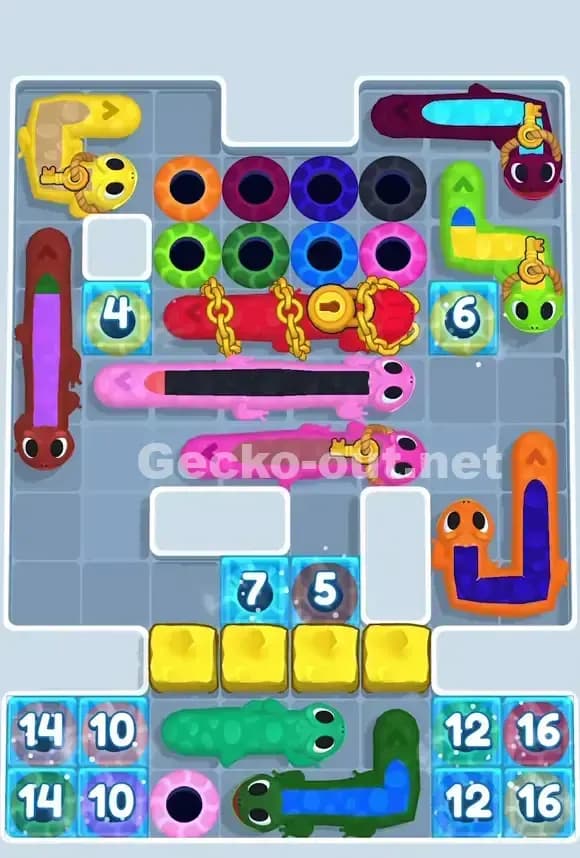
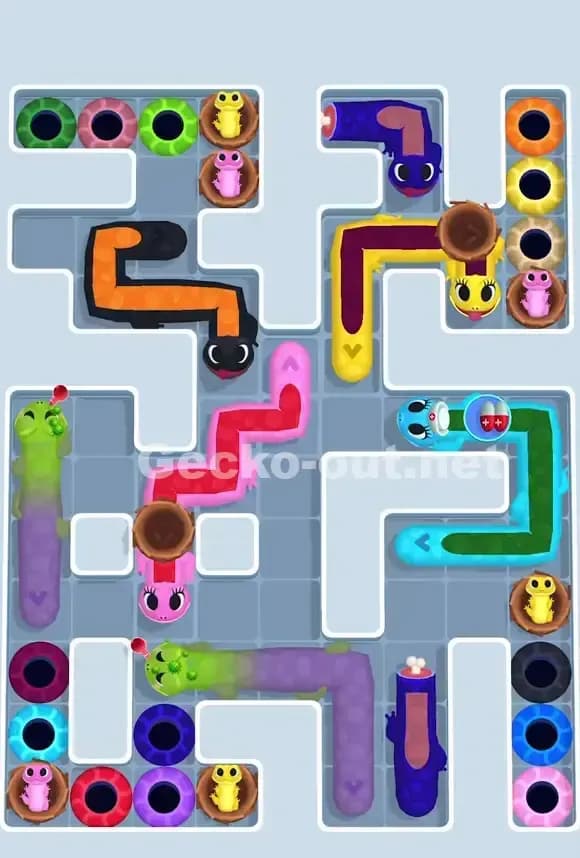
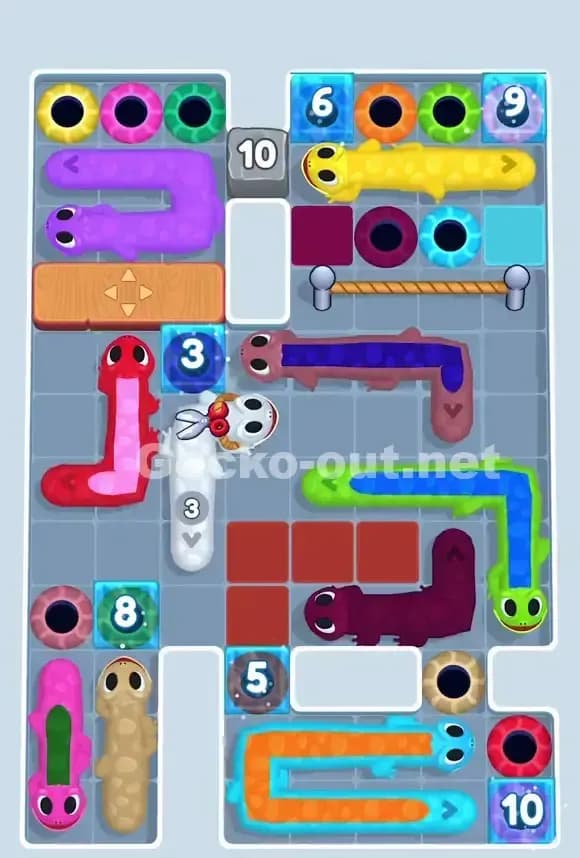
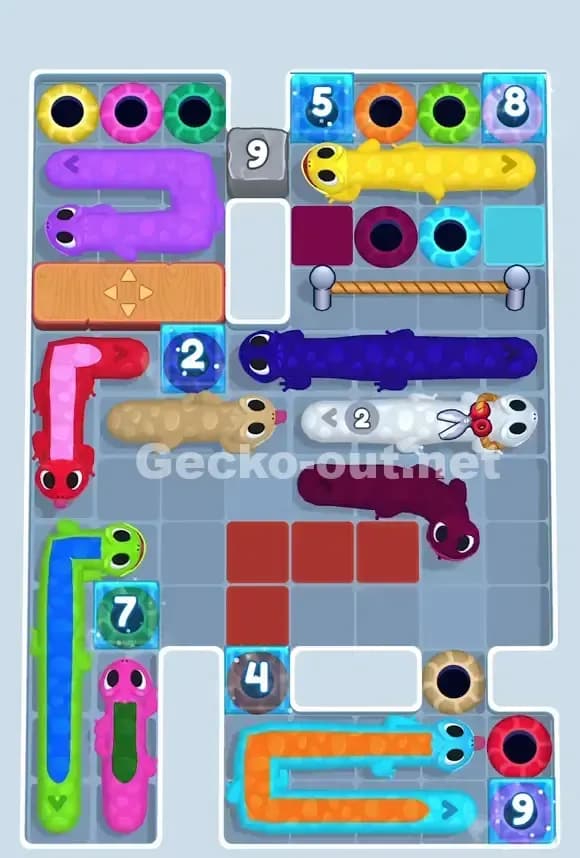
Gecko Out Level 757 is a densely packed puzzle with seven geckos spread across a complex grid, each locked behind walls, frozen sections, and tight corridors. You're working with a yellow gecko, a purple gang (two linked geckos), a red gecko, a teal gecko, a lime/green gecko, a pink gecko, and a tan gecko. The board is divided into distinct zones by thick gray walls, which means you can't simply slide geckos horizontally or vertically across the entire space—you have to navigate around solid barriers and through narrow choke points. The timer reads 10 moves, which sounds forgiving until you realize that one wrong path can jam multiple geckos and waste precious actions. Several exits are frozen or locked behind toll gates, meaning you need to clear specific geckos in a particular order, or you'll block your own escape routes.
Win Condition and Timer Pressure
To beat Gecko Out Level 757, every single gecko must reach a hole matching its color before the timer hits zero. The timer isn't forgiving—it counts down with each drag action you perform, so dawdling or experimenting costs you dearly. The board's wall layout forces long, winding paths that eat up moves quickly. The real challenge is that early choices directly affect later ones: if you drag the wrong gecko head first, you might accidentally box in a second gecko, and suddenly you're forced to backtrack or reset. This is why a clear mental plan before you start dragging is the difference between a clean win and a frustrating failure on Gecko Out Level 757.
Pathing Bottlenecks and Logical Traps in Gecko Out Level 757
The Central Corridor Jam
The biggest bottleneck in Gecko Out Level 757 is the narrow vertical corridor in the center-right section of the board, which is the only viable exit path for at least three geckos. The yellow gecko needs to exit through the upper-right zone, the lime gecko must navigate through the lower-right corridor, and the teal gecko is also competing for the same general escape route. If you drag any of these heads without a clear secondary exit plan, you'll create a knot where bodies block each other, and unraveling that tangle costs multiple moves. The purple gang gecko, being a linked pair, is even more dangerous in this space because its long body can choke off the entire corridor in a single misguided drag.
Subtle Problem Spots
One sneaky trap is the frozen exit on the right side—it looks like a valid hole, but it's locked or icy, meaning you'll waste a move dragging a gecko there only to discover it can't escape. Another subtle killer is the toll gate area in the middle-upper section; if you haven't cleared the correct geckos in the correct order, the toll won't open, and you'll be stuck. Finally, the pink gecko and tan gecko in the lower-left are visually isolated, which makes them seem easier, but their exit path actually funnels back toward the congested central corridor, so they're not truly "safe" until the center is clear.
The Moment It Clicks
I'll be honest—my first two attempts on Gecko Out Level 757 felt chaotic. I was dragging geckos in whatever order seemed fastest, and by move six I'd created a logjam where the purple gang's body was blocking the lime gecko's path, and the red gecko couldn't reach its hole because the teal gecko's route cut across it. The frustration was real. But then I stepped back and realized: if I prioritized clearing the long, awkward geckos first (purple gang, lime gecko) and parked the smaller ones in safe dead-end zones temporarily, I could keep the central corridor open. That shift in thinking—from "move as many geckos as possible" to "move in the right order to keep lanes free"—made the whole puzzle snap into focus.
Turn-by-Turn Path Strategy to Beat Gecko Out Level 757
Opening: Secure the Long Geckos and Clear Key Lanes
Start by dragging the purple gang gecko (the two-linked purple heads) out first. Yes, it's long and awkward, but that's exactly why it needs to go early. Plot a careful path from its starting position in the left-center area, around the walls, and toward its purple hole in the upper-left. This move costs you one action, but it removes the biggest obstacle blocking other geckos from repositioning. Next, move the yellow gecko—drag its head from the top-left zone up and around to the upper-right exit. Again, one move, but now you've cleared two major pieces and opened sightlines for the remaining five.
Your third move should target the lime/green gecko on the right side. This gecko needs to snake through the lower-right corridor to reach its exit. Drag its head carefully down and around, avoiding the walls and the now-empty spaces left by the purple and yellow geckos. Parking it in its hole ends your third move. At this point, you've used three moves but cleared three geckos, and the board is suddenly much less crowded.
Mid-Game: Reposition and Avoid Cross-Blocking
Now you have four geckos left (red, teal, pink, tan), and the board is starting to breathe. Your fourth move should be the teal gecko. It's medium-length and needs to navigate the central zone to reach its cyan hole on the right-center. Drag its head carefully so its body doesn't cross the path where the red gecko will eventually need to go. Think two moves ahead: visualize where the red gecko's path will be, and make sure your teal gecko's body doesn't occupy that space.
For move five, grab the red gecko. It's long and has a J-shaped or L-shaped starting position, which makes it tricky. Drag its head from the left-center area, around the walls, and toward its red hole in the lower-right. Because you've already cleared the purple gang and partially opened the board, the red gecko now has room to stretch. The key is not to second-guess the path—drag confidently once you've identified the route.
End-Game: Finish Strong and Avoid Last-Second Gridlock
You're now down to three moves remaining and three geckos (pink, tan, and possibly one more). Your sixth move should be the pink gecko from the lower-left. Plot a path from its current position around the walls and toward its pink hole. Because the board is now largely empty, this should be straightforward. Move seven: tan gecko. By now, you have just a few open spaces, but the tan gecko is small enough to navigate them.
If you're running low on time (near the final move or two), commit to quick, clean drags rather than pausing to overthink. At this stage, most of the complex untangling is already done, so your intuition is probably solid. If you do find yourself in a jam in the final moves—say, the last gecko can't quite reach its hole because another gecko's body is in the way—resist the urge to panic-reset. Instead, look for a one-move workaround: can you drag the blocking gecko slightly to create a new path? On Gecko Out Level 757, the timer is tight enough that wasting a move hurts, but not so tight that a clever one-move pivot won't save you.
Why This Path Order Works in Gecko Out Level 757
Untangling via Body-Follow Logic
The reason this strategy works is rooted in how Gecko Out Level 757's drag-and-follow mechanic operates. When you drag a gecko's head, the body doesn't teleport—it traces the exact path you drew, following in sequence. This means long geckos are "expensive" to move because they occupy many grid spaces for the duration of their journey. By moving long geckos early, you prevent them from becoming anchors that trap shorter geckos later. The purple gang and red gecko are your most expensive pieces, so removing them first gives every other gecko maximum freedom. Once they're out, the short geckos (pink, tan) can dart through the remaining corridors without colliding.
Additionally, the order leverages the concept of "safe parking." When you drag the teal gecko before the red gecko, you ensure the teal gecko's final body position doesn't block the red gecko's future path. It's not accidental; it's intentional sequencing based on analyzing how bodies will occupy grid space in the endgame.
Timer Management: Pause Strategically, Commit Decisively
Gecko Out Level 757 gives you 10 moves, which is enough if you plan ahead and few enough that hesitation kills you. Before your first drag, spend 15–20 seconds mentally tracing the path for the first two geckos. Know exactly where the purple gecko's head is going and roughly how the yellow gecko will follow. Don't over-plan every single move—that leads to paralysis—but have a clear picture of the first three actions. Then, commit. Drag the purple gecko smoothly, watch it reach its hole, and immediately identify the next target. This rhythm of "brief planning, decisive action, quick reassessment" will keep you moving without burning extra moves on undo or restart.
Boosters: Optional Backup, Not Required
Gecko Out Level 757 can be beaten without boosters if you follow this strategy cleanly. However, if you do find yourself at move nine with one gecko still waiting, an extra-time booster is a reasonable safety net. A hint booster is unnecessary here—the board is small enough that visual inspection will reveal the optimal path without external guidance. Skip the hammer or unlock tools; they're for levels where frozen exits or locked gates are genuinely blocking your progress, and Gecko Out Level 757's frozen sections are passable with correct sequencing. Save your boosters for genuinely stuck moments rather than using them as a crutch from the start.
Mistakes, Fixes, and Logic You Can Reuse in Other Gecko Out Levels
Common Pitfalls and Corrections
Mistake #1: Dragging geckos in random order. Many players assume that any order is fine as long as geckos eventually escape. On Gecko Out Level 757, this backfires because the board's walls create dependencies. The fix: always clear long geckos first, short geckos last. This principle applies to any level where geckos are of vastly different lengths.
Mistake #2: Not visualizing where a gecko's body will rest. Players often drag a head to the exit without checking whether the body will block another gecko's path. The fix: trace the full path (including where the body settles) before dragging. This is especially critical for gang geckos or frozen sections, where a misaligned body is game-ending.
Mistake #3: Ignoring safe dead-end zones. If you're running out of space, park a small gecko in an isolated corner or cul-de-sac (a dead-end corridor with a wall) temporarily. This keeps the main corridors clear for larger geckos. The fix: always identify 1–2 "parking spots" before you start, so you know where to stash geckos if the board gets cramped.
Mistake #4: Forgetting which exit is which color. Dragging a gecko to the wrong-colored hole wastes a move. The fix: spend 10 seconds at the start matching each gecko's color to its hole. On Gecko Out Level 757, the colors are mostly obvious, but frozen or partially hidden exits can trick you.
Mistake #5: Panicking and using boosters too early. If you mess up move two, don't immediately use an extra-time booster. Instead, reset and replay cleanly. Boosters are for genuine impossibilities, not small stumbles. The fix: accept that one or two failed attempts are normal, and treat each failure as a learning step toward the optimal path.
Reusing This Logic on Similar Levels
Gecko Out Level 757's approach—clear long geckos first, sequence moves to keep corridors open, avoid cross-blocking—is a transferable mental model for any gang-gecko level, frozen-exit puzzle, or tight-corridor map. Whenever you encounter a level with multiple geckos and limited space, ask yourself: "Which gecko is longest? Which corridors are bottlenecks? What's the safest parking spot?" If you can answer those three questions, you've already solved 70% of the puzzle. The specific walls and colors change, but the underlying logic of "length and order matter" holds across Gecko Out's entire difficulty spectrum.
The Final Encouragement
Gecko Out Level 757 is genuinely tough—its timer is unforgiving, its layout is intricate, and its bottlenecks punish poor sequencing. But it's also absolutely beatable with a clear plan and disciplined execution. The fact that you're reading this guide means you're already in a mindset to win. Take the strategy outlined here, run through it once mentally, and then commit to the drag sequence with confidence. Your first attempt might fail, but by attempt three, you'll have internalized the board layout and the move order will feel intuitive. You've got this. Gecko Out Level 757 is waiting for you to conquer it.