Gecko Out Level 252 Solution Walkthrough | Gecko Out 252 Answer
How to solve Gecko Out level 252? Get step by step solution & cheat for Gecko Out level 252. Solve Gecko Out 252 easily with the answers & video walkthrough.
Gecko Out Level 252: Board Layout, Rules, and Win Condition
Reading the starting board
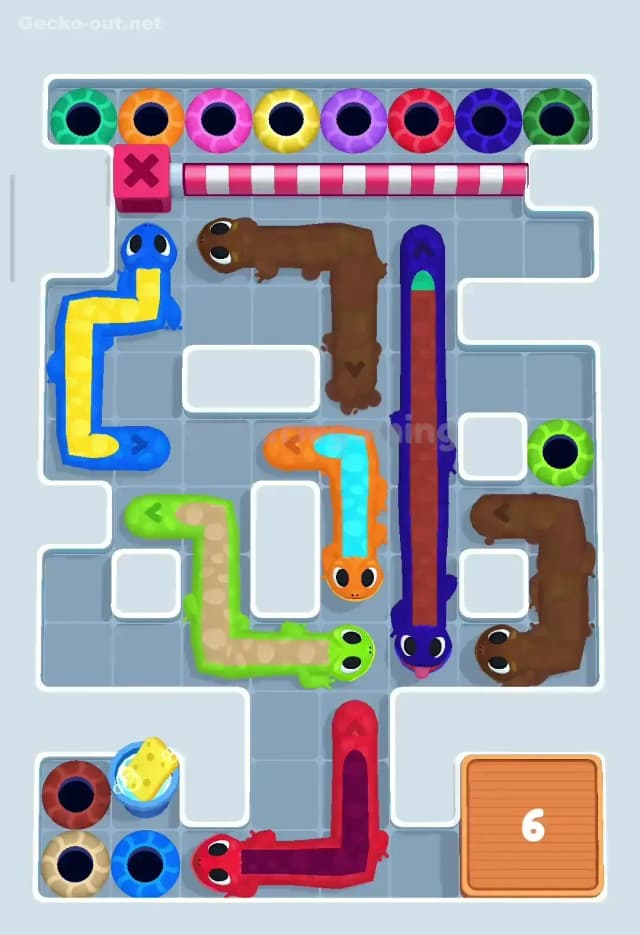
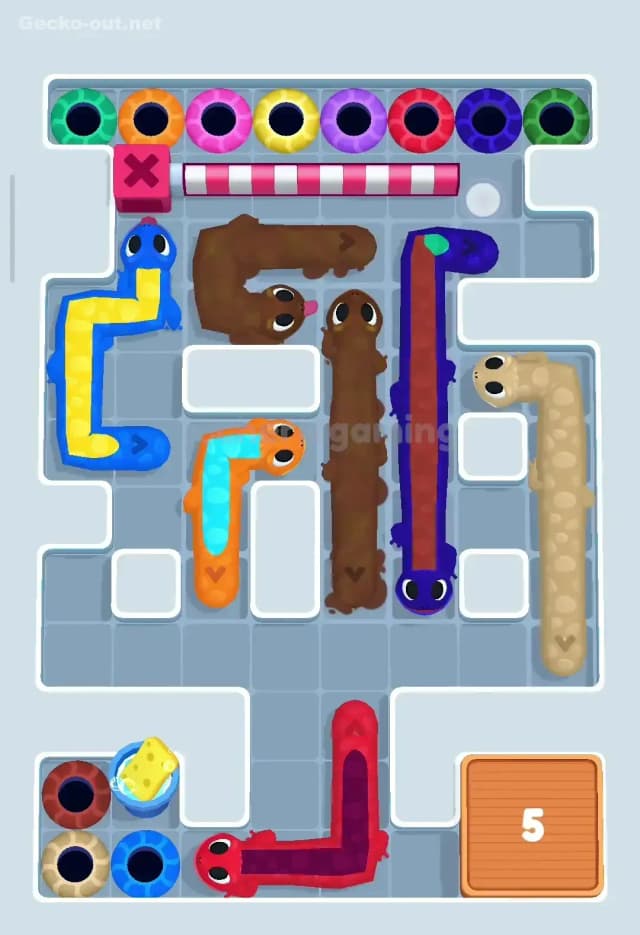
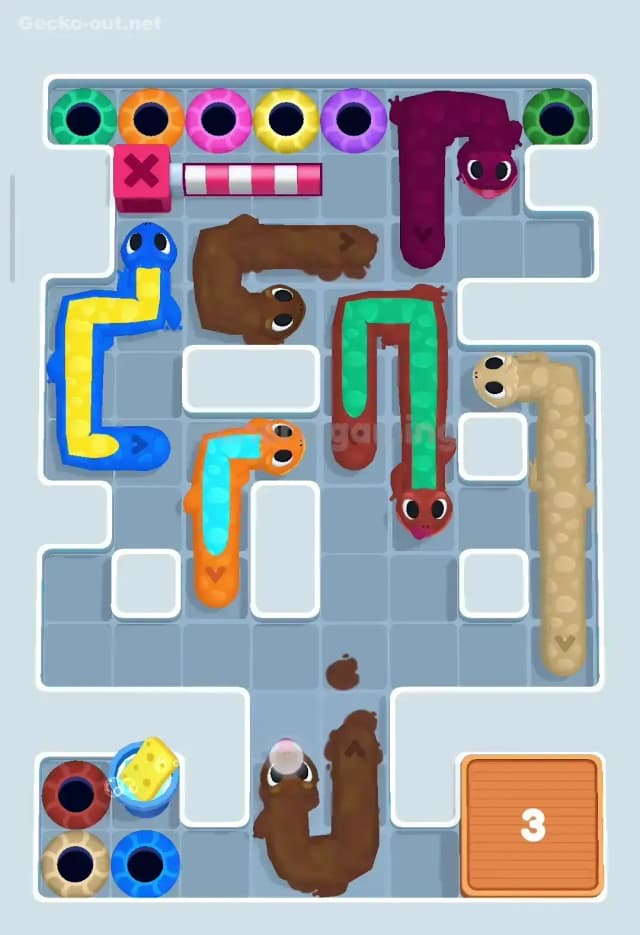
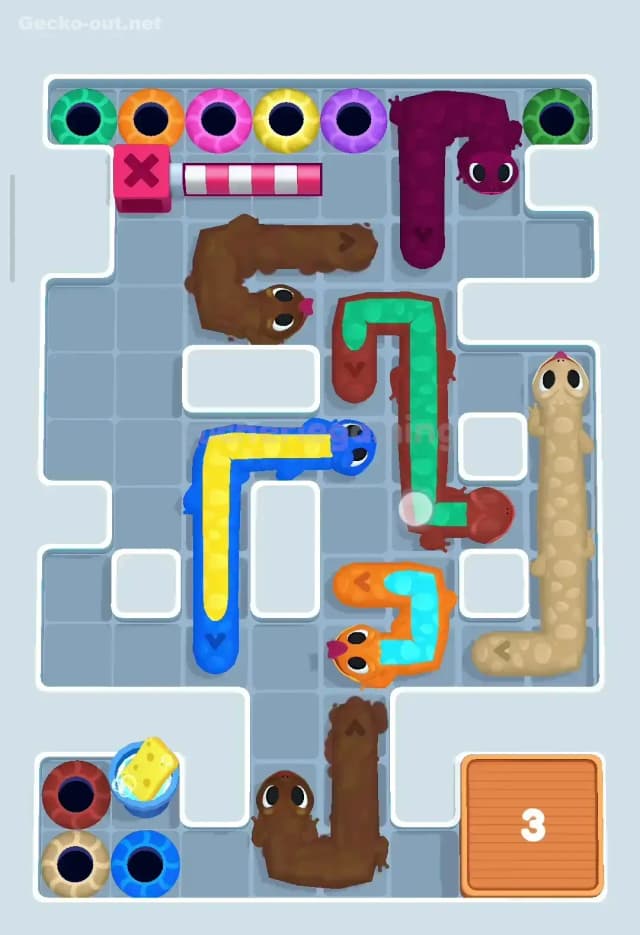
In Gecko Out Level 252 you’re dropped into a tight vertical board packed with long, bendy bodies. There are seven geckos on the grid: a tall purple one running almost the full height of the board in the center-right, two chunky brown L‑shapes along the top and right side, a blue‑headed gecko hugging the left wall, a short orange gecko in the middle, a long green gecko looping through the lower center, and a red gecko resting along the very bottom. Their matching holes are split between a rainbow row of exits along the top edge and a small cluster of holes tucked into the bottom‑left corner, plus a single green hole on the right side.
The level is full of fixed white blocks that create narrow corridors. There’s only a one‑tile channel up the middle, and another thin lane that wraps around the bottom‑left corner where a bucket and three holes sit. That means most of Gecko Out 252 is about threading each gecko through these tight corridors in the right order so their bodies don’t permanently seal a path you still need.
Timer pressure and the path‑drag rules
The win condition is the same as every other Gecko Out level: you have to guide every gecko to the hole of its own color before the timer hits zero. In Gecko Out Level 252, the timer is brutally short—only a handful of seconds—so you can’t “feel it out” once you start. You need a plan in your head and then you execute it cleanly in one go.
Because the game uses head‑drag pathing, whatever line you draw with the head is exactly where the body will follow, section by section. If you snake a gecko across the middle and then back on itself, that wide loop becomes a moving wall for everyone else. On Gecko Out 252 that’s the core difficulty: a single sloppy drag can turn the long purple or green gecko into a giant barrier that makes several exits unreachable. So you’re not just aiming for the right destination; you’re aiming for minimal, tidy paths that keep lanes open for the next geckos.
Pathing Bottlenecks and Logical Traps in Gecko Out Level 252
The biggest bottleneck: the tall purple gecko
The biggest bottleneck in Gecko Out Level 252 is the tall purple gecko in the center-right column. Its body already occupies the main vertical highway from bottom to top. Any time you move it, that entire column becomes a sliding wall that can cut off the middle exits, the right‑side green hole, and even access between the top and bottom halves of the board.
The trick is to treat the purple gecko as a “door” you open only when you’re ready. If you send it straight to its top exit too early, its trailing body will sweep through the middle and trap one of the browns or the orange gecko. If you never move it, neither the green gecko nor the right‑side brown can reach their holes. The winning solution basically revolves around when and how you move that purple piece.
Subtle problem spots you might overlook
One subtle trap is the little pocket around the bucket and bottom‑left exits. It looks like there’s plenty of room, but once the red gecko curls around in there, there’s only space for one more body to pass cleanly. If you park a long tail in that corner instead of exiting immediately, you’ll block the path for the green gecko’s final route.
Another easy mistake area in Gecko Out 252 is the middle cluster around the orange and green geckos. The white blocks create a U‑shape channel, and if you path the green gecko too far up into the U, you’ll completely box in the orange one. Finally, the top row behind the striped barrier is narrower than it looks; sending a brown gecko across that row with a big curve can cover more than one exit and force awkward backtracking.
When the solution finally “clicks”
The first few times I tried Gecko Out Level 252, I kept doing what feels natural: send the purple gecko straight up and “get it out of the way.” Every time, that move made the board worse, not better. The breakthrough came when I stopped touching purple at the start and instead focused on clearing the bottom‑left corner and freeing the middle from below.
Once I realized the red and green geckos could both exit before the purple even moved, the puzzle snapped into place. The level went from feeling like chaos to feeling like a choreographed dance: bottom‑corner cleanup, mid‑board rearrange, then a quick final sweep of exits in a set order.
Turn-by-Turn Path Strategy to Beat Gecko Out Level 252
Opening: clear the bottom and set up the middle
Before you start the timer on Gecko Out 252, memorize this opening sequence. First, take the red gecko at the bottom. Drag its head left along the bottom wall, curl it neatly up into its matching hole in the bottom‑left cluster, and don’t draw any unnecessary loops. You want that tail completely gone from the board.
Next, use the space the red left behind to move the long green gecko. Drag the green head down and left around the central white block, then through the bottom corridor and into its own hole (either in the same corner cluster or toward the right, depending on your color match). The key is to keep its path hugging the outer edges so its body doesn’t swing back into the center lanes.
With the bottom cleared, nudge the blue‑headed gecko on the left up or down just enough to straighten it and park its body flush against the left wall. You’re not exiting it yet; you’re just making room so the orange gecko can move later without colliding.
Mid-game: preserve the central lanes and line up exits
In the mid‑game phase of Gecko Out Level 252, your job is to keep the central channel open while setting up short, direct exit paths.
Start by moving the right‑side brown gecko. Drag its head around the nearby white blocks so it swings either up toward its top exit or across to the right‑side hole, but avoid letting its body lie across the central vertical lane. Think of its path as a tight L or J shape hugging the outer right wall.
Now, reposition the orange gecko in the middle. Pull its head down a tile or two, then around the white block so that its path to its exit is a nearly straight line, ready for the end‑game. Again, don’t actually send it home yet; just stage it so one final quick drag will finish it.
Only after those are set should you gently adjust the tall purple gecko. Slide its head just enough to uncork any blocked paths to the remaining exits, but keep its body mostly vertical. If you make the purple snake zigzag, you’ll instantly lose the clean lanes you’ve been preserving.
End-game: exit order and last-second saves
For the end‑game of Gecko Out 252, commit to a strict exit order so the timer doesn’t catch you thinking. I’ve had the most success with this sequence:
- Fire the blue‑headed gecko to its top exit via the left corridor.
- Immediately send the orange gecko along the short path you staged earlier.
- Move the top brown L‑shaped gecko into its matching top exit.
- Finish with the tall purple gecko, dragging it straight up through the central column into its hole.
The reason you finish with purple is that its long tail will sweep through the center one last time, but at that point there’s nobody left to inconvenience. If you’re low on time, skip any tiny adjustments and just draw the most direct line possible for each remaining gecko. A slightly imperfect path is better than hesitating and timing out.
Why This Path Order Works in Gecko Out Level 252
Using body-follow rules to untangle instead of re-knot
This plan for Gecko Out Level 252 leans into the body‑follow rule instead of fighting it. By clearing the red and green geckos first, you remove the longest bodies from the most cramped area, so nothing is left behind to swing across crucial corridors. Parking geckos along outer walls and staging short, straight exit paths means that when you finally move the purple gecko, its sweeping body only travels through spaces you no longer need.
Each move is about minimizing how much new space a gecko occupies. You’re never dragging one across the board “just because”; every path is either an immediate exit or a tight staging line that avoids the center.
Balancing planning time and execution time
With the short timer in Gecko Out 252, the real thinking happens before you touch anything. I like to give myself a full minute just staring at the board, visualizing the order: bottom red, bottom green, park blue, move right brown, stage orange, adjust purple, then the four quick exits. Once I’m confident, I start the swipes.
During execution, don’t pause between moves. The drag animations will resolve in order, so if you queue the paths quickly, the geckos will stream to their exits almost like a chain reaction. The only time you should slow down is when drawing around tight corners; a mis-drag that bumps into a wall wastes more time than a slightly slower but accurate line.
Boosters: nice to have, not required
Gecko Out Level 252 is absolutely beatable without boosters. A time booster can give you breathing room if you’re still learning the route, but once you’re comfortable, you don’t need it. Hammer-style tools that remove obstacles are overkill here; the puzzle is designed around the existing walls, and breaking them just makes the level less interesting. I’d save boosters for levels with true frozen exits or multi‑gecko “gang” chains—this one is more about patience and path discipline.
Mistakes, Fixes, and Logic You Can Reuse in Other Gecko Out Levels
Common mistakes and how to fix them
One big mistake on Gecko Out Level 252 is moving the purple gecko first. Fix: ignore it until the bottom and middle are mostly resolved; treat purple as the final key, not the opener.
Another frequent error is parking geckos in the bottom‑left corner instead of exiting them. Any tail you leave there blocks the other gecko’s route. The fix is simple: whenever you send a gecko into that corner, make sure the path ends in its hole.
Players also often over‑curve paths. Every extra bend makes the body cover more tiles. The fix is to aim for straight segments hugging walls and to redraw mentally if your first instinct is an S‑shaped drag.
Finally, trying to exit orange too early tends to trap the green or purple gecko. Get used to staging orange in a safe position and waiting until the last burst of moves.
Reusing this logic on other knot-heavy levels
The thinking you develop on Gecko Out 252 carries over to a lot of late‑game Gecko Out levels. Anytime you see one very long gecko in a central lane, treat it as a door and plan to move it late. When exits are split between a corner cluster and a top row, clear the corner first so you don’t trap yourself in a cul‑de‑sac.
On gang‑gecko or frozen‑exit levels, the same ideas apply: remove long bodies from tight pockets first, stage short exit paths, and only then free or move the big central piece. If you can look at a messy knot and mentally “peel off” the easiest outer geckos, you’ll find most of the high‑number Gecko Out levels suddenly feel much fairer.
Final encouragement for Gecko Out Level 252
Gecko Out Level 252 looks brutal at first glance: long bodies, tiny corridors, and a cruel timer. But once you see that it’s really about bottom‑corner cleanup, careful staging, and a late purple exit, it becomes a satisfying, repeatable solve. Take your time planning, commit to the move order, and treat every drag as a deliberate, minimal path. With that mindset, Gecko Out 252 stops being a wall and turns into one of those levels you’ll breeze through on the first try after it finally “clicks.”