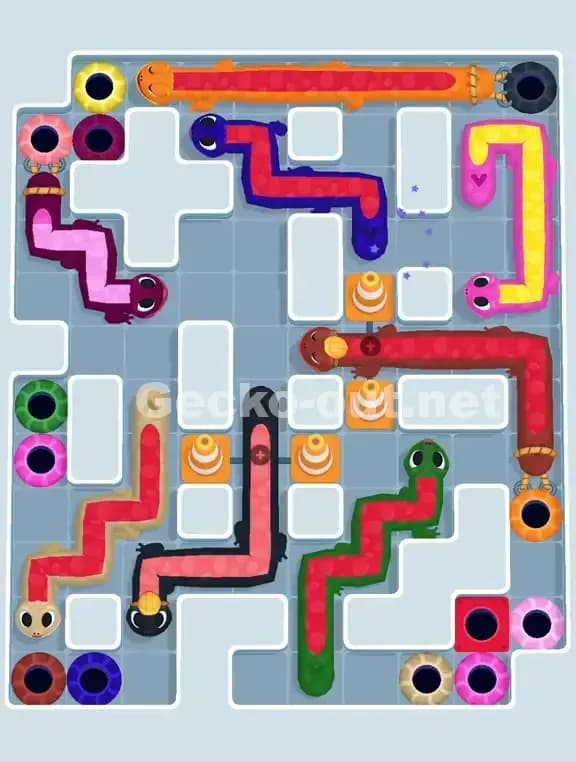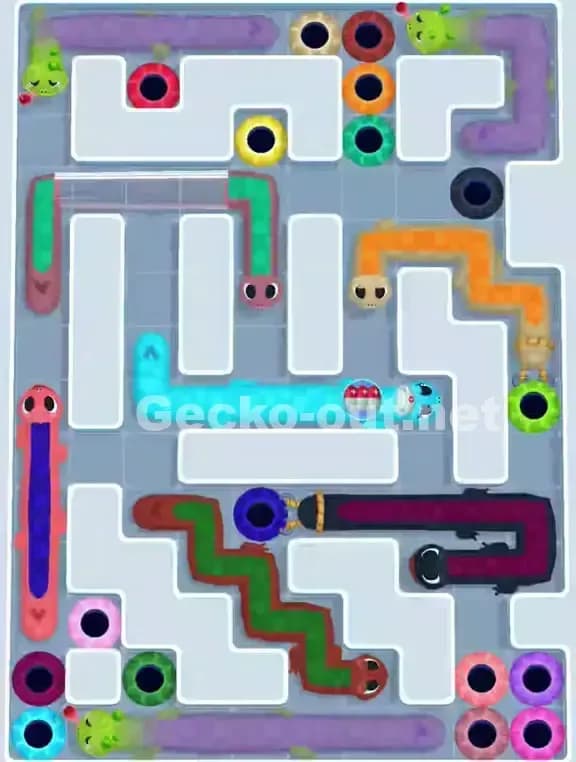
Gecko Out Level 938 Solution Walkthrough | Gecko Out 938 Answer
How to solve Gecko Out level 938? Get step by step solution & cheat for Gecko Out level 938. Solve Gecko Out 938 easily with the answers & video walkthrough.


Gecko Out Level 938: Board Layout, Rules, and Win Condition
Understanding the Starting Board
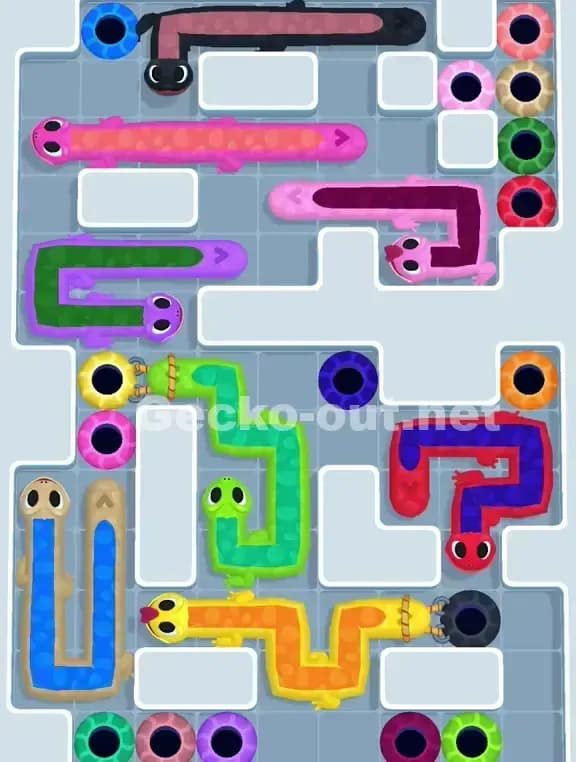
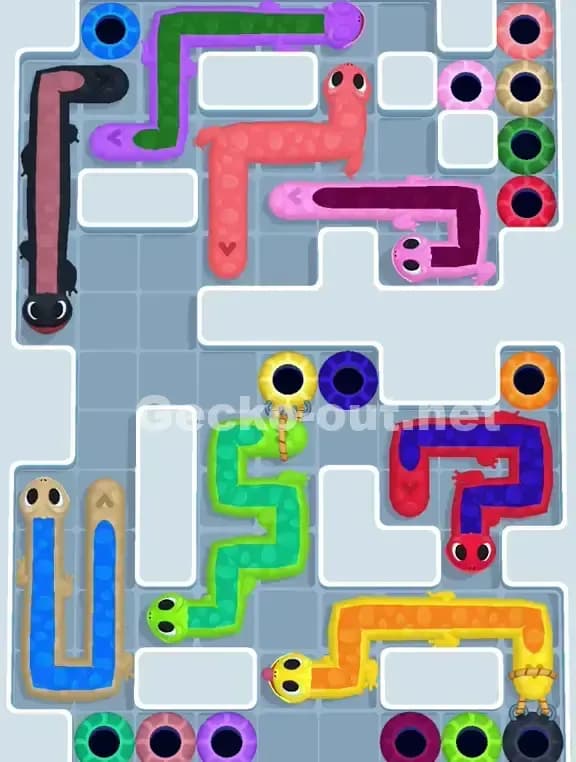
Gecko Out Level 938 is a dense, multi-gecko puzzle that demands careful sequencing and spatial awareness. You're working with seven geckos of different colors spread across a fairly compact board: a blue gecko at the top left, a pink/magenta horizontal gecko dominating the upper-middle section, a magenta L-shaped gecko in the middle-right, a green L-shaped gecko on the left side, a yellow gecko in the lower-middle area, an orange gecko on the right edge, a red gecko at the bottom-right, and several smaller support geckos positioned throughout. The board is filled with white wall obstacles that create a maze-like structure, forcing each gecko's body to navigate specific corridors. Some exits are locked or frozen, meaning you can't use them until you've cleared certain geckos or obtained the right tool. The layout is deliberately tight—there's minimal wiggle room, and one poorly chosen path can jam up the entire board and steal your remaining time.
The Win Condition and Timer Pressure
Your goal in Gecko Out Level 938 is to guide every single gecko to its matching color hole before the timer runs out. Each gecko's head is draggable, and its body follows the exact path you trace. If any gecko remains on the board when time expires, you fail the level, no matter how close you were. This timer pressure makes planning absolutely essential—you can't afford trial-and-error or hesitation. The challenge isn't just finding a path; it's finding the fastest sequence that keeps the board flowing smoothly without creating traffic jams.
Pathing Bottlenecks and Logical Traps in Gecko Out Level 938
The Primary Bottleneck: The Pink Horizontal Gecko
The biggest jam point in Gecko Out Level 938 is undoubtedly the long pink horizontal gecko stretching across the upper-middle section. This gecko is massive and occupies a critical north-south corridor that almost every other gecko needs to pass through or around. If you move the pink gecko last, you'll create a gridlock where other geckos physically cannot reach their exits because the pink body blocks every viable route. Conversely, if you move it too early, its exit hole might become blocked by another gecko's body as you shuffle things around. The sweet spot is moving the pink gecko second or third, after you've cleared enough space but before the remaining geckos need that corridor.
Subtle Problem Spot #1: The Green and Purple L-Shaped Collision Zone
On the left side of Gecko Out Level 938, the green L-shaped gecko and the purple-outlined L-shaped gecko are positioned so their bodies can easily tangle if you're not deliberate about order. The green gecko needs to slide out first, giving the purple one a clean lane to exit. If you do this backward, the purple gecko's body will cross the path the green one needs, locking both in place.
Subtle Problem Spot #2: The Red and Yellow Exit Cluster
At the bottom-right of Gecko Out Level 938, the red and yellow geckos converge near several exit holes. The red hole and the yellow hole are close together, but their entry paths are slightly offset. If you drag the red gecko's head greedily toward its hole without accounting for the yellow gecko's body position, you'll create a collision that wastes precious seconds and potentially forces a restart.
Subtle Problem Spot #3: The Frozen or Locked Top Exit
Some exits in Gecko Out Level 938 may be frozen or locked initially. You'll need to either use a tool (like a hammer) to break them or clear a prerequisite gecko first. Don't assume every hole is immediately accessible—check which exits are active before committing to a path.
Personal Reaction to the Challenge
Honestly, Gecko Out Level 938 frustrated me on my first two attempts because I kept moving the pink horizontal gecko too late, and it created an impassable gridlock in the middle. I felt like I was so close—I'd get five geckos out with about 8 seconds left, but the remaining two were completely stuck. The turning point came when I stepped back and realized I needed to think of the pink gecko as a "traffic manager" that had to move earlier to open lanes for everyone else. Once I reordered my moves to get the pink gecko out by the halfway mark, suddenly the whole puzzle clicked, and the remaining geckos flowed to their exits almost effortlessly. That's when it hit me: Gecko Out Level 938 isn't about individual gecko speed—it's about board choreography.
Turn-by-Turn Path Strategy to Beat Gecko Out Level 938
Opening: Clearing the Lanes
Start by moving the green L-shaped gecko on the left side first. This gecko is relatively self-contained and doesn't block anyone else if you remove it early. Drag its head down and to the right toward the green hole on the left edge. Its body will follow the wall contours, and once it's out, you've freed up a major left-side corridor. Next, move the blue gecko from the top-left corner downward toward the blue hole. This move keeps the top-left area clear and prevents the blue body from interfering with the pink gecko's eventual exit path. "Park" any smaller support geckos (like the magenta one at top-right) by moving them to safe corners if their holes aren't immediately accessible. The key is to avoid creating a logjam while you figure out the order for the heavier hitters.
Mid-Game: Managing the Pink Gecko and Keeping Critical Lanes Open
Once you've cleared the green and blue geckos, immediately move the pink horizontal gecko. Drag its head from left to right toward the pink hole on the upper-right. Watch carefully—its long body will sweep through the middle corridors, so make sure no other gecko's body will cross into those spaces once the pink gecko is gone. Now that the pink gecko is safely out, the board suddenly feels less claustrophobic. Move the yellow gecko next. Drag it from the lower-middle area down and around toward the yellow hole at the bottom-left corner. Its body is moderately long, so trace a path that avoids the already-exited geckos and doesn't trap the red gecko. Follow immediately with the orange gecko (top-right). This gecko is smaller and has a clear shot to the orange hole on the far right, so it's a quick win that opens more space.
End-Game: The Final Squeeze and Timer Management
You're down to the last three geckos: the red, the magenta L-shaped one, and the purple L-shaped one. First, handle the magenta L-shaped gecko by dragging it down and to the right toward the magenta hole. Its L-shape means its body will hug the walls, so trace carefully to avoid the red gecko's current position. Next, move the purple L-shaped gecko. With the magenta gecko gone, the left side is now wide open. Drag the purple gecko's head downward and then right, following the wall contours toward the purple hole. Finally, move the red gecko. By now, you should have at least 5–10 seconds left, which is plenty of time for a single gecko. Drag the red gecko's head down and right toward the red hole at the bottom-right. If you're cutting it very close on time, don't panic—commit to a path and execute it quickly. Second-guessing yourself in the final seconds will eat your clock.
Why This Path Order Works in Gecko Out Level 938
Head-Drag Pathing and Body Flow
The reason this sequence unravels Gecko Out Level 938 instead of tightening the knot comes down to understanding how body-following works. When you drag a gecko's head, its body traces the exact path you drew, pixel by pixel. If you move a long gecko too late, its body becomes a permanent obstacle for everyone else. By front-loading the removal of large geckos (pink, green, blue) and leaving the shorter, more agile ones for last, you're systematically shrinking the total body mass on the board. Each removal opens new lanes that the remaining geckos can use. The sequence is a reverse topological sort: you're prioritizing geckos that block the most paths first, and leaving flexible, easy-exit geckos for the final rush.
Timer Management: Pause, Read, Commit
Here's my honest approach: spend the first 10–15 seconds pausing and reading the board carefully. Trace each gecko's path in your mind before you touch it. Once you're confident in your sequence, move quickly and commit to each path without hesitation. Dragging is fast—you can move a gecko in 2–3 seconds once you know the route. That means even if you spend 15 seconds planning, you still have 85+ seconds to execute seven geckos, which is more than enough. Don't waste time re-planning mid-level; trust your initial read and execute.
Booster Strategy for Gecko Out Level 938
You can beat Gecko Out Level 938 without boosters if you follow the sequence above, but if you find yourself running low on time during practice attempts, an extra-time booster (usually +30 seconds) deployed at the mid-game mark (after 3–4 geckos are out) is a solid insurance policy. Alternatively, if any exits in your version are locked and you don't have time to clear the prerequisite gecko, a hammer booster can instantly unlock them. However, these boosters shouldn't be necessary—they're safety nets, not the primary strategy. Master the path order, and you'll beat Gecko Out Level 938 clean.
Mistakes, Fixes, and Logic You Can Reuse in Other Gecko Out Levels
Common Mistake #1: Moving the Longest Gecko Last
Players almost always want to move the smallest geckos first because they feel "easier," but this leaves massive geckos like the pink one blocking the board at the end. Fix: Always prioritize removing long geckos early, regardless of size. A long gecko is a long gecko—get it off the board to free up space for everyone else.
Common Mistake #2: Not Tracing Paths Before Dragging
In the rush to beat the timer, players drag gecko heads without fully planning the route. The gecko's body then collides with a wall or another gecko, forcing a retry. Fix: Spend 2–3 seconds tracing your intended path with your finger or cursor before you commit to the drag. This tiny pause prevents huge backtracking losses.
Common Mistake #3: Ignoring the Frozen/Locked Exit Status
Some exits are visibly frozen or locked, but players don't notice and waste time trying to drag a gecko into a blocked hole. Fix: Do a quick visual scan of all exit holes at the start. Note which ones are accessible and which aren't. Plan your sequence accordingly.
Common Mistake #4: Creating Unnecessary Crossover Paths
When dragging a gecko, the path you choose matters enormously. A roundabout path might collide with another gecko's body later, even if that gecko is on the opposite side of the board. Fix: Always drag in the most direct, wall-hugging route possible. Detours are tempo-killers.
Common Mistake #5: Moving Support Geckos at the Wrong Time
Small support geckos should either be moved very early (to clear space) or very late (when the board is open). Moving them mid-game often creates unexpected collisions. Fix: Categorize geckos as "large traffic managers" (move early) or "small finishers" (move late), and stick to that plan.
Reusing This Logic on Similar Levels
Gecko Out Level 938 is a template for gang-gecko and knot-heavy levels. Whenever you see multiple long geckos competing for space, apply the same logic: move the longest ones first, use the mid-game to reposition, and save small geckos for the end. If a level has frozen exits, identify which geckos unlock them and prioritize those removals. If there are choke points (narrow corridors only one gecko can fit through at a time), treat those corridors like traffic lights—only one gecko passes through per turn, and you must sequence accordingly.
Final Encouragement
Gecko Out Level 938 is genuinely challenging, and if you're stuck on it, you're in good company. But it's absolutely beatable, and the satisfaction of orchestrating seven geckos into perfect harmony in under 90 seconds is huge. Once you nail this level, you'll have internalized the spatial reasoning and sequencing skills that make every subsequent Gecko Out puzzle feel more intuitive. Trust the plan, trust your reading of the board, and commit to your moves. You've got this.