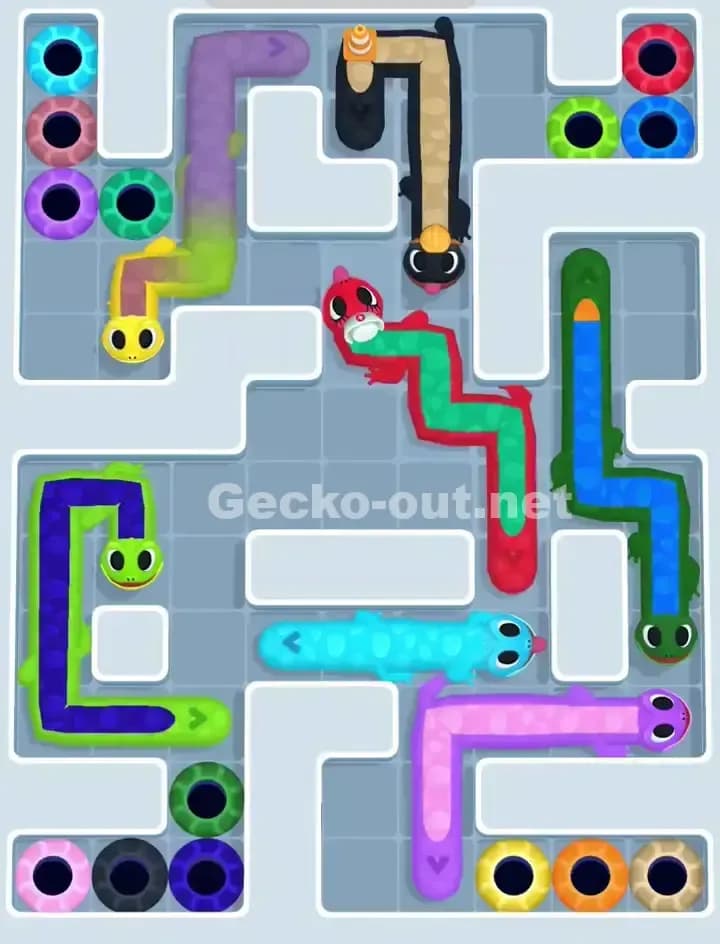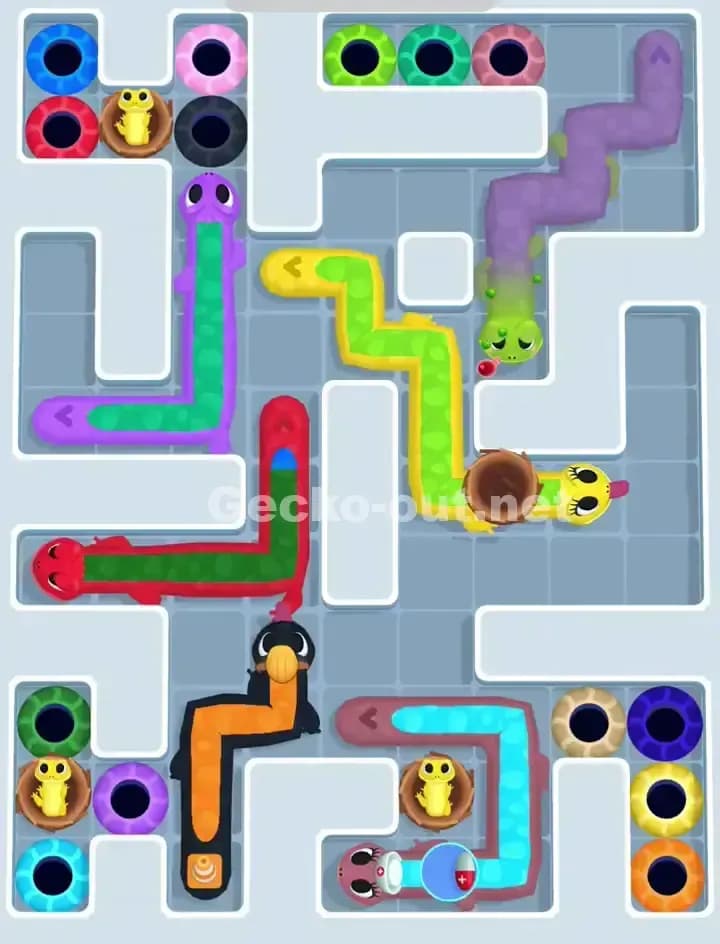
Gecko Out Level 1107 Solution Walkthrough | Gecko Out 1107 Answer
How to solve Gecko Out level 1107? Get step by step solution & cheat for Gecko Out level 1107. Solve Gecko Out 1107 easily with the answers & video walkthrough.
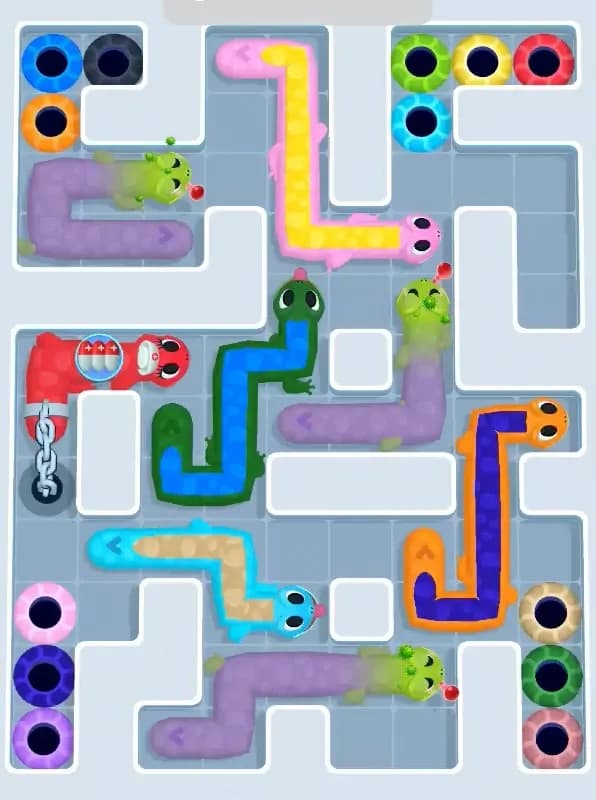
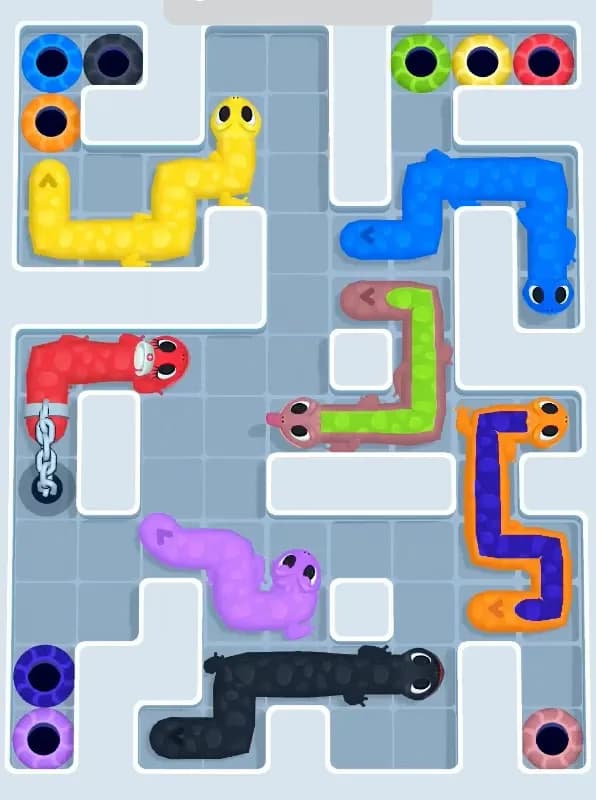
Gecko Out Level 1107: Board Layout, Rules, and Win Condition
The Starting Board: Geckos, Colors, and the Big Knot
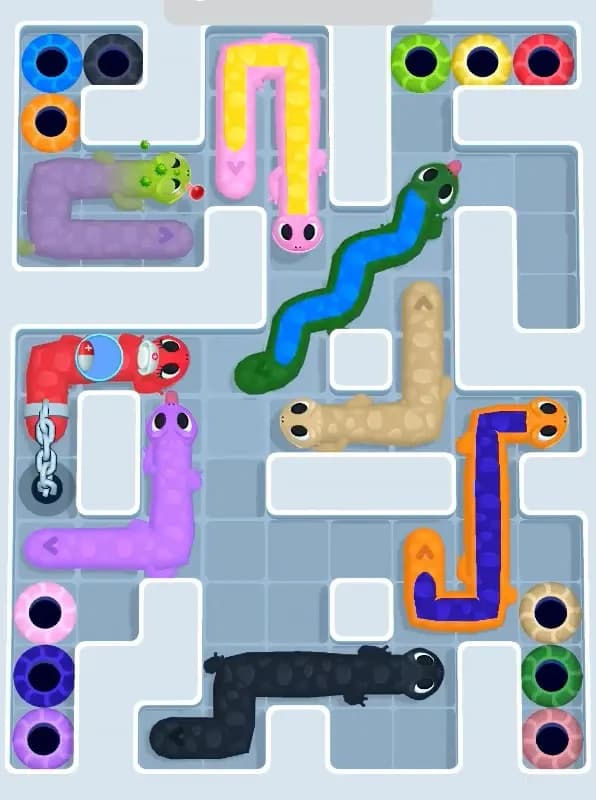
Gecko Out Level 1107 is a visual maze of intertwined bodies and tight corridors that'll make your head spin on first glance. You're looking at roughly eight geckos spread across the board in different colors: blue, orange, pink, yellow, green, red, cyan, and purple. Each gecko is coiled or stretched across the grid like a tangled rope, and they're positioned in every corner and crevice imaginable. What makes Gecko Out 1107 particularly tricky is that several geckos are already packed into overlapping lanes, which means careless dragging will immediately jam the whole system. The exit holes are scattered around the perimeter—mostly on the sides and corners—each one color-matched to its corresponding gecko. There are also a handful of white walls that create hard boundaries, and some geckos are positioned in clusters that force you to think about the order in which you move them, or you'll lock yourself into a dead end.
The Win Condition and the Timer's Role
To beat Gecko Out 1107, every single gecko must reach its color-matched hole before the timer runs out. There's no partial credit here—if even one gecko is still on the board when time hits zero, you fail and restart. The timer is typically generous enough to give you breathing room if you plan carefully, but it punishes hesitation and trial-and-error. Since each gecko's body follows the exact path you drag its head, there's zero margin for sloppy finger work. This is where Gecko Out Level 1107 separates casual players from strategic thinkers: you have to visualize the exit route for each gecko before you commit the drag, or you'll waste precious seconds undoing a bad move and reshuffling the board.
Pathing Bottlenecks and Logical Traps in Gecko Out Level 1107
The Central Corridor Bottleneck
The absolute biggest chokepoint in Gecko Out Level 1107 is the central vertical and horizontal corridor that runs through the middle of the board. This is where the blue, pink, and green geckos are all trying to snake their way through simultaneously, and if you move them in the wrong order, you'll have three bodies crossing paths and locking each other in place. The blue gecko in particular is a gang-like obstacle—it's long, it's got multiple coils, and its path intersects with at least two other geckos. If you drag blue out of the center without first clearing a safe lane for it, you'll create a domino effect where every gecko behind it gets bottlenecked. I learned this the hard way: I moved blue first on my second attempt, thinking I'd clear the way, only to watch the cyan gecko get completely trapped underneath the blue path. That's when it clicked—I needed to move cyan and pink before blue, so blue had a clear shot to its exit.
The Upper-Left Cluster and the Compression Trap
The upper-left quadrant of Gecko Out 1107 contains a dense cluster of three geckos (blue, orange, and purple heads all within a few cells of each other). Because they're so close, dragging one head at an angle will almost certainly clip the body of another. This is a compression trap—the more geckos you have in a small area, the fewer directional options each one has. If you're not careful, you'll find that the only way forward for one gecko is backward for another, creating a logical stalemate. The trick is to move the geckos in this cluster to their exits one at a time, and always drag the head in a wide, unambiguous arc that clearly clears the neighbors. Rushing through this section is a recipe for frustration.
The Right-Side Orange-to-Purple Crossing
On the right side of Gecko Out 1107, there's a secondary choke where the orange and purple geckos are both trying to reach exit holes that are only a few cells apart. Their bodies curve and coil in such a way that if you move orange first and drag it across the center, purple gets hemmed in and can't reach its exit without backtracking. Similarly, the cyan gecko near the bottom is positioned so that its path can block the orange gecko's route if you're not deliberate about sequencing. This is a classic order-dependency trap—the solution doesn't exist until you find the exact sequence that lets each gecko's path clear without intersecting.
Personal Reaction and the Breakthrough Moment
Honestly? My first three attempts at Gecko Out Level 1107 felt like trying to untangle a ball of yarn while wearing mittens. I was dragging geckos in all directions, watching them pile up on each other, and resetting over and over. The frustration peaked when I got four geckos out cleanly and then realized the blue gecko couldn't reach its exit because I'd left a purple coil in the way. But here's when the light bulb went on: I stopped moving and spent 30 seconds just looking at the board without touching it. I traced each gecko's body mentally, backward from its exit hole to its head, and suddenly the sequence became obvious. Gecko Out 1107 isn't actually random chaos—it's a logic puzzle with a specific answer. Once you see the dependency chain, it becomes almost mechanical.
Turn-by-Turn Path Strategy to Beat Gecko Out Level 1107
Opening: Clear the Edges, Park the Long Geckos
Your first move on Gecko Out 1107 should be to identify and move the gecko that has the shortest, most direct path to its exit. Typically, this is one of the geckos on the perimeter—maybe the yellow gecko or the cyan gecko if they're not too coiled. Get one gecko out quickly to reduce board congestion and build momentum. Next, park any long or gang-like geckos (like the blue gecko or the pink gecko) in a "neutral zone" where they won't interfere with other paths. By "park," I mean drag them into a corridor or open space where they can sit uncoiled and ready to move without crowding other geckos. This buying you time to think about the middle section without the pressure of multiple overlapping bodies. Don't dive into the central cluster yet—that's where you'll need the clearest board state to navigate safely.
Mid-Game: Untangle the Center Without Creating New Knots
Once you've cleared the perimeter, shift your focus to Gecko Out Level 1107's central bottleneck. Here's the key: move geckos whose paths diverge before moving geckos whose paths converge. In practical terms, if the cyan gecko and the pink gecko both travel through the center but then split toward different exits, move the one that splits first. This maximizes the open space available for the other geckos. As you work through the center, constantly check your progress against the remaining exits—are you accidentally blocking any exit holes with a gecko's body? If a gecko's tail is coiled over an exit it needs to use later, you'll need to reposition it. This is where the timer becomes your friend rather than your enemy: moving slowly and deliberately through the mid-game saves you from having to undo three bad moves at the end. Also, keep an eye on any frozen or icy exits (if Gecko Out 1107 includes them)—those can only be reached from specific directions, so you might need to position a gecko with a particular approach angle before you finalize its path.
End-Game: Exit Order and the Last-Second Sprint
In the final stretch of Gecko Out 1107, you'll typically have 3–4 geckos left on the board. The order you exit them matters enormously because each gecko you remove opens up new space for the remaining ones. Move the gecko with the most restrictive exit second-to-last, so the gecko that has the easiest path goes out last. This way, if you're low on time, you can execute that final move quickly without overthinking. Watch the timer closely in these final seconds—if you're down to less than 5 seconds and you've got two geckos left, don't hesitate. Commit to a path and drag with confidence. Hesitation and half-moves waste time. If you're truly stuck and the timer is under 3 seconds, use a booster (like extra time or a hint) rather than restart from scratch.
Why This Path Order Works in Gecko Out Level 1107
The Body-Follow Rule and Untangling Logic
Gecko Out Level 1107's fundamental mechanic is that the body follows the head's path exactly. This means every gecko's route is deterministic and unchangeable once you let go—the head reaches the exit, the tail snaps into place along the dragged path, and the gecko locks in. This rule actually makes the puzzle easier once you accept it, because you can trace backwards from each exit and ask, "What's the only head-to-exit path that doesn't cross another gecko's body?" By working backward from exits and forward from heads simultaneously, you can find the unique sequence that solves Gecko Out 1107. The key insight is that you're not actually moving geckos randomly—you're decoding a hidden dependency graph where gecko A must exit before gecko B because gecko A's body physically blocks gecko B's path otherwise.
Timer Management: When to Pause, When to Commit
The timer in Gecko Out 1107 isn't a sprint—it's a pacing tool. In the first 20–30 seconds, you should pause frequently, analyze the board, and plan your next two moves out loud if possible. Verbalization forces you to clarify your thinking and catch logical errors before they happen. Once you've identified the sequence and executed the first 3–4 geckos, the tempo can pick up because the remaining board state is simpler. Don't feel guilty about pausing; the timer only counts down during active gameplay, and taking a 10-second mental break is infinitely better than executing five moves in panic and creating a new knot. Gecko Out 1107 rewards strategic patience, not reflexive button-mashing.
Booster Strategy: Do You Actually Need Them?
Gecko Out Level 1107 is absolutely solvable without boosters if you follow this strategy—you don't need extra time, hammer tools, or hints. That said, if you've already completed 40–50 seconds of the level and you're stuck on the last two geckos with a timer under 10 seconds, using an extra-time booster is a pragmatic choice rather than a failure. Hint boosters are useful if you're genuinely lost on which gecko to move next, but by the time you've completed this guide, you'll have a mental checklist that should prevent that confusion. Save your boosters for the truly frustrating moments, not as a crutch for every level.
Mistakes, Fixes, and Logic You Can Reuse in Other Gecko Out Levels
Common Mistake #1: Moving the Longest Gecko First
Players often assume that removing the biggest obstacle (the longest gecko) first will clear space. Wrong. Gecko Out Level 1107 punishes this because the longest gecko's path is usually the most restrictive and overlaps with the most other bodies. Instead, move it middle in your sequence, after you've cleared smaller geckos that might block its exit. Fix: Prioritize by exit freedom, not by gecko size. A short gecko with a clear exit always moves before a long gecko with a crowded corridor.
Common Mistake #2: Dragging in Straight Lines
New players often drag gecko heads in the most obvious straight line toward an exit, forgetting that the body coils behind the head and can intersect walls or other geckos. Fix: Always drag in a wide arc that gives the body room to follow without clipping anything. Think of it like threading a needle—the path needs to be clear from start to finish, not just for the head.
Common Mistake #3: Not Tracing Backward from Exits
You can spend 10 seconds staring at a gecko head and wondering where to drag it, or you can spend 5 seconds looking at the exit and asking, "What's the only path that leads here?" Fix: Always start your analysis at the exit hole, then trace backward to the gecko's head. This reverses the mental load and makes the solution obvious.
Common Mistake #4: Forgetting About Coiled Tails Blocking Future Exits
A gecko's tail might end up coiled over an exit hole it doesn't use, but if that exit is needed by another gecko, you've just created a collision. Fix: After every gecko move, scan the board for tails that are now blocking exits. If one is, reposition the gecko before moving on.
Common Mistake #5: Panicking and Restarting Too Early
You get stuck on one gecko, timer hits 20 seconds, and you restart. Mistake. Most "stuck" situations on Gecko Out 1107 are just one misplaced gecko away from being solvable. Fix: Take a breath, undo the last move or two, and re-analyze. You're probably closer to the solution than you think.
Reusing This Logic on Similar Levels
Any Gecko Out level with multiple intertwined geckos and a tight timer will benefit from this approach: analyze backward from exits, move by dependency order, and prioritize board-clearing moves over direct moves. If a level has frozen exits or gang geckos, apply the same bottleneck analysis—find the central choke point, identify which gecko must move first to unblock it, and work outward. Gecko Out Level 1107 is a masterclass in this structure, so once you've beaten it, you'll recognize the pattern immediately on harder levels.
Final Encouragement
Gecko Out Level 1107 is genuinely tough, but it's not unfair. It's a level that respects planning and punishes haste—exactly the kind of puzzle that feels amazing to solve once you crack the code. You've got this. Spend 30 seconds reading the board, trust the backward-tracing method, and commit to your sequence with confidence. Every gecko on Gecko Out 1107 has a safe path to its exit; you just have to find it in the right order.