Gecko Out Level 1049 Solution Walkthrough | Gecko Out 1049 Answer
How to solve Gecko Out level 1049? Get step by step solution & cheat for Gecko Out level 1049. Solve Gecko Out 1049 easily with the answers & video walkthrough.


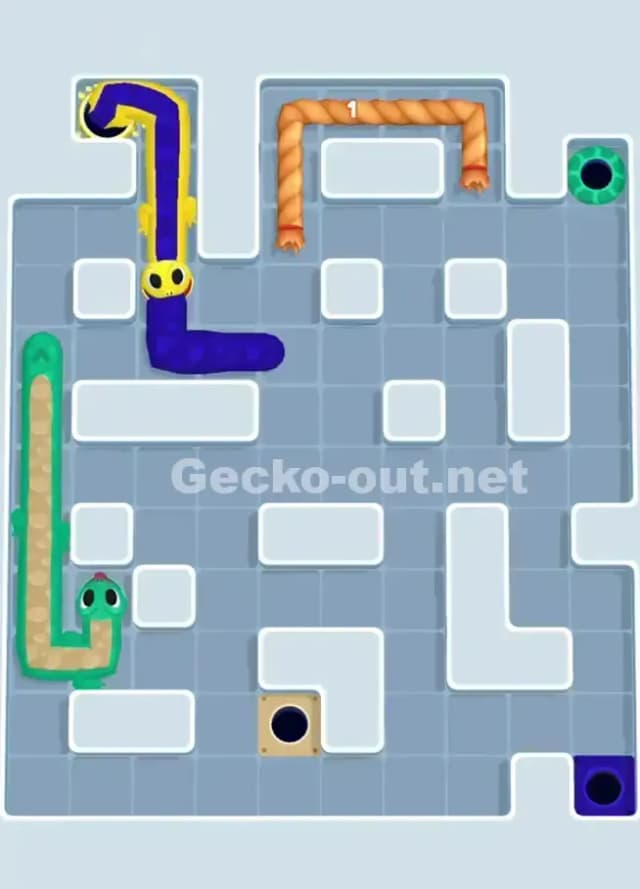
Gecko Out Level 1049: Board Layout, Rules, and Win Condition
Starting Board: Geckos, Colors, and Key Obstacles
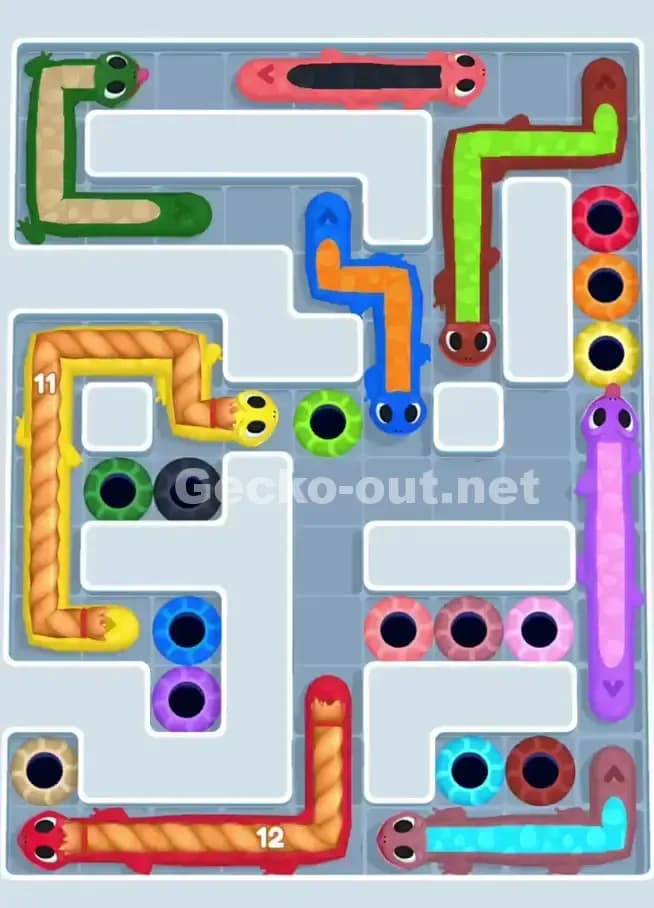
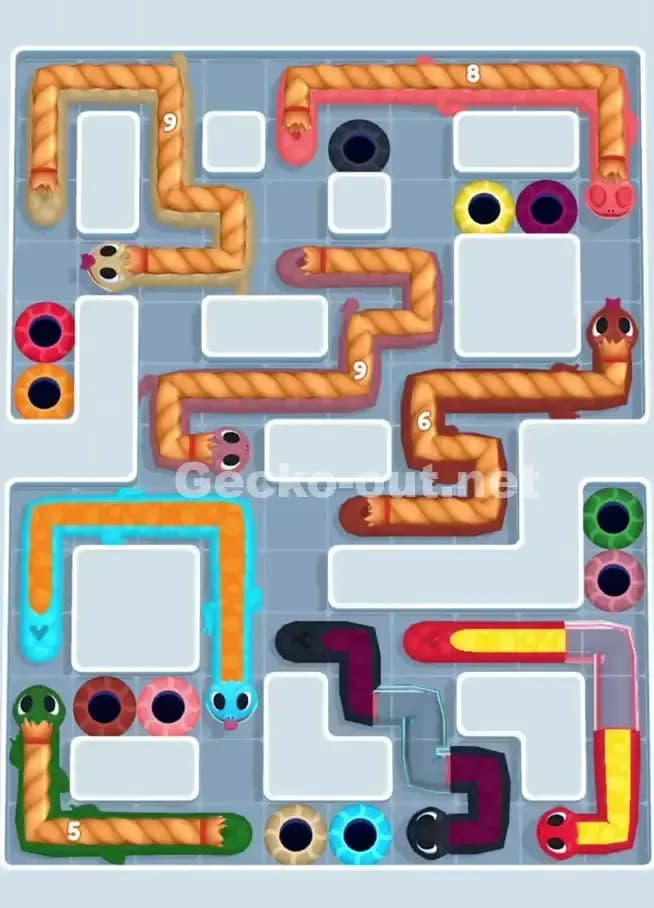
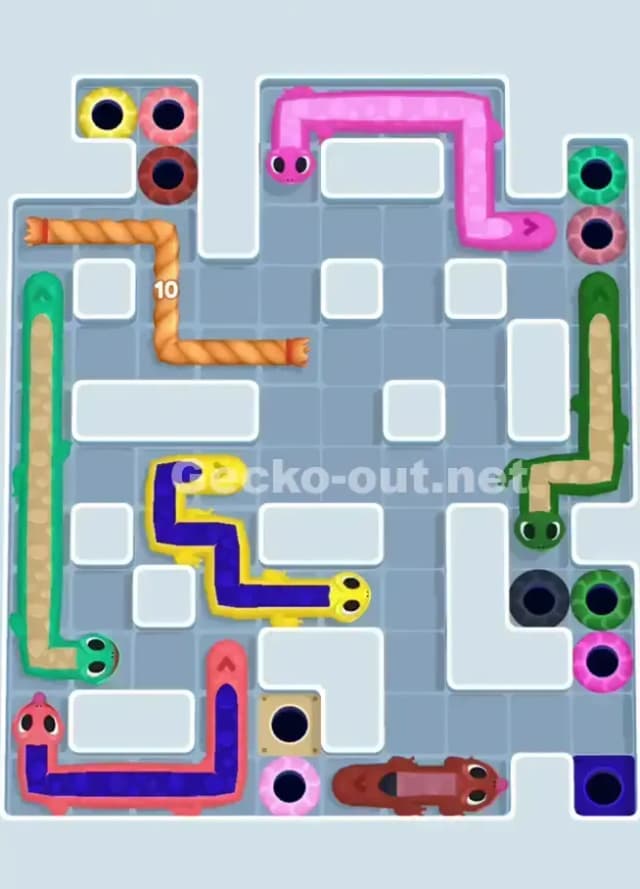
Gecko Out Level 1049 is a densely packed puzzle with eight geckos of different colors scattered across a complex grid. You've got yellow, pink, red, green, cyan, orange, brown, and dark blue geckos all competing for space and exit routes. What makes this level particularly tricky is that several geckos are already tangled together in long, winding chains—especially the cyan and blue gang geckos that snake across the lower half of the board, and the pink gang that winds through the upper-middle section. The board is crammed with white obstacle squares that act as walls, forcing you to navigate around them carefully. There are also colored exit holes scattered throughout: a yellow hole in the upper left, a pink hole in the upper right, a green hole on the left side, and several others positioned strategically around the perimeter. The timer is tight, so you can't afford to waste moves or get stuck repositioning geckos mid-puzzle.
Win Condition and Timer Pressure
To beat Gecko Out Level 1049, every single gecko must reach its matching-colored hole before the timer runs out. The timer doesn't give you much breathing room—you're looking at roughly 60–90 seconds depending on your device. This means you can't afford to drag a gecko down a dead-end path and then undo it; every move counts. The drag-path mechanic means the gecko's body follows exactly where you drag its head, so if you create a path that blocks another gecko's exit route, you've just locked yourself into a harder puzzle. The challenge isn't just about finding the holes—it's about sequencing your moves so that early geckos don't accidentally barricade later ones.
Pathing Bottlenecks and Logical Traps in Gecko Out Level 1049
The Critical Bottleneck: The Cyan-Blue Gang Chain
The biggest bottleneck in Gecko Out Level 1049 is undoubtedly the cyan and blue gang geckos that form a long, serpentine chain across the lower portion of the board. This chain is so long and so tightly wound that it physically blocks access to several exit holes and forces other geckos to wait. If you try to move the cyan gecko first without a clear plan, its body will snake across half the board and trap the brown, orange, and yellow geckos that need to pass through that same corridor. The cyan gecko's exit hole is positioned in a way that requires you to thread it through a narrow passage, and if you don't get the path exactly right, you'll waste precious seconds repositioning. I found myself staring at this chain for a good 30 seconds before I realized the solution: you have to move the blue gecko first to clear space, then carefully guide cyan out of the way before tackling anything else.
Subtle Problem Spot #1: The Pink Gang's Upper Maze
The pink gang gecko winds through the upper-middle section of the board in a tight, rectangular loop. It looks like it should be easy to route to the pink exit hole in the upper right, but there's a trap here: if you drag the pink gecko's head too aggressively toward the hole, its long body will wrap around the white obstacles and create a knot that blocks the green gecko's path downward. The pink exit is close, but the route is deceptively narrow. You have to drag the head in a very specific arc—not the most direct path, but the one that keeps the body from tangling with the board's geometry.
Subtle Problem Spot #2: The Red-Orange Overlap Zone
In the middle-left area, the red and orange geckos are positioned dangerously close to each other. If you move red first without planning ahead, its body will sprawl across the space orange needs to reach its exit. Conversely, if you move orange first, red gets boxed in. The trick is to move one of them into a "parking spot"—a safe area where it won't interfere—while you clear a path for the other. This requires you to think two or three moves ahead, which is mentally taxing when the timer is ticking.
Subtle Problem Spot #3: The Yellow-Brown Squeeze
The yellow gecko in the upper left and the brown gecko in the lower-middle area both need to exit, but their paths converge in a tight corridor. If you route yellow down and to the right before brown is safely out of the way, yellow's body will block brown's only viable exit route. This is a classic "which gecko goes first?" puzzle, and the answer isn't obvious until you trace both paths mentally.
Personal Reaction: The "Aha!" Moment
Honestly, Gecko Out Level 1049 frustrated me for my first two attempts. I kept moving geckos in what seemed like logical order—smallest first, or closest to exit first—and I'd hit a wall where two geckos were blocking each other with no way to untangle them. But then I realized the solution wasn't about moving the geckos closest to their exits; it was about moving the geckos that were blocking everyone else. Once I identified the cyan-blue chain as the primary obstacle and committed to clearing it first, the rest of the puzzle fell into place. That shift in perspective—from "get each gecko out" to "clear the board's knots in the right order"—is what made Gecko Out Level 1049 suddenly feel solvable.
Turn-by-Turn Path Strategy to Beat Gecko Out Level 1049
Opening: Clear the Blue Gecko and Park the Cyan
Start by moving the blue gecko out of the way. The blue gecko is the tail end of the cyan-blue chain, and it's the easiest to extract. Drag its head toward the dark blue exit hole in the lower right corner. The path is relatively straightforward—you're moving it away from the center of the board, which immediately opens up space. Once blue is out, you've freed up the corridor that cyan needs to use. Don't rush; make sure blue's body doesn't accidentally wrap around any obstacles as it exits.
Next, carefully guide the cyan gecko toward its exit hole (positioned in the middle-left area). The cyan gecko is long, so you need to drag its head in a smooth, deliberate arc that avoids the white obstacles. Think of it like threading a needle: the path exists, but it's narrow. Once cyan is out, you've cleared the biggest bottleneck on the board, and suddenly you have much more room to maneuver.
Mid-Game: Sequence the Gang Geckos and Manage Overlap Zones
With the cyan-blue chain cleared, tackle the pink gang gecko next. Drag its head toward the pink exit hole in the upper right. The route requires you to move upward and then curve right, being careful not to let the body wrap around the central white obstacles. The pink gecko's exit is close, but the path is serpentine, so take your time and drag smoothly.
Now move to the red-orange overlap zone. Here's the key: move the orange gecko first. Drag it toward its exit hole (lower-middle area), parking it safely out of the way. Once orange is secure, red has a clear path to its exit hole (upper-left area). Red's route is more direct, so you can move it quickly.
With the gang geckos and overlap zones handled, you've cleared most of the board's major knots. You should have roughly 20–30 seconds left on the timer, which is plenty of time for the remaining geckos.
End-Game: Exit the Remaining Geckos in Quick Succession
Move the yellow gecko toward its exit hole in the upper left. Yellow's path is now clear because you've already moved red and the pink gang out of the way. Drag yellow's head upward and slightly left; the exit is close and the route is straightforward.
Next, move the brown gecko toward its exit hole (lower-middle area). Brown's path should be clear now that orange is already out. Drag it downward and slightly right.
Finally, move the green gecko toward its exit hole (left side, middle area). Green is one of the last geckos, so its path should be almost completely clear. Drag it left and slightly downward.
If you're running low on time (under 10 seconds), don't panic. The last gecko or two usually have the clearest paths because you've already removed all the obstacles. Move quickly but deliberately—a rushed drag that creates a bad path is worse than a careful drag that takes an extra second.
Why This Path Order Works in Gecko Out Level 1049
Head-Drag Pathing and the Body-Follow Rule
The reason this sequence works is that it respects the fundamental rule of Gecko Out Level 1049: the body follows the exact path you drag the head. By moving the longest, most tangled geckos first (cyan and blue), you're removing the obstacles that would otherwise constrain every other gecko's path. If you tried to move yellow or green first, their bodies would have to navigate around the cyan-blue chain, which would either force them into inefficient paths or block them entirely. By clearing the chain first, you're essentially "unlocking" the board for everyone else. The gang geckos (pink, cyan, blue) are the keys; the solo geckos (yellow, red, orange, brown, green) are the passengers. Move the keys first, and the passengers have a smooth ride.
Timer Management: Pause, Read, Commit
Gecko Out Level 1049 rewards a balance between careful planning and decisive action. Spend the first 10–15 seconds pausing and mentally tracing the paths for the cyan and blue geckos. Identify exactly where you'll drag each head and what obstacles you need to avoid. Once you've got a clear mental picture, commit and move quickly. Don't second-guess yourself mid-drag; if you've planned well, the path will work. For the mid-game and end-game geckos, you can move faster because the board is less congested. The timer is your friend if you use it strategically: a few seconds of planning at the start saves you 20 seconds of repositioning later.
Boosters: Optional, Not Required
Gecko Out Level 1049 doesn't require boosters if you follow this strategy. However, if you find yourself stuck with 5 seconds left and one gecko still on the board, an extra-time booster is a reasonable safety net. A hint booster can also be useful if you're genuinely unsure about the cyan gecko's path—it'll show you the exact route, which saves you from trial-and-error. That said, the puzzle is absolutely beatable without boosters if you execute the plan above. Save your boosters for levels where the solution is genuinely obscure; Gecko Out Level 1049 just requires methodical thinking.
Mistakes, Fixes, and Logic You Can Reuse in Other Gecko Out Levels
Mistake #1: Moving Solo Geckos Before Gang Geckos
The Problem: Players often move the yellow or green gecko first because they're close to their exits. This leaves the cyan-blue chain in the middle of the board, blocking everyone else's paths.
The Fix: Always identify the longest, most tangled gecko chains first. Move them out of the way before touching any solo geckos. In Gecko Out Level 1049, this means cyan and blue first, no exceptions.
Mistake #2: Dragging Heads Too Quickly Without Planning
The Problem: Rushing the drag creates inefficient paths. The gecko's body wraps around obstacles in unexpected ways, and suddenly you've created a new knot instead of solving the old one.
The Fix: Trace the path mentally before you drag. Imagine the gecko's body following your drag line. If it would wrap around a white obstacle or another gecko, adjust your drag arc before you commit. A 2-second pause saves 10 seconds of repositioning.
Mistake #3: Forgetting About Overlap Zones
The Problem: In Gecko Out Level 1049, the red-orange and yellow-brown zones are tight. If you move both geckos in the same direction without planning, they'll block each other.
The Fix: Identify overlap zones early. Move one gecko into a "parking spot" (a safe area away from the action) while you clear a path for the other. This is especially important in levels with multiple geckos of similar sizes.
Mistake #4: Not Accounting for Body Length
The Problem: A gecko's body is much longer than its head. If you drag the head to the exit hole, the body might still be tangled in the middle of the board, blocking other geckos.
The Fix: When dragging a gecko to its exit, make sure the entire body has a clear path, not just the head. For long geckos like cyan and blue in Gecko Out Level 1049, this means planning a route that's wider and more curved than you'd initially think.
Mistake #5: Panicking When the Timer Gets Low
The Problem: With 10 seconds left and two geckos still on the board, players often make rushed, bad drags that create new problems.
The Fix: Trust your planning. If you've cleared the major bottlenecks, the remaining geckos have clear paths. Move them quickly but deliberately. A bad drag is worse than a slow, good drag.
Reusing This Logic on Similar Levels
This strategy applies to any Gecko Out level with gang geckos or long chains. The principle is always the same: identify the longest, most tangled gecko first, move it out of the way, and then handle the solo geckos. Levels with frozen exits or toll gates add complexity, but the core logic remains: clear the board's knots in the right order, and the rest falls into place. Gecko Out Level 1049 is a masterclass in this approach, so if you can beat it, you'll have the mental framework to tackle even harder levels.
Final Encouragement
Gecko Out Level 1049 is genuinely tough—it's a level that punishes hasty decisions and rewards careful planning. But it's absolutely beatable, and the satisfaction of untangling that cyan-blue chain and watching all eight geckos exit smoothly is worth every second of effort. You've got this. Identify the bottlenecks, plan your moves, and commit. Gecko Out Level 1049 will fall.