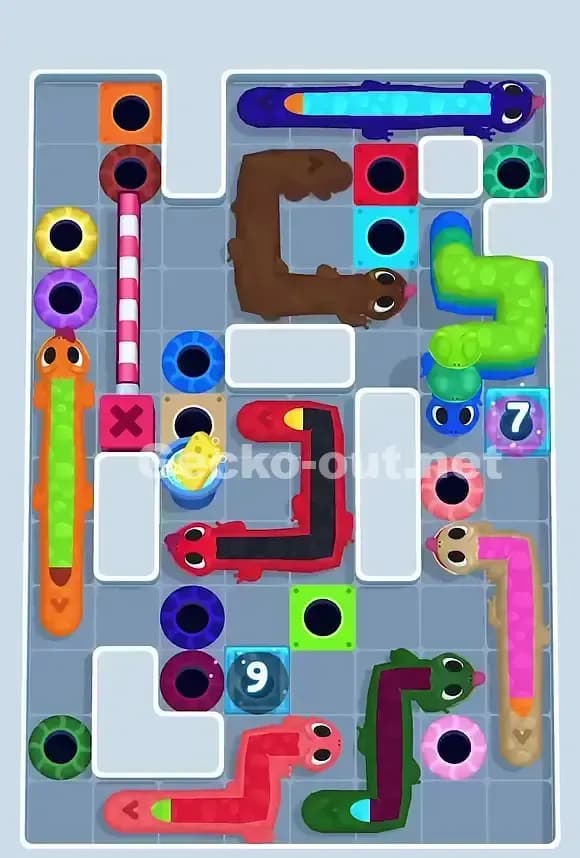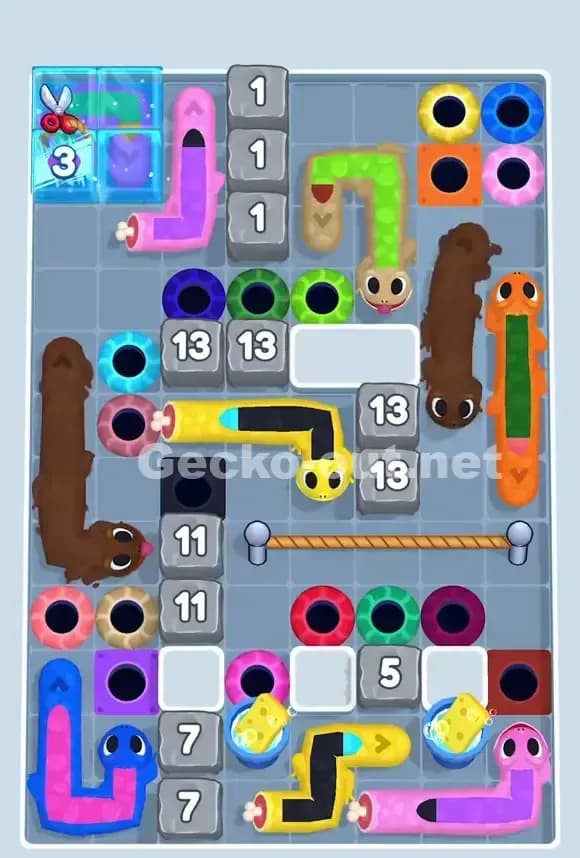
Gecko Out Level 861 Solution Walkthrough | Gecko Out 861 Answer
How to solve Gecko Out level 861? Get step by step solution & cheat for Gecko Out level 861. Solve Gecko Out 861 easily with the answers & video walkthrough.

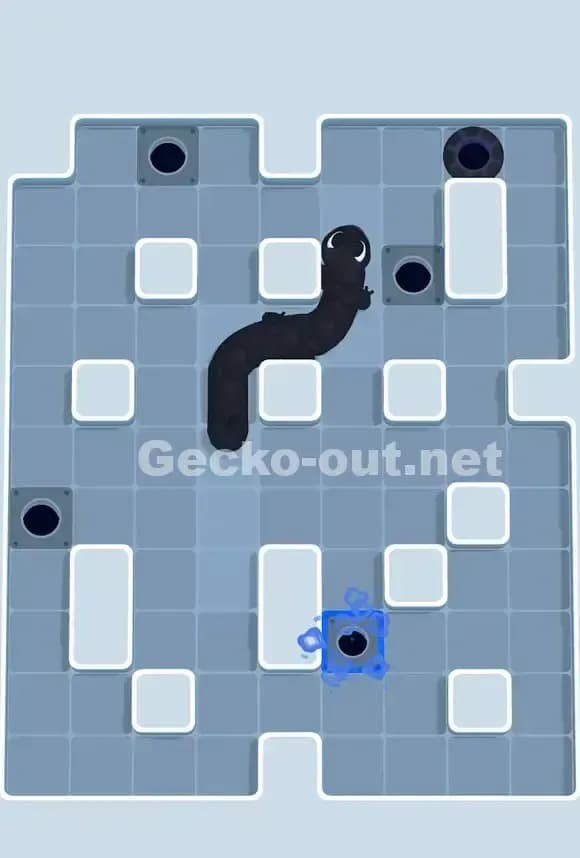
Gecko Out Level 861: Board Layout, Rules, and Win Condition
Starting Board: A Complex Multi-Gecko Maze
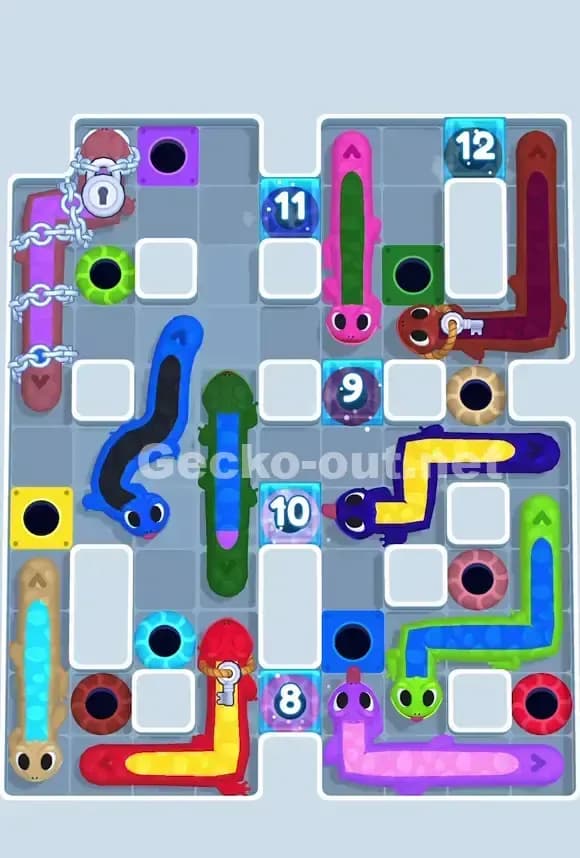
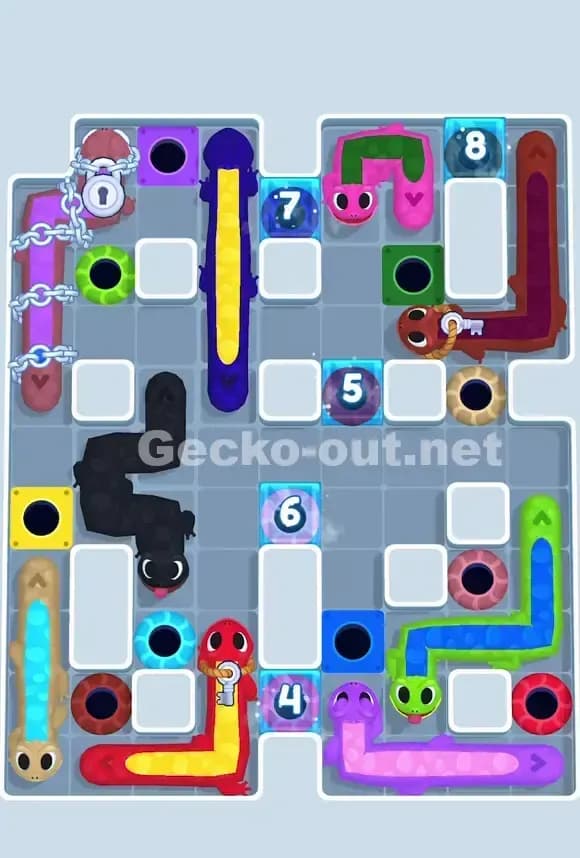
Gecko Out Level 861 throws a lot at you right from the start. You're looking at roughly eight to ten geckos spread across a sprawling, asymmetrical grid filled with walls, obstacles, and numbered gang-gecko clusters. On the left side, you've got a chain-linked gang of geckos (marked with chain symbols) that move as a single unit—they're locked together, which means you can't separate them no matter how you drag. In the center and right portions, there are numbered gang geckos (geckos 8, 9, 10, 11, and 12) that must exit in a specific numerical order before the others can move freely. The board also features several solid white empty squares (safe holding areas), dark walls, and a few critical exit holes scattered around—one on the far left (red), one in the upper center (magenta/pink), and others tucked into corners. The timer is ticking from the moment you start, and you've got maybe 90–120 seconds to get every single gecko to its matching-colored exit hole.
The Win Condition and Timer Pressure
To beat Gecko Out Level 861, every gecko must reach a hole matching its body color before the timer hits zero. The tricky part is that the timer doesn't pause while you're thinking—it's constantly counting down. This means you can't afford lengthy deliberation between moves; you need a clear plan before you start dragging heads. The path-based movement system compounds this pressure: once you drag a gecko's head, its body follows the exact route you've drawn, which means one wrong turn or an overly long detour eats precious seconds. You'll succeed only if you combine spatial awareness, careful planning, and confident execution.
Pathing Bottlenecks and Logical Traps in Gecko Out Level 861
The Critical Bottleneck: The Left-Side Chain Gang
The most severe chokepoint in Gecko Out Level 861 is the chain-linked gecko gang on the far left side of the board. These geckos are physically connected and move as one blob; they occupy multiple grid squares simultaneously and can't be split apart. To escape, the entire chain must snake through a narrow corridor toward the red exit on the lower left. Here's the frustrating part: if you move any other gecko into that corridor first, the chain gang gets completely stuck and can't progress. I realized quickly that the chain gang must be one of the first things you move, or you'll paint yourself into an unwinnable corner. Their exit path is fixed and non-negotiable, so getting them out early clears the runway for everyone else.
Subtle Problem Spot #1: The Numbered Gang Order Lock
The numbered geckos (8, 9, 10, 11, 12) have an invisible dependency: they must exit in ascending numerical order. You can't drag gecko 12 out before gecko 11 leaves, even if gecko 12's path is clear. This constraint creates a hidden timer within the timer—you're not just managing spatial chaos, you're also managing sequencing. Many players (myself included, on my first attempt) try to optimize individual paths without realizing that the gang-order rule will auto-fail them if they break it. It's a rule that doesn't announce itself loudly, so you have to be actively watching those numbered labels.
Subtle Problem Spot #2: The Magenta Gecko's Awkward Exit
There's a magenta (pink) gecko somewhere in the upper-middle area, and its exit hole is in a tight corner that requires a very specific curved drag path. If you don't plan this route early, other geckos will crowd that region, and you'll be forced to redraw the path in a way that causes collisions. Additionally, the magenta gecko's body is relatively long, so a sloppy drag will cause it to overlap walls or other geckos' positions, which is an instant fail. I remember spending precious seconds on my first run trying to squeeze the magenta gecko around a wall after I'd already parked two other geckos nearby—totally avoidable with forethought.
Subtle Problem Spot #3: The Bottom-Right Maze
The lower-right quadrant of Gecko Out Level 861 has a dense cluster of walls creating a winding path to the green exit. The green gecko's body is also quite long, so you need to drag its head in a smooth, arc-like motion to avoid sharp turns that would make the body fold back on itself. If you leave this gecko for the endgame when you're stressed and rushing, you'll almost certainly drag it incorrectly and waste 10+ seconds repositioning.
The "Aha!" Moment
I'll be honest: my first two attempts at Gecko Out Level 861 felt hopeless because I didn't understand the gang-order lock and the chain constraint working together. I'd get the chain gang stuck, or I'd move gecko 11 out before gecko 8, which broke the sequence. About halfway through my third attempt, after watching the timer run down, I stepped back (mentally) and realized: move the immobile chain first, then handle the numbered geckos in order, and park everything else in safe white squares until the major traffic clears. Once I reframed the puzzle that way, it clicked, and I could see the solution path clearly.
Turn-by-Turn Path Strategy to Beat Gecko Out Level 861
Opening: Prioritize the Chain Gang and Gecko 8
Start by immediately dragging the chain-linked gecko gang on the left toward the red exit. Don't overthink the route—since they're chained, there's only one viable path anyway. Your goal is to clear them off the board in the first 20–30 seconds so they're no longer a spatial anchor blocking other geckos. While the chain is exiting, your mental focus should shift to gecko 8 (the first numbered gang gecko). Identify where gecko 8 is, what color it is, and where its matching hole is. Plan a direct path from gecko 8's current position to its exit, avoiding walls and other geckos. Don't move gecko 8 yet—just have the plan in your head. Any other gecko that isn't in gecko 8's immediate path should be parked in one of the white safe squares (the empty white tiles scattered around the board). Parking geckos early is a huge time-saver; it removes them from the puzzle temporarily so you can focus on the critical geckos without worrying about collisions.
Mid-Game: Respect the Numbered Sequence and Keep Lanes Open
Once the chain gang is gone and gecko 8 is heading toward its exit, immediately move gecko 9, then gecko 10, then gecko 11, then gecko 12 in that exact order. Don't deviate. I know it's tempting to optimize individual paths, but respecting the numbering order is non-negotiable—it's like a traffic light that only turns green in sequence. As each numbered gecko exits, the board becomes less cluttered. Here's the key mid-game strategy: after each numbered gecko leaves, take a half-second pause to see which safe white squares are now available. You want to reposition any parked geckos so they're out of the way of the next numbered gecko's path. For example, if the blue gecko (parked in a white square) is sitting in gecko 10's direct exit corridor, drag the blue gecko to a different white square the moment gecko 9 finishes exiting. This proactive repositioning prevents last-minute collision disasters.
End-Game: The Final Dash Against the Clock
By the time you've cleared the chain gang and all five numbered geckos, you should have about 30–50 seconds left (depending on your speed). Now you're dealing with whatever geckos remain—probably the magenta one, the green one, the blue one, and any others. Check the timer: if you have more than 25 seconds, you can still afford one careful, well-planned path per gecko. If you're under 25 seconds, you need to move faster, but not recklessly. Exit the geckos in this order: whichever gecko has the shortest, clearest path to its exit hole first. Usually, that's the one that's already closest to its hole or in a region with minimal walls. The magenta gecko (if it's still on board) should be second-to-last because of its tight corner requirement. Save the green gecko for last if possible, because if you rush it and mess up its long winding path, you'll have just enough time to quickly redraw it once. Don't let the timer pressure you into dragging multiple geckos in rapid succession without checking that each one actually made it to its hole—one misclick can mean starting the level over.
Why This Path Order Works in Gecko Out Level 861
Head-Drag Pathing and the Body-Follow Rule: Untangling, Not Tightening
The reason this strategy works is rooted in how movement operates in Gecko Out Level 861. When you drag a gecko's head, its body rigidly follows the exact path you've drawn—there's no AI adjustment, no auto-optimization. This means if you drag the chain gang first, their entire body traces a single, fixed line, and no other gecko can later claim that corridor because the chain's path is already "baked in." By moving the least flexible geckos (chain-linked, numbered in order) first, you're essentially reserving their optimal paths while the board is most open. You're untangling the puzzle systematically rather than tightening the knot by moving flexible geckos first and then having to squeeze immobile geckos into whatever gaps remain. It's the difference between solving a knot by loosening the first loop versus tightening it and hoping the last loop magically fits.
Timer Management: Pausing vs. Committing
Gecko Out Level 861 rewards smart pauses and quick commits in equal measure. At the very start, pause for three seconds to scan the entire board, identify the chain gang and numbered geckos, and sketch a rough mental map of safe white squares. That three-second pause saves you 20 seconds of confused dragging later. Once you've formulated your plan, commit. Drag the chain gang without hesitation. Move gecko 8, then 9, then 10, without second-guessing the routes—trust your plan. In the mid-game, pause for half a second between each numbered gecko's exit to reposition parked geckos. In the end-game, don't pause at all unless the timer is above 25 seconds; if it's below 25 seconds, pause only long enough to identify which gecko has the shortest exit path, then move it immediately. The mental rhythm is: think hard early, move fast later.
Booster Strategy: Optional, Not Essential
Gecko Out Level 861 doesn't strictly require boosters like extra time or hint tools. However, if you're struggling with the numbered gecko sequencing or the magenta gecko's tight corner, a hint booster can save you 10–15 seconds of confusion. An extra-time booster is useful only as a last resort—if you've executed the strategy correctly but are still 5 seconds short at the end, extra time will let you finish. I'd recommend tackling Gecko Out Level 861 without boosters first; if you fail twice using the strategy above, then consider using a hint booster to double-check your numbered gecko order or the magenta gecko's exit path. This way, you're learning the puzzle while keeping boosters as a genuine backup, not a crutch.
Mistakes, Fixes, and Logic You Can Reuse in Other Gecko Out Levels
Mistake #1: Moving Flexible Geckos Before Immobile Ones
Many players move the "easy" geckos (the ones without special constraints) first, thinking they'll be quick. Then they get stuck because the immobile chain-linked geckos or numbered geckos have no viable path left. Fix: Always scan the board for gang geckos, chain-linked geckos, and numbered sequences before dragging any gecko. Move the constrained geckos first; they have fewer options, so get them out while the board is open.
Mistake #2: Ignoring the Numbered Gang Order
Players see geckos 8, 9, 10, 11, 12 and assume they can exit in any order. Then the game fails them on gecko 12 because gecko 11 never left. Fix: Before touching any numbered gecko, mentally repeat the order aloud: "8, then 9, then 10, then 11, then 12." Treat it like a mandatory sequence, not a suggestion. Mark it visually by dragging them in that strict sequence with no deviations.
Mistake #3: Not Using White Safe Squares for Parking
Players try to keep all geckos moving simultaneously and end up with overlapping paths and collisions. Fix: Use the white empty tiles as temporary holding areas. Park non-urgent geckos there early, then reposition them as the board clears. This reduces cognitive load and prevents last-minute crashes.
Mistake #4: Over-Complicating End-Game Paths
When time is short, players panic and drag geckos in erratic, winding paths trying to "save" them. This causes body overlaps and tile collisions. Fix: In the end-game, take a breath and drag the remaining geckos via the simplest, straightest path to their holes, even if it's not the shortest on paper. A slightly longer, collision-free path beats a short, broken path every time.
Mistake #5: Rushing the Magenta Gecko Without a Plan
The magenta gecko's tight-corner exit feels tricky, so players either skip it until the end (wrong) or rush it and fail (also wrong). Fix: Plan the magenta gecko's path during the mid-game when you have breathing room. Drag it confidently in a smooth arc toward its corner exit during the mid-game, not the endgame.
Reusing This Logic on Similar Levels
Gecko Out Level 861 teaches a universal pattern: identify constraints, move constrained units first, park flexible units, then handle the remainder in sequence. This logic transfers directly to other gang-gecko levels, frozen-exit levels, and toll-gate levels. Any time you see a numbered sequence or chain link, apply the same order-first principle. Any time the board looks cluttered, use white squares as parking lots. Any time you're running low on time, simplify the paths rather than complicate them. The core skill—reading constraints, respecting immobility, and committing to a plan—is universal across Gecko Out levels.
The Encouraging Truth
Gecko Out Level 861 is tough, genuinely. It's packed with visual noise, multiple gecko types, and time pressure all at once. But it's absolutely, 100% beatable once you stop trying to optimize every gecko individually and start thinking about the level as a sequence of constraints. The chain gang must go first, the numbered geckos must go in order, and everything else is flexible. Follow that principle, use the white squares wisely, and trust your initial plan. You've got this. The level will click, just like it did for me on attempt three, and you'll wonder why it ever seemed so impossible.