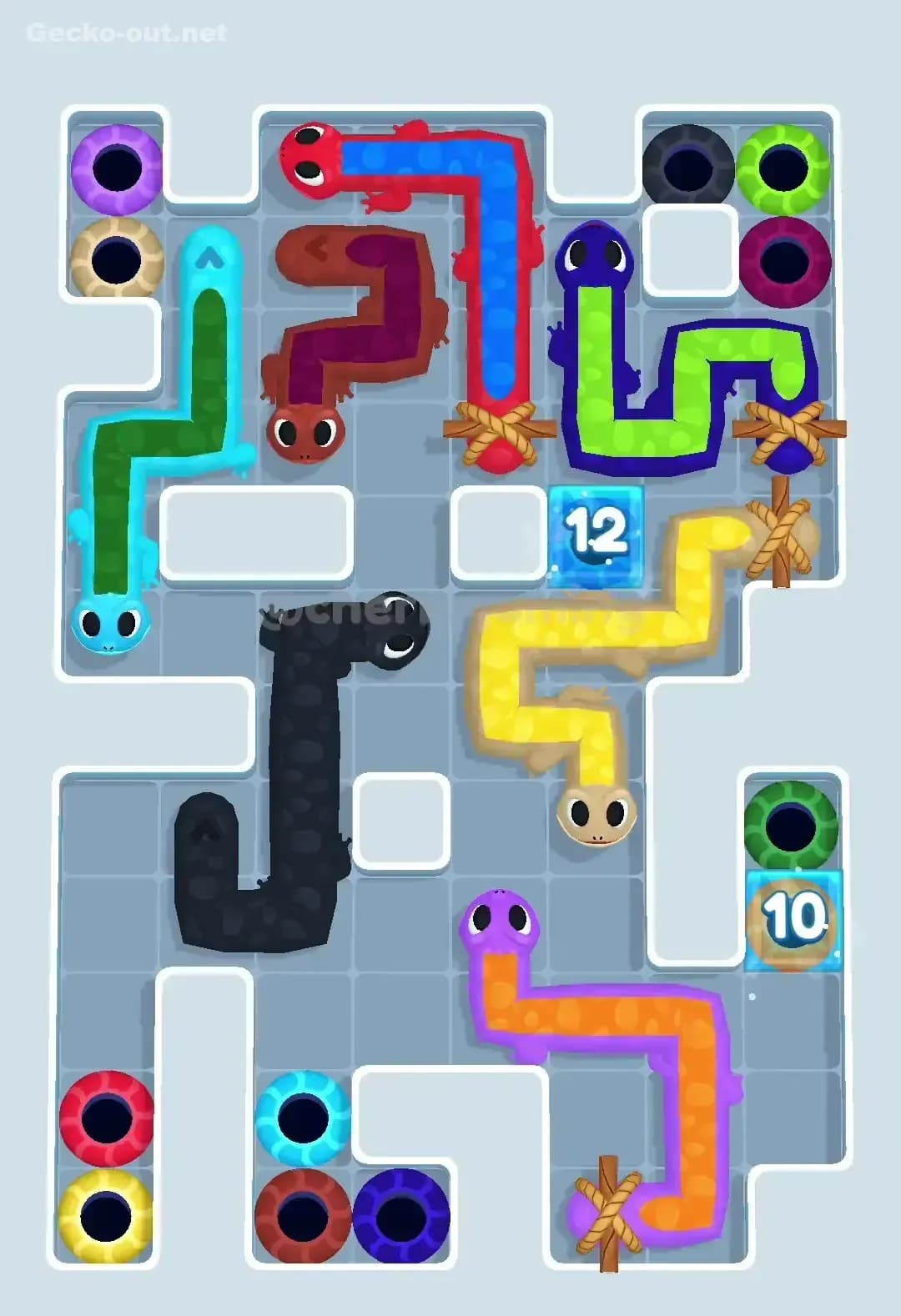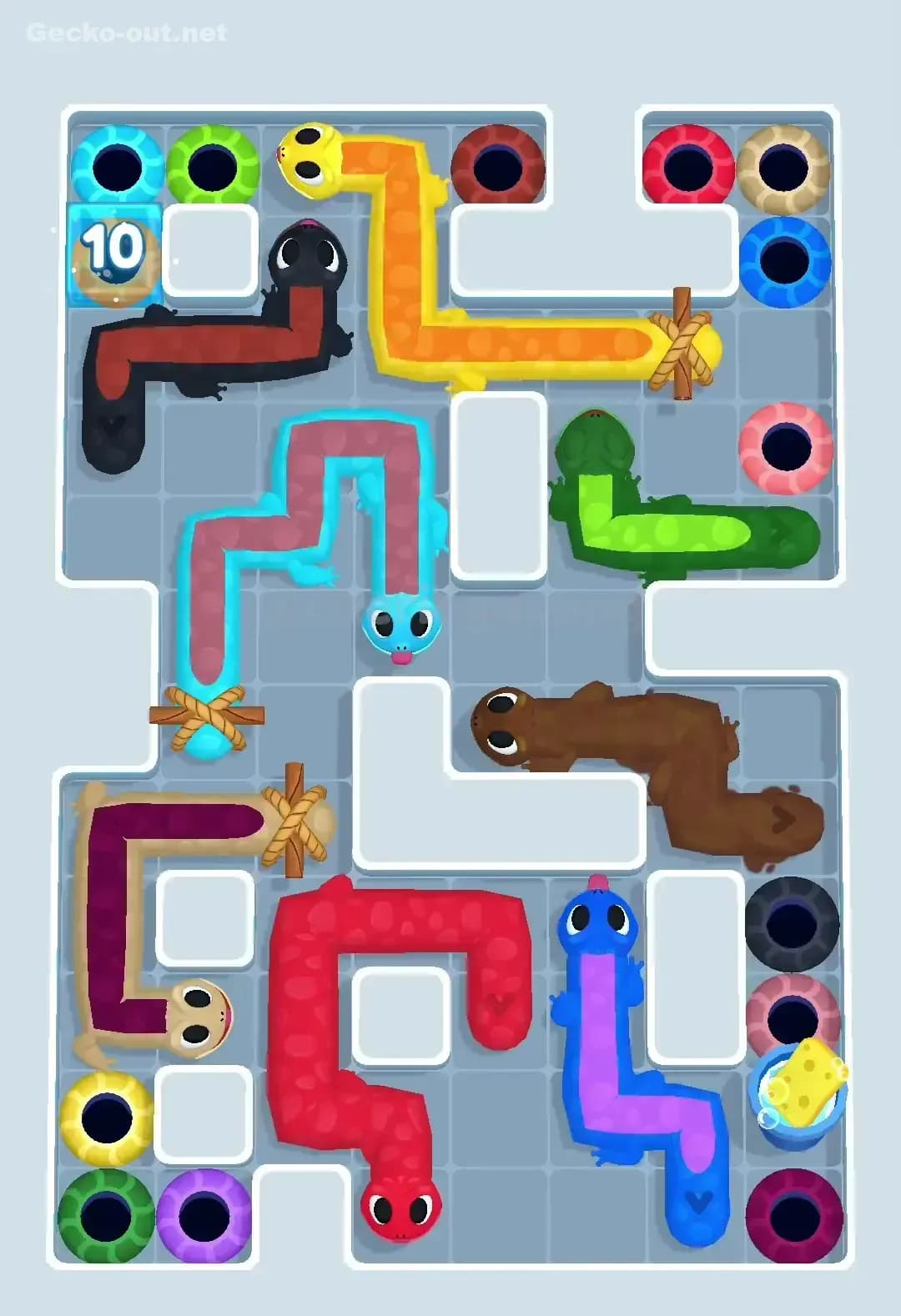
Gecko Out Level 507 Solution Walkthrough | Gecko Out 507 Answer
How to solve Gecko Out level 507? Get step by step solution & cheat for Gecko Out level 507. Solve Gecko Out 507 easily with the answers & video walkthrough.
Gecko Out Level 507: Board Layout, Rules, and Win Condition
The Starting Board: Colors, Knots, and Obstacles
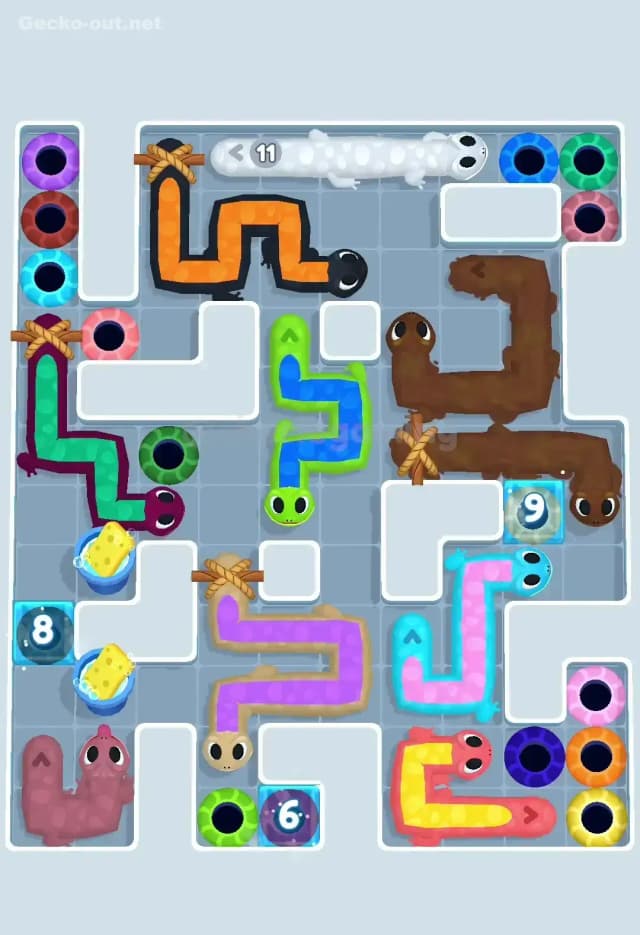
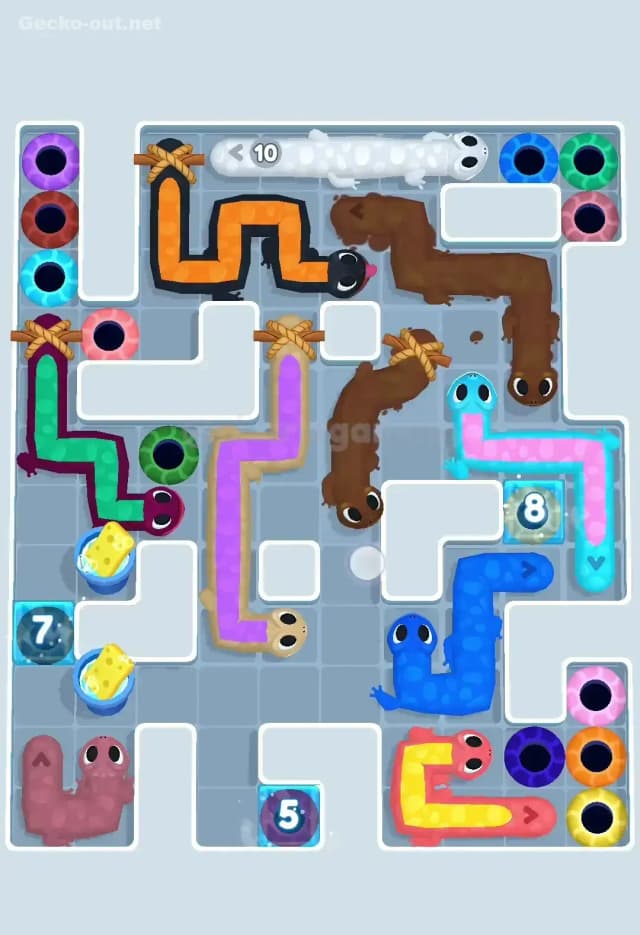
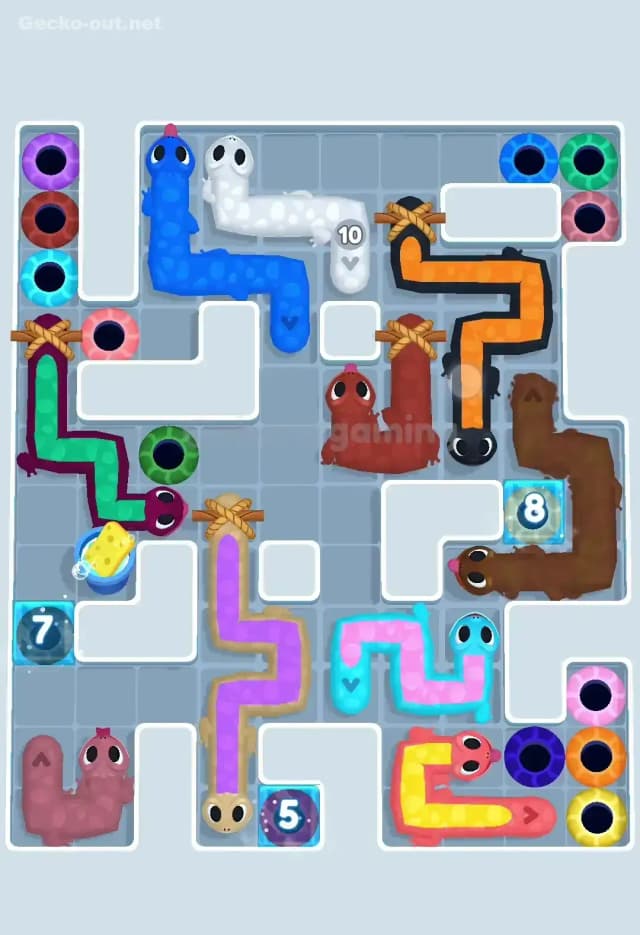
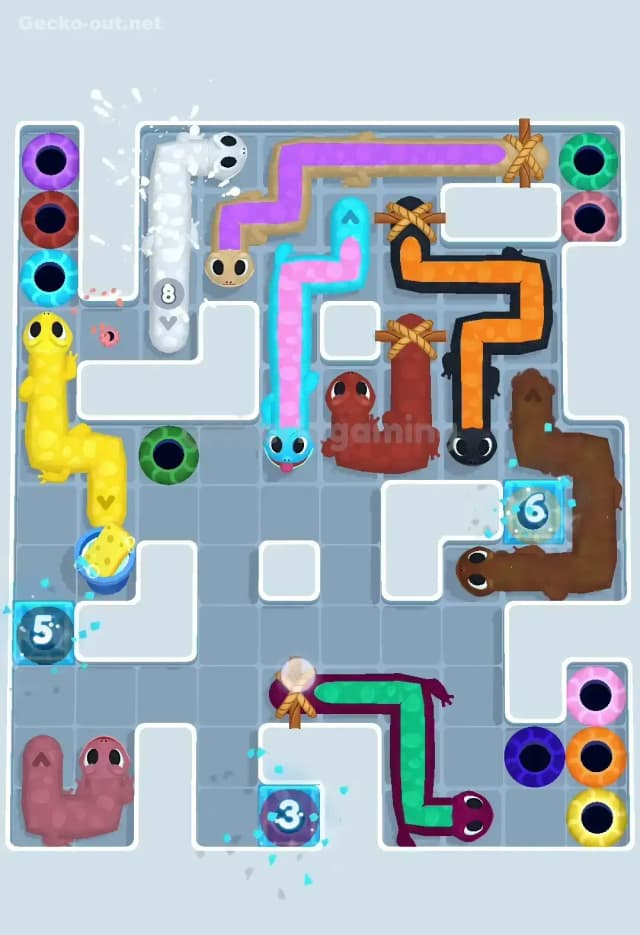
Gecko Out Level 507 throws you straight into a crowded maze. You’ve got a mix of short and long geckos in bright colors: orange, brown, teal, magenta, lime green, bright blue, light blue, pink, sand/purple, and a stubby red‑yellow one near the bottom right. On top of that, a white gecko sits frozen near the top with a move counter, and several exits or tiles are locked behind icy number blocks.
The exits are mostly pushed out to the edges. There’s a stack of colored holes on the far left, another cluster on the bottom right, and a few single exits scattered around the middle and bottom lanes. Some geckos are “gang” linked with rope (teal with magenta on the left, and a cyan–pink pair on the right), meaning you have to move them carefully or they’ll tangle the entire board. Sponge buckets sit near a couple of frozen/numbered blocks, hinting that those icy tiles are important to unlock mid‑run.
The central area is a tight grid of corridors with a small lime‑green gecko and a blue one standing right where everyone wants to pass. Long geckos (the brown one on the right and the orange one at the top) snake through those corridors and threaten to block both the upper and lower halves of the level if you move them without a plan.
Win Condition and Why the Timer Hurts Here
As always in Gecko Out 507, your goal is to drag each gecko’s head along a path that leads its body to the matching-colored exit. The body follows the exact trail you draw—no auto‑shortcuts—so every extra zigzag literally uses up board space and time. You can’t cross walls, other geckos, locked exits, or frozen tiles.
The twist in Gecko Out Level 507 is how the strict timer combines with those cramped corridors and frozen elements. You don’t have enough time to “try things and undo”; if you scribble experimental paths, you’ll run out of seconds just as the last gecko reaches its exit. The level expects you to plan a route order, use fairly straight paths, and avoid redrawing bodies over and over. Once you understand which geckos must move first to open lanes, the level suddenly feels fair instead of impossible.
Pathing Bottlenecks and Logical Traps in Gecko Out Level 507
The Main Bottleneck: Central Crossroads and Right Corridor
The single biggest bottleneck in Gecko Out Level 507 is the central crossroads formed by the lime‑green gecko and the small blue one beneath it. They sit between the left‑side gang geckos and the big brown gecko on the right. If you park either of those small geckos badly, you effectively split the board into two islands and strand half your exits.
The long brown gecko hugging the right wall is the second part of that bottleneck. When its body stretches along the narrow right corridor, it blocks the way for the cyan and pink gang pair that needs to snake up and down those same lanes. If you try to finish the brown gecko too early, you’ll realize too late that the right‑side exits are now completely walled off.
Subtle Problem Spots You Might Not Notice
First subtle trap: the sand/purple gecko across the lower middle. It looks like “easy points,” but if you line it straight into its exit too soon, its body forms a hard barrier that makes it extremely awkward for the bottom‑left pink gecko and the red‑yellow gecko on the right to find clean paths.
Second trap: the left‑side teal/magenta gang geckos. Because they’re roped together, any fancy S‑curve you draw for one of them doubles the mess for the other. If you swing them through the middle without a plan, their combined bodies occupy a huge swath of the board and box in the green and blue geckos.
Third trap: the frozen white gecko at the top. It’s tempting to focus on thawing/unlocking it early, but until the central lanes are clear, moving it just wastes time and risks blocking upper exits. It’s actually safer to treat that white gecko as an end‑game piece.
When the Level “Clicks”
I’ll be honest: Gecko Out Level 507 felt like chaos the first time I played it. I’d get seven or eight geckos out, then stare at a single trapped gecko with zero remaining routes and a timer at 2 seconds. The turning point was when I stopped treating each gecko as an isolated puzzle and started thinking in “corridor ownership”: who owns the central cross, who owns the right wall, and who touches the bottom lanes first.
Once I decided that the tiny center geckos were there to temporarily hold space and then evacuate, while the long brown and orange geckos should move late and mostly in straight lines, the board suddenly made sense. From then on, it was just execution.
Turn-by-Turn Path Strategy to Beat Gecko Out Level 507
Opening: Clearing Space and Safe Parking
In Gecko Out Level 507, your opening goal is to free the middle without committing any long bodies to permanent walls.
- Nudge the lime‑green gecko up and into the small alcove above it. Don’t send it to its exit yet; just park it so its tail no longer clogs the central vertical lane.
- Slide the small blue gecko downward and tuck it into a lower‑left nook near the sponge buckets, again without finishing it. You want its body tight against a wall so you regain the middle tiles.
- Adjust the sand/purple gecko slightly so it curves closer to the bottom edge but leaves a one‑tile highway running vertically through the center. Think of it as “building” a clear vertical lane for later geckos.
- Now gently reposition the teal/magenta gang pair on the left, curling them along the outer left wall while keeping the exits column accessible. If you can, pre‑align one of them so it only needs a short straight drag into its hole later.
- If there’s a short, low‑impact gecko near an already clear exit (often the stubby pink one at the bottom-left), finish that one now to remove body clutter.
After these moves, the middle of Gecko Out 507 should feel much more open, and all the long geckos still have room to maneuver.
Mid-game: Holding Lanes and Moving Long Geckos
Mid‑game is where Gecko Out Level 507 is won or lost. Your job is to keep three key highways open: the central vertical lane, the right‑side corridor, and the bottom path that links left to right.
- Start threading the teal/magenta gang geckos to their exits on the far left, using as straight a route as possible so their bodies don’t bulge into the middle again.
- Once the left gang is mostly resolved, bring the sand/purple gecko to its exit using a tight cornering path that hugs the bottom. Don’t let it creep upward or it will slice the board in half.
- With left and lower clutter reduced, you can now reposition the long brown gecko on the right. Drag its head in a broad loop that keeps most segments hard against the outer wall. Only finish the brown gecko if you’re sure the cyan/pink gang pair still has a full path to their exits.
- When things look open, cash in the lime‑green and small blue geckos by drawing short, direct paths to their exits. They should each be a quick flick now, costing almost no time.
If you’ve done this smoothly, the only major pieces left should be the cyan/pink gang pair, the red‑yellow gecko on the bottom right, and the frozen white gecko at the top.
End-game: Exit Order and Time Pressure
For the end‑game of Gecko Out Level 507, exit order matters a lot.
- Guide the cyan/pink gang pair first, while the right corridor is still open. Take them on a mostly vertical path along the right wall, with minimal weaving.
- Next, route the red‑yellow gecko into the bottom‑right exit cluster. Because most central bodies are gone, you can draw almost straight into its hole.
- Finally, unlock and move the frozen white gecko. At this point, it should have a clean horizontal shot to its exit with maybe one bend. Draw confidently; don’t over‑wiggle.
If the timer is low, prioritize short, guaranteed paths over “perfect” ones. It’s better to give a gecko a slightly longer loop you’re sure fits than to hesitate and re‑draw three times.
Why This Path Order Works in Gecko Out Level 507
Using Path-following to Untangle Instead of Tighten
Gecko Out Level 507 punishes wild scribbles. Because bodies literally trace your path, any extra curves are future walls. This plan works because you:
- Park small geckos early in compact, wall‑hugging shapes.
- Save long geckos for when corridors are mostly cleared, letting you use straight or gentle paths.
- Clear gang geckos in ways that don’t drag both bodies through the core of the board.
You’re effectively shrinking the “active knot” over time instead of dragging it around the maze.
Timer Management: When to Think and When to Move
I’d suggest spending the first 5–10 seconds just reading Gecko Out 507: spot the exits, identify the central crossroads, and mentally mark your three main highways. After that, commit to the opening parking moves quickly—they’re low risk and high reward.
During mid‑game, pause briefly before moving each long gecko or gang pair. Ask yourself: “After this path, can anything still pass through the middle / right corridor / bottom lane?” If yes, go fast. If no, redraw before releasing. In the end‑game, you don’t think much; you just execute the pre‑planned direct routes.
Are Boosters Needed Here?
Boosters in Gecko Out Level 507 are helpful but absolutely optional if you follow this plan.
- A time booster is nice if you’re still learning the route, but once you internalize the order, you shouldn’t need it.
- A hammer/clear tool could rescue a mis‑drawn long gecko, but that’s more of a safety net than part of the strategy.
- Hints tend to highlight obvious exits rather than the corridor logic, so they don’t really teach you the underlying solution.
I’d treat boosters as backup for stubborn attempts, not the core way to beat Gecko Out 507.
Mistakes, Fixes, and Logic You Can Reuse in Other Gecko Out Levels
Common Mistakes in Gecko Out Level 507
-
Finishing the brown or sand/purple geckos too early
Fix: Keep long bodies uncommitted until you’re sure they won’t block the right corridor or the bottom lane. -
Parking the green or blue gecko in the middle of the board
Fix: Always tuck short geckos into alcoves or corners, never in the crossroads. -
Over‑curving gang gecko paths
Fix: Think “straight with minimal bends.” Every bend doubles the space used when two roped geckos move together. -
Chasing the frozen white gecko first
Fix: Treat that top lane as late‑game. Clear the central and right corridors before thawing and moving it. -
Redrawing paths under time pressure
Fix: Visualize the route for a second, then draw it once. Undoing repeatedly is what actually kills the timer in Gecko Out 507.
Reusing This Approach on Other Knot-heavy Levels
The logic you use in Gecko Out Level 507 transfers well to other tricky Gecko Out levels:
- Identify the key highways early and mentally assign them to specific geckos.
- Park small or flexible geckos in dead‑ends so the “big snakes” have room later.
- Handle gang geckos with minimal curves and avoid dragging them through chokepoints.
- Delay frozen geckos or frozen exits until the surrounding area is decluttered.
Whenever you see a level with lots of long bodies and tight corridors, think in terms of “who owns which corridor and when?” That mindset alone solves a surprising number of puzzles.
Final Encouragement
Gecko Out Level 507 looks brutal at first glance, but it’s one of those puzzles that becomes satisfying once you see the structure hiding under the chaos. If you take a moment to plan the opening, respect the central bottleneck, and follow the path order above, you’ll find that Gecko Out 507 is absolutely beatable—without burning through boosters. Stick with it for a few runs, and that “impossible” tangle turns into a clean, almost rhythmic escape sequence.