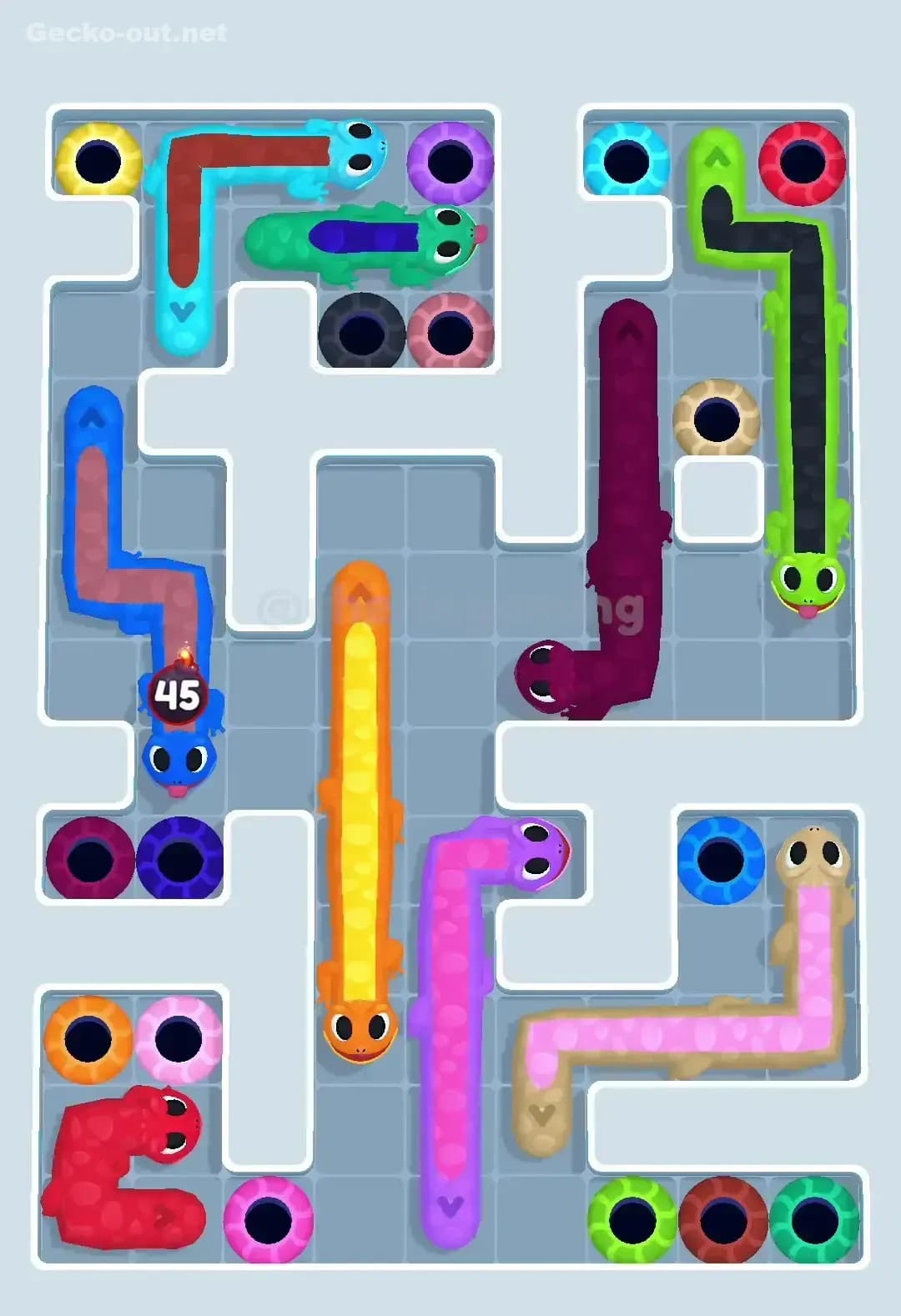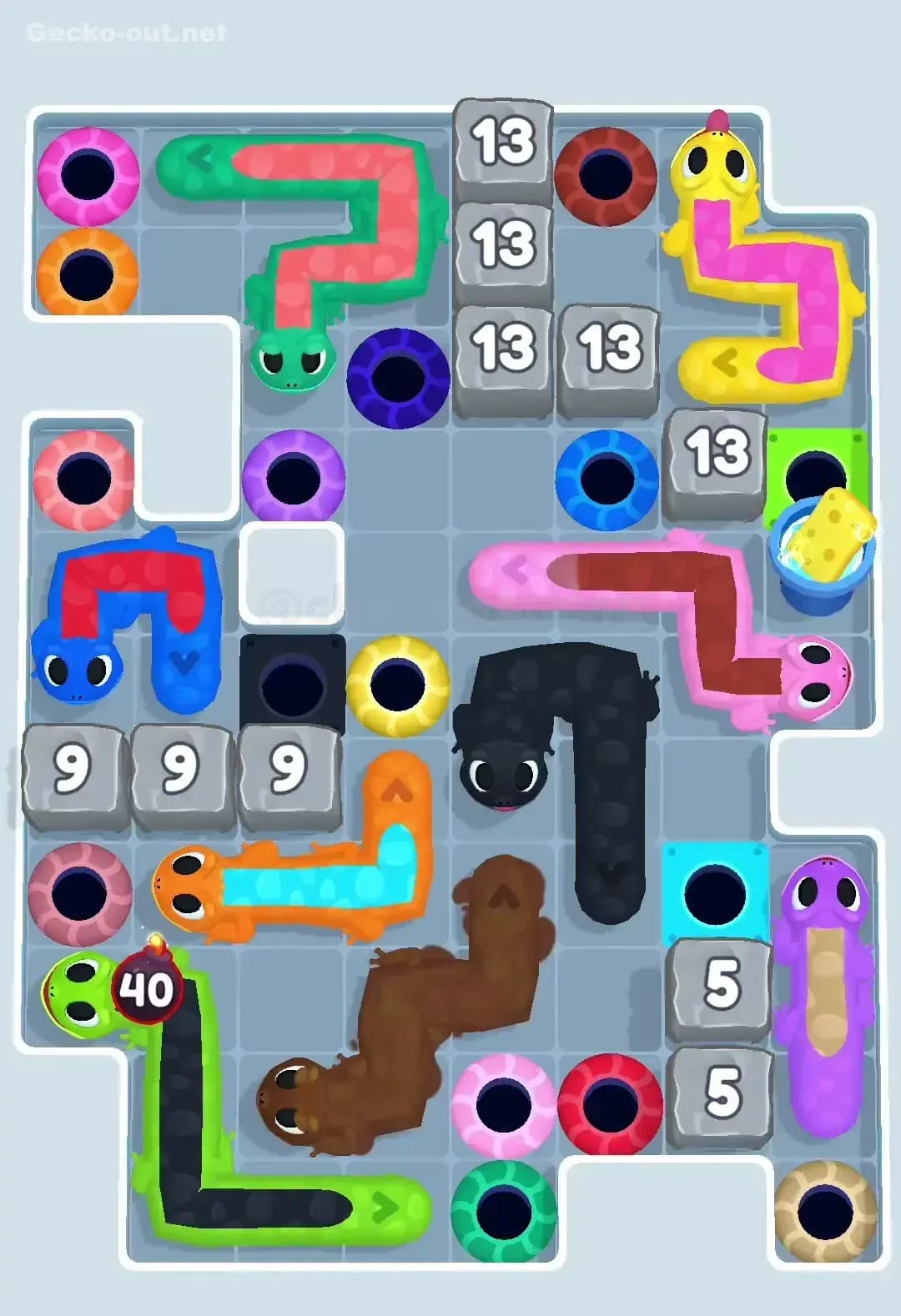
Gecko Out Level 385 Solution Walkthrough | Gecko Out 385 Answer
How to solve Gecko Out level 385? Get step by step solution & cheat for Gecko Out level 385. Solve Gecko Out 385 easily with the answers & video walkthrough.
Gecko Out Level 385: Board Layout, Rules, and Win Condition
How the board starts in Gecko Out 385
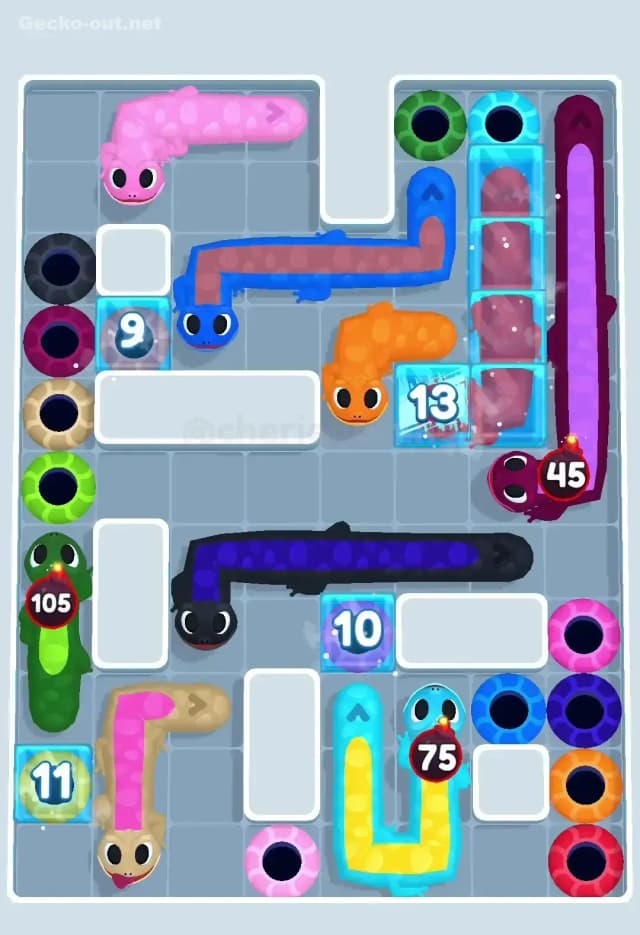
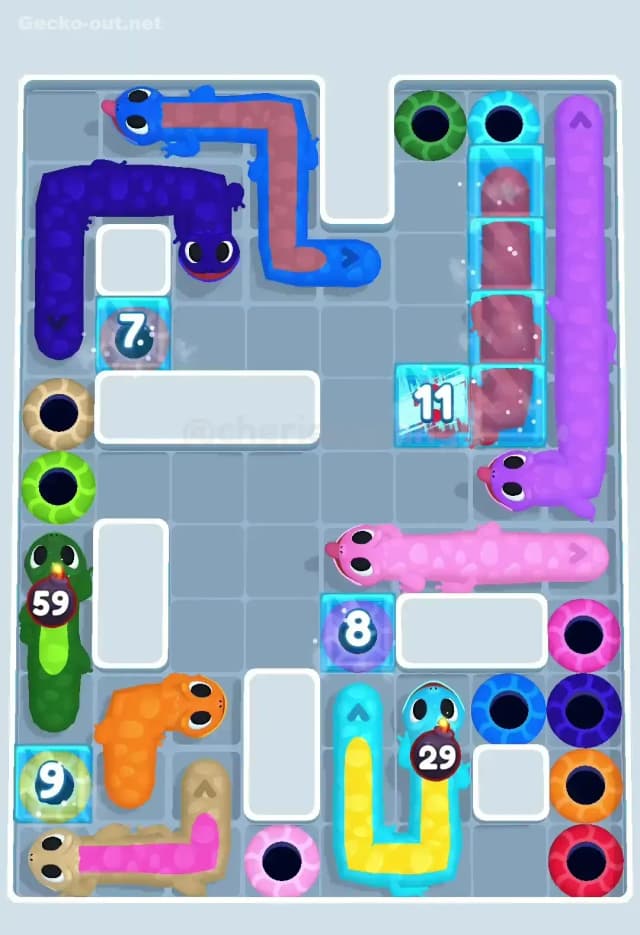
When you load Gecko Out Level 385, the board looks like a tangled traffic jam. You’ve got a mix of long “bus” geckos and short stubby ones:
- A pink gecko sitting in the upper-left area.
- A long blue gecko running across the upper middle.
- An orange gecko trapped in the center-right strip.
- A tall magenta/red stack on the right, with several segments frozen in ice.
- A long dark purple gecko stretched through the middle.
- A green vertical gecko on the left side.
- A beige–pink gecko in the lower-left chamber.
- A U-shaped yellow/cyan gecko in the lower-right corner.
Around the edges are matching colored holes, some open and some currently frozen behind icy blocks labeled with numbers like 9, 10, 11, and 13. Those numbers tie into the main timer: the ice behaves like a wall until the timer hits that value, then the frozen hole or corridor opens up.
Walls slice the board into three big zones: the top corridor (pink/blue), the central lane (orange/purple), and the bottom corridor (green, beige, cyan). Gecko Out 385 immediately feels cramped, and that’s intentional. Almost every move you make with a long gecko can lock out 2–3 others if you’re careless.
Win condition and why the timer matters
Your goal in Gecko Out Level 385 is straightforward on paper: drag each gecko’s head so its body follows a path into the hole of the same color, without crossing walls, other geckos, or still-frozen exits. In practice, the path-follow rule plus the timer is what makes this level nasty.
The path you draw is the exact route the body takes, so every wide loop or unnecessary detour both:
- Costs precious seconds.
- Leaves the gecko’s body lying across the board, blocking future routes.
At the same time, the global timer is counting down toward those icy numbers. Some geckos also have individual countdown badges (like 105, 75, 45), which means you can’t stall forever. In Gecko Out 385, you’re balancing three things every second: keep the long bodies hugged to walls, avoid crossing future exit lanes, and pace yourself so key exits thaw just as you’re ready to use them.
Pathing Bottlenecks and Logical Traps in Gecko Out Level 385
The main bottleneck corridor
The single biggest bottleneck in Gecko Out Level 385 is the right-hand side: the vertical magenta/red corridor and the exits at the top-right and lower-right. That magenta body is locked behind several ice tiles, and everything that wants to exit through the right or top-right has to respect that one-tile-wide channel.
If you drag any long gecko (especially the purple or blue one) so it lies across that right corridor, you’ve basically sealed off half the board. The correct mindset is: that right edge is a reserved highway. You only fully commit a gecko through there when you’re actually sending it home.
Subtle traps that keep causing failures
There are a few less obvious trouble spots in Gecko Out 385:
-
Central cross-lane. The dark purple gecko in the middle can stretch left–right and block both the lower section and the orange gecko if you swing it too low or too high. You want it snug along one wall, not lazily across the middle.
-
Lower-left choke. The green vertical gecko, the beige–pink gecko, and the 11-ice block create a narrow “L” path. If you curl beige through that space before planning green’s path, you’ll trap one of them and need a full reset.
-
Bottom-right exit cluster. The cyan U-shaped gecko sits beside several colored holes and the 10-ice tile. It’s tempting to send cyan out as soon as you see its hole, but if its path cuts through the only safe lane for purple/blue later, you’ll lose the end-game.
When the level starts to make sense
My first attempts at Gecko Out Level 385 felt chaotic: I kept “solving” one gecko at a time and then realizing I’d paved over everyone else. The turning point was when I treated each long gecko as a moving wall, not just something to get out quickly.
Once I started parking bodies tightly along the outer walls and leaving the center column open as long as possible, Gecko Out 385 suddenly clicked. The frustration turned into a nice “aha”: this level isn’t about reaction speed, it’s about staging exits in the right order and using frozen tiles as temporary blockers until you’re ready.
Turn-by-Turn Path Strategy to Beat Gecko Out Level 385
Opening: create space and park safely
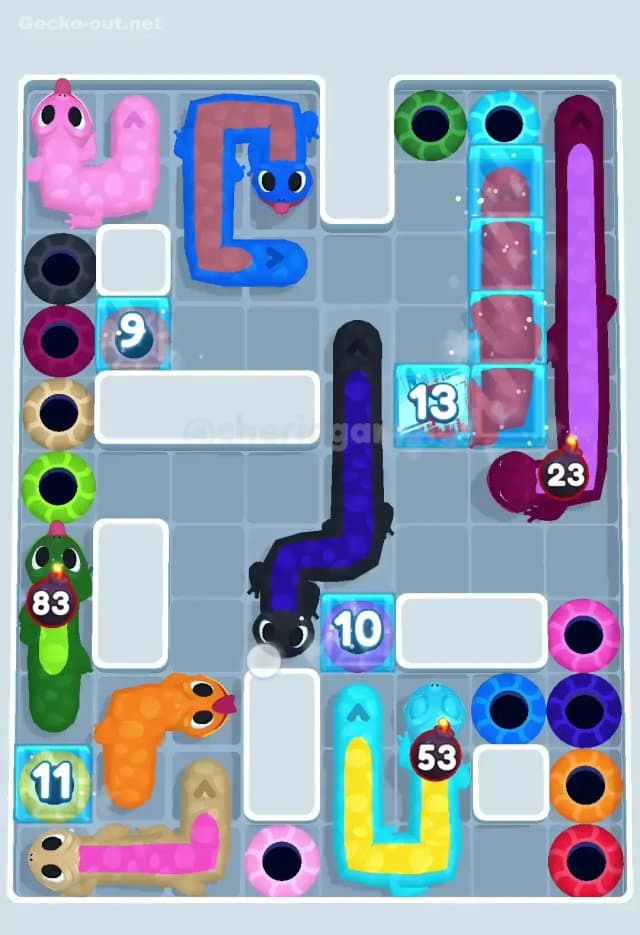
In the opening of Gecko Out 385, you’re not trying to finish anyone yet. You’re just building a clean board:
-
Straighten the dark purple gecko. Drag its head so the body lies neatly along the central horizontal lane but hugs a wall (top or bottom of its zone). Don’t leave it diagonally through intersections.
-
Slide the blue gecko into a tidy path. Shift blue so it runs cleanly across the upper section without blocking the vertical drop lanes you’ll need for pink and orange later. You can park blue along the top boundary.
-
Tuck pink to the upper-left or along the left wall. Give pink a short, simple parked position rather than a big loop. You’re just freeing up the cells near the center.
-
Shape the cyan U into a tight corner. Keep the cyan-yellow gecko pressed against the bottom and right edge so its body doesn’t spill into the middle of the board. You’ll use that corner parking to swing others past later.
-
Move beige slightly but don’t exit it yet. Just un-kink the beige–pink gecko so it’s ready to snake around the 11-ice once that opens.
By the end of the opening, every long gecko should be hugging a wall, and the central passages between top, middle, and bottom should look surprisingly open.
Mid-game: protect lanes and set up exits
Mid-game is where Gecko Out Level 385 is won. Your goal here is to line up near-final paths so you only need short final drags once the ice numbers trigger.
-
Solve the left column early.
- Work the beige–pink gecko toward its matching hole in the lower-left, using a path that hugs the outer edge and doesn’t cross the central lane.
- Once beige is gone, reposition the green gecko upward into its hole on the left side. Keep its path skinny so it doesn’t invade the center.
-
Prep the blue and purple.
With the left side freer, you can now:- Park blue so its head is near its exit corridor, but leave an open lane for orange to cross later.
- Adjust purple so its tail doesn’t sit in front of right-side exits. Ideally, purple runs straight along a central horizontal path that leads efficiently to its hole.
-
Stage orange and cyan.
- Nudge orange into a position where it can slip into its exit with one smooth motion once the 13-ice segment clears.
- Keep cyan’s U-shape clean; don’t let it snake into the mid-board. As soon as its exit lane is truly free and you’re sure no one needs that corridor, send cyan home with a crisp U-turn path.
Throughout this phase, focus on “one-lane highways”: every long path should be a nearly straight strip, never a big spiral. That’s what keeps Gecko Out 385 under control.
End-game: ordered exits and timer panic management
When the timer hits the ice numbers (9, 10, 11, 13), corridors and exits open and Gecko Out Level 385 turns into a sprint.
-
Exit order. A safe, consistent order is:
- Any remaining left-side geckos (green/beige if not already done).
- Cyan in the bottom-right once you’re sure its route won’t be needed.
- Blue and purple through the middle lanes.
- Orange and then the magenta/red stack on the right, using the freshly opened vertical corridor.
-
Avoid last-second choke points. In the final moves, never drag a gecko across more than one intersection. If a path requires weaving through 2–3 other bodies, don’t take it; reposition others first.
-
Low on time? Commit. If the global timer is close to the lowest remaining ice number or a gecko’s individual timer, pick a straight route and go. A short, imperfect path that works is better than a perfect path you never finish drawing.
Why This Path Order Works in Gecko Out Level 385
Using the body-follow rule to untangle, not tighten
The whole plan for Gecko Out 385 is built around the body-follow rule. By always hugging walls and minimizing bends, you’re effectively turning each gecko into a temporary fixed wall that you can predict. Because you park them in safe zones, when you finally drag them to their holes, their bodies retract cleanly, opening big corridors instead of leaving random knots.
You also deliberately delay sending geckos through the right-side bottleneck until the very end. That avoids the classic mistake of plugging the only vertical highway with a long body.
Timer management: when to think vs. when to move
In Gecko Out Level 385, the best approach is:
- Think early. Use the first chunk of time to study the ice numbers (9, 10, 11, 13) and mentally map which exits they’re shielding. Plan where each long gecko can park without ever needing to be redrawn.
- Move fast late. Once your parking is correct, the final exits should be short, almost straight lines. That lets you blaze through the last geckos while the timer is low, instead of still re-routing them.
The individual countdowns (like 105, 75, 45) look scary, but if you avoid rewinding and redrawing paths, you’ll beat those comfortably.
Boosters: optional, not mandatory
For Gecko Out Level 385, boosters are very much optional:
- An extra-time booster helps if you consistently reach the last one or two geckos with a nearly solved board. Use it just before starting the final sequence of exits.
- A hammer-style wall breaker is technically overkill; this level is designed to be solved within the natural walls.
- Hints can be useful once or twice if you’re totally stuck, but they often show one local path, not the full lane-management idea.
If you follow the wall-hugging strategy and exit order above, you shouldn’t need any boosters to beat Gecko Out 385.
Mistakes, Fixes, and Logic You Can Reuse in Other Gecko Out Levels
Common mistakes in Gecko Out Level 385
Here are the big errors I see over and over in Gecko Out 385, plus how to fix them:
-
Dragging long geckos across the middle early.
Fix: First turns are for parking against walls, not exiting. Don’t let purple or blue rest in the center. -
Exiting cyan too soon.
Fix: Keep that U-shaped cyan gecko as a tidy corner piece until you’re sure its exit lane won’t be used by purple/blue later. -
Looping paths to “stay safe.”
Fix: Avoid spirals. Every extra bend increases the chance you’ll cross a future route and wastes time. Keep all paths almost straight. -
Ignoring thaw timings.
Fix: Before moving, note which exits are behind 9/10/11/13 ice. Plan to have the matching gecko’s head waiting nearby as the timer hits those numbers. -
Redrawing whole geckos repeatedly.
Fix: Commit to good parking positions. If you find yourself clearing and redrawing the same long gecko, that’s a sign you didn’t hug a wall tightly enough.
Reusing this logic in other tough levels
The strategy that beats Gecko Out Level 385 scales really well to other knot-heavy or gang-gecko stages:
- Treat long geckos as temporary walls that you place consciously.
- Use outer edges and corners as parking lots.
- Respect bottleneck corridors (one-tile channels, frozen stacks) and don’t send anything through them until the end.
- Plan exit order based on which gecko blocks the most others, not which one is closest to its hole.
Whenever you see frozen exits, gang timers, or narrow choke points in other Gecko Out levels, remember how you staged the exits on Gecko Out 385 and copy that structure.
Final encouragement for Gecko Out 385
Gecko Out Level 385 looks brutal at first glance, and I totally get the “there’s no way this all fits” feeling. But once you slow down, park the long geckos against the walls, and respect that right-side bottleneck, the level becomes a satisfying puzzle instead of a scramble.
Stick to the lane-based plan, keep your paths straight and efficient, and you’ll watch the entire board unwind in the last few moves. Gecko Out 385 is tough, but it’s absolutely beatable with a clear plan—and now you’ve got one.