Gecko Out Level 742 Solution Walkthrough | Gecko Out 742 Answer
How to solve Gecko Out level 742? Get step by step solution & cheat for Gecko Out level 742. Solve Gecko Out 742 easily with the answers & video walkthrough.


Gecko Out Level 742: Board Layout, Rules, and Win Condition
The Starting Board: A Multi-Color Puzzle with Tight Corridors
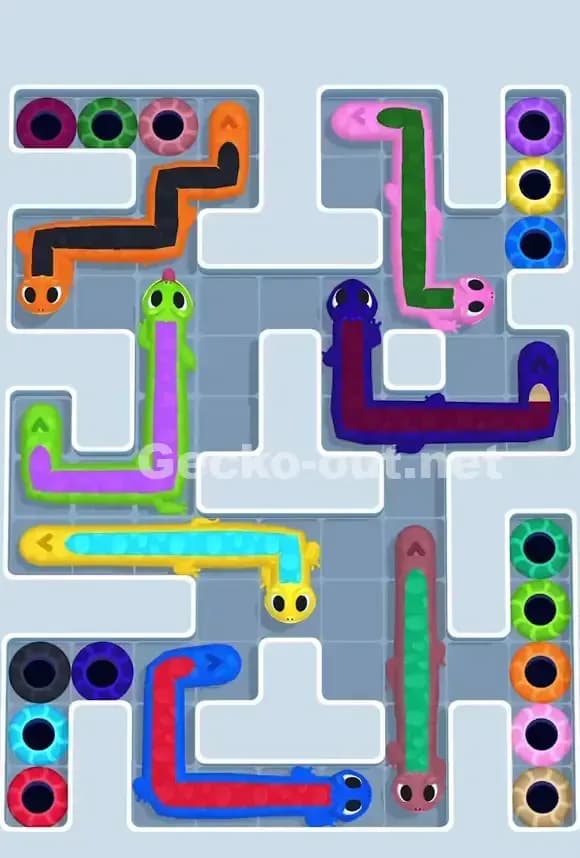
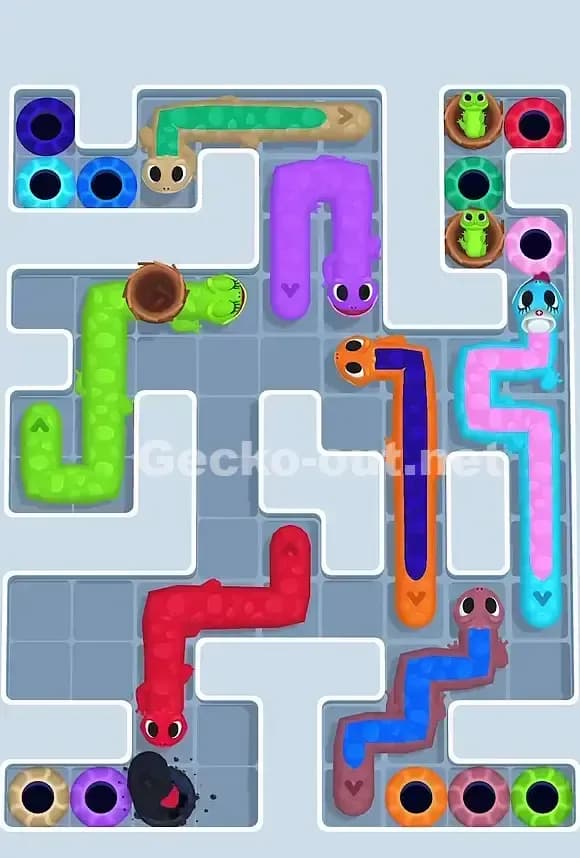
Gecko Out Level 742 is a sprawling, multi-gecko challenge that demands careful planning and precise pathing. You're looking at seven geckos spread across the board in different colors: greens, purples, yellows, cyans, and reds. The starting positions are deliberately scattered—some geckos are packed tightly together on the left side, while others occupy key junction points in the middle and right sections of the board. The exit holes are color-matched and positioned at various edges, which means you can't just drag any gecko anywhere; each one has a specific destination.
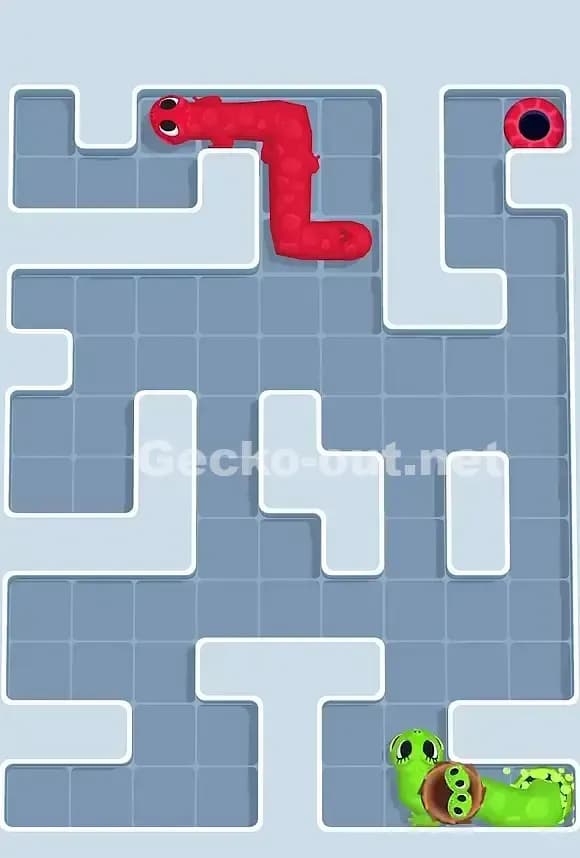
The real complexity comes from the narrow corridors and tight choke points winding through the center of the level. Large sections of the board are blocked by white walls, forcing geckos to navigate specific paths. Some exits appear frozen or otherwise restricted, and there's precious little wiggle room—the board is essentially a maze where body collision isn't just an inconvenience, it's a puzzle-solver. You'll notice right away that several geckos are physically longer and take up more grid space, which means moving them first could either unlock the board or lock everyone in place.
The Win Condition and Timer Pressure
To win Gecko Out Level 742, every single gecko must reach its color-matched hole before the timer runs out. There's no partial credit here; one gecko stuck means a failed attempt. The timer is generous enough to allow for careful planning, but not so generous that you can afford multiple mistakes or do things in the wrong order. This is where the path-based movement rule becomes critical: when you drag a gecko's head, its body must follow that exact route, so inefficient or overlapping paths eat up both board space and precious seconds.
Pathing Bottlenecks and Logical Traps in Gecko Out Level 742
The Central Corridor: Your Biggest Chokepoint
The absolute bottleneck on Gecko Out Level 742 is the central vertical corridor that runs down the middle of the board. This narrow lane is the only viable route for several geckos to reach their exits, and if you're not strategic about it, you'll end up with multiple gecko bodies clogging the same space, leaving them all stranded. The long purple gecko is the primary culprit here—it's bulky, it's in a starting position that forces it through or near this corridor, and if you move it carelessly, it'll block the path for faster, smaller geckos that could've slipped past in seconds.
Three Subtle Problem Spots
First, watch the left side of the board where three geckos start in close proximity. They're not linked, but their size and proximity mean that moving one without planning for the others will create an immediate jam. If you drag the topmost green gecko without first staging the others elsewhere, you've effectively locked them into a waiting game while that gecko navigates the board—wasting valuable time and board real estate.
Second, pay attention to the exits on the right edge. Some of them are stacked vertically, and the paths leading to them converge. This creates a second potential traffic jam. You might successfully route a gecko to the right side only to find that the exit lane is already occupied by another gecko's body that you haven't moved yet. This is a timing trap, not a pathing trap—one wrong decision about exit order cascades into a lockdown.
Third, there's a subtle dead-end trap in the lower-left section. A gecko moving through that area has limited options for reorienting, so if you drag its head in a way that doesn't anticipate the exit route, you might paint yourself into a corner and have to restart.
That Moment of Clarity
Honestly, when I first looked at Gecko Out Level 742, I felt that familiar spike of frustration—so many geckos, so many walls, and the timer ticking away. But then I realized something crucial: the solution isn't about moving fast; it's about moving in the right sequence. Once I identified which gecko was genuinely blocking everyone else (that long purple one) and committed to getting it out of the way first, the whole board suddenly felt less like a knot and more like a series of straightforward slides. The breakthrough came when I stopped thinking "which gecko should I move next?" and started thinking "which gecko, if removed, opens the most paths for everyone else?"
Turn-by-Turn Path Strategy to Beat Gecko Out Level 742
Opening: Clear the Staging Area
Start with the green gecko positioned on the left side of the board. This gecko is relatively short, has a clear shot to an exit, and by moving it first, you're freeing up physical space on the crowded left side. Drag its head along the green-marked path (if available) or along the safest route toward its matching hole. Once it's out, you've bought yourself room to maneuver the other left-side geckos without them all tangling.
Next, address the purple gecko that occupies a central position. This is the moment where many players hesitate, but don't. Plot its route carefully—it needs to traverse the central corridor, and you want to do this before other geckos are anywhere near that lane. Drag its head slowly and deliberately, watching for walls and dead ends. Once the purple gecko is committed to its path, it's going to take up the corridor for a while, so make sure you've already moved or mentally staged any other geckos that might need that space in the next few moves.
Now that the major obstacles are out of the way, move the yellow gecko toward its exit. This one should have clearer sightlines now.
Mid-Game: Maintain Open Lanes and Avoid Retroactive Blocks
By the mid-game phase of Gecko Out Level 742, you should have three to four geckos already exited. The board should feel less claustrophobic. However, this is where many players slip up: they drag a gecko in a way that made sense at the time, only to realize its body is now blocking the exit route for a gecko they hadn't even moved yet.
The key is to keep the right-side approaches clear for the right-side geckos. Before you move any gecko, trace its path all the way to the exit with your eyes and ask: "Does this path's body position block anyone else's exit route?" If the answer is yes, you need to either reorder your moves or find an alternative path that loops around.
For any remaining long geckos, commit fully to moving them sooner rather than later. A long gecko sitting stationary on the board takes up more space than a long gecko actively being dragged and exiting—sounds weird, but it's true because once you start the drag, you're committing to removing it. Don't park long geckos in "safe" spots and hope to move them later; that hope is a time-waster.
End-Game: Exit Order and Last-Second Saves
You're down to the final two or three geckos on Gecko Out Level 742, and now the timer is probably visible and ticking. Resist the urge to rush. Take five seconds to verify that the next gecko's exit is genuinely unobstructed. The smallest oversight—a gecko body still lingering in the exit corridor—will force you to waste time shuffling that gecko out of the way first.
Exit order in the final stretch should prioritize geckos whose exit paths would otherwise block others. If you have a cyan gecko whose exit lane runs through the same corridor as a red gecko's exit, move the cyan one first. This leaves the red gecko a clear shot at the very end, and even if you're cutting it close on time, you know for certain that the final gecko can exit without delay.
If you're genuinely low on time with one gecko left, don't panic. Check whether a booster like a time extension is available. If the booster will guarantee success and you're unsure of your no-booster speed, use it. But if you've been careful and methodical, you should have time to spare.
Why This Path Order Works in Gecko Out Level 742
Head-Drag Pathing and the Body-Follow Rule
The strategy works because it respects the fundamental rule of Gecko Out Level 742: the body follows the head's exact path, so every drag is permanent and consequential. By moving longer geckos and central-position geckos first, you're clearing physical space before you need it. When a short gecko later needs to zip across the board to its exit, the path is already open because the long gecko that would've been in the way is already gone.
This is the opposite of what inexperienced players do—they move convenient geckos first (the short ones, the ones already near exits) and save the long, tangled geckos for last, only to discover that those geckos can't move without displacing three others. By inverting the priority, you're always expanding your options instead of constraining them.
Managing the Timer: Pause vs. Commit
Gecko Out Level 742 gives you enough time to think, but not enough time to overthink. The sweet spot is a 5-10 second mental planning phase before each gecko move. During that phase, trace the full path, identify potential blocks, and commit. Once you hit "drag," don't second-guess—follow through to the exit. Hesitation and backtracking cost more time than a slightly inefficient but committed path.
If you find yourself stalling or repeatedly restarting, pause the level (if possible) and map out the entire sequence on paper or in your head. Which gecko exits first, second, third? Why? Does that order actually respect the board's geometry? Thirty seconds of strategic pause beats three botched attempts.
Booster Usage: Optional, Not Essential
Gecko Out Level 742 is designed to be solvable without boosters if you play optimally. That said, a time extension booster is useful insurance if you're within, say, 15 seconds of the timer and have one gecko left. Don't use time boosters reactively unless you're confident you can execute the remaining moves. A hint booster is less useful here because the paths are fixed—hints help with logic puzzles, not pathing logistics.
Mistakes, Fixes, and Logic You Can Reuse in Other Gecko Out Levels
Five Common Mistakes on Gecko Out Level 742 and How to Fix Them
Mistake 1: Moving short geckos first. Short geckos are tempting because they seem easy, but on Gecko Out Level 742, they're often the "filling" that gets squeezed into leftover space. Fix: Always inventory which gecko is physically longest and/or most centrally positioned, and move it first.
Mistake 2: Dragging geckos into dead ends without an exit plan. A gecko can reach a dead-end corridor if the exit hole is in that corridor, but if you're not certain, you'll waste time backing up or restarting. Fix: Before dragging, visually trace the path to the exit hole. If the path is unclear, don't drag yet.
Mistake 3: Stacking geckos on the same exit lane. You route one gecko toward an exit, and while it's still in transit, you route another gecko to the same exit. Their bodies collide mid-path. Fix: Geckos exit in order; make sure the previous gecko is fully exited before the next one enters the exit corridor.
Mistake 4: Ignoring the timer until it's critical. You move methodically, but you don't glance at the timer, so by the time you realize you have only 20 seconds left with three geckos to go, you're panicked. Fix: Glance at the timer every two to three moves. If you're ahead of pace, relax. If you're behind, start committing faster and accept that your paths will be less perfectly optimized.
Mistake 5: Trying to find "optimal" paths that don't exist. Gecko Out Level 742 has constraints—you can't reshape walls, and you can't shrink geckos. Sometimes the path is what it is. Fix: Differentiate between "this path doesn't work mechanically" (restart) and "this path is inefficient but valid" (take it and move on).
Reusing This Strategy on Similar Levels
This approach—clear the board's core bottleneck first, maintain open lanes, exit in sequence—works on any Gecko Out level with multiple geckos, frozen exits, or gang-linked geckos. The logic is universal: remove constraints before trying to work within them. On levels with frozen exits, the same principle applies: figure out which gecko unlocks the freeze mechanism, move it first or sequence it strategically, then clear the board methodically.
For levels with gang geckos (linked pairs or trios), think of the entire gang as one super-long gecko and apply the same "move it early, move it decisively" rule.
Concluding Encouragement
Gecko Out Level 742 is tough—there's no getting around that. But it's not tough because it's random or unfair; it's tough because it demands you think in sequence and respect the geometry of the board. Once you've beaten it, you've proven to yourself that you can handle the puzzle's complexity, and that confidence carries forward. Every subsequent level becomes a variation on a theme you've already mastered. You've got this.