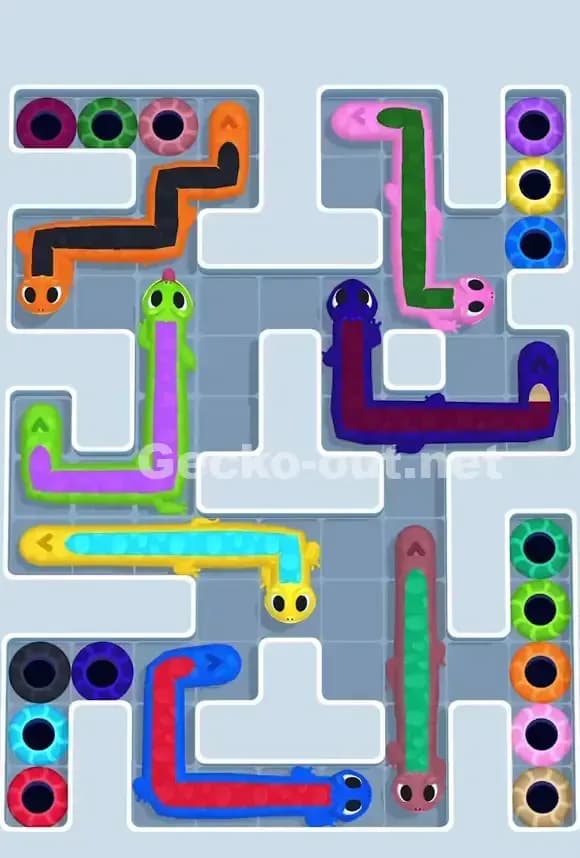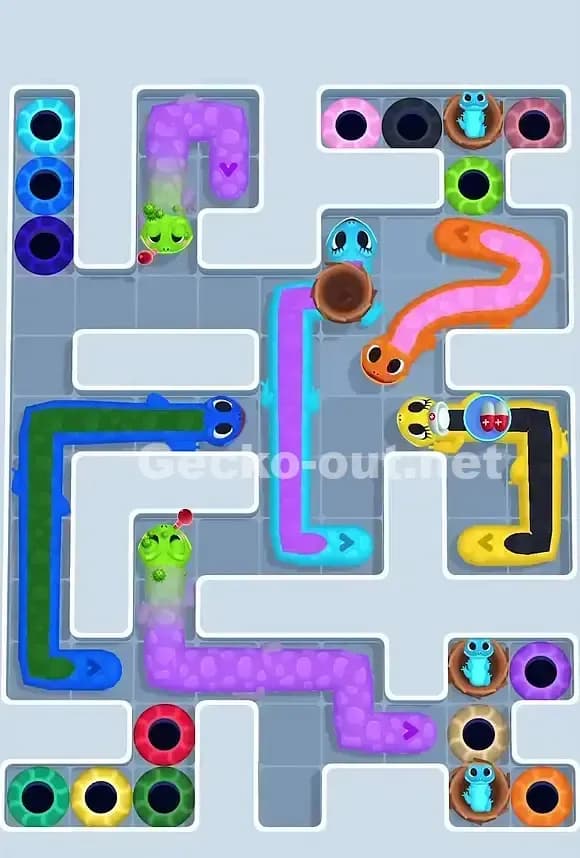
Gecko Out Level 744 Solution Walkthrough | Gecko Out 744 Answer
How to solve Gecko Out level 744? Get step by step solution & cheat for Gecko Out level 744. Solve Gecko Out 744 easily with the answers & video walkthrough.
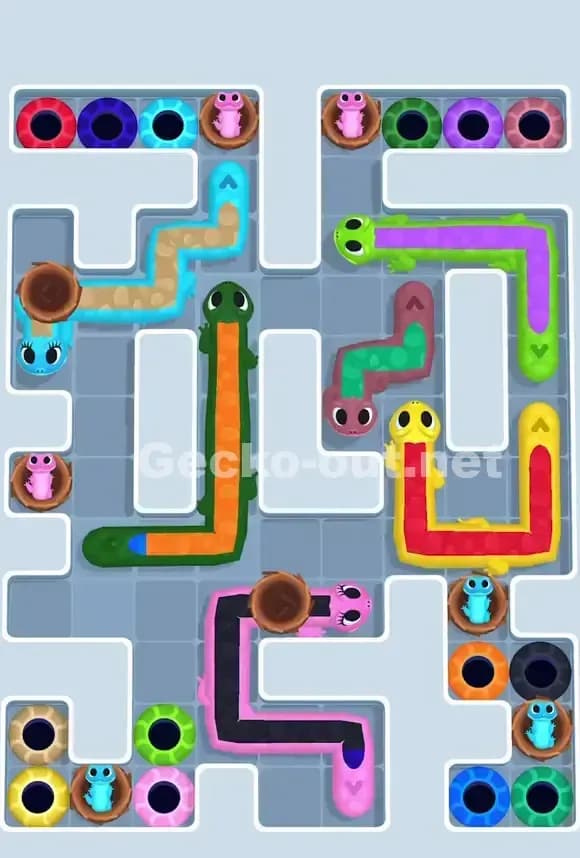
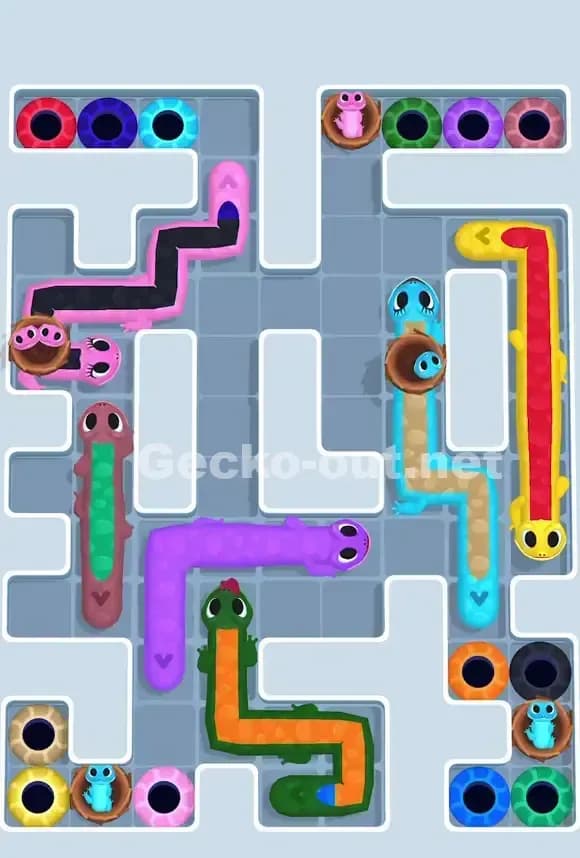
Gecko Out Level 744: Board Layout, Rules, and Win Condition
Starting Board: Geckos, Colors, and Key Obstacles
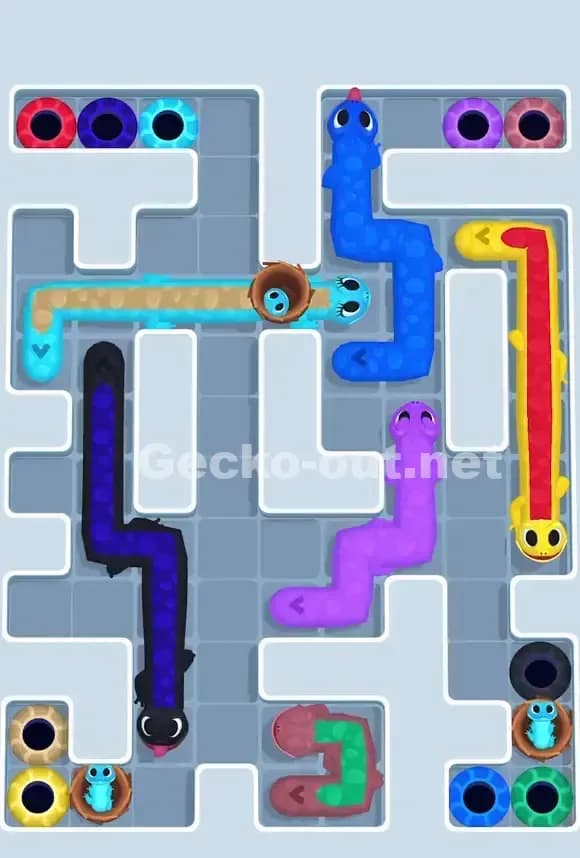
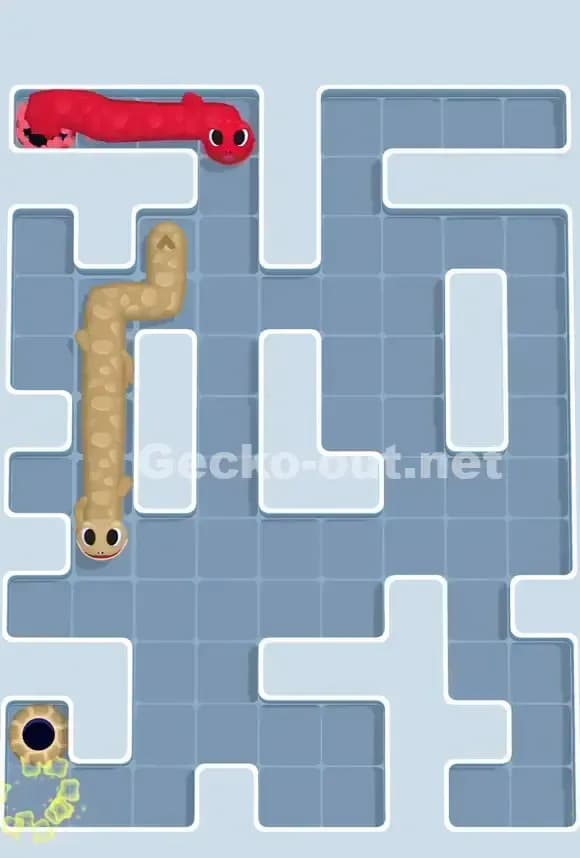
Gecko Out Level 744 is a densely packed puzzle with eight geckos competing for limited space on a complex, winding board. You've got a red gecko (top left), blue gecko (top left area), cyan gecko (top center), brown gecko (top right area), green gecko (right side), purple gecko (top right), pink gecko (center-right), and yellow gecko (center). Each gecko needs to reach its matching colored hole, and they're scattered across the map in ways that'll make you want to pull your hair out at first glance. The board features a maze-like layout with multiple corridors, narrow choke points, and several large white walls that segment the playing space into distinct regions. There's a timer ticking down from the moment you start, so you can't afford to waste moves or get tangled in dead ends.
Win Condition and Timer Pressure
To beat Gecko Out Level 744, every single gecko must reach its corresponding colored hole before the timer hits zero. The twist? You can only move one gecko at a time by dragging its head, and the body follows the exact path you trace. If two geckos try to occupy the same space or if a gecko's body crashes into a wall or another gecko, that path fails and you've wasted precious seconds. This means planning matters hugely—you can't just drag randomly and hope for the best. The timer creates constant pressure, so you need to know your sequence before you commit to movement.
Pathing Bottlenecks and Logical Traps in Gecko Out Level 744
The Critical Bottleneck: The Center Corridor
The single biggest bottleneck in Gecko Out Level 744 is the central vertical and horizontal corridor that runs through the middle of the board. Multiple geckos need to pass through or near this zone to reach their exits, and if you get even one gecko stuck or mispositioned, you'll block everyone else behind it. The green gecko on the right side and the yellow gecko in the center are especially vulnerable here because their paths naturally converge on this tight space. If you move the green gecko too early without planning the yellow gecko's route, you'll create a gridlock that wastes thirty seconds trying to untangle.
Subtle Problem Spot #1: The Top-Left Cluster
The red, blue, and cyan geckos all start in close proximity on the left side of the board, and their respective holes are spread across different regions. The red hole is somewhere along the left periphery, the blue hole is in the upper-center area, and the cyan hole is in the middle-left zone. If you move these three without a clear exit strategy, they'll pile up and block each other's paths. The tight corridors connecting this cluster to the rest of the board mean you need to execute these three moves in a very specific order, or you'll spend your entire timer trying to shuffle them around.
Subtle Problem Spot #2: The Brown-Pink Overlap Zone
The brown gecko (top right) and pink gecko (center) both have paths that want to use overlapping sections of the board. The brown gecko needs to work its way down and around to reach its hole, while the pink gecko's path is more central. If you move brown too aggressively without clearing pink first, brown's body will block pink's exit route. This is a classic Gecko Out Level 744 trap—the two geckos aren't directly adjacent, but their body paths conflict, and you won't realize it until you're halfway through a move.
Subtle Problem Spot #3: The Bottom-Right Exit Cluster
Three geckos have holes clustered in the bottom-right area (yellow, blue, and one of the secondary colors). The pathways leading to these exits are narrow and converge at a single choke point. If you don't time the order of these three exits perfectly, the first one out will block the second, and the second will block the third. You basically need to move them in reverse order of their proximity to the exit—farthest first, closest last.
Personal Reaction: When It Clicked
I'll be honest: the first time I looked at Gecko Out Level 744, I thought it was impossible. The board is so crowded, and there are so many geckos, that it felt like they were all tangled in a Gordian knot. I tried brute-forcing moves, dragging geckos randomly, and I failed three times in a row. But then I took a breath and actually traced each gecko's potential path on paper, working backward from the exits. I realized that the solution wasn't about finding clever tricks—it was about respecting the timer, committing to a strict order, and accepting that some geckos have to wait patiently while others go first. Once I saw the puzzle as a sequence instead of a simultaneous problem, everything fell into place.
Turn-by-Turn Path Strategy to Beat Gecko Out Level 744
Opening: Clear the Left Cluster and Park the Blockers
Start with the cyan gecko on the top-left area because it has the most direct path to its hole and won't interfere with other geckos if you move it early. Drag cyan down and around through the upper corridors to reach its cyan hole in the middle-left region. Don't rush—trace the full path before you commit, making sure it doesn't cross through areas where other geckos will need to travel. Once cyan is out, move the blue gecko next. Blue's hole is also in the upper-center area, and moving blue early opens up space in the left cluster for red to maneuver later. Finally, address the red gecko by dragging it through the remaining left-side corridors to its hole. By the end of this opening phase, you've cleared the entire left side of the board, which gives you maximum flexibility for the messy middle section.
Mid-Game: Untangle the Central Knot and Protect Key Lanes
Now comes the hard part. The brown gecko at the top-right needs to move because its body is long and will block other geckos if you don't shift it. Drag brown down the right side of the board, being extremely careful to keep its path clear of the yellow and pink geckos that'll need to use similar routes. Park brown's body in a safe zone—somewhere along the bottom-right where it's out of traffic. Next, move the purple gecko from the top-right. Purple also has a long body, and its exit is somewhere in the right-center area. Drag purple carefully to avoid overlapping with brown's parked body. After purple is out, you've now cleared the top-right entirely, which means you have breathing room for the central geckos. Move the green gecko from the right side now. Green is another longer gecko, and its path will snake through the center corridor. This is when you need absolute focus—drag green's head slowly and deliberately, making sure every inch of its body follows the path you intend and doesn't accidentally bump into pink or yellow, who are still waiting.
End-Game: Execute the Exit Sequence and Beat the Clock
You're now in the final phase with just three or four geckos left, and they're all clustered in the center and bottom-center areas. Check your timer—if you're below 30 seconds, you need to move decisively without second-guessing. Move the pink gecko next because its hole is accessible and moving it frees up the central corridor for the remaining geckos. Drag pink through its path quickly but carefully. Then move the yellow gecko. Yellow's hole is in the bottom-center, and now that pink and green are gone, yellow has a clear lane to its exit. Drag yellow down and into its hole. Finally, if there are any remaining geckos (like a secondary-colored gecko or a parked blocker), move them to their exits in whatever order keeps you from hitting the timer. As long as all geckos reach their holes before the timer hits zero, you win Gecko Out Level 744.
Why This Path Order Works in Gecko Out Level 744
Using Head-Drag Pathing to Avoid Tightening the Knot
The secret to Gecko Out Level 744 is respecting how body-follow mechanics work. When you drag a gecko's head, the body traces that exact path behind it. If you move gecko A before gecko B, and gecko A's body ends up blocking gecko B's only exit route, you've created a dead end that'll cost you the entire level. The path order I've outlined starts with geckos that have clear, isolated exits (cyan, blue, red on the left) and progressively moves toward geckos with overlapping path zones (brown, purple, green, pink, yellow). This order ensures that as each gecko exits, it removes its body from the board entirely, opening new lanes for the remaining geckos instead of blocking them. It's the opposite of tightening the knot—it's methodically untangling it, one gecko at a time.
Managing the Timer: When to Pause and When to Move
Gecko Out Level 744 gives you enough time to solve it if you move efficiently, but not enough time to bumble around. The strategy here is to pause for a full five seconds before each move. During those five seconds, mentally trace the gecko's head from its current position to its hole, imagining its body following behind. If you spot a potential collision, adjust your mental path until it's clear. Once you've locked in the path, commit 100%—don't hesitate or second-guess mid-drag. This approach sounds slow, but it's actually faster than moving quickly and making mistakes that require you to restart entire sequences. As the timer gets below 60 seconds, you can afford to move a bit faster, but maintain the same level of focus. Never rush so much that you're dragging paths blindly.
Booster Strategy: Optional But Not Necessary
Gecko Out Level 744 can be beaten without boosters if you execute the sequence perfectly. However, if you've already made two failed attempts and you're frustrated, spending a booster on extra time is a reasonable call. The "extra 30 seconds" booster is the most useful here because it gives you a safety net if you're two or three moves away from victory but running low on time. Skip the hint booster—you've got this guide, which is better than a vague hint. Skip the "hammer" or obstacle-removal tools because Gecko Out Level 744 doesn't have icy exits or toll gates that require tools; it's pure pathing. If you're going to use a booster, wait until you're down to your last three geckos and you can see victory within reach. Don't waste a booster on an attempt where you're still figuring out the early moves.
Mistakes, Fixes, and Logic You Can Reuse in Other Gecko Out Levels
Mistake #1: Moving Long Geckos Without Parking Them
The Error: Players often move a long gecko (like brown or green in Gecko Out Level 744) and then immediately move a second gecko without waiting to see where the first gecko's body settled. This leads to the second gecko's path being blocked by the first gecko's tail, forcing a restart.
The Fix: After moving any gecko longer than three body segments, pause for a second and visually confirm that its entire body is now in a safe, parked location. Only then move the next gecko. This simple habit eliminates the most frustrating failures in Gecko Out Level 744.
Mistake #2: Assuming All Geckos Can Exit in Parallel
The Error: New players think that because there are eight geckos and eight holes, they can move them in any order. But Gecko Out Level 744 proves this wrong repeatedly—some geckos block others, and order absolutely matters.
The Fix: Always work backward from the exits. Identify which gecko's path is closest to its exit and can leave last, then identify which gecko must leave first to clear the path for everyone else. Build your move sequence in reverse priority, not in the order geckos appear on the board.
Mistake #3: Dragging Paths Through Crowded Central Corridors Too Early
The Error: Players move central geckos (like yellow or pink) before clearing the surrounding geckos, because they think they're being efficient. In Gecko Out Level 744, this creates a permanent bottleneck.
The Fix: Prioritize clearing the perimeter first. Move geckos on the left, top, and right edges before touching the geckos in the middle. This gives you maximum space and flexibility for the toughest moves.
Mistake #4: Not Fully Visualizing the Path Before Dragging
The Error: Players click a gecko and start dragging without a complete mental picture of where the head needs to go, resulting in wasted movements and false starts.
The Fix: Before touching the screen, trace the full path with your eyes or finger (without dragging). From gecko head to hole, what's the route? Are there obstacles? Will the body collide with anything? Only drag once you've answered these questions. This costs five extra seconds per move but saves thirty seconds by eliminating false starts.
Mistake #5: Ignoring the Timer and Moving Carelessly in the End-Game
The Error: Players cruise through the early and mid-game, then panic when they see the timer dropping below 60 seconds. They rush the final moves, make mistakes, and fail Gecko Out Level 744 despite being close to victory.
The Fix: Maintain the same careful pace throughout. If you've cleared the board correctly up to the final three geckos, you'll have enough time to move them thoughtfully. Don't change your approach just because the timer is visible. Trust the process.
Reusing This Logic on Similar Levels
The approach you've learned in Gecko Out Level 744 applies directly to other levels with multiple geckos, gang mechanics (linked geckos that move together), or frozen exits. The core principle is: clear the perimeter first, handle the center last, and never move a gecko that blocks another gecko's only exit route. Whenever you're stuck on a multi-gecko level, ask yourself: "Which gecko is farthest from its exit?" and move that one last. Build your sequence backward from victory, not forward from the start. This single mindset will unlock dozens of similar puzzles.
Final Encouragement
Gecko Out Level 744 is genuinely challenging, but it's not unfair. Every failure teaches you something about the board's layout or the order of moves. The fact that you're reading this guide means you're already halfway to victory—you've got a proven strategy and you understand the pitfalls. The next time you load Gecko Out 744, execute this plan step by step, trust your planning, and watch those geckos drop into their holes one by one. You've got this.