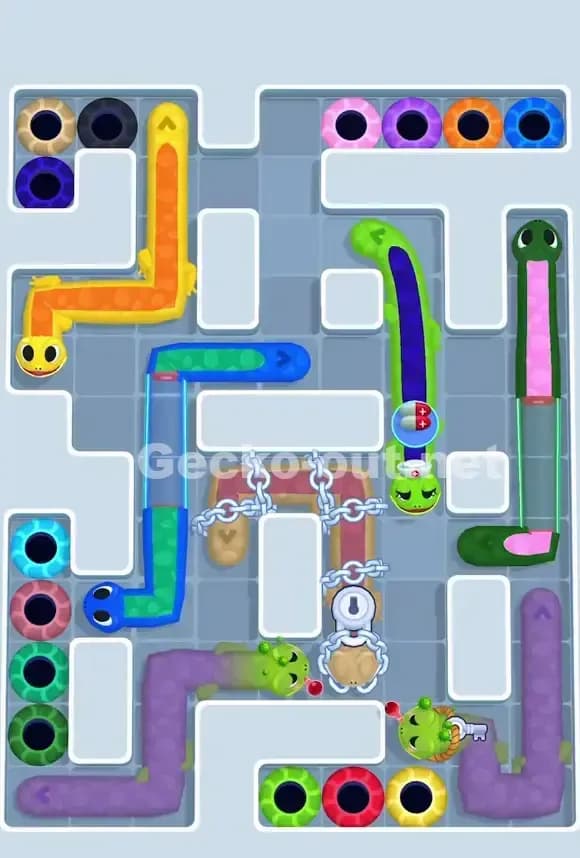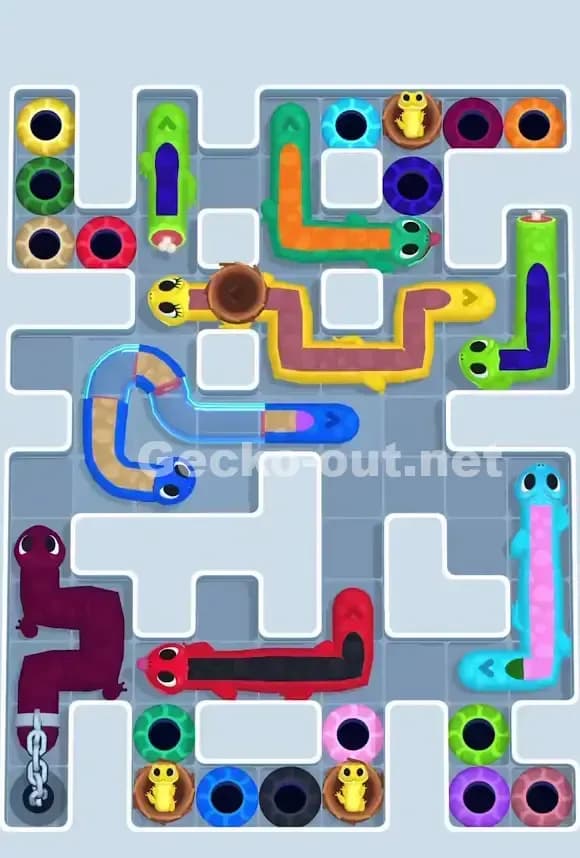
Gecko Out Level 882 Solution Walkthrough | Gecko Out 882 Answer
How to solve Gecko Out level 882? Get step by step solution & cheat for Gecko Out level 882. Solve Gecko Out 882 easily with the answers & video walkthrough.
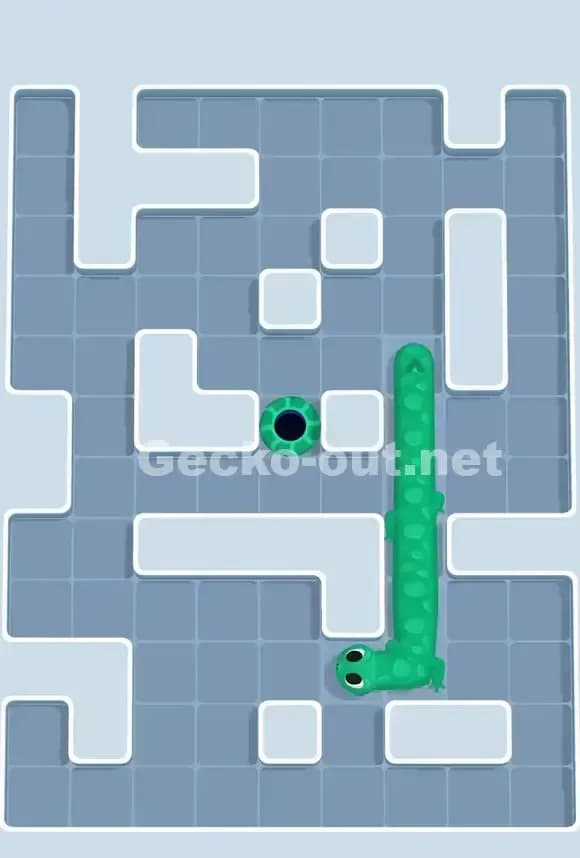
Gecko Out Level 882: Board Layout, Rules, and Win Condition
The Starting Board: Geckos, Colors, and Terrain
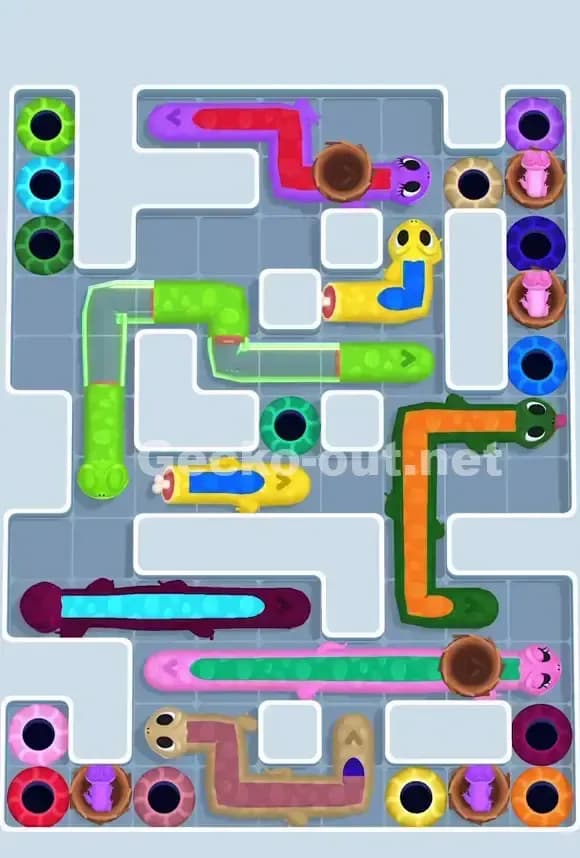
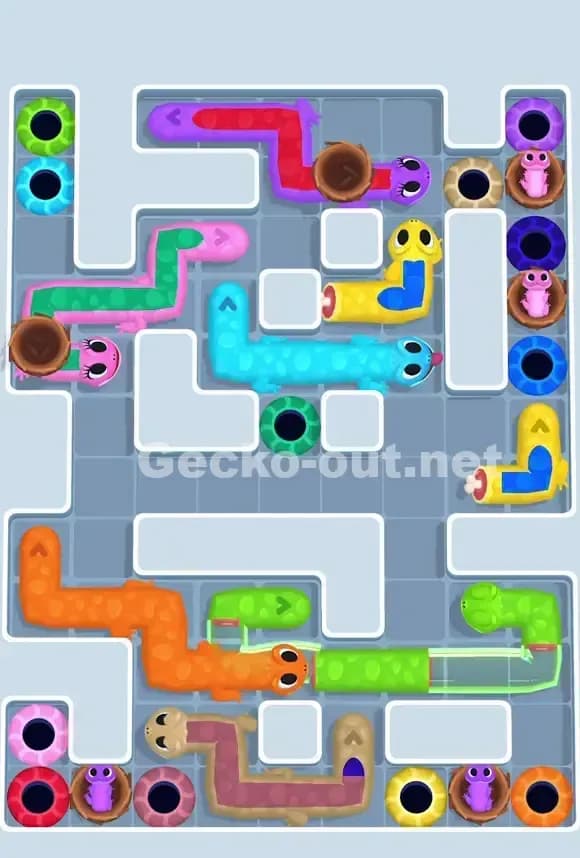
Gecko Out Level 882 is a crowded, multi-colored puzzle with seven geckos spread across the board in a tight formation that demands careful spatial planning. You've got a vibrant mix: green, blue, red, purple, yellow, cyan, and orange geckos—each one locked into a matching-colored exit hole somewhere on the grid. The board itself is a maze of white walls and gray pathways, with several key choke points that will make or break your run. There are two gang-linked geckos (the cyan pair at the bottom and the magenta pair on the right side) that move as a single unit, which adds complexity because you're really managing nine individual gecko segments, not seven independent creatures. The layout features a wide-open middle section sandwiched between narrow corridors on the left and right, creating natural bottlenecks that you'll need to navigate with precision.
Win Condition and Timer Pressure
To beat Gecko Out Level 882, every single gecko must reach its matching-colored hole before the timer expires. The timer is unforgiving—you've got roughly 90–120 seconds depending on your game settings—which means you can't afford to second-guess your paths or waste moves repositioning geckos. The twist is that the body-follow mechanic means each gecko's tail traces the exact path you drag its head through, so if you're not thinking two moves ahead, you'll accidentally create a wall that locks other geckos in place. This is where Gecko Out Level 882 gets genuinely tricky: it's not just about reaching exits, it's about orchestrating a sequence of moves that keeps every gecko's path open until the very end.
Pathing Bottlenecks and Logical Traps in Gecko Out Level 882
The Critical Choke Point: The Green Corridor's Exit Squeeze
The single biggest bottleneck in Gecko Out Level 882 is the green corridor on the left side of the board and the narrow exit channel it feeds into. The green gecko is a long, segmented creature that occupies the entire left spine of the puzzle, and if you move it carelessly, it'll block access to multiple exits at once. The real trap is that the green gecko's exit is tucked away in a corner, and the path to reach it requires threading through a tight vertical passage that's barely wider than the gecko itself. If the cyan or purple geckos accidentally cross this corridor before the green one escapes, you've created a gridlock that wastes precious seconds trying to untangle. I found myself staring at this section for a full 20 seconds on my first attempt because I'd sent the yellow gecko on a diagonal that cut right through the green corridor—rookie mistake.
Subtle Problem Spots: The Right-Side Gang and the Bottom Magenta Pair
The right side of the board hosts a cluster of three single geckos (red, brown, and blue) whose exits are stacked vertically, but they share a common approach corridor. If you move them in the wrong order, the first one you drag will park its body in a way that blocks the second and third from reaching their holes. The blue gecko's exit is particularly sneaky because it's tucked behind a white wall that forces a very specific approach angle—miss it by one grid square, and you'll have to backtrack and redo the entire sequence. Meanwhile, the magenta gang gecko at the bottom center is a two-segment unit that's bent at a right angle, so when you drag it toward its exit (the brown hole on the bottom right), its tail will sweep across a large portion of the lower board, potentially trapping the cyan gang gecko or the pink gecko if they haven't already escaped.
The Moment It Clicked
Honestly, Gecko Out Level 882 felt overwhelming on my first two runs because I was treating it like a free-for-all and just dragging geckos to their exits in whatever order felt natural. It wasn't until I actually mapped out the exit holes and traced backward from each hole to its gecko's starting position that I realized there was only one viable order. That's when the solution snapped into focus—it's not a puzzle about speed; it's a puzzle about understanding dependencies. Once I saw that the green gecko had to leave first, and the cyan gang had to leave second, everything else fell into place like dominoes.
Turn-by-Turn Path Strategy to Beat Gecko Out Level 882
Opening: Secure the Left Spine, Then the Bottom
Start by moving the green gecko straight down and out through its exit at the bottom left corner of the green corridor. Don't rush—take a clear, unobstructed path with no unnecessary detours because this gecko is long and any wasted space will create interference for the next moves. Once green is out, immediately move the cyan gang gecko (the elongated two-segment unit at the bottom center-left) toward its exit. The cyan exit is in the far bottom-left area, so drag the head downward and then left, keeping the body tight against the walls to avoid sprawling across the board. Parking these two early clears the left side and prevents the gang gecko's rightward-pointing tail from interfering with mid-board traffic later.
Mid-Game: Stagger the Right-Side Stack and Keep the Center Clear
Now that the left spine is clear, you have breathing room in the center. Next, move the blue gecko (right side, top-ish area) straight down to its exit on the far right. The trick here is to drag it in one smooth motion without letting it curl into the center of the board—stick to the right edge. Once blue is out, move the brown gecko (directly below blue) down to its exit, again hugging the right wall. Then send the red gecko (top-right area) through its exit without crossing the paths of the geckos you've already moved. The pattern here is simple: top-to-bottom on the right side, staying right-aligned the whole time. This approach prevents any of the three from blocking each other's exits because they're all using the same corridor but in a sequential, non-overlapping manner. While you're doing this, the yellow gecko in the center-right can wait—don't move it yet because its path will likely cross multiple other geckos, and you want to move it only when you've cleared enough space.
End-Game: Funnel the Remaining Geckos in Tight Sequence
With green, cyan, blue, brown, and red out of the way, you've got four geckos left: yellow, purple, and the magenta gang (two segments). Move the yellow gecko next—drag its head downward and then right toward the yellow exit at the bottom-center area. It's got more freedom now that the board is less crowded, so take a direct route. After yellow, move the purple gecko (top center-right) down and slightly left to its exit on the right side—be careful not to cross the path you just laid for yellow because the tail will get in the way. Finally, move the magenta gang gecko last. Since it's a two-segment unit, dragging it will be a bit trickier because the bend in its body means the tail swings wider than a straight gecko. Direct the head toward the brown hole at the bottom right, and let the tail follow naturally—by this point, there should be zero other geckos on the board, so you have complete freedom. If you're running low on time, commit to the move decisively and don't second-guess the path.
Why This Path Order Works in Gecko Out Level 882
Head-Drag Mechanics and Body-Follow Logic
The reason this sequence is mandatory for Gecko Out Level 882 is rooted in the body-follow rule itself. When you drag a gecko's head, its body segments trace that exact path and stay locked to the route, meaning the gecko occupies grid space along the entire dragged line, not just at start and finish. If you move the yellow gecko before the green gecko, yellow's body will sprawl across the green corridor and physically prevent green from ever reaching its exit—you'll have created an unsolvable knot. By moving geckos in the order of their positional "depth" (left-side geckos first, then right-side, then center), you're essentially clearing lanes one at a time rather than trying to weave everyone through each other simultaneously. The gang geckos are particularly important to move early because their larger footprints can block multiple exit routes at once, so getting them off the board before single geckos move gives you much more flexibility.
Timer Management: Pause, Read, Commit
Gecko Out Level 882 gives you enough time to win if you're efficient, but not enough time to waste moves. Here's my timer philosophy: take 10–15 seconds at the start to visually trace each gecko's path from start to exit and confirm the order in your head. Don't move randomly. Once you start moving, stop pausing between geckos—commit to the sequence without hesitation because hesitation eats seconds. The only time you should pause mid-game is if you've made a mistake (dragged a gecko in the wrong direction) and need to decide whether to reset or improvise. If you're below 30 seconds when you reach the final gecko or two, slightly increase your drag speed—you can still be accurate even when moving quickly, and the time pressure is real.
Booster Usage: Optional, Not Essential
For Gecko Out Level 882, boosters like extra time or a hint are genuinely optional. The level is solvable in well under 90 seconds if you follow the optimal sequence, so a time booster is overkill. A hint booster could save you frustration on your first or second attempt if you're stuck on the order, but once you understand the dependencies (left side, then right side, then center), the solution is obvious. I'd recommend playing through once or twice without boosters to learn the logic—you'll get more satisfaction from the win, and you'll internalize the pattern for similar gang-gecko levels later.
Mistakes, Fixes, and Logic You Can Reuse in Other Gecko Out Levels
Five Common Mistakes and How to Avoid Them
Mistake 1: Moving center geckos before side geckos. If you drag yellow or purple out early, their bodies become obstacles for the left and right geckos, creating unavoidable gridlock. Fix: Always move geckos that occupy the board's edges and corners before moving center geckos. In Gecko Out Level 882, this means green and cyan first, right-side stack second, center last.
Mistake 2: Dragging geckos diagonally when straight paths are available. Diagonal drags take longer to execute and create larger "footprint" areas because the body travels through more grid squares. Fix: Prioritize cardinal directions (up, down, left, right) whenever possible. Save diagonal moves only when a wall forces you to change direction.
Mistake 3: Ignoring the gang gecko's bent shape. The magenta and cyan gang geckos aren't straight lines—they're L-shaped or curved, so their tails swing wide and unexpected ways. Fix: Before moving a gang gecko, mentally rotate its shape and trace where the tail will end up. If that tail-end square is occupied or will block another gecko, adjust your approach.
Mistake 4: Not leaving "parking spaces" for long geckos. If you move a gecko straight to its exit without giving intermediate geckos a place to rest, you'll create traffic jams. Fix: When moving a long gecko like green, drag it all the way to its exit in one motion—don't stop halfway and "park" it in the middle because that wastes space.
Mistake 5: Confusing exit holes by color. There are a lot of colored holes on Gecko Out Level 882, and it's easy to misread which one belongs to which gecko. Fix: Before you start, hover over each gecko and confirm its color, then locate its matching hole. Write it down mentally: green → bottom-left, cyan → bottom-left-ish, etc.
Reusing This Logic on Similar Levels
The strategy you master on Gecko Out Level 882 applies directly to any level with gang geckos, multiple color clusters, or tight corridors. Whenever you see a level with a long gecko occupying one side of the board and a gang gecko occupying another, prioritize moving edge-occupying geckos first. If a level has frozen exits or locked corridors, apply the same "clear the edges, then funnel the center" approach because frozen obstacles intensify the need to avoid blocking key paths. Gang gecko levels especially benefit from this logic because the larger footprint of a bent gecko means early removal prevents exponential complications later.
Final Encouragement
Gecko Out Level 882 is tough—there's no denying that—but it's absolutely beatable with a clear, logical approach. The beauty of this level is that once you understand the order (left → right → center), you can execute it flawlessly in under a minute. You've got this. The next time you see a crowded board with multiple gang geckos and tight corridors, you'll recognize the pattern immediately, and you'll solve it faster than you solved Gecko Out Level 882. Keep practicing, trust the sequence, and you'll breeze past this level and dozens like it.