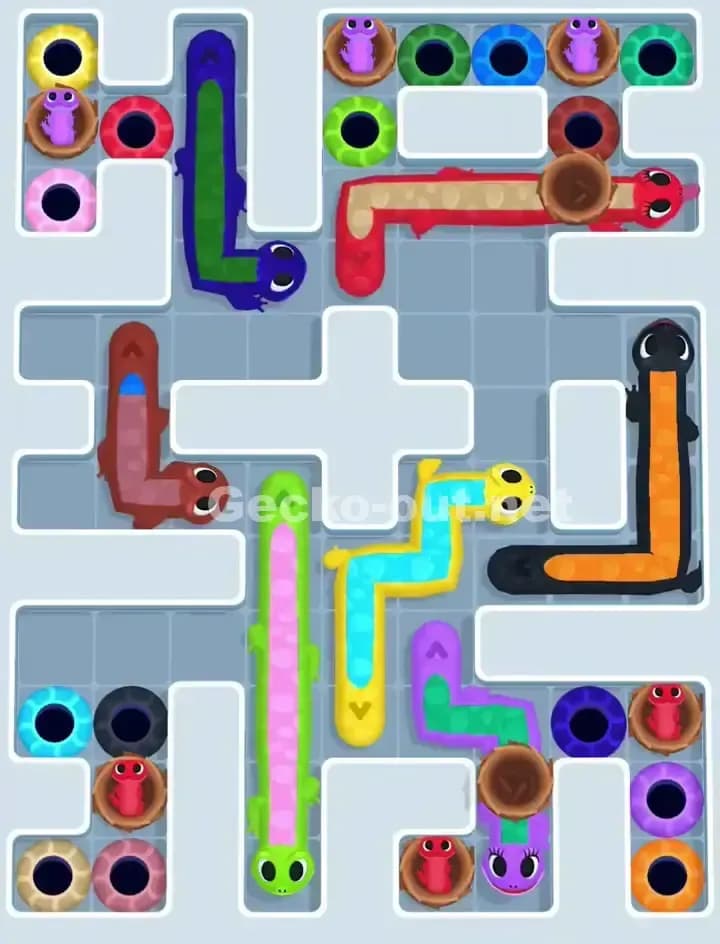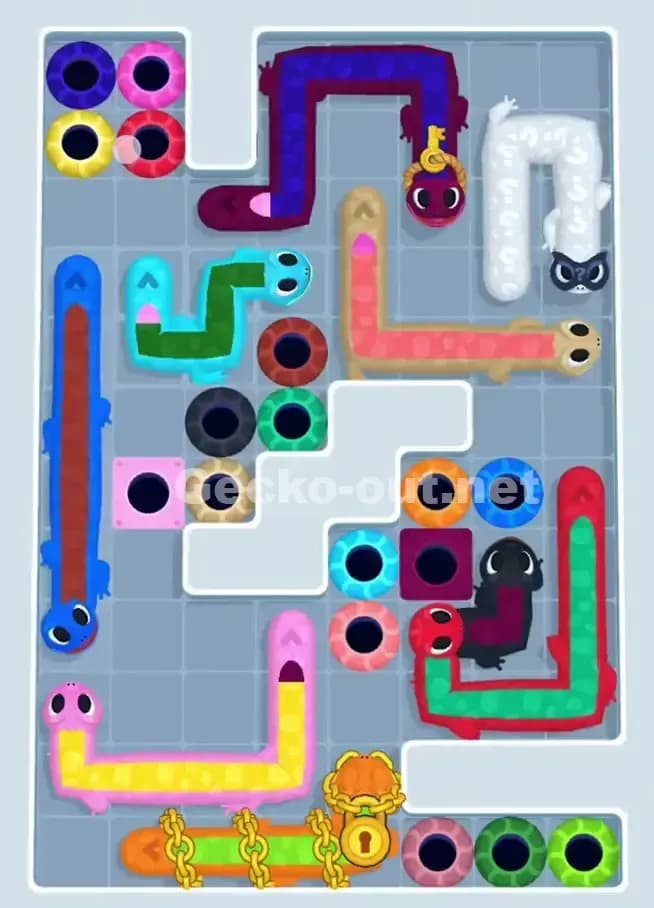
Gecko Out Level 1079 Solution Walkthrough | Gecko Out 1079 Answer
How to solve Gecko Out level 1079? Get step by step solution & cheat for Gecko Out level 1079. Solve Gecko Out 1079 easily with the answers & video walkthrough.

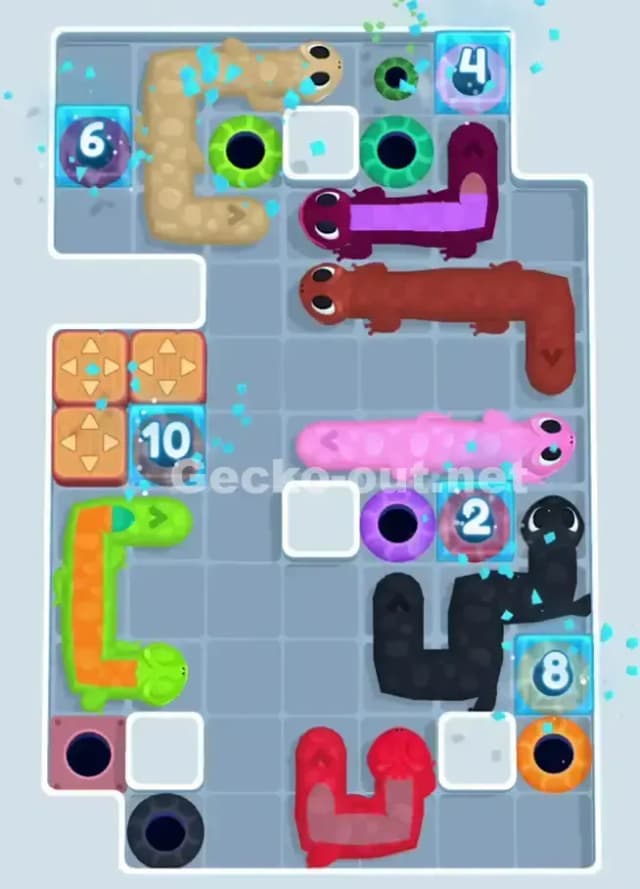

Gecko Out Level 1079: Board Layout, Rules, and Win Condition
Starting Board Overview and Key Obstacles
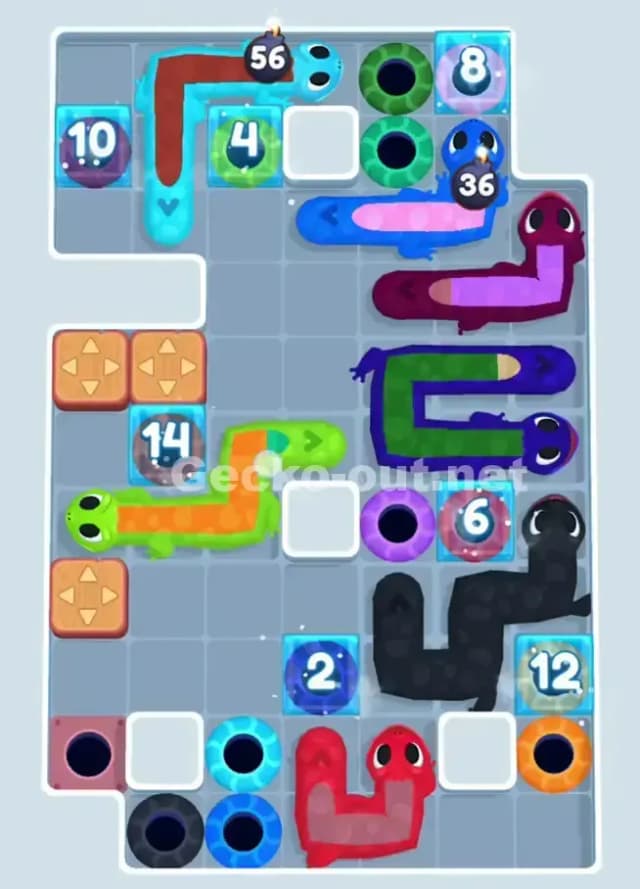
Gecko Out Level 1079 is a densely packed puzzle with seven distinct geckos scattered across a vertical, multi-chambered grid. You're working with a red gecko (labeled 75), a cyan gecko (labeled 5), two green geckos (labeled with eye symbols), a blue gecko (labeled 55), a purple gecko (labeled with a horned symbol), and several others color-coded throughout the board. What makes this level particularly tricky is that nearly every gecko's path intersects with walls, locked passages, or other geckos' bodies, creating a tangled knot that demands careful sequencing.
The board itself features several structural obstacles that aren't just decorative. There's a toll gate with orange directional tiles that acts as a checkpoint, white empty cells that serve as temporary "parking spots," and multiple gang geckos (geckos linked in pairs or groups) that move as single units. You'll also notice a horizontal striped bar in the middle section, which constrains vertical movement and forces geckos to navigate around it rather than through it. The overall layout feels like a maze deliberately designed to punish impatient or chaotic dragging.
Win Condition and Timer Pressure
Your goal in Gecko Out Level 1079 is straightforward on paper: drag each gecko's head to guide its body into a matching-colored hole before the timer runs out. However, the 75-second countdown creates real pressure because the board is so crowded. If you waste moves repositioning geckos or accidentally create a blocked corridor, you'll burn precious seconds with nothing to show for it. The win condition isn't just about getting geckos out—it's about getting them out in the right order so that earlier exits don't lock doors or create impassable knots for the geckos still waiting.
The body-follow mechanic is essential here too. Unlike games where movement is instant, in Gecko Out Level 1079 the gecko's body traces the exact path your head drag creates. This means a single poorly planned drag can wind a gecko's tail around an obstacle in a way that later blocks another gecko's exit route. You're not just solving a puzzle; you're choreographing a sequence of movements where each decision ripples forward.
Pathing Bottlenecks and Logical Traps in Gecko Out Level 1079
The Critical Bottleneck: The Toll Gate Corridor
The single biggest chokepoint in Gecko Out Level 1079 is the toll gate area in the middle-left section of the board. This is where multiple gecko paths converge, and it's the only practical route for several geckos to exit downward. The orange directional tiles flanking the gate aren't just visual flavor—they telegraph that this passage has strict rules about how bodies can thread through it. If you send a long gecko through this corridor first without planning ahead, you'll effectively lock shorter geckos out of their own escape routes because the longer gecko's body will still be occupying the passage as a physical barrier.
I found myself stuck here repeatedly on my first few attempts because I didn't realize the toll gate wasn't a "use once and forget" obstacle—it's a shared resource that every downward-exiting gecko has to navigate. The moment it clicked that I needed to clear short geckos through that passage first, leaving the long geckos for later routes, the puzzle suddenly felt solvable. This is the mental shift Gecko Out Level 1079 demands from you.
Subtle Problem Spot #1: The Purple Horned Gecko's Unexpected Length
At first glance, the purple horned gecko on the right side looks like it should have a straightforward exit path down the yellow-and-black corridor. However, its body is deceptively long—it curves around multiple cells in a way that isn't immediately obvious from its resting position. If you drag this gecko too early or try to force it through a tight space, you'll create a physical knot that blocks the yellow gecko (labeled 13) from exiting below it. The trap is that the purple gecko looks available to move, but moving it at the wrong time is actually the worst possible choice.
Subtle Problem Spot #2: The Cyan Gecko and the Red Gecko's Tangled Starting Position
The cyan gecko (labeled 5) and the red gecko (labeled 75) start in a cramped upper-left area with very limited maneuvering room. Their holes are in completely different regions of the board, yet their bodies are so close that one wrong drag can wrap them around each other. What's insidious here is that they're not technically "gang" geckos (linked together), so the game won't warn you they're about to collide. You have to manually trace each potential path mentally and realize that the cyan gecko must exit before the red gecko can move safely, or vice versa, depending on which direction you choose to route each one.
Subtle Problem Spot #3: The Green Geckos and the Central White Void
Two green geckos with eye symbols occupy upper portions of the board, and their natural exit routes seem to point toward the central white empty cells. However, those white cells are shared staging areas, and if both green geckos try to "park" there simultaneously or use overlapping paths, they'll block each other. Additionally, the white cells create a visual trap—they look like safe zones, but they're actually navigation chokepoints that demand precise timing.
My Moment of Clarity
I'll be honest: my first five attempts at Gecko Out Level 1079 felt overwhelming. There are so many moving parts that I kept defaulting to "just drag geckos out as fast as I can," which predictably led to tangled bodies and failed runs. The turning point came when I stopped looking at the board as "seven independent puzzles" and started seeing it as "one massive traffic problem." Once I asked myself, "If I were these geckos, which one would I want to exit first to clear space for the others?" everything clicked into focus. Gecko Out Level 1079 went from frustrating to genuinely satisfying.
Turn-by-Turn Path Strategy to Beat Gecko Out Level 1079
Opening: Clear the Smallest Geckos First, Park Strategically
Your opening move in Gecko Out Level 1079 should be to identify and route the shortest geckos first. This typically means targeting the green gecko with the eye symbol that's closest to an exit, or the cyan gecko (labeled 5) if you can route it cleanly without crossing other bodies. The strategic reason is simple: short geckos occupy less board real estate, so getting them out of the way immediately frees up corridors for the larger, more complex geckos that'll need those paths later.
For the geckos you're not immediately exiting, use the white empty cells as temporary parking spots. Drag their heads into positions where their bodies snake into safe zones but don't create barriers across critical corridors. Think of it like parking cars in a garage—you want to nestle them in corners and edges, not leave them blocking the main driveway.
Mid-Game: Maintain Lane Discipline and Avoid Recursive Knots
Once you've cleared one or two geckos, your mid-game focus in Gecko Out Level 1079 should be ruthless about lane discipline. Identify which paths are shared (like the toll gate corridor) and enforce a "first-out, first-served" system. If a long gecko needs to use a shared corridor, make sure all shorter geckos that might need that same corridor have already exited. Conversely, don't route a gecko through a tight space if a longer gecko is already parked there—you'll create what I call a "recursive knot" where neither gecko can move without unraveling the other.
For the gang geckos or linked pairs, treat them as single units. Don't try to separate them mentally; instead, trace their combined path as one extra-long body and plan around that. The blue gecko (labeled 55) and any linked geckos should be routed as complete units with their exit timing determined by their combined length, not optimized individually.
End-Game: Execute the Exit Sequence with Precision Timing
In the final stretch of Gecko Out Level 1079, you'll have three to four geckos left, and the timer will probably show 20–30 seconds remaining. Don't panic. Instead, take a breath and execute your planned exit order with precision. Drag the geckos whose paths are now unobstructed, moving from longest to shortest if possible, so that the final gecko has the entire board open for its exit route.
Watch the timer carefully during these last moves. If you're cutting it close with 10 seconds or fewer, commit to a direct path for the remaining geckos rather than trying to optimize their routes. A slightly inefficient exit is infinitely better than running out of time while you're deliberating. For Gecko Out Level 1079, especially in the end-game, decisiveness beats perfection.
Why This Path Order Works in Gecko Out Level 1079
Head-Drag Sequencing Prevents Tail Tangles
The reason this approach is so effective for Gecko Out Level 1079 is rooted in the body-follow mechanic. When you drag a gecko's head, its body doesn't teleport—it traces your exact path, cell by cell, in real-time. If you route geckos in the correct sequence (smallest to largest, or shortest-path to longest-path), each gecko's body vacates the board progressively, opening up space rather than consuming it. This is the opposite of what happens when you route geckos chaotically. Chaotic routing means a long gecko's body might still occupy a critical corridor while you're trying to squeeze a different gecko through the same space. Structured sequencing means each exit is a "unlocking" moment rather than a "locking" moment.
Timer Management: Read vs. Commit
Here's the counter-intuitive part of beating Gecko Out Level 1079 efficiently: you should spend the first 10–15 seconds reading the board carefully, even if the timer is counting down. Trace each gecko's path with your eyes. Identify the bottlenecks. Plan the sequence. Then, once you've locked in your strategy, commit and execute without second-guessing. This balanced approach prevents the frustration of running out of time because you overthought a mid-game decision, but it also prevents the disaster of rushing blindly and creating a knot you can't untangle.
If you find yourself stalled with 30 seconds left and two geckos still on the board, that's usually a sign that your sequencing was off. Rather than trying to salvage the run, it's better to fail and restart with your newfound insights. Gecko Out Level 1079 rewards learning and adaptation; it punishes stubbornness.
Booster Strategy: When (and When Not) to Use Them
For Gecko Out Level 1079, I'd recommend not using time boosters on your first few attempts. Instead, use a booster tactically if you've executed your strategy perfectly and find yourself just barely short of time—say, 3–5 seconds remain and one gecko is stuck halfway to its exit. In that case, a time booster is a legitimate tool. However, if you're using a booster because your sequencing was wrong, you're masking the real problem, and you'll keep failing at higher difficulty levels.
If Gecko Out Level 1079 offers a "hint" or "reveal" booster, consider using it on your first run to understand the board layout better. That knowledge investment pays dividends for your mental model of the puzzle.
Mistakes, Fixes, and Logic You Can Reuse in Other Gecko Out Levels
Mistake #1: Dragging the Longest Gecko First
The Problem: It's tempting to start with the most visually obvious gecko or the one that looks "stuck." Often, that's a long gecko. Moving it first seems like you're making progress, but you're actually consuming the entire board's capacity in one move.
The Fix: Always audit gecko length before you start dragging. Make a mental note of which geckos are short (1–2 cells), medium (3–4 cells), and long (5+ cells). Exit in that order: short → medium → long.
Mistake #2: Not Pre-Planning the Toll Gate Sequence
The Problem: In Gecko Out Level 1079, the toll gate is a shared resource, but new players often treat it as an obstacle rather than a choreography point. They drag the first gecko through it without considering whether a second gecko will need it, and suddenly they're stuck.
The Fix: Before making your first move, trace every gecko's route and count how many geckos will use the shared corridor. Rank them by body length, then plan to route them in ascending-length order through that corridor. This same logic applies to any bottleneck on any Gecko Out level.
Mistake #3: Parking Geckos in the Wrong Spots
The Problem: It's easy to drag a gecko's head into a white empty cell and assume it's "safe," but if its body snakes across a critical corridor, it's blocking that corridor for other geckos. You've created a static knot.
The Fix: When parking a gecko, drag its head in a way that curls its body into a corner or against a wall, not across active corridors. Use white cells as anchors, not as arbitrary stopping points. The gecko should occupy the least amount of "traffic" space possible.
Mistake #4: Confusing Gang Geckos with Independent Geckos
The Problem: Some geckos in Gecko Out Level 1079 might be linked (gang geckos), and trying to route them independently can cause them to collide with each other or tangle unexpectedly.
The Fix: At the start, visually identify which geckos are linked. Treat them as a single long unit with one exit point. Route the entire unit together, not half of it now and half later.
Mistake #5: Ignoring the Timer Until It's Critical
The Problem: You can get so focused on solving the puzzle that you don't notice the timer creeping down. Then suddenly you're in panic mode with 5 seconds left and two geckos still on the board.
The Fix: Check the timer every two geckos. If you're at the halfway point and the timer shows less than 50% remaining, speed up. If it shows more than 50%, you're in good shape and can afford a few more seconds of deliberation.
Reusable Logic for Similar Levels
The principles you learn from Gecko Out Level 1079 transfer directly to other gang-gecko, frozen-exit, or knot-heavy puzzles. Whenever you encounter a level with a shared bottleneck and multiple geckos needing to pass through it, apply the "shortest-first" sequencing rule. If a level has gang geckos or linked pairs, treat them as atomic units rather than trying to optimize individual members. And if a level has a tight timer and a complex board, always invest 10–15 seconds in planning before you commit to movement. These strategies are universally applicable because they're based on the underlying mechanics, not on specific level geometry.
Conclusion: Gecko Out Level 1079 Is Hard, But It's Beatable
Gecko Out Level 1079 is genuinely one of the trickier levels you'll encounter, and if you've spent time frustrated on it, that's not a reflection of your skill—it's proof that the level designers did their job well. The real victory isn't just getting all seven geckos out before the timer hits zero; it's the moment when the chaotic jumble of bodies and obstacles suddenly resolves into a clear, logical sequence in your mind. That "aha!" moment is what makes Gecko Out so satisfying.
With the strategies outlined here, you have a concrete framework for tackling Gecko Out Level 1079: read the board, plan the sequence, route short geckos first, protect shared corridors, and execute decisively. Stick to this approach, and you'll not only beat this level but develop intuition for how to approach similar challenges. You've got this.