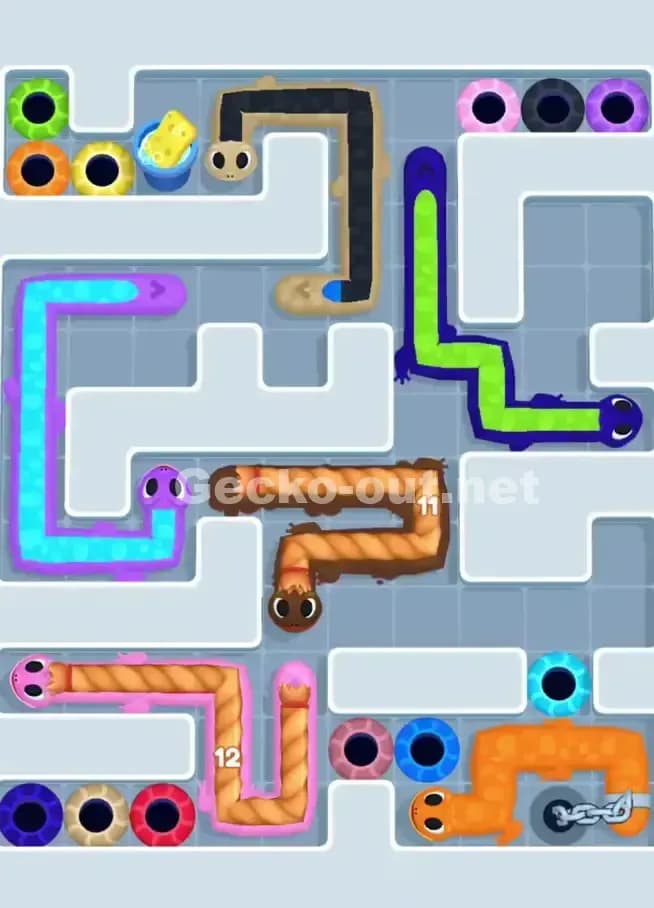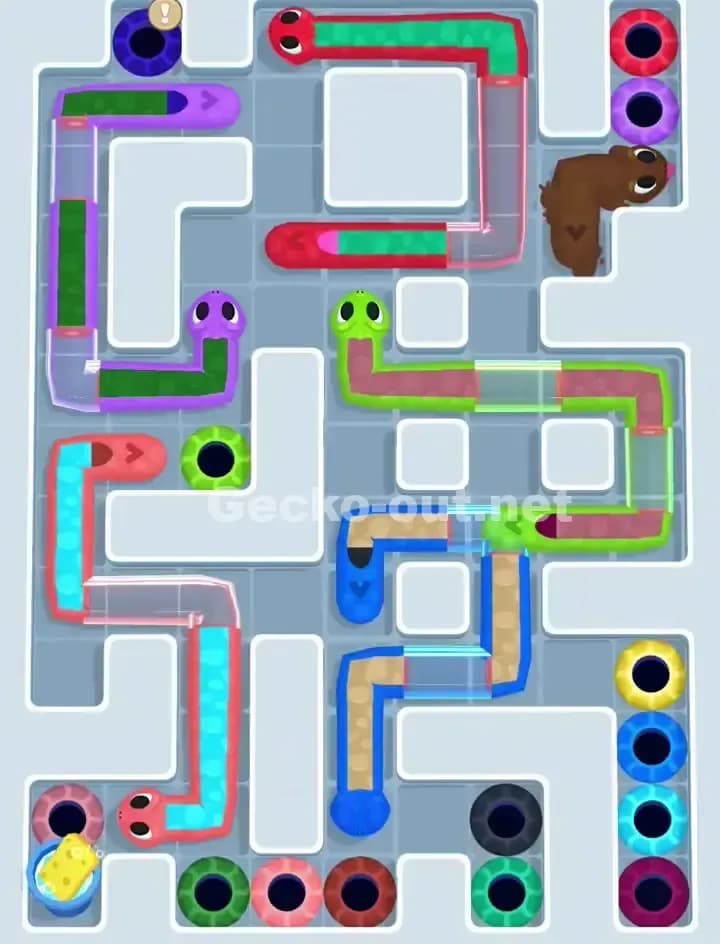
Gecko Out Level 1026 Solution Walkthrough | Gecko Out 1026 Answer
How to solve Gecko Out level 1026? Get step by step solution & cheat for Gecko Out level 1026. Solve Gecko Out 1026 easily with the answers & video walkthrough.
Gecko Out Level 1026: Board Layout, Rules, and Win Condition
Starting Board: Geckos, Colors, and Obstacles
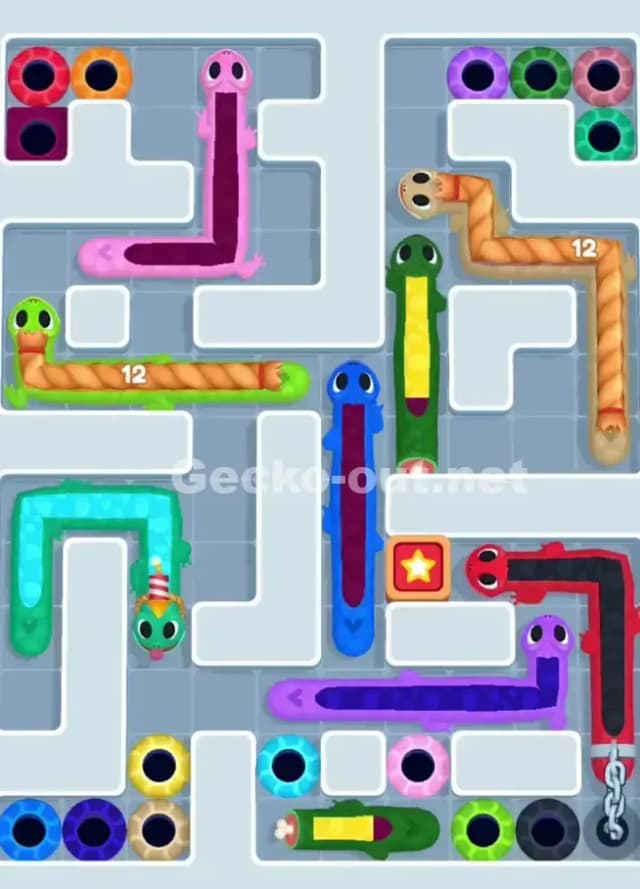
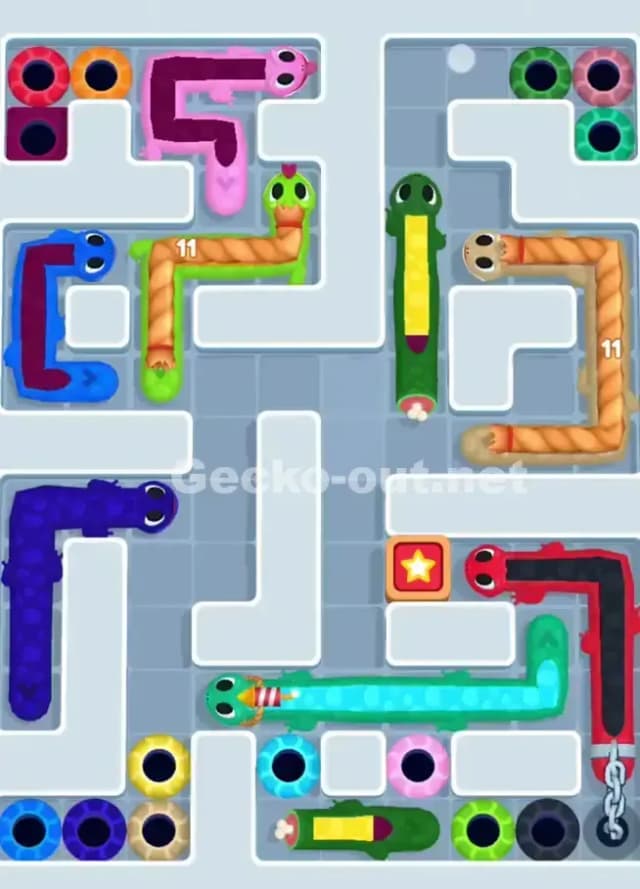
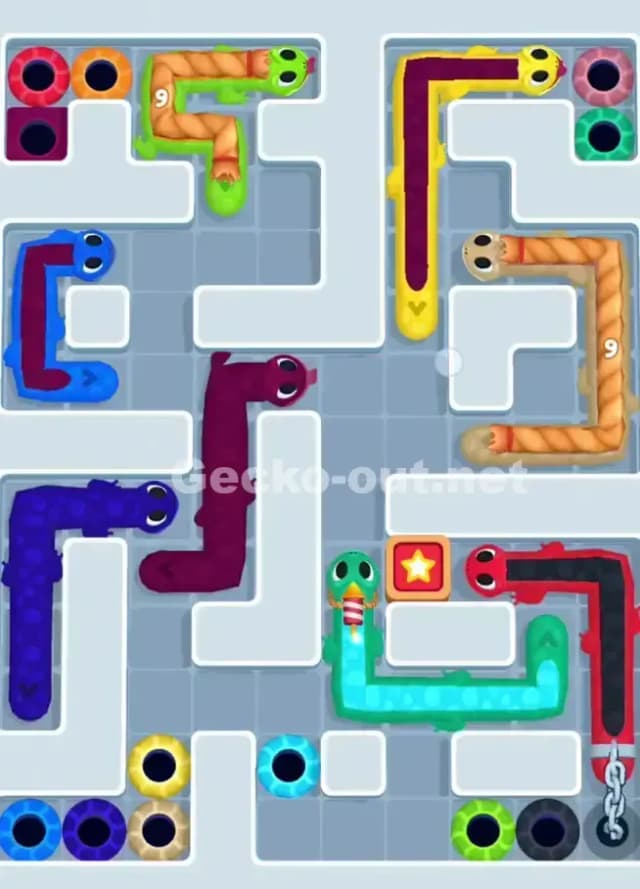
Gecko Out Level 1026 is a dense, multi-colored maze that demands careful planning from the very first drag. You're working with at least eight geckos of different colors—red, orange, pink, green, blue, purple, yellow, and cyan—scattered across a tight, L-shaped and spiral corridor system. The board features two long gang geckos marked with the number "12" on their bodies, signaling that these are extended creatures whose entire length must navigate the narrow passages without getting stuck or tangled. There's also a frozen cyan exit (marked with a glowing border) on the left side and what appears to be a red locked exit on the right. A golden star booster sits near the center-bottom area, but don't rely on it as your safety net. The pathways are deliberately cramped, with multiple choke points where only one gecko can fit at a time, and several "warning holes" scattered throughout that won't accept your gecko if the color doesn't match.
Win Condition and Timer Pressure
To beat Gecko Out Level 1026, every single gecko must reach a hole of its matching color before the timer expires. The timer is unforgiving—you'll have roughly 60–90 seconds depending on your difficulty setting—which means dilly-dallying over every micro-decision isn't an option. However, deliberate speed beats panicked rushing every single time. You must drag each gecko's head along a valid path from its starting position to its escape hole, and the body will follow that exact route. If any gecko is still on the board when time runs out, the entire level resets. This creates a psychological push-pull: you need to move fast enough to finish, but thoughtfully enough not to paint yourself into a corner where two geckos block each other's only viable exit route.
Pathing Bottlenecks and Logical Traps in Gecko Out Level 1026
The Critical Choke Point: The Central Spiral
The single biggest bottleneck in Gecko Out Level 1026 is the narrow vertical spine that runs down the center of the board. This is where the long gang geckos and several shorter ones must pass through to reach their exits. If you're not careful about the order and pathing of your drags, you'll create a traffic jam where a long gecko's body blocks the path of a second gecko, forcing you to restart. The cyan frozen exit on the left and the blue and red exits on the right all feed into or near this central corridor, which means almost every gecko eventually needs access to this bottleneck. If you drag a long gecko carelessly through this zone without planning where it'll stop, you'll trap shorter geckos behind it with no alternate route.
Subtle Problem Spots: Gang Geckos and Tight Turns
The two "12" gang geckos are your biggest headache because their long bodies can't bend sharply without clipping walls or other geckos. One orange gang gecko sits in the upper-right area, and a second one is positioned in the lower-left quadrant. These aren't just longer—they're inflexible, and dragging them requires you to plot a path that respects their full length. You'll need to visually trace their entire body as you drag to ensure no part of them overlaps a wall mid-journey. Additionally, the frozen cyan exit blocks normal entry, so the cyan gecko must use a workaround path, and the red locked exit won't open until you've placed a specific gecko or met a hidden condition. Watch out for the pink and purple geckos in the upper-middle section; they're close to each other and can easily become tangled if you're not precise with your head-drag angle.
The Aha Moment
Honestly, the first time I attempted Gecko Out Level 1026, I felt genuinely frustrated. I kept dragging geckos in what felt like the most direct path, only to find that the body's route clipped a wall or blocked another gecko's exit mid-way. The breakthrough came when I stopped thinking about individual geckos and started thinking about the board as a flow problem: which gecko must move first to open lanes for everyone else? Once I identified that the long orange gang gecko in the lower section needed to exit early to unblock the central corridor, suddenly everything else fell into place. The relief of that realization was immense, and it completely changed how I approach tangled, multi-gecko levels.
Turn-by-Turn Path Strategy to Beat Gecko Out Level 1026
Opening: Establish a Safe Staging Area
Your first move in Gecko Out Level 1026 should be to route the bottom-left cyan gang gecko toward the frozen cyan exit on the left side. This gecko is long and needs space to maneuver, but it also serves a crucial purpose: removing it from the board early opens up the lower-left corridor for other geckos. Drag its head carefully along the outer edge of the board, curving around the white obstacle spaces, and guide it into the frozen cyan exit. The frozen exit does work for cyan geckos—that's the whole point—so don't second-guess yourself here. Once it's out, you've created breathing room for the orange gang gecko and any green geckos that share that region.
Next, handle the long orange gang gecko in the lower-right or middle area. Identify its target hole (orange) and plot a path that moves it toward the exit zone without sending it through the central spine yet. If you can, "park" it in a holding area near its exit so it's not blocking critical corridors. Then move the yellow gecko—it's usually less entangled and can be routed out quickly, which further opens the board.
Mid-Game: Keep Critical Lanes Open and Reposition Methodically
As you move into the middle phase of Gecko Out Level 1026, your focus shifts to managing the central vertical corridor. The pink and purple geckos in the upper section need careful handling; drag one (let's say pink) first, tracing a path that goes around rather than through the tightest parts of the maze if possible. Watch the body carefully as it follows your drag line—if any part overlaps a wall square, the path is invalid and you'll need to restart the drag.
For the green geckos scattered around the board, prioritize those whose holes are in the congested central region. Move a green gecko out first before moving a blue or red gecko into that same corridor; order matters because a blue gecko's body takes up space that a green gecko might need. The board rewards you for thinking three moves ahead, so before dragging any gecko, ask yourself: "After this gecko exits, will another gecko be able to reach its hole?" If the answer is no, reconsider the sequence.
The two long gang geckos must exit before you move the smaller ones through the spine. Yes, this sounds backwards—shouldn't you move the small ones first to get them out of the way? Not in Gecko Out Level 1026. The gang geckos are slower to drag and more likely to clip walls, so completing them early ensures you don't run out of time debugging a complex path. Move them deliberately, using broad, gentle curves, and don't cut corners.
End-Game: Final Geckos and Last-Second Timing
By the time you're down to your last two or three geckos in Gecko Out Level 1026, the board should feel almost empty. You'll have 15–25 seconds remaining on the timer. The remaining geckos should have clear, obstacle-free paths to their holes. If they don't, you made a mistake earlier and should restart. But assuming you've followed the sequence, simply drag the final geckos in quick succession toward their matching exit holes. Blue goes to the blue hole, red to red, and so on. Move fast but don't skip the visual check—one wrong drag here wastes precious seconds.
If you're genuinely low on time (5–10 seconds left) and only one or two geckos remain, use the golden star booster only if the remaining gecko's path is genuinely ambiguous or blocked. Otherwise, trust your setup and finish without it.
Why This Path Order Works in Gecko Out Level 1026
How Head-Drag Pathing and Body-Follow Mechanics Prevent Knots
The genius of the strategy above is that it uses the body-follow rule to your advantage rather than fighting against it. By routing long geckos out first, you prevent their bodies from ever becoming obstacles for shorter geckos later. The head-drag mechanic means you're essentially drawing a line that the gecko will follow pixel-for-pixel—there's no "pathfinding AI" that reroutes the gecko. If you draw a path that clips a wall, the gecko stops and the move is invalid. So Gecko Out Level 1026 demands that you pre-visualize the full route before you start dragging. The opening sequence (cyan, orange, yellow) removes the longest and most cumbersome geckos, which shrinks the effective complexity of the remaining puzzle from "eight tangled geckos" to "four simple geckos finding empty lanes."
Timer Management: Pause and Commit
Here's the honest truth about Gecko Out Level 1026: you need to spend the first 10–15 seconds just reading the board and planning your sequence. This isn't wasted time; it's the most valuable investment you can make. Before you drag the first gecko, trace the cyan exit path with your eyes, then the orange path, then the green exits. Identify which gecko is blocking which, and commit to an order. Once you start dragging, move with confidence and speed. Each drag should take 3–5 seconds, not 20. If you mess up a drag, restart immediately rather than overthinking a recovery—your time is precious, and a clean run from the start is often faster than salvaging a half-broken board.
Booster Strategy: When and Why
The golden star booster on Gecko Out Level 1026 is optional, not essential. If you follow the opening sequence and mid-game corridor management, you should finish with 10+ seconds to spare. A golden star gives you extra time (usually 30 seconds), so use it only if you're running below 10 seconds with more than two geckos left. Don't use it preemptively as a "safety net"—that teaches you sloppy pathing. Save boosters for genuine emergencies, and they'll make you a better player in the long run.
Mistakes, Fixes, and Logic You Can Reuse in Other Gecko Out Levels
Five Common Mistakes on Gecko Out Level 1026 and How to Fix Them
Mistake 1: Dragging long geckos last. Players often try to move small geckos first, thinking they're easier. Wrong. Long geckos are harder to path and more likely to create blockages, so move them early. Fix: Always prioritize gang geckos (marked with numbers) and move them within the first 30 seconds. This instantly opens the board for smaller geckos and buys you mental clarity.
Mistake 2: Forcing a gecko through the central corridor when an outer path exists. The board has multiple routes, but players tunnel-vision on the most direct-looking path. Fix: Before dragging, identify at least two possible routes for each gecko and choose the one that keeps the central corridor free for geckos that truly need it. This takes 5 seconds and saves 30 later.
Mistake 3: Not visually tracing the full body during a drag. You drag the head confidently, but the body clips a wall mid-route and your move fails. Fix: Always pause before dragging and trace the gecko's entire body length along your intended path with your eyes. Make sure no part of it overlaps a wall square or another gecko.
Mistake 4: Ignoring the frozen cyan exit. Players try to route the cyan gecko through a normal path and waste time debugging it. Fix: Recognize that the frozen cyan exit is specifically designed for cyan geckos; use it without hesitation. This is a gift, not a trap.
Mistake 5: Running out of time with one gecko left. You panic, drag too fast, miss the hole, and reset. Fix: If you're at 15+ seconds with three or fewer geckos left, you've already won—slow down, breathe, and execute three perfect drags. Rushing the endgame is where wins turn into losses.
Reusable Logic for Similar Levels
The logic behind Gecko Out Level 1026 applies to any level with multiple gang geckos, tight corridors, or frozen/locked exits. Here's what to carry forward: Long geckos first, short geckos last. Identify the single biggest bottleneck and route geckos away from it until the board is clear. Use frozen and locked exits as strategic tools, not complications. Spend 10–15 seconds planning before you drag anything. These principles work on Gecko Out levels 1020, 1025, 1027, and beyond—anywhere you find tangled, multi-color chaos.
Final Encouragement
Gecko Out Level 1026 is legitimately tough. The combination of long geckos, tight corridors, and a strict timer makes it feel impossible until you find the right sequence. But that's exactly why beating it feels so good. You've got a clear plan now: move cyan and orange first, keep the central spine open, and finish with confidence. The solution is there, waiting for you to execute it. Go beat Gecko Out Level 1026, and enjoy that victory screen.