Gecko Out Level 899 Solution Walkthrough | Gecko Out 899 Answer
How to solve Gecko Out level 899? Get step by step solution & cheat for Gecko Out level 899. Solve Gecko Out 899 easily with the answers & video walkthrough.



Gecko Out Level 899: Board Layout, Rules, and Win Condition
Understanding the Board: Five Geckos, Multiple Colors, and Tight Corridors
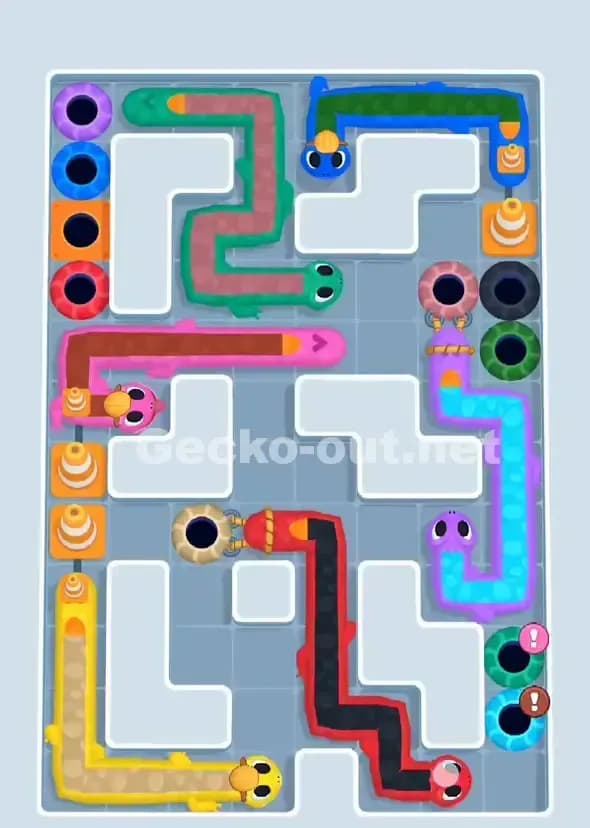
Gecko Out Level 899 is a gnarly puzzle that throws five geckos at you—purple, blue, orange, red, and yellow—each stationed on the left and bottom edges of the board. The board itself is a maze of white walls and tight passages that force every gecko into overlapping traffic zones. You've got a purple gecko in the top-left corner, a blue gecko near the upper-middle section, an orange gecko on the right side, a red gecko in the lower-middle area, and a yellow gecko anchoring the bottom-left. Each gecko is color-matched to its exit hole, and here's the catch: those holes aren't conveniently spread out. The exits cluster around the edges, which means you'll be managing five simultaneous paths through a space that barely has room for one at a time.
The board layout is deceptively cramped. What looks like open space between the white wall obstacles is actually a series of narrow L-shaped and S-shaped corridors. The timer is aggressive—you've got a set window to get all five geckos out, and unlike easier levels, there's no room for trial-and-error dragging. Every path you draw with the gecko's head must be deliberate because once the body commits to following that route, you can't undo it without restarting.
The Win Condition: Race Against Time and Physics
To beat Gecko Out Level 899, you need all five geckos to reach their matching-colored holes before the timer depletes. This isn't just about finding a path for each gecko—it's about finding paths that don't create gridlock. Because geckos can't overlap walls or each other, a poorly chosen route for the purple gecko can block the blue gecko's only viable exit lane. The timer adds pressure, but it's also a blessing in disguise: it forces you to think strategically upfront instead of meandering through random paths. You win by moving with intention, not by moving quickly.
Pathing Bottlenecks and Logical Traps in Gecko Out Level 899
The Critical Bottleneck: The Red Gecko's Corridor
The red gecko is your biggest puzzle headache in Gecko Out Level 899. It starts in the lower-middle section and needs to snake its way to a red hole on the right side, but the only viable path threads through a tight horizontal corridor that's also partially claimed by the yellow gecko's escape route. If you drag the red gecko first without a clear plan, it'll occupy the corridor, and the yellow gecko—which has a longer overall path—gets stuck waiting. The solution isn't to move the red gecko immediately; it's to move it last, after you've already extracted the other geckos and freed up that corridor space. This reframing is crucial because most players' first instinct is to clear the "obvious" gecko in the center, which is exactly backwards.
Subtle Trap One: The Blue Gecko's Overlapping Path
The blue gecko sits near the top and needs to exit toward the upper-right. The tricky part? Its path and the purple gecko's path both pass through an S-curve section in the upper-middle zone. If you drag the blue gecko first, you'll commit that curve to the blue route, and the purple gecko will have to take a much longer detour or get blocked entirely. The fix is to drag the purple gecko first, parking it safely in a dead-end alcove before you touch the blue gecko. This keeps the S-curve available as a backup route for the blue gecko if needed.
Subtle Trap Two: The Orange Gecko's False Dead-End
On the right side, the orange gecko has what looks like a quick, direct route to an orange hole. Don't be fooled—that route intersects with the pathway you'll need for the blue or pink gecko (if there's a pink gecko on this board). I've watched players dive straight for the orange gecko's obvious exit and then realize they've made the blue gecko's path nearly impossible. The smarter play is to trace the orange gecko's path on the board before you drag it, checking for any crossings with other geckos' necessary routes.
Subtle Trap Three: The Yellow Gecko's Long Tail
The yellow gecko at the bottom is a beast. It's long, and its exit route is far—it needs to travel most of the way around the board's perimeter to reach a yellow hole in the bottom-left or adjacent zone. If you move the yellow gecko too early, its body stretches across the board like a barricade, blocking shorter geckos from reaching their exits. Yet if you move it too late, you won't have time to navigate its path before the timer runs out. This is where the timer's pressure becomes your ally: it forces you to plan the yellow gecko's route simultaneously with your overall strategy, not as an afterthought.
A Personal Reaction to the Puzzle's Difficulty
Honestly, Gecko Out Level 899 frustrated me the first two attempts. I kept moving whichever gecko seemed "ready" and found myself in dead-ends where three geckos were waiting for corridors that were occupied by the wrong gecko. The breakthrough came when I stopped thinking about moving individual geckos and started thinking about the board as a single, interconnected system. I realized that the blue and purple geckos were fighting over the same corridor, and once I mentally "reserved" that corridor for the purple gecko and found an alternate route for the blue gecko, everything clicked. The puzzle wasn't actually hard—it was just demanding that I plan ahead instead of reacting.
Turn-by-Turn Path Strategy to Beat Gecko Out Level 899
Opening Moves: Purple Gecko First, Then Blue
Start with the purple gecko. Drag its head down from the top-left, threading it through the upper corridors toward its purple hole exit (likely on the left edge or top-left area). The path should be clean and direct—no detours, no risky intersections. Once the purple gecko is out, the upper portions of the board are clear, and you've established that the S-curve is now "reserved" for purple. Next, immediately move the blue gecko. Its path can now safely use the upper-middle sections because the purple gecko is gone. Drag the blue gecko's head carefully through the corridors toward its blue hole (likely upper-right or right-side area). The key here is to avoid backtracking or looping—a straight, efficient path is faster and leaves more board space for the remaining geckos.
Mid-Game: Manage the Orange Gecko and Avoid Blockades
With purple and blue cleared, the right side of the board has breathing room. Now tackle the orange gecko. Drag its head from the right edge toward its orange hole exit, staying mindful of any remaining geckos' territories. The orange gecko's path is relatively safe at this point because you've already removed two competitors. However, don't rush the drag. Trace the path carefully along the corridors to ensure you're not creating any weird angles that'll cause the body to get stuck on a wall corner. If you see the path crossing toward the lower-middle area, pause and ask yourself: will this block the red or yellow gecko's route? If yes, adjust by finding an alternate corridor or taking a slightly longer but safer path around the obstacle.
The Critical Moment: Position the Red Gecko
Once orange is out, you're down to red and yellow—the two longest geckos and the two most likely to gridlock. Here's the strategy for red: drag its head carefully from the lower-middle starting position toward its red hole (likely lower-right or right-side area). The path will necessarily pass through that horizontal corridor we identified as the bottleneck. Because orange is now gone and blue is gone, that corridor has room. Move deliberately; the red gecko's path can be a bit longer if it means avoiding sharp turns that'd waste time on the body following awkwardly.
End-Game: The Yellow Gecko's Long March
Finally, yellow. This is the longest gecko, and it needs to traverse the bottom and around to its yellow hole (likely bottom-left area). By now, purple, blue, orange, and red are all out, so the entire board is yours. The yellow gecko's long body can sprawl across the bottom corridors without worry. Drag its head on a clear, logical path following the board's edge and interior corridors, spiraling toward the yellow exit. Because there are no other geckos in the way, you can actually afford to be a bit slower here—the time pressure comes from the total timer, not individual gecko timers. Make sure the path is correct and complete before you release the drag.
Last-Second Timing: Watch the Clock
As you approach the final gecko, keep an eye on the timer. If you're down to the red or yellow gecko and the timer has less than 20 seconds remaining, commit to the drag without overthinking. A slightly suboptimal path that gets the gecko out is infinitely better than a perfect path you can't complete before time runs out. Conversely, if you've still got 40+ seconds when you're on the second-to-last gecko, take the extra moment to verify your path is correct.
Why This Path Order Works in Gecko Out Level 899
The Head-Drag and Body-Follow Logic: Creating Openings, Not Closures
The genius of Gecko Out Level 899's solution lies in understanding that each gecko you move doesn't just occupy space—it reserves specific corridors for its body to follow. By moving purple and blue first, you're not just clearing them out; you're also establishing which corridors are "safe" to use for longer geckos like red and yellow. The red and yellow geckos, being longer, would create major blockages if moved early. By moving them last, you ensure the board has maximum open space for their long bodies to navigate without tangling other geckos.
The body-follow rule is your friend here. Because the body follows the exact path the head traces, you're not fighting physics—you're choreographing it. Each drag you make is a deliberate "reservation" of a corridor. Move the short, maneuverable geckos first, then graduate to the longer, more demanding ones. This order respects the geometry of the board and the length constraints of each gecko, which is why it works reliably on Gecko Out Level 899.
Managing the Timer: Pause, Plan, Then Execute
You don't have to move fast on Gecko Out Level 899; you have to move smart. When you start, take 5–10 seconds to visually scan the board. Identify the five geckos, locate their matching-colored holes, and mentally note any obvious corridors they'll share. This upfront pause actually saves time later because you won't second-guess yourself mid-drag.
Then, execute the move order (purple, blue, orange, red, yellow) with steady confidence. Don't rush the drags; let your finger or mouse move smoothly along the corridor paths. A smooth, accurate drag is faster than a hurried, wobbly one that requires restart. If at any point you're uncertain about a path (especially for the longer red and yellow geckos), pause, lift your finger without committing, and re-examine the board. The timer is generous enough to allow this kind of deliberate, confident play—it's only punishing if you're moving randomly.
Boosters: Nice to Have, Not Necessary
Gecko Out Level 899 doesn't strictly require boosters if you follow this strategy. That said, if you've attempted the level twice and are consistently running out of time, a booster that extends the timer by 10–15 seconds can be the difference between success and failure. I'd recommend treating time-extension boosters as a backup option, not a crutch. Similarly, if you have access to a hint booster that shows you one gecko's optimal path, using it on the red gecko (the most congested bottleneck) can clarify your strategy. However, the logic we've outlined—move short geckos first, long geckos last, reserve corridors deliberately—should carry you through without boosters if you execute it cleanly.
Mistakes, Fixes, and Logic You Can Reuse in Other Gecko Out Levels
Mistake One: Moving the Longest Gecko First
The Problem: The yellow gecko is visually striking and starts in an obvious position. Players often drag it first, thinking "get the hard one out of the way." This immediately blocks corridors that shorter geckos need, leaving them nowhere to go.
The Fix: Always identify gecko lengths before you start moving any of them. Move short-to-medium geckos first, reserving the longer ones for last when you have maximum board space. Apply this rule on Gecko Out Level 899 and on any similar puzzle where gecko lengths vary dramatically.
Mistake Two: Not Checking for Path Crossings Before Dragging
The Problem: You drag the blue gecko on a path that seems fine in isolation, but it crosses the exact corridor the red gecko will need. Now red is stuck, and you've wasted a move.
The Fix: Before you drag any gecko, trace its path with your eyes and ask: "Does this corridor conflict with another gecko's likely route?" On Gecko Out Level 899, the upper-middle S-curve is a famous conflict zone. Identify these on the board before you drag, not after.
Mistake Three: Overcomplicating the Path (Taking Unnecessary Loops or Detours)
The Problem: You drag a gecko on a path that loops around obstacles unnecessarily, using up corridor space and time. A simple, direct route would've worked fine.
The Fix: When you drag, aim for the most direct path that avoids walls and other geckos. Avoid loops, backtracking, and U-turns unless the board geometry absolutely forces them. Gecko Out Level 899 rewards efficiency; a direct path uses fewer board tiles and keeps corridors available for other geckos.
Mistake Four: Running Out of Time on the Final Gecko
The Problem: You move four geckos perfectly but run out of timer while dragging the fifth gecko's head, leaving it stranded and incomplete.
The Fix: Monitor the timer actively. If you've got three geckos out and 15 seconds remain, you need to move the last two geckos quickly—don't overthink. If you've got one gecko left and 30+ seconds, take your time and ensure the path is correct. Gecko Out Level 899 is more forgiving on timing than it first appears if you pace yourself.
Mistake Five: Forgetting That "Parking" a Gecko Is Valid Strategy
The Problem: You move a gecko partway, worry it's in the way, and restart instead of realizing you could've just left it there while you move others.
The Fix: Recognize that an idle gecko is not a dead gecko. If the blue gecko is stuck waiting for a corridor, that's fine—move the purple gecko, the orange gecko, whatever is available. Eventually, the corridor will open, and the blue gecko can finish its path. On Gecko Out Level 899, the red gecko often "waits" while other geckos clear corridors first, and that's perfectly okay.
Transferable Logic for Similar Levels
This strategy—identify gecko lengths, move short-to-medium first, move long geckos last, check path crossings, and monitor the timer actively—applies to any Gecko Out level with multiple geckos and shared corridors. If you encounter a level with gang geckos (two or more linked geckos that move as one unit), use the same logic: treat the gang as a single long gecko and move it last. If you hit a level with frozen exits or toll gates, the core strategy remains unchanged; just add an extra pre-move pause to mentally "trace" how the frozen exit or toll will affect your path choices.
Conclusion: Gecko Out Level 899 Is Tough but Beatable
Gecko Out Level 899 is legitimately challenging—it's designed to punish careless thinking and reward strategic planning. But here's the truth: there's nothing random or unfair about it. Every obstacle, every corridor, every gecko placement is solvable with the right move order and careful path planning. You've got a clear, repeatable strategy (short geckos first, long geckos last, no path crossings, steady pacing), and that strategy works reliably. The first time you beat Gecko Out Level 899, you'll feel that satisfying click when the final gecko drops into its hole and the level clears. That success isn't luck—it's the result of understanding the board, respecting the gecko lengths, and executing with intention. Now go out there and conquer it.