Gecko Out Level 623 Solution Walkthrough | Gecko Out 623 Answer
How to solve Gecko Out level 623? Get step by step solution & cheat for Gecko Out level 623. Solve Gecko Out 623 easily with the answers & video walkthrough.
Gecko Out Level 623: Board Layout, Rules, and Win Condition
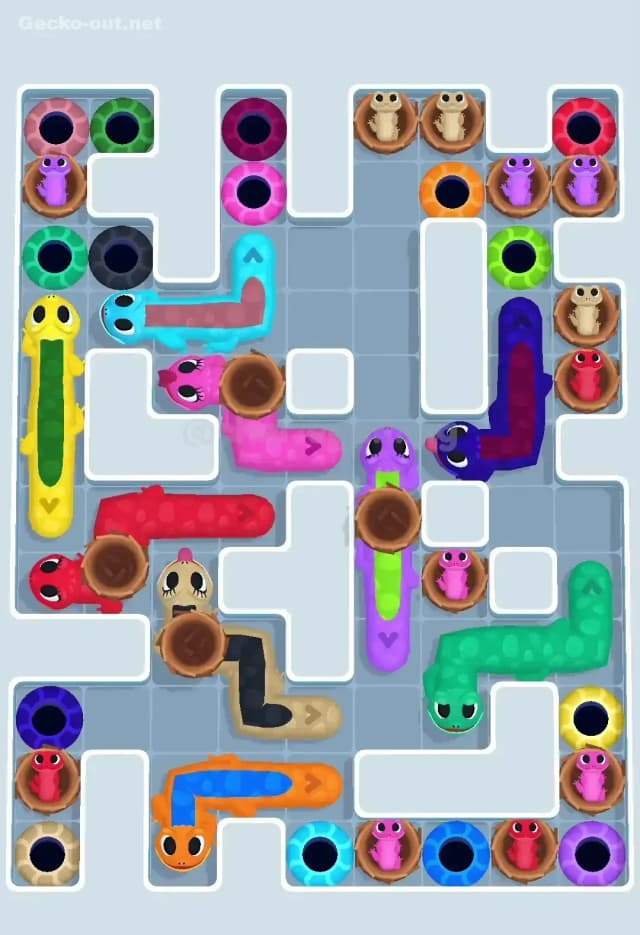
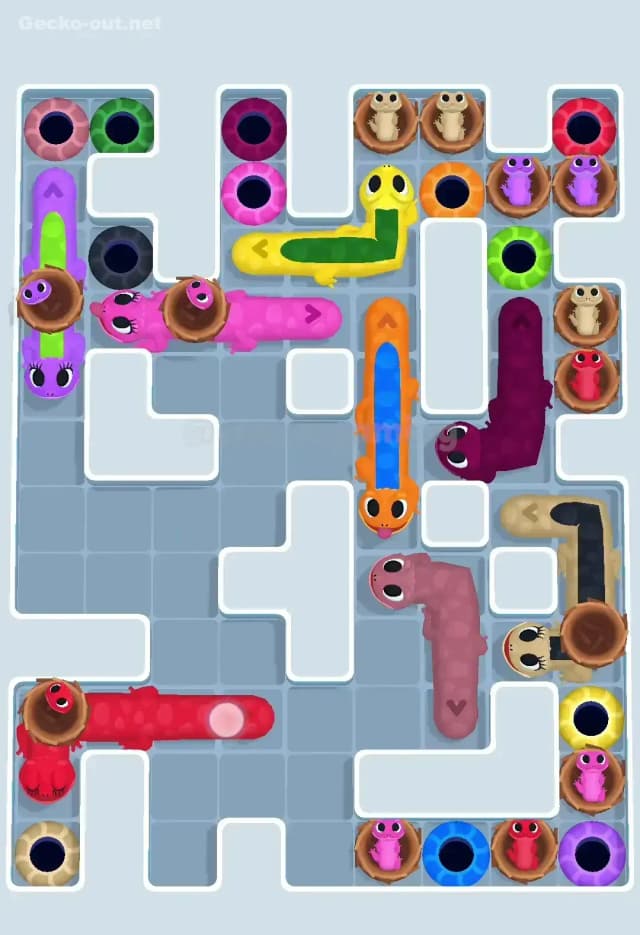
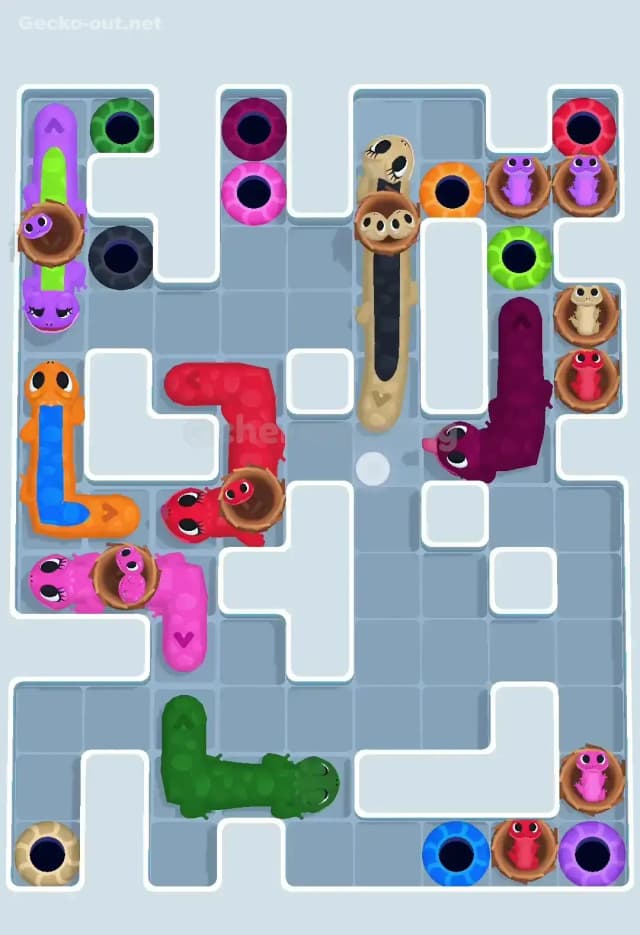
The starting tangle in Gecko Out 623
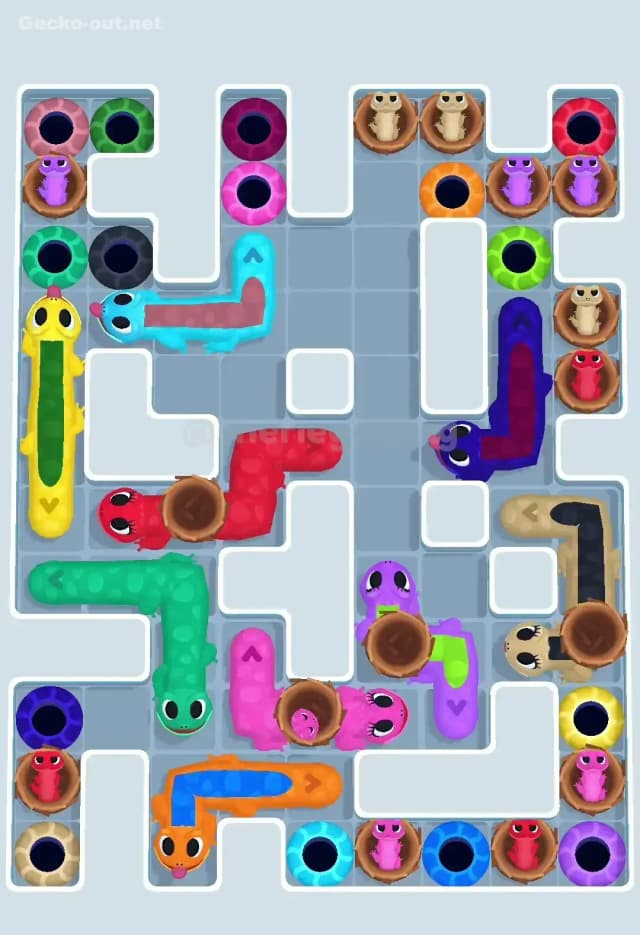
Gecko Out Level 623 throws you into a tight maze packed with walls, logs, and long snakes of color. You’ve got a full rainbow of geckos: a tall yellow one along the left wall, a chunky red one in the lower left, a long green gecko coiled along the bottom‑right corridor, a cyan gecko near the top middle, a purple one running vertically near the center-right, a pink gecko wedged just above the middle, a dark blue L‑shaped gecko on the right, and a beige “gang” gecko with a black tail sitting right in the central crossroads.
Colored donut holes ring the outer walls and a few inner pockets. Each hole matches one of your geckos, and the tiny baby geckos sitting in the rings tell you which color belongs where. Scattered brown logs block key turns; they’re placed just annoyingly enough that you can’t just draw straight lines and be done. There are also a handful of small, empty squares in the center that act as your temporary parking spots. Almost every usable lane is one tile wide, so defense against self‑blocking is the main puzzle in Gecko Out 623.
Win condition and why the timer hurts here
To beat Gecko Out Level 623, every gecko has to slither into the donut hole with the same colored ring. You drag the gecko’s head along a route, and its body follows the exact path. Geckos can’t overlap each other, walls, logs, or holes of the wrong color. Once a gecko’s head reaches its matching hole, it dives in and disappears, freeing the tiles its body occupied.
The twist is the strict timer. You don’t have time for lots of trial‑and‑error drawing; if you restart too many moves because a body got stuck across a corridor, the clock just runs out. Because the path is recorded exactly, a sloppy curve can leave a trail that loops back through a choke point and locks the board. Gecko Out 623 is really about drawing clean, purposeful routes that free lanes instead of cluttering them, and doing it fast enough that you’re not staring at the board when the timer hits zero.
Pathing Bottlenecks and Logical Traps in Gecko Out Level 623
The main choke point gecko
The single biggest bottleneck in Gecko Out Level 623 is the beige gecko with the black tail sitting in the central hub. It lies across the only bridge between the left half and the right half of the map. Until you reposition it, the long green and purple geckos on the right can’t really reach their exits, and the red and yellow geckos on the left can’t squeeze past either.
Because of that, your plan basically lives or dies on how you handle that beige gecko. Move it too early and you snake its body through lanes other geckos need later. Move it too late and you’ll have a pile‑up at the central corridor with no time left. You want to use it as a “gatekeeper”: shift it just enough to open the passage, then park it in a dead‑end where it can’t cause trouble.
Sneaky problem spots that ruin runs
There are a few subtle traps in Gecko Out 623:
- The bottom row is a fake shortcut. The long green gecko loves to sprawl along that lane, but if you drag it straight left or right without thinking, its body ends up sealing off multiple exits. Later geckos will need that bottom row to curve into their own holes.
- The top‑left cluster of holes is easy to block with the tall yellow gecko. If you route yellow inefficiently, its body can stretch across the access corridor, and suddenly nobody else can reach those top exits.
- The central vertical lane next to the purple gecko looks like a clean highway, but if you park anyone there “just for a second,” you’ll block the curve that purple or blue needs to turn into their matching holes.
All three of these mistakes feel harmless while you’re doing them, then you realize a minute later that a final gecko simply cannot reach its exit without redrawing half the board.
When Gecko Out Level 623 finally clicks
I’ll be honest: the first time I played Gecko Out Level 623, I burned the timer three runs in a row by trying to brute‑force random paths. It felt like one of those levels where every move makes things worse. The turning point was when I stopped thinking “How do I get this one gecko out?” and started thinking “Which lanes must be free at the very end?”
Once that clicked, the puzzle opened up. I realized the center corridor and the bottom row are sacred: you keep them open as long as possible, then spend them in the final exits. After a couple of runs focusing on parking geckos in side pockets instead of main roads, the layout suddenly felt logical rather than cruel.
Turn-by-Turn Path Strategy to Beat Gecko Out Level 623
Opening: Early priorities and safe parking
In Gecko Out 623, start with the geckos whose exits are nearby and whose bodies free space rather than eat it.
- First, move the cyan gecko near the top center into its matching top‑side hole. Draw a tight, minimal route that doesn’t swing through the central hub. When it disappears, you gain a roomy corner and keep the central tiles untouched.
- Next, adjust the beige central gecko just enough to open the passage between left and right. Swing its head into the small side alcove near the bottom of that central region and park it there. Don’t send it to its hole yet; it’s safer as a compact parked snake than as a long trail through the board.
- Use the new space to route the pink gecko in the upper middle into its matching hole. Aim to pull it upward or sideways into a nearby exit so that its body doesn’t cross the center lane.
Your opening goal is simple: free 2–3 geckos that are close to exits while clearing and protecting the middle of the board as your future highway.
Mid-game: Keeping lanes open and threading the long bodies
Once the top and central areas are less crowded, you can deal with the long geckos that dominate Gecko Out Level 623.
- Tackle the tall yellow gecko on the left. Draw its path along the left wall and then directly into its matching hole near the top cluster. Keep the path hugging the wall so its body doesn’t cut across the interior corridor.
- With yellow gone, give the red gecko in the lower left a simple, clean line toward its bottom‑row hole. Again, hug outer walls; don’t loop into the center. Clearing red opens that whole lower‑left side.
- Now focus on the purple vertical gecko near the center-right. Route it in a straight line, then bend just once toward its matching hole on the right. Use the central opening you preserved earlier; make sure no parked bodies sit in that turn.
- Finally, prepare the long green gecko at the bottom-right. Before you move it, quickly check that every other gecko that needs the bottom row has already escaped or has an alternative route. Then drag green along the outermost lanes, avoiding stray loops. Once it’s out, the bottom of the map becomes wide open.
In this mid‑game phase, think of yourself as “peeling” the board from the outside in. Clear wall‑hugging routes first, and only then start cutting across shared corridors.
End-game: Exit order, last choke points, and low‑time plans
By the end of Gecko Out Level 623, you should have just a couple of geckos left: usually the dark blue L‑shaped one on the right and the parked beige gang gecko in the middle.
- Send the dark blue gecko next. Use the now‑open bottom row or central column as a smooth curve into its color‑matched hole. Since most others are gone, you can be slightly more generous with the path as long as it doesn’t double back through the same turn you need for beige.
- Finish with the beige gang gecko. From its parking spot in the central alcove, draw the most direct possible line to its exit, avoiding unnecessary wiggles so the body doesn’t sprawl into dead lanes.
If you’re low on time, prioritize straight‑line exits over perfect elegance. You’ve already protected the key corridors; at this point, even a slightly messy path should work because there are so few bodies left on the board.
Why This Path Order Works in Gecko Out Level 623
Using head‑drag pathing to untangle instead of knotting
This plan for Gecko Out 623 always routes early geckos along edges and shallow turns. Because bodies follow the exact drawn path, that means you’re “braiding” the snakes around the outer walls and leaving the heart of the maze open. Parking the beige central gecko keeps its body short and controlled, so later you can draw a clean, final path without undoing earlier work.
By saving the long green and dark blue geckos for late, you avoid dragging huge bodies through crowded intersections. They instead sweep through lanes that are already mostly empty, which feels satisfying instead of chaotic.
Managing the timer: when to think, when to move
On Gecko Out Level 623, you should actually pause at the start for a few seconds. Scan for your must‑have lanes: the central hallway, the bottom row, and the left‑edge corridor up to the top cluster. Once you’ve identified those, stop over‑planning and start drawing.
Move fast on short, obvious exits like cyan, pink, and yellow. These are “free” time; they clear bodies without much risk. Slow down a little for the beige and green geckos, where a bad curve can block winning paths. After a run or two, you’ll know the shapes by feel and can execute them quickly without staring at the timer.
Booster usage: optional, not required
Gecko Out Level 623 is very beatable without boosters, but if you’re stuck:
- A hint booster early can highlight which gecko the level expects you to move first (usually matches the cyan or pink exit).
- A hammer‑style remover is best saved for a late mistake, like mis‑routing the long green gecko and sealing the bottom row. Breaking one log or undoing one body there can salvage a nearly‑won run.
- Extra time is overkill, but if you’re consistently timing out with one gecko left, popping an extra‑time booster before starting the level gives you room to draw carefully.
Use boosters as insurance, not as your main plan. Once you understand the path logic, you won’t need them.
Mistakes, Fixes, and Logic You Can Reuse in Other Gecko Out Levels
Common mistakes in Gecko Out Level 623 (and how to fix them)
- Parking in the center: Leaving any gecko’s body in the middle crossroads early is a disaster. Fix it by always parking in side alcoves or along walls.
- Dragging big loops: Drawing lazy, curved paths for short exits makes their bodies longer than necessary. In Gecko Out 623, always go for the shortest possible route; shorter bodies mean more breathing room later.
- Moving the long green gecko too early: If you do this, it seals the bottom row. Instead, delay green until most others are gone.
- Forgetting exit colors: In the rush, it’s easy to send a gecko past its own hole while aiming for somewhere else. Take half a second before each move to pair head color with ring color.
- Spamming restarts: Constantly restarting eats time and momentum. Commit to a full run using the strategy above; you’ll learn more from near‑wins than from reflex resets.
Reusing this logic in other tough Gecko Out levels
The core ideas from Gecko Out Level 623 carry over nicely:
- Identify the “sacred” lanes that late‑game geckos must use, and protect them early.
- Park problem geckos (especially multi‑colored gang geckos) in small dead‑ends until you’re ready to route them cleanly.
- Clear short, wall‑hugging exits first to shrink the knot, then move long geckos through an already‑thinned maze.
- Draw the shortest possible paths; pretend every unnecessary curve costs you a tile of free space and a second of timer.
Final encouragement
Gecko Out Level 623 looks brutal at first glance, but once you treat it as a lane‑management puzzle instead of a pure maze, it becomes surprisingly fair. You’re not expected to find some pixel‑perfect miracle route; you just need a sensible order, clean lines, and a bit of discipline about where bodies are allowed to rest.
Stick to the plan—edge exits first, central parking for beige, long geckos last—and you’ll see Gecko Out 623 flip from “impossible” to “Oh, that’s it?” in just a few attempts.