Gecko Out Level 483 Solution Walkthrough | Gecko Out 483 Answer
How to solve Gecko Out level 483? Get step by step solution & cheat for Gecko Out level 483. Solve Gecko Out 483 easily with the answers & video walkthrough.
Gecko Out Level 483: Board Layout, Rules, and Win Condition
Understanding the Starting Board
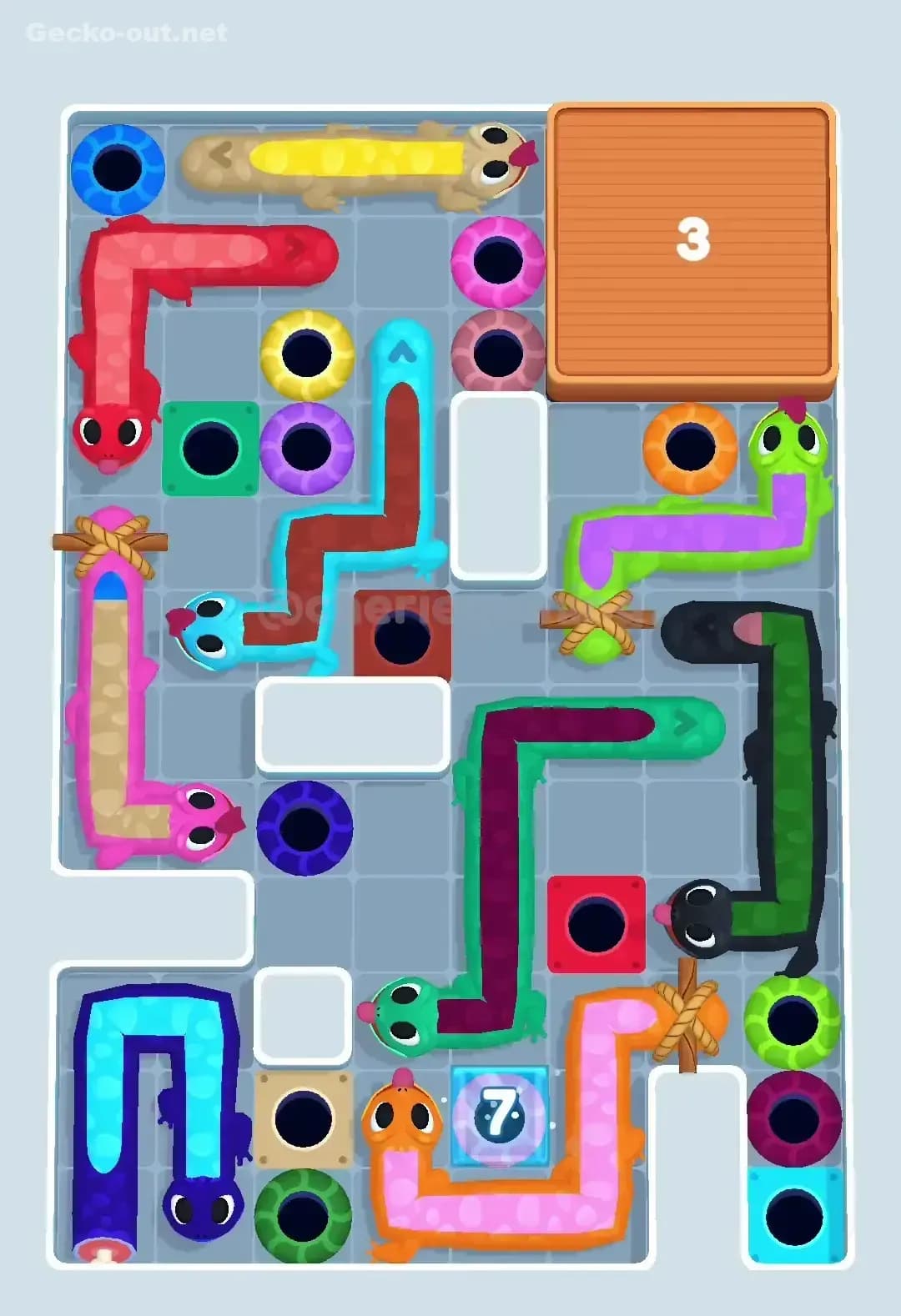
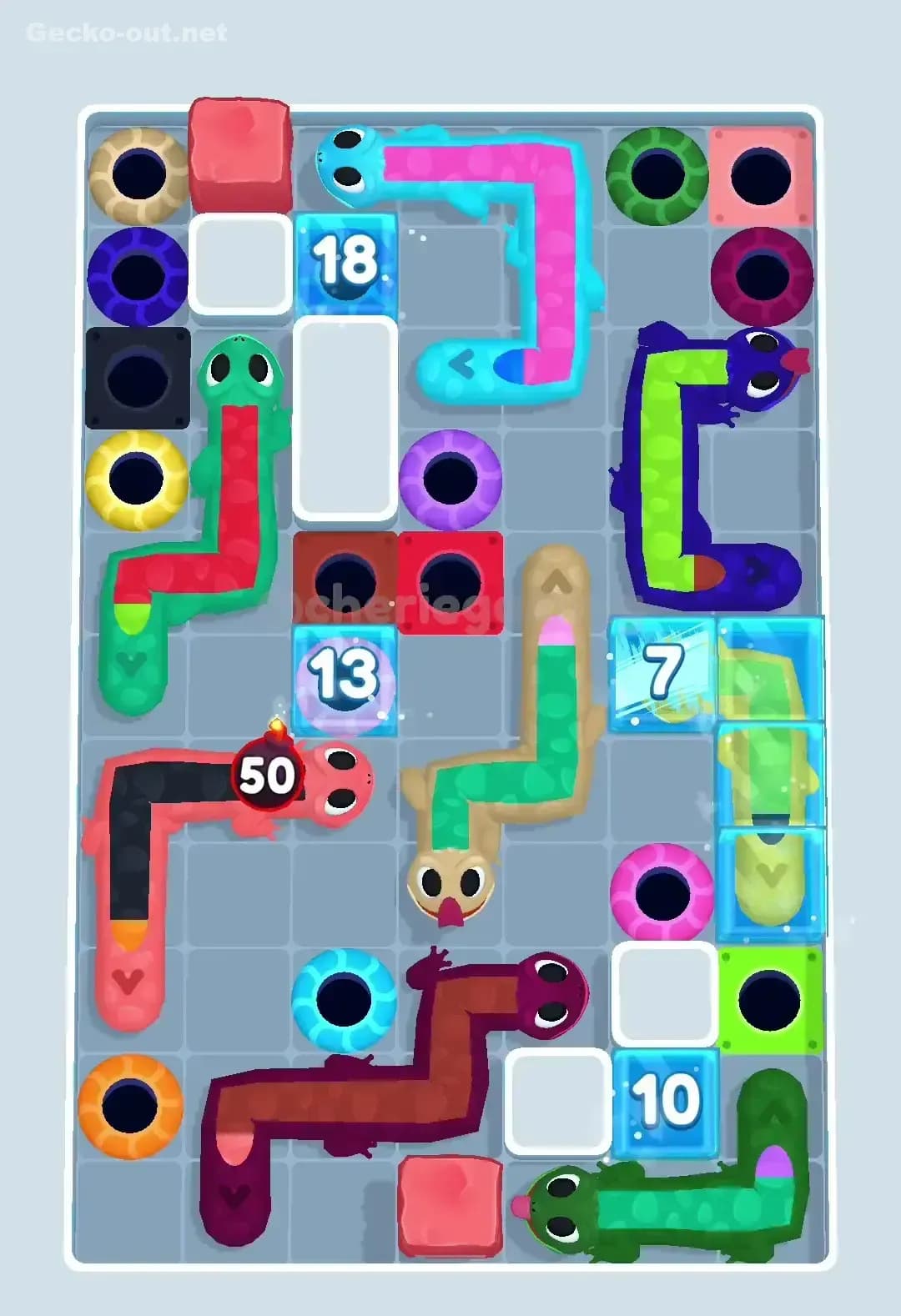
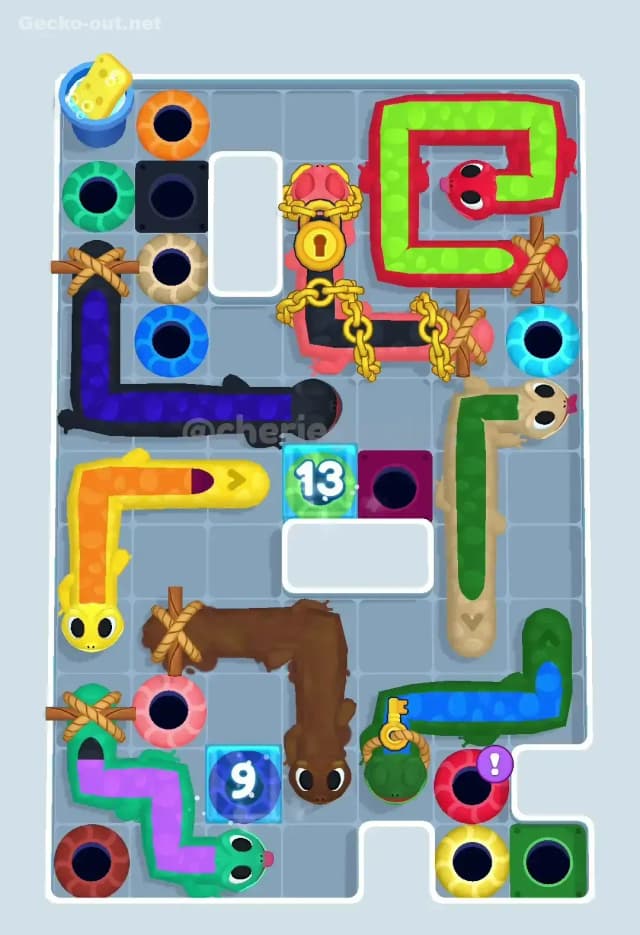
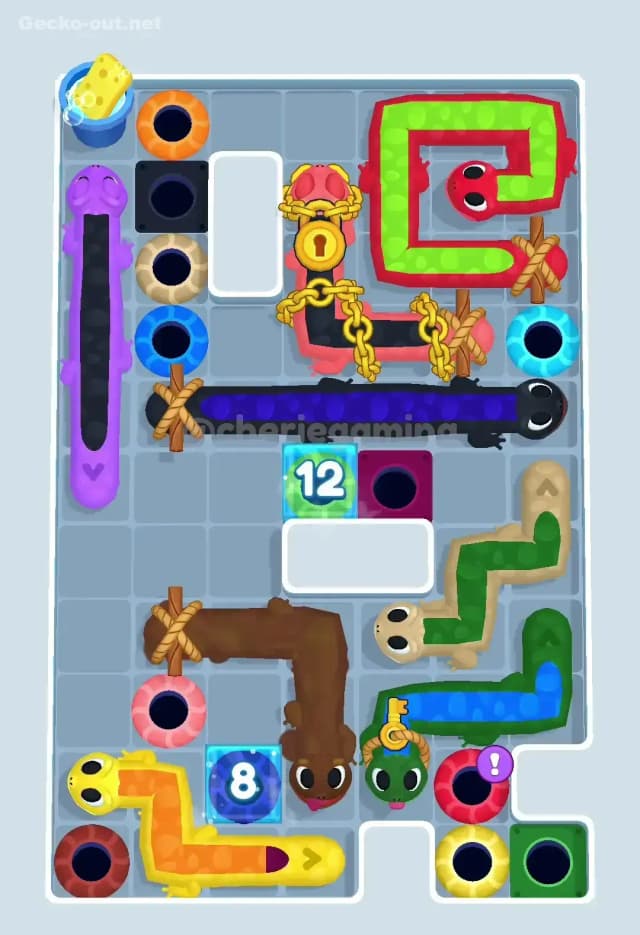
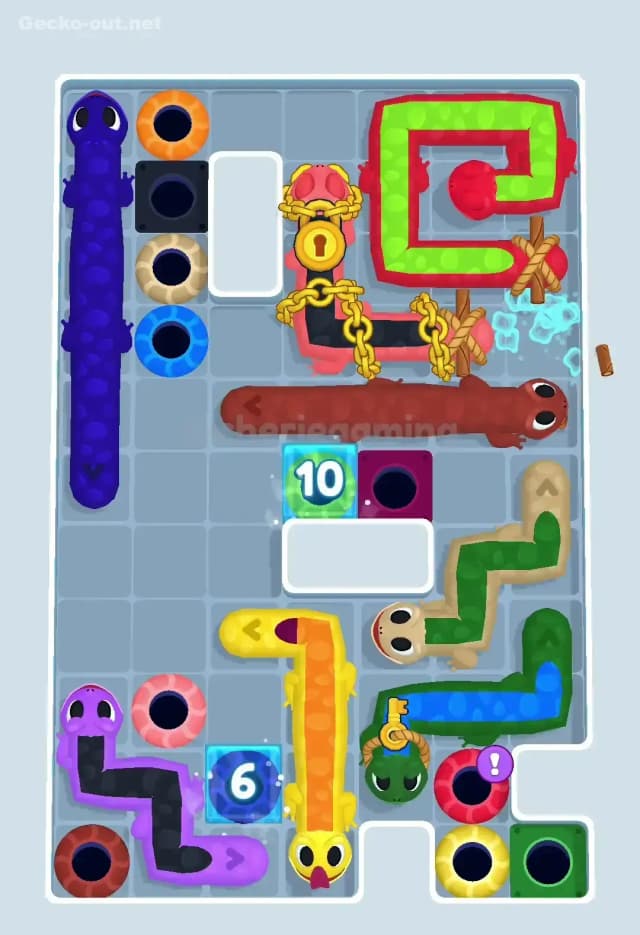
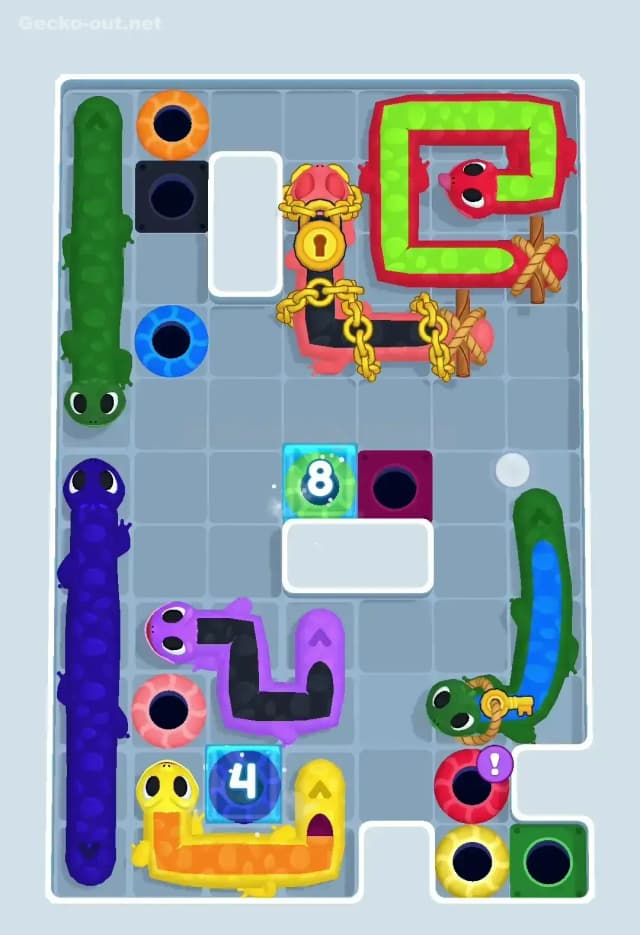
Gecko Out Level 483 throws you into one of the densest tangles you've encountered so far. The board is packed with seven geckos of varying colors—yellow, orange, green, blue, brown, purple, and red—each needing to reach their matching colored hole. What makes this level immediately intimidating is how tightly wound the gecko bodies are around each other. The yellow gecko sits coiled in the upper-left corner, while the brown gecko sprawls across the middle-right section like a massive wall. The blue gecko occupies a significant vertical column on the left side, and several geckos are connected by rope knots, meaning they're "gang geckos" that move together. You'll also spot padlocks blocking certain exits and a move counter showing "13" and "9" on blue tiles, indicating limited-move zones or specific timing requirements.
The sheer number of circular holes scattered across the board might seem helpful at first, but many are decoys or belong to geckos you haven't even identified yet. The tight spacing between walls, gecko bodies, and obstacles means almost every square inch of this grid matters. One wrong drag can create a knot that's impossible to untangle within the time limit.
Win Condition and the Timer Challenge
To beat Gecko Out Level 483, you must guide every gecko head to its corresponding colored exit hole before the countdown hits zero. The drag-and-path mechanic is unforgiving here: when you drag a gecko's head, its entire body follows that exact route, cell by cell. If you draw a path that loops back on itself or crosses through occupied spaces, the gecko will either refuse to move or create a collision that blocks other geckos from reaching their exits.
The timer in Gecko Out Level 483 is aggressive. You don't have the luxury of trial-and-error replays within a single attempt—every second counts, and hesitation costs you. The level punishes players who try to solve one gecko at a time without considering how each move impacts the remaining geckos. You're not just solving seven individual puzzles; you're orchestrating a synchronized escape where order and efficiency determine success.
Pathing Bottlenecks and Logical Traps in Gecko Out Level 483
The Brown Gecko Bottleneck
The single biggest obstacle in Gecko Out Level 483 is the brown gecko sprawled horizontally across the lower-middle section of the board. Its body acts like a dam, blocking vertical and diagonal movement for almost every other gecko. If you try to move the brown gecko too early, you'll discover its path to the brown exit requires threading through spaces currently occupied by the yellow, green, or blue geckos. But if you leave the brown gecko until last, its massive body prevents other geckos from reaching their exits in the bottom-right quadrant.
This creates a classic catch-22: the brown gecko can't move until others clear out, but those others can't escape because the brown gecko is in the way. The solution requires breaking the usual instinct to "finish one gecko completely before starting another." Instead, you need to partially reposition the brown gecko to open a critical lane, then pivot to other geckos, and return to brown only when the final path is clear.
Gang Geckos and Rope Constraints
Look closely at the ropes connecting certain gecko bodies—particularly the red and green geckos on the right side. These gang geckos move as a unit, meaning dragging one head repositions both bodies simultaneously. In Gecko Out Level 483, this constraint is both a challenge and an opportunity. If you're not careful, moving the red gecko will drag the green gecko into a position that blocks the purple or blue exits. However, if you plan the gang movement correctly, you can use their linked motion to clear two obstacles at once, freeing up the congested middle corridor faster than solving them individually.
The rope mechanic also means you can't isolate problems. Every move with a gang gecko ripples across the board, so you need to visualize both paths before committing to the drag.
Locked Exits and Timing Pressure
Several exits in Gecko Out Level 483 are protected by padlocks, and some appear frozen or otherwise inaccessible. The orange-ringed hole near the brown gecko, for example, might not unlock until you've completed a specific sequence elsewhere on the board. I spent three attempts trying to force the yellow gecko out early, only to realize its exit was locked behind a chain that required moving the orange gecko first. That delay cost me precious seconds and created a cascade of traffic jams.
The numbered tiles—showing "13" and "9"—add another layer of complexity. These likely indicate move limits or countdown triggers for specific zones. If you drag a gecko through these zones inefficiently, you'll burn through your move allowance before clearing the board.
The Moment It Clicked
Honestly? Gecko Out Level 483 felt impossible until I stopped thinking about individual geckos and started mapping out the order of escapes. The breakthrough came when I realized the blue gecko—despite being massive—was actually the key to unlocking the entire left side. Once I repositioned blue to hug the left wall, suddenly the yellow and brown geckos had room to breathe. That single insight turned a chaotic mess into a solvable sequence.
Turn-by-Turn Path Strategy to Beat Gecko Out Level 483
Opening: Clear the Blue Gecko First
Your first move in Gecko Out Level 483 should focus on the blue gecko in the left column. Drag its head downward and slightly to the right, guiding its body into a compact vertical position that hugs the left wall. This move accomplishes two things: it opens up the upper-left corner for the yellow gecko, and it clears a diagonal lane that the brown gecko will need later.
Do not try to exit the blue gecko immediately. Instead, park it in a safe holding position near its blue hole but not yet inside. This reserves the exit path while freeing up space for the yellow and orange geckos to maneuver.
Next, tackle the yellow gecko. Drag its head clockwise around the upper-left obstacles, threading it through the now-open space where the blue gecko used to coil. Guide the yellow gecko toward its exit in the top-center area, but again, don't complete the exit yet. Park it one or two squares away.
Mid-Game: Unravel the Gang Geckos and Brown Bottleneck
With the left side loosened, shift focus to the gang geckos on the right—red and green. Drag the red gecko's head toward the top-right corner, deliberately moving both linked bodies upward and out of the central corridor. This dual motion should pull the green gecko into a position where it can later snake down toward its exit in the lower-right without crossing the brown gecko's path.
Now address the brown gecko. Drag its head leftward, carefully routing its body through the space the blue gecko vacated earlier. The brown gecko's path should arc around the center obstacles and position its head near the brown exit in the bottom-middle section. This is the trickiest drag in Gecko Out Level 483—take your time to visualize the full path before committing, because one mistake here will block the purple or orange geckos from escaping.
Once brown is positioned (but not exited), move the orange gecko. Drag it through the upper-middle corridor, using the space the yellow gecko opened. Route orange toward its exit near the locked padlock area, making sure its body doesn't cross back through the gang gecko zone.
End-Game: Sequential Exits and Timer Management
With all geckos positioned near their exits, you enter the final sprint of Gecko Out Level 483. Exit geckos in this order to avoid last-second blocks:
- Yellow gecko – Complete its exit first to clear the top-center area.
- Blue gecko – Send it into the blue hole to fully open the left column.
- Orange gecko – This should unlock any chain-locked exits and clear the upper-middle.
- Gang geckos (red, then green) – Exit red first, which should automatically position green for an easy final drag.
- Brown gecko – With the center now clear, brown can make its exit without obstruction.
- Purple gecko – Save purple for second-to-last; its path should be trivial once brown is gone.
- Final gecko – Whichever color remains, it should have a direct line to its exit.
If you're running low on time (under 10 seconds), resist the urge to rush. A single misclick will cost more time than a one-second pause to confirm your drag path. If you've positioned everyone correctly in the mid-game, the exits should fall like dominoes.
Why This Path Order Works in Gecko Out Level 483
Leveraging Body-Follow Mechanics
The strategy for Gecko Out Level 483 works because it respects the fundamental rule: the body follows the head's exact path. By repositioning geckos without immediately exiting them, you're essentially "pre-loading" the solution. Each gecko's body acts as a temporary barrier that controls where other geckos can move. When you park the blue gecko vertically along the left wall, you're not just moving one gecko—you're creating a fixed boundary that forces the yellow and brown geckos into efficient paths.
This approach also prevents the classic mistake of "finishing" one gecko too early. If you exit the yellow gecko in move two, its body vanishes from the board, which sounds helpful but actually removes a structural element that was channeling other geckos into optimal paths. By keeping geckos on the board until the end-game sequence, you maintain control over the traffic flow.
Timer Management and Decision Points
Gecko Out Level 483 demands a balance between planning and execution speed. In the opening and mid-game, you should spend 3-5 seconds per move visualizing the full drag path. Look for potential collisions, locked exits, and gang gecko ripple effects before you commit. However, once you've positioned all geckos near their exits, the end-game sequence should be rapid-fire: one exit every 1-2 seconds.
The numbered tiles (13 and 9) likely represent move budgets for specific zones. If you follow the path order above, you'll naturally stay within these limits because you're minimizing backtracking and redundant movements. Each drag serves multiple purposes: opening a lane, repositioning a blocker, and pre-staging the next gecko's path.
Booster Usage: Optional but Strategic
You can beat Gecko Out Level 483 without boosters if you execute the plan correctly. However, if you're struggling with the timer, consider using a time-extension booster right before the end-game sequence (after positioning all geckos but before starting the exit chain). This gives you breathing room to double-check each exit path without the panic of a countdown.
Alternatively, a hint booster in the opening moves can help identify the correct blue gecko repositioning if you're unsure where to park it. Avoid using a hammer or obstacle-removal booster—the level doesn't have breakable walls or crates, so those tools won't help here. The challenge in Gecko Out Level 483 is pure logic and pathing, not physical obstacles.
Mistakes, Fixes, and Logic You Can Reuse in Other Gecko Out Levels
Common Mistakes in Gecko Out Level 483
Mistake 1: Exiting geckos too early. Many players complete the yellow or blue gecko in the first few moves, thinking it simplifies the board. Instead, this removes structural elements that were guiding other geckos into efficient paths. Fix: Park geckos near their exits but don't complete them until the end-game sequence.
Mistake 2: Ignoring gang gecko constraints. Dragging the red gecko without considering the green gecko's position creates impossible tangles. Fix: Always visualize both gang gecko paths simultaneously before moving either one.
Mistake 3: Rushing the brown gecko. The brown gecko's size and central position make it tempting to "get it out of the way" immediately. But forcing brown too early blocks exits for orange, purple, or the gang geckos. Fix: Reposition brown partially in the mid-game, then exit it only after yellow, blue, and orange are gone.
Mistake 4: Drawing looping paths. When panicking under timer pressure, players often drag a gecko's head in a circular route that crosses its own body. The game will reject this move, costing you time. Fix: Before dragging, trace the intended path with your eyes to ensure it's collision-free.
Mistake 5: Misreading locked exits. Trying to force a gecko into a padlocked hole wastes moves and creates frustration. Fix: Identify which gecko unlocks the chain (usually orange or yellow in this level) and prioritize that gecko's positioning.
Reusable Strategies for Similar Levels
The core logic of Gecko Out Level 483—repositioning before exiting, managing gang geckos as units, and sequencing exits to avoid last-second blocks—applies to any high-difficulty Gecko Out level with dense tangles. Levels in the 400-500 range often feature oversized geckos, linked constraints, and aggressive timers. The "park-and-sequence" approach works universally because it transforms a chaotic knot into a controlled queue.
You can also reuse the blue-gecko-first opening on any level where a large gecko occupies a central column or row. By moving the biggest obstacle first, you create breathing room for smaller geckos to maneuver without constant collisions.
Final Encouragement
Gecko Out Level 483 is legitimately tough—it took me five attempts to crack the correct sequence, and even then, I finished with only four seconds remaining. But here's the thing: once you see the solution, it feels obvious in hindsight. The level isn't unfair or luck-based; it's a pure test of spatial reasoning and order-of-operations thinking.
If you're stuck, take a break and return with fresh eyes. The answer is always on the board, waiting for you to see the pattern. And when you finally watch all seven geckos escape in perfect sequence, that victory screen feels incredibly earned. You've got this—Gecko Out Level 483 is tough, but you're tougher.