Gecko Out Level 176 Solution Walkthrough | Gecko Out 176 Answer
How to solve Gecko Out level 176? Get step by step solution & cheat for Gecko Out level 176. Solve Gecko Out 176 easily with the answers & video walkthrough.



Gecko Out Level 176: Board Layout, Rules, and Win Condition
What You’re Dealing With On This Board
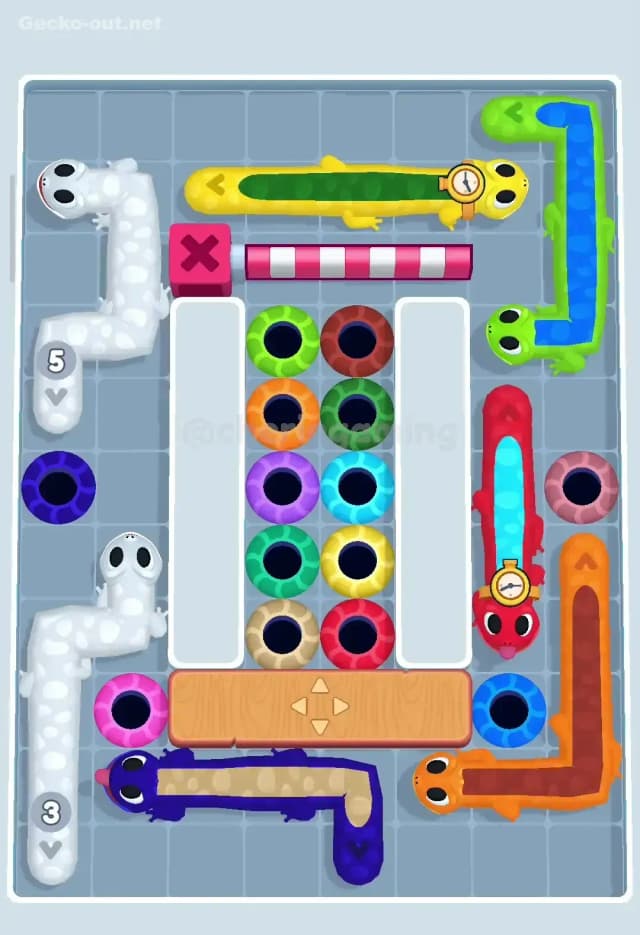
Gecko Out 176 drops you onto a tall, narrow board packed with long bodies and tiny gaps. You’ve got a full crowd: two long ghost‑white geckos down the left side, a timer yellow gecko stretched across the very top, a green–blue L‑shaped gecko hugging the top‑right corner, a timer red gecko running vertically on the right, a chunky orange L‑gecko at the bottom‑right, and a purple gecko lying along the bottom just left of center. In the middle sits a column of multi‑colored holes fenced in by two white walls, plus a couple of extra holes around the edges that match the outer geckos. A pink X block and a striped barrier protect the upper part of the board, while a wooden slider with arrow buttons blocks the lower exits. Every bit of color you see on Gecko Out Level 176 matters, because every gecko has at least one matching hole somewhere in that cluster.
The layout is tight enough that you can’t just scribble any path and hope it works. One badly drawn line can cut off an entire side of the board. The left white pair share the same central zone as the purple gecko, and the right trio (green–blue, red, orange) all fight over the same exit lanes. Gecko Out 176 is all about planning how you’ll take turns using those central corridors and moving that wooden bar so nobody gets trapped behind someone else’s tail.
Win Condition And Why The Timer Hurts
You win Gecko Out Level 176 by guiding every gecko into a hole of its own color before the timer runs out. Movement is pure “head‑drag”: you drag the head along the grid, and the body follows every bend you draw. If you snake a long path, the body will fill that exact route and act like a wall for the rest of the level. You can’t cross another body, walls, the X block, or blocked exits, and you can’t undo a path except by restarting.
The trick here is that two geckos have little stopwatches. If you send those timer geckos home early, you effectively buy yourself more time to think later. But you don’t have enough seconds to experiment with five completely different ideas. Gecko Out 176 rewards you for pausing at the start, planning a clean order, and then drawing fast, efficient paths that don’t loop around for no reason.
Pathing Bottlenecks and Logical Traps in Gecko Out Level 176
The Main Bottleneck: Central Exit Corridor
The single biggest choke point in Gecko Out 176 is the narrow corridor in front of the central colored holes. Every long gecko on the board eventually needs to pass through that lane or around it, and once a big body is parked there, the others have a hard time squeezing through. The wooden slider at the bottom of the board also ties into this; when it’s blocking the lower row of holes, you’ve effectively cut the board in half.
Because of that, you can’t let a random gecko “camp” in front of the exits. The yellow and red timer geckos, in particular, love to leave their bodies lying straight across key lanes. If you send them home in the wrong order, their tails make a wall that stops the white pair from ever reaching their pale holes. Solving Gecko Out Level 176 means thinking of the central lane as shared highway space, not a parking lot.
Subtle Traps That Don’t Look Dangerous At First
One subtle problem spot is the top‑right corner where the green–blue L‑gecko curls around the yellow timer gecko. If you move the green–blue one too early and draw a fat, loopy path, its body can seal off the upper half of the board so the yellow gecko never gets a straight shot to its hole. Another hidden trap is the lower center: if you drag the purple gecko up and around before adjusting the wooden bar, you can easily create a dead end that blocks the orange or red gecko from sliding to their matching exits.
The left side has its own tiny trap. The two white geckos share that column, and if you exit the top white one first with a long winding path, the leftover body can make it nearly impossible for the lower white gecko to bend around into the central exit area. In Gecko Out 176 you don’t just have to worry about “who exits when” but also “what shape they leave behind while exiting.”
When The Level Finally Clicks
I’ll be honest: the first time I hit Gecko Out Level 176, I burned the clock three times in a row just rearranging bodies and getting nowhere. It feels like every move just tightens the knot. The moment it started making sense was when I stopped thinking of the goal as “free any gecko I can” and instead focused on freeing the timer geckos first while keeping the central corridor empty. Once I realized the wooden bar was basically a gate I could time, the whole layout turned from chaos into a sequence.
After that, my runs were way calmer. I knew I wanted yellow out, then red, then the right‑side pair, then the whites and purple. When you see Gecko Out Level 176 as a series of reservations for the same hallway instead of seven separate puzzles, it stops feeling impossible and starts feeling like a very strict traffic puzzle.
Turn-by-Turn Path Strategy to Beat Gecko Out Level 176
Opening: Set Up The Board And Free The First Timer
- Before moving any heads, mentally note the matching holes: yellow and red have clear matches in the upper and middle rows, the whites match the pale holes, the purple and orange have lower holes, and the green–blue L has its own bright exit.
- Nudge the wooden slider just enough so the bottom central row isn’t blocked; you don’t need a huge shift, just enough space for later exits.
Now start with the yellow timer gecko at the top. Drag its head in a short, mostly straight path toward its matching yellow hole in the central grid. Hug the barrier and walls to keep the tail tight; don’t loop around the middle. When it drops in, you’ve created more time and cleared some top‑side clutter without clogging the main corridor.
Next, gently reposition the green–blue L‑gecko in the top‑right. Don’t exit it yet. Instead, drag its head a few tiles so its body lines the outer wall and leaves a clean channel across the top toward the central grid. You’re “parking” it out of the way so later geckos can pass.
Mid-game: Clear The Right Side And Protect The Highway
Now focus on the red timer gecko running vertically on the right. With the green–blue body tucked against the wall, drag the red head up and then inward to its matching red hole. Again, keep the route short and avoid crossing too deep into the center; you just want a clean dive into its exit. That second timer payout gives you enough breathing room for the trickier long bodies.
With both timer geckos gone, it’s time to deal with the orange L‑gecko at the bottom‑right. Use the space freed by the red body to bend the orange head around the right wall and into its orange hole in the lower section of the central grid. Make sure you don’t drag across the lower center in a way that traps the purple gecko; hug the far right edge as much as possible.
Only after orange is out should you fully exit the green–blue L‑gecko. Slide its head along the top lane and then drop straight down into its matching hole. Since you pre‑parked it earlier, this path is quick and doesn’t sprawl across the middle. This keeps Gecko Out 176’s central highway free for the left‑side geckos that still need it.
End-game: Left Whites, Then Purple Clean-up
At this point, the entire right side is mostly empty, and the only big bodies left are the two white geckos on the left and the purple gecko near the bottom. Start with the upper white gecko. Drag its head through the central corridor into the higher pale hole, drawing a path that hugs the left wall and slides in without looping around other holes.
Then take the lower white gecko and thread it through the same corridor but into the lower pale hole. The key is drawing a slightly offset route so its body doesn’t exactly duplicate the first white path; leave just enough room for the purple gecko to snake past if needed. Finally, send the purple gecko from the bottom center up into its matching purple hole. If you’ve kept the wooden bar shifted and avoided fat loops, there’ll be a clean lane open. When time is low, focus on crisp, straight lines—no decorative curves.
Why This Path Order Works in Gecko Out Level 176
Using Head-Drag And Body Follow To Untangle, Not Tighten
Gecko Out Level 176 punishes greedy moves where you exit whoever is closest first. By prioritizing the yellow and red timer geckos, you remove the longest straight bodies that would otherwise block multiple lanes. Parking the green–blue L first means its eventual exit is short and doesn’t carve big walls through the center.
The left‑side sequence (upper white, lower white, then purple) uses the body‑follow rule in your favor. Each new path is drawn along the “shadow” of an old one, so you’re reusing already‑occupied lanes instead of creating new barriers. You’re essentially pulling threads out of a knot in a specific order so the knot gets looser with every move.
Managing The Timer: Think First, Then Commit
The timer in Gecko Out 176 makes you want to start dragging immediately, but the best runs spend the first few seconds just reading the board. I like to use that time to decide exactly which holes each gecko will use and in what order. Once you’ve locked that in mentally, you can move quickly without second‑guessing yourself.
After freeing the yellow timer gecko, that’s your cue to speed up mid‑game. The time bonuses mean you can afford one or two careful pauses (for example, before routing the orange L), but you shouldn’t redraw paths. If you catch yourself hovering with a head because you’re unsure, drop it and restart; over‑drawing kills more time than restarting does.
Do You Need Boosters Here?
Boosters in Gecko Out Level 176 are helpful but totally optional if you follow this path order. A time booster is the only one that really changes the feel of the level, and even that just gives you more room for mistakes rather than unlocking new lines. If you’re really stuck, using a hammer‑style “remove one gecko” tool on the trickiest long body (often the orange or a white) makes everything trivial, but I’d save that for later levels.
If you do use a hint, trigger it early—before you’ve drawn complex paths—so it shows you the intended order for the timers. Watching where the hint sends the yellow or red gecko can confirm you’re thinking about Gecko Out 176 the right way.
Mistakes, Fixes, and Logic You Can Reuse in Other Gecko Out Levels
Common Mistakes On Gecko Out Level 176
- Exiting the green–blue L first and blocking the top: fix this by only “parking” it at the start and exiting it after yellow and red are gone.
- Drawing long spiral paths for the timer geckos: keep their routes short and direct to avoid building giant walls.
- Sending the purple gecko out before the whites: this often blocks their shared corridor; always prioritize the whites into their pale holes first.
- Forgetting to move the wooden slider: if the bar still covers the lower row, orange and purple have no clean exit; adjust it early in the opening.
- Panicking when the timer turns red: frantic scribbles usually create dead ends—restart and follow the planned order instead of trying to “rescue” a doomed run.
Reusing This Logic On Other Knot-Heavy Levels
The approach you use on Gecko Out 176 scales really well to other Gecko Out levels with gang geckos, timers, and frozen exits. First, identify shared corridors and promise yourself you won’t leave a body there unless it’s on its final exit path. Second, free time‑giving geckos in the first third of the level; the extra seconds make the later tangles much safer. Third, “park” complex geckos against outer walls before actually sending them home, so their eventual exit path is short and controlled.
On frozen‑exit or toll‑gate boards, the same mindset applies: you’re scheduling access to each narrow lane. Think of every path as reserving a corridor for one gecko only, then reopening it for the next. Once you start seeing the board like that, Gecko Out Level 176 stops being an outlier and just becomes another strict traffic puzzle you know how to handle.
Final Encouragement
Gecko Out 176 looks brutal at first glance, with that crowded central grid and the timer ticking down, but it’s absolutely beatable once you respect the bottlenecks. Tackle the timer geckos early, keep the central corridor clear, and only let bodies occupy lanes when they’re on their way out for good. After a couple of attempts with this plan, you’ll feel the level go from “no way” to “oh, I’ve got this.” And once you’ve cracked Gecko Out Level 176, you’ll be a lot more confident facing the next knot of geckos the game throws at you.